

Nelson was the New Zealand Company’s second settlement. The site was chosen by Captain Arthur Wakefield (1799–1843) in 1841 and Trafalgar and Nile Streets were the first roads surveyed. Wakefield intended Trafalgar Street as predominantly a commercial area and Nile Street to be residential in character.
The house is located near the far end of Nile Street, towards the Maitai Valley. Thomas Marsden (1809?–1876), of the well-known Nelson landowning family and Isel estate, had the Crown Grant for the property from the 1850s and it was sold by his wife Mary in 1903. Understandably, Nelson’s centre featured greater density housing from an earlier period than the end of Nile Street, which remained semi-rural until the early twentieth century. For example, the properties near 176 Nile Street featured large market garden greenhouses. During this period the property was owned and occupied by David Henry Whiting (1858?–1945) who had a vegetable market garden and plant nursery.
There is some ambiguity around the exact construction date for the house. Whiting sold the property, featuring ‘an attractive bungalow,’ to Leslie Spencer Goodall in 1920, whereas in 1909 it had been advertised as being a ‘good 4-roomed cottage’. This suggests that the current house was built between 1909 and 1919. The discovery of newspapers dated 1906 from behind the scrim wall linings suggests a slightly earlier construction date. While there is the possibility that the house may retain a small portion of the Whiting’s original cottage, historic photographs indicate the earlier building was substantially if not totally replaced.
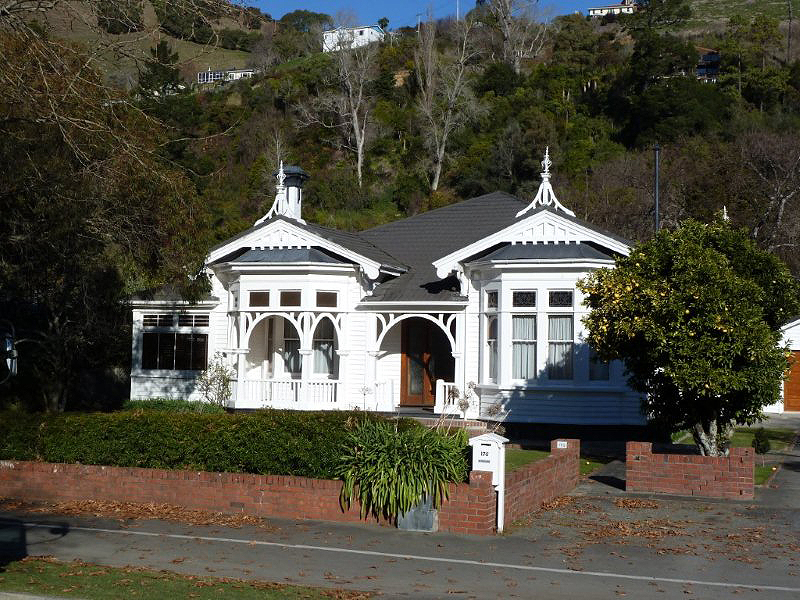
The early twentieth century was a period of transitional house architecture. The house at 176 Nile Street East is characteristic of this, essentially following a typical villa format but with some skilfully integrated bungalow features. For example, the ubiquitous bungalow entrance porch, integrated into the main roofline, then extends into an open bay. This is in symmetry with the main bay window gable section, so the combination references a traditional double bay villa. The simple decorative arch aspects in the porch and those of the bargeboards are consistent with transitional houses. The house was enlarged on its east and south sides in the mid-twentieth century.
As well as being a transitional period for New Zealand house architecture, the early twentieth century was also a time of change in this area of Nelson. There was a building boom spurred by growing commercial and manufacturing sectors which meant fringe areas changed from being semi-rural in character to residential neighbourhoods. The building activities at the house’s property are reflective of this and the section was also then subdivided into smaller house lots in 1923. The resulting buildings on the house’s neighbouring two sections are typical modest bungalows. Therefore, the house is important within the spectrum of twentieth century housing in this area of Nelson. There are no other architecturally comparable Nelson houses currently on the List. The interior of the house has been sympathetically restored to a high quality, retaining the original timber joinery, carved fire surrounds and coffered ceilings.
List Entry Information
Status
Listed
List Entry Status
Historic Place Category 2
Access
Private/No Public Access
List Number
1577
Date Entered
25th November 1982
Date of Effect
25th November 1982
City/District Council
Nelson City
Region
Nelson Region
Extent of List Entry
Extent includes the land described as Lot 1 DEED 159 (RT NL60/177), Nelson Land District and the building known as House thereon.
Legal description
Lot 1 DEED 159 (RT NL60/177), Nelson Land District
Status
Listed
List Entry Status
Historic Place Category 2
Access
Private/No Public Access
List Number
1577
Date Entered
25th November 1982
Date of Effect
25th November 1982
City/District Council
Nelson City
Region
Nelson Region
Extent of List Entry
Extent includes the land described as Lot 1 DEED 159 (RT NL60/177), Nelson Land District and the building known as House thereon.
Legal description
Lot 1 DEED 159 (RT NL60/177), Nelson Land District
Historical and Associated Iwi / Hapū / Whānau
Completion Date
2nd May 2016
Report Written By
Karen Astwood
Information Sources
Salmond, 1986
Jeremy Salmond, Old New Zealand Houses 1800-1940, Auckland, 1986, Reed Methuen
White & Edwards, 1995
White, Jeanie & Phillip Edwards, Windows on the Past, South Street residents, Nelson, 1995.
McAloon, 1997
McAloon, Jim, Nelson: A Regional History, Cape Catley, Whatamango Bay, 1997.
Newport, 1991
Newport, Jeff, A Short History of Nelson Province, Nikau Press, Nelson, 1991.
Other Information
This place was identified as significant under previous legislation with different information requirements. It remains significant under the current legislation. There is opportunity under our legislation and policies to add to this information. Further information about this place may be available from the Central Regional Office of Heritage New Zealand Pouhere Taonga. Please note that entry on the New Zealand Heritage List/Rarangi Korero identifies only the heritage values of the property concerned, and should not be construed as advice on the state of the property, or as a comment of its soundness or safety, including in regard to earthquake risk, safety in the event of fire, or insanitary conditions. A fully referenced upgrade report is available on request from the Central Region Office of Heritage New Zealand
Historical and Associated Iwi / Hapū / Whānau
Completion Date
2nd May 2016
Report Written By
Karen Astwood
Information Sources
Salmond, 1986
Jeremy Salmond, Old New Zealand Houses 1800-1940, Auckland, 1986, Reed Methuen
White & Edwards, 1995
White, Jeanie & Phillip Edwards, Windows on the Past, South Street residents, Nelson, 1995.
McAloon, 1997
McAloon, Jim, Nelson: A Regional History, Cape Catley, Whatamango Bay, 1997.
Newport, 1991
Newport, Jeff, A Short History of Nelson Province, Nikau Press, Nelson, 1991.
Other Information
This place was identified as significant under previous legislation with different information requirements. It remains significant under the current legislation. There is opportunity under our legislation and policies to add to this information. Further information about this place may be available from the Central Regional Office of Heritage New Zealand Pouhere Taonga. Please note that entry on the New Zealand Heritage List/Rarangi Korero identifies only the heritage values of the property concerned, and should not be construed as advice on the state of the property, or as a comment of its soundness or safety, including in regard to earthquake risk, safety in the event of fire, or insanitary conditions. A fully referenced upgrade report is available on request from the Central Region Office of Heritage New Zealand
Current Usages
Uses: Accommodation
Specific Usage: House
Former Usages
General Usage: Accommodation
Specific Usage: House
Current Usages
Uses: Accommodation
Specific Usage: House
Former Usages
General Usage: Accommodation
Specific Usage: House
Location
Sign up to hear more
Get the latest heritage news, features and events delivered
straight to your inbox.
