Early History
Christchurch and the wider area have a long history of Māori occupation. The vast network of wetlands and plains of Kā Pakihi Whakatekateka o Waitaha (Canterbury Plains) is inherently important to the history of its early occupation. The area was rich in food from the forest and waterways. Major awa (river) such as the Rakahuri (Ashley), Waimakariri, Pūharakekenui (Styx) and Rakaia were supplied from the mountain-fed aquifers of Kā Tiritiri o te Moana (Southern Alps). Other spring-fed waterways such as the Ōtākaro (Avon) meandered throughout the landscape. The rivers teemed with tuna, kōkopu, kanakana and inaka; the wetlands were a good supply of wading birds and fibres for weaving, food and medicine; and the forest supplied kererū, kokopa, tui and other fauna as well as building materials. Ara tawhito (travelling routes) crossed over the landscape, providing annual and seasonal pathways up and down and across the plains and in some cases skirting or traversing the swamps. Permanent pā sites and temporary kāinga were located within and around the Plains as Ngāi Tahu established and used the mahinga kai sites where they gathered and utilised natural resources from the network of springs, waterways, wetlands, grasslands and lowland podocarp forests that abounded along the rivers and estuaries. The area now known as St Albans in Christchurch was part of the wetlands as a rich and valuable source of mahinga kai for tangata whenua.
Except for very small reserves, the Canterbury region was controversially purchased from Ngāi Tahu by the Crown in 1848. The Canterbury Association oversaw the systematic European settlement of Canterbury and surveyed the town of Christchurch and rural sections outside of the town boundary. In the 1850s, when the land was being taken up by colonial settlers, St Albans was ‘swampy land’ bounded by sandy ridges with flax, raupo, toetoe, fern and manuka. Lack of roading and poor drainage with the swampy ground was problematic for many landowners, who banded together to install drains to drain the land for farming. However, draining the soil created issues of subsidence and inability to clear protruding former buried native forestry due to risk of peat fires. With road boards and municipal councils working together, gradually the situation improved and landowners began developing their land, subdividing and establishing large permanent homes.
The land that Chippenham Lodge is situated on was part of one of the first sections (Rural Section 136) taken up in St Albans, in 1851. It was allocated to James Wyatt of Bangor, Wales, initially as a leasehold and officially purchased in 1856. James Wyatt did not live there but, rather, acquired the property for his son, Benjamin. By 1853, Benjamin Wyatt is recorded as a farmer at this 100-acre block of land bounded by St Albans Street, Innes Road, Rutland Street and Papanui Road, which he named Springfield. Benjamin Wyatt’s wife, Sophia, gave birth to a daughter at Springfield (Papanui Road) in January 1858, but Sophia died there early the following year, 1859, and Wyatt made moves to sell up. Auctioneer Joseph Longden was instructed to sell subdivided portions of Rural Section 136 and appears to have purchased much of this himself, in March 1859, for investment purposes. He on-sold sections the following year to the likes of millinery shop owner Jane Skillicorn and brothers George and Francis Goldney of Cora Lynn station near Arthur’s Pass.
When the Press published ‘Claims to Vote’ in the Electoral District of Avon on 19 April 1862, F. B. Goldney had a freehold house and land on part of section 136 in St Albans and George Goldney had a freehold ‘red brick house’ in St Albans. This ‘red brick house’ is understood to be the six-roomed brick dwelling the Goldney brothers had built in 1862, which they named Chippenham Lodge, after their birthplace in Wiltshire.
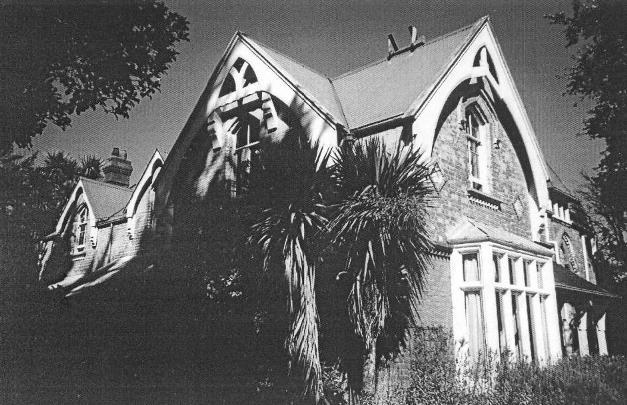
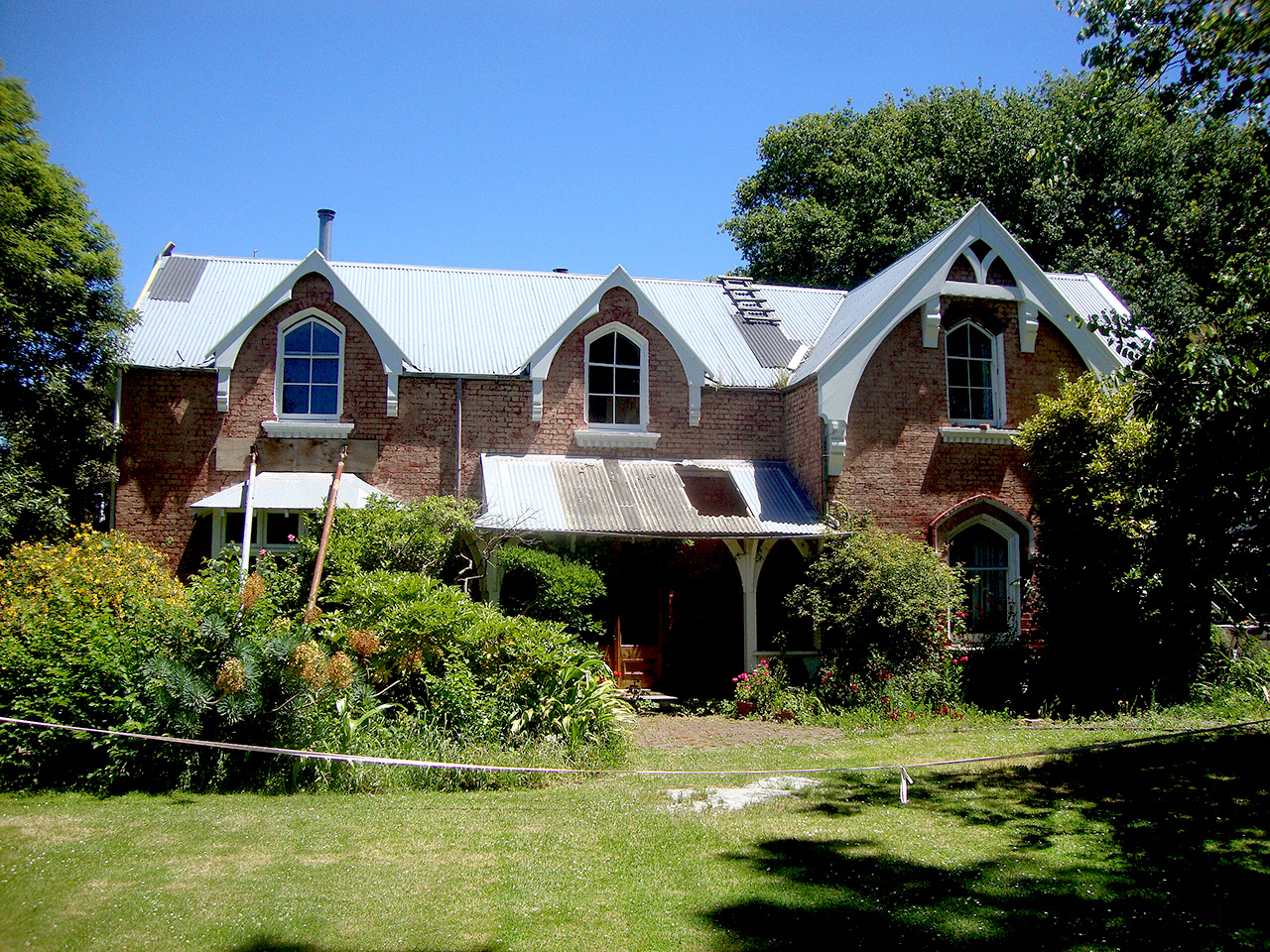
In mid-1865, following the decision of George Goldney to return to England, ‘Chippenham Lodge, consisting of 25 acres of meadow land, with a six-roomed brick cottage and outbuildings, at St Albans’ was put up for sale. It was purchased by Henry W. Mytton, an importer, wine merchant and bond store owner, who in 1865-1866 transformed the existing dwelling into a much grander house with a distinct Gothic Revival character through modifications and the addition of a substantial new wing. Designed by the firm Bury and Mountfort, it is thought that Maxwell Bury played the major architectural role in these 1865-1866 alterations and additions. Mountfort’s letter and account book for the contractors’ work for Mytton at Chippenham Lodge gives a flavour of the makeover done to the existing dwelling at this time: ‘Pointing old Building’, altering the fireplace in the kitchen, stairs from the kitchen, skylight, and alterations in the hall.
Mytton’s wife, Maria (née Jackson) gave birth to a daughter at Chippenham Lodge in June 1867. However, almost immediately after this, he variously advertised all his household effects and livestock as well as trying to let the place, as follows: ‘CHIPPENHAM LODGE, ST. ALBANS. TO LET, A BRICK HOUSE, of ten rooms and offices, suitable for a gentleman’s residence. Good orchard, and twenty-five acres securely fenced and laid down in excellent pasture’. It turned out Mytton was in financial strife and needed to downsize, though he retained ownership of this property until 1875.
From the late 1860s until 1874, Chippenham Lodge was rented to Thomas Ingham Joynt, an early New Zealand-trained lawyer. Joynt lived there with his wife, Edith, and growing family, some of whom were born at the house. Joynt became well known during his time living at this place. In 1871 he was defence lawyer for a high-profile murder case involving two servants employed by wealthy landowner, William ‘Ready Money’ Robinson (Margaret Burke stabbed by Simon Cedeno). Also in 1871, while living at Chippenham Lodge, he was elected a member of the Canterbury Provincial Council for Kaiapoi. When Joynt and his family vacated the house in 1874, his recent years of occupation there was part of its selling point.
In 1875 the house and 39 acres were purchased by neighbouring landowner, the Honourable John Thomas Peacock, a wealthy Australian-born shipping merchant and former Lyttelton Member of Parliament and Canterbury Provincial Councillor. Later that same year Peacock transferred the house and five acres of land around it to his brothers-in-law, John Evans Brown and Henry Richard Webb. Peacock remained at his adjacent large property, Hawkesbury, and with his sisters Elizabeth (Garrick) and Augusta (Webb) nearby and the Browns at Chippenham Lodge, the area became something of a substantial extended family enclave. Although both Brown and Webb are named on the Certificate of Title, in fact, it appears that Peacock gifted Chippenham Lodge specifically to his sister, Theresa and her husband, John Evans (‘Yankee’) Brown. American-born Brown farmed at Swannanoa and served as the Member of Parliament for Ashley from 1871 to 1879, before moving permanently to Chippenham Lodge in 1875. From there, Brown continued activity in local body politics, both in rural North Canterbury and Christchurch, pushing for tram and train transport and taking up a position on the Christchurch Hospital and Charitable Aid Board. His busy work meant he was often absent, leaving Theresa and staff (servants and, later, a nurse) at the house. Sadly, the Browns had previously lost an infant to measles in 1875, and then within the space of one week, two children died of diphtheria in 1877. Theresa died in 1880, and the following year, 1881, Brown exchanged Chippenham Lodge for Richard Walton’s house, ‘Amwell’, on Papanui Road. Brown remarried in 1883 and returned to the United States at the end of the 1880s. Richard Walton, an auctioneer and land agent, his wife Alice and their five children lived at Chippenham Lodge from around 1881 until around 1887.
A description of the house in early 1883 identified the functions of the 18 rooms of the brick house. On its ground floor there was a large drawing room, dining room, breakfast and day room, library, large kitchen, scullery, large pantry, jam closet room, store room, cellar and ante-room. On the first floor were seven bedrooms, a linen closet and bathroom. Also on the five-acre property were: ‘a House with large washhouse and man’s room’, a three-stalled stable, coach-house, large room, tool house, large store room, fruit room and hayloft.
Between 1889 and 1893 the house was tenanted by Thomas Cheal Norris, accountant of the North Canterbury Charitable Aid Board, his wife Alice and family. In 1895, Peacock purchased Chippenham Lodge for the second time, this time for seven years, during which multiple smaller sections were subdivided off. A year after unsuccessfully trying to sell the house itself in 1898, Peacock employed architect R. W. England (Jnr) to design extensive improvements, including painting and paperhanging, in 1899. It is thought that the verandah was altered and a hipped gable added at this time.
In 1902 the house and a portion of the property was sold to Walter Joseph Moore, an accountant and estate agent. Moore’s wife was Mary Louisa Whitcombe, stepdaughter of the wealthy businessman and politician, the Honourable Edward Stevens. Stevens family-funded the purchase of Chippenham Lodge, by way of mortgage. Further subdivision took place during Moore’s tenure. Variously in 1914 and 1915-1916, the Moores vacated the property to allow the house to be used by notable British guests, the Honourable James Borthwick and his wife. Borthwick was in Christchurch to oversee the construction of new freezing works for Borthwicks Meat Company, at Belfast, north of Christchurch. As well as being involved in community matters – for example, Mary Moore was vice president of the New Brighton Children’s Convalescent Home – the Moores led a social time at Chippenham Lodge, holding dances and other events. In December 1920, two of the Moores’ daughters – Freda and Gwen – were each married in a double wedding service at St Mary’s, Merivale. The large wedding reception of Freda and her new husband, Philip Keddell, and Gwen and her new husband, J. F. Mills, took place at Chippenham Lodge.
In 1922 James and Nesta Maling purchased the property. Formerly mayor of Geraldine and then of Timaru, and a founding director of Pyne Gould Guinness, James Maling was a prominent Canterbury figure. Nesta was recognised as being particularly active in community service.
In 1924 the house was bought by Hugh Thomas Dyke Acland (later Sir Hugh), who also carried out further subdivision. A prominent surgeon, Acland and his wife, Evelyn (Lady Acland) lived at Chippenham Lodge as their family home for over 30 years, regularly hosting family, friends and notable guests at functions at the house. The Aclands were keen gardeners and garden parties at Chippenham were common, often for the benefit of a charitable cause. At Chippenham, Lady Acland was particularly supportive of women’s causes – for example, in celebrating nurses associated with Nurse Maude, contributing to institutions supportive of homeless elderly women in London, and hosting large gatherings of doctors’ wives and women doctors.
The Aclands maintained a close connection to Hugh’s family home at Mount Peel Station, of which he was part owner and was chairman of the Peel Forest Board. Ngaio Marsh had a close friendship with the Acland family, something which remained important to her throughout her life, and was a regular visitor to the Aclands at both Chippenham Lodge and Mount Peel. Marsh often asked Hugh Acland - a surgeon with an interest in theatre - for advice on how she could kill off one of the characters in her crime novels.
In 1961, five years after Hugh Acland’s death in 1956, the property was owned briefly by (Arthur) Basil and Aileen Glubb and then in 1963 passed to (Walcot) Robin and Annette Wood. The Wood family especially continued the tradition of entertaining in the house and its spacious grounds. One of the Woods’ five children, Mandy, evocatively recalls the joy of growing up in Chippenham Lodge, which included eavesdropping on parental conversation via the dining room serving hatch.
Chippenham as a Commune/Intentional Community
In 1971 the house was bought by a group of mainly university students to establish a co-operative intentional community – an ‘urban commune dedicated to social change and environmental issues’. The idea for the commune in Christchurch had started around a year earlier, in 1970, with a group of senior students – some with young families – exploring a different version of shared living. While they admired James K. Baxter’s commune at Jerusalem, up the Whanganui River, they wanted something a little more stable and organised. Already calling themselves ‘the commune’, the Christchurch group gathered to share weekly meal nights and weekend group gardening, and began saving and looking for a cluster of older cheaper houses close together to buy. In readiness for such a property purchase, the group formed ‘Community Assistance Incorporated’ (‘C.A.I.’), whose suggested activities included ‘bulk buying scheme, workshop and tools, arts and crafts, banking facilities (on donation basis), Van, printing press, magazine and reading room, cooperation with other communities, crèche, darkroom’. In July 1971 one of the commune members, who worked as a proofreader at the Press, saw an advertisement for ‘INVESTMENT extraordinary, first day offered. A really unique opportunity for enterprising purchaser to acquire one of Canterbury’s early regal homes with terrific potential. This imposing two-storey brick residence of distinctive Gothic architecture is extremely well constructed and contains 7 spacious bedrooms with covered (sic) ceilings, elegant ballroom, drawing room and living room … Price $20,000’. The commune immediately viewed and purchased the house by gathering loans from its members (or their parents), with the help of a sympathetic lawyer who secured half the purchase price through a mortgage from an elderly private investor. The house required some repair and maintenance, but the grounds, including its old timber cottage thought to have been built before the brick house, added to the potential. Regardless of whether they had loaned money or not, all members paid the same weekly rent and had the same equal status in community decision making. Initially the place housed five or six couples (and babies) and two singles. Some of the founders included Walter and Marian Logeman (Hobbs), Wendy and Peter Low, Howard and Barbara Gray, Morris and Shonagh Love and singles Tim Court and Peter Williams.
Based on an ethos of shared resources and governance, it was a very social city hub, continuing the tradition of previous owners who would frequently host neighbouring relatives or those from out of town. Over time the C.A.I. purchased nearby properties to form a wider cooperative community, but Chippenham Lodge remained the flagship commune. The commune shared tasks, including collectively raising children. In the early 1970s, they purchased a bakery in Redcliffs, for many years operating a worker cooperative style bakery – Vital Foods – to produce some of Christchurch’s first widely-distributed full grain breads. Residents of Chippenham Lodge shared part-time work at the bakery and the income generated helped with study, creative activities and political activism.
From the outset it was agreed that Chippenham Commune would be a base and support system for radical political and social action in the wider community. They were active ‘greenies’ and the first 15 issues of New Zealand Environment magazine were published from there. Along with the neighbouring Mansfield commune, Chippenham Lodge residents were involved with Greenpeace gatherings and planning sessions during its formative years, contributing to the environmental and anti-nuclear activism that defined Greenpeace New Zealand’s early campaigns. Chippenham Lodge residents – notably teachers Walter and Marian Logeman and Roger Stoutjesdijk – were pivotal in the creation of an alternative high school. They convinced Minister of Education, Phil Amos, to attend a meeting of the ‘Chippenham Education Committee’ and he was hosted overnight at Chippenham Lodge. The result was the creation of New Zealand’s first alternative state secondary (libertarian) school, known as Four Avenues, which operated from a house in Gloucester Street in central Christchurch from 1975 until 1993.
By the mid-1970s, Chippenham Commune had a strong feminist focus and for a time just about all its members were women. They were concerned about gender equality, shared roles and women’s health. Commune residents, particularly Rosie Howard and Diane Shannon, were instrumental in establishing New Zealand’s first women’s refuge, specifically for women escaping abusive husbands or fathers. While the refuge (or safe house) itself was not at Chippenham Lodge, commune residents and those of the neighbouring commune, Mansfield, provided financial backing through a pledge system and contributed volunteer labour and resources to help renovate and run the refuge. Chippenham Lodge residents also played a major role in arranging travel and support for women seeking legal abortions in Australia. A telephone in a cupboard under the staircase was used to coordinate these trips, as abortion was illegal in New Zealand at the time.
While not flush with money, residents of the commune took seriously the matter of raising funds for restoration of the house and caring for its grounds. In 1981, for example, the residents raised money to replace the heavy bargeboards, replacing the guttering and cleaning the brickwork. They had multiple open days as fundraisers, often during Heritage Week, generally getting up to 100 visitors.
While Chippenham has been a different community for different people at different times, the reasons for living communally have remained relatively consistent. Not only is it cheaper to live communally, but by sharing living resources, electricity, and food, it is an ecologically sound principle. As a centre for people exploring how they could have power over their lives, Chippenham became a place where ideas and ways of living could be experimented with. Strong debate and disagreement were part of democratic living at the commune – sometimes this was just too much for residents and they moved on.
The commune, which reformed as the Heartwood Community Te Ngakau o te Rakau Incorporated in 1996, still occupied the house at the time of the Canterbury Earthquakes of 2010-2011. Structural damage caused by the major February 2011 earthquake meant the brick building had to be vacated. A proposal was put forward by former resident, David Welch, that the building be dismantled and reassembled in a more prominent and publicly accessible site such as Hagley Park. This did not eventuate. Instead, in 2023, part of the site was subdivided and the main part, with Chippenham Lodge and the timber cottage with its early origins, was transferred from Heartwood Community Te Ngakau o te Rakau Incorporated to Ōtākaro Land Trust. As of 2026, this Trust is seeking to raise funds for repair and strengthening so that the building can once again be occupied for communal living. Even while not occupied, due to earthquake damage, the place continues to have an activist connection, for example as a place of storage for protest placards.