Quick links


Quick links
Quick links
Quick links
Quick links
Quick links
City Malthouse (Former)
71 Colombo Street, Beckenham, CHRISTCHURCH
Private
Historic Place Category 2
List No. 1902
Quick links:
List GalleryLocationDetails
71 Colombo Street, Beckenham, CHRISTCHURCH
Private
Historic Place Category 2
List No. 1902
List Entry Information
Status
Listed
List Entry Status
Historic Place Category 2
Access
Private/No Public Access
List Number
1902
Date Entered
24th June 2005
Date of Effect
24th June 2005
City/District Council
Christchurch City
Region
Canterbury Region
Extent of List Entry
Registration includes the building its fixtures and fittings, and the land on RT CB15F/957.
Legal description
Lot 1 DP 18904 (RT CB15F/957), Canterbury Land District
Status
Listed
List Entry Status
Historic Place Category 2
Access
Private/No Public Access
List Number
1902
Date Entered
24th June 2005
Date of Effect
24th June 2005
City/District Council
Christchurch City
Region
Canterbury Region
Extent of List Entry
Registration includes the building its fixtures and fittings, and the land on RT CB15F/957.
Legal description
Lot 1 DP 18904 (RT CB15F/957), Canterbury Land District
Why is this place significant?
Cultural Significance
Social significance as the home of the Canterbury Children's Theatre, Christchurch's premier children's theatre company, for forty years.
Historic Significance
Historical Significance or Value Historical significance as New Zealand's oldest surviving malthouse; as a monument to the important place of brewing in New Zealand's early industrial development, and the once central role that independent maltsters and malthouses played in brewing.
Physical Significance
Architectural and technological significance as an early and now the only known example of an intact stand-alone malthouse. There are two individually identified malthouses on the register, but these (in Blenheim and Wanganui, both Cat. II) are only portions of what were full brewery complexes. There are several other surviving malthouses that also constitute parts of such brewery complexes (such as Ward's Brewery, Christchurch), but these were never stand-alone malthouses and are therefore not registered independently of those larger complexes.
Why is this place Category 1 / Category 2?
Detail Of Assessed Criteria
(a) reflects the significant place of malting and brewing in New Zealand's industrial history, where the industry and its buildings were among the most substantial in colonial towns. (e) is held in high esteem by the Canterbury Children's Theatre, who have maintained the historical integrity of the structure whilst adapting it for their purposes. (i) is the oldest remaining malthouse in New Zealand. (j) is the only intact, remaining, stand-alone malthouse left in New Zealand.
Why is this place significant?
Cultural Significance
Social significance as the home of the Canterbury Children's Theatre, Christchurch's premier children's theatre company, for forty years.
Historic Significance
Historical Significance or Value Historical significance as New Zealand's oldest surviving malthouse; as a monument to the important place of brewing in New Zealand's early industrial development, and the once central role that independent maltsters and malthouses played in brewing.
Physical Significance
Architectural and technological significance as an early and now the only known example of an intact stand-alone malthouse. There are two individually identified malthouses on the register, but these (in Blenheim and Wanganui, both Cat. II) are only portions of what were full brewery complexes. There are several other surviving malthouses that also constitute parts of such brewery complexes (such as Ward's Brewery, Christchurch), but these were never stand-alone malthouses and are therefore not registered independently of those larger complexes.
Why is this place Category 1 / Category 2?
Detail Of Assessed Criteria
(a) reflects the significant place of malting and brewing in New Zealand's industrial history, where the industry and its buildings were among the most substantial in colonial towns. (e) is held in high esteem by the Canterbury Children's Theatre, who have maintained the historical integrity of the structure whilst adapting it for their purposes. (i) is the oldest remaining malthouse in New Zealand. (j) is the only intact, remaining, stand-alone malthouse left in New Zealand.
Construction Professional
Name
Hendry, John
Type
Architect
Biography
No biography is currently available for this construction professional
Name
Wilkie & Bruce
Type
Architectural Partnership
Biography
No biography is currently available for this construction professional
Construction Details
Start Year
1867
Type
Original Construction
Start Year
1869
Type
Addition
Description
Addition of a second outhouse.
Start Year
1887
startYearCirca
Type
Modification
Description
Lean-to added to north elevation.
Start Year
1955
startYearCirca
Type
Modification
Description
Lowering of outhouse ventilators and removal of furnaces.
Start Year
1965
Finish Year
1969
Type
Modification
Description
Alterations for Canterbury Children's Theatre, including concrete block addition to west elevation.
Start Year
1975
Finish Year
1976
Type
Modification
Description
Alterations in outhouse areas.
Start Year
1984
Type
Modification
Description
Window enlarged, new interior stair and sprinkler system installed.
Start Year
2000
Type
Modification
Description
Raising of part of roof of 1887 addition.
Start Year
2003
Type
Modification
Description
Earthquake strengthening and raising of remainder of 1887 roof.
Construction Materials
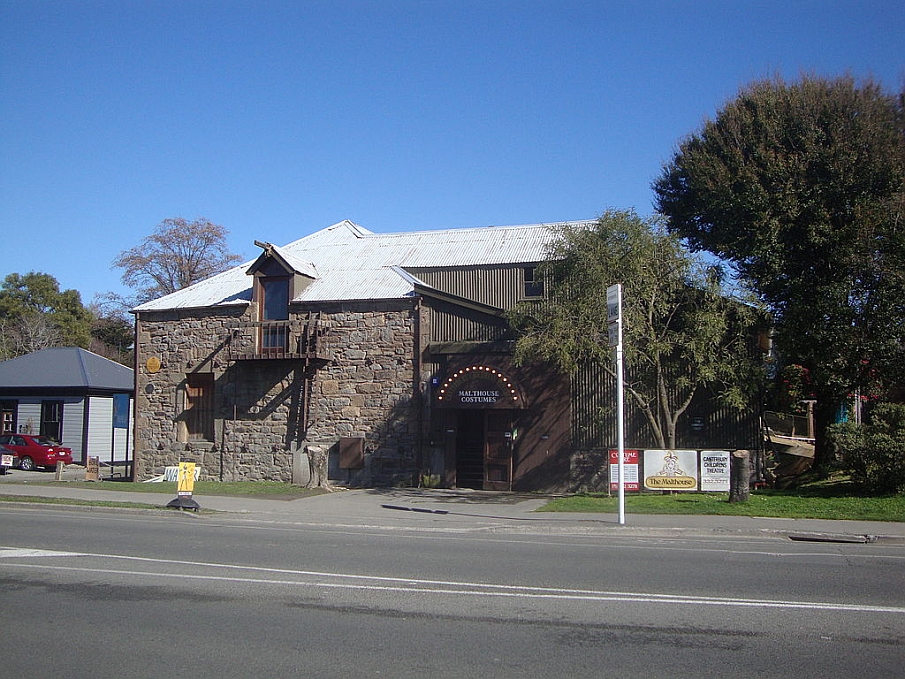
The original malthouse is shaped rubble brought to course, with a corrugated iron roof. Later additions are in corrugated iron and concrete block.
Construction Professional
Name
Hendry, John
Type
Architect
Biography
No biography is currently available for this construction professional
Name
Wilkie & Bruce
Type
Architectural Partnership
Biography
No biography is currently available for this construction professional
Construction Details
Start Year
1867
Type
Original Construction
Start Year
1869
Type
Addition
Description
Addition of a second outhouse.
Start Year
1887
startYearCirca
Type
Modification
Description
Lean-to added to north elevation.
Start Year
1955
startYearCirca
Type
Modification
Description
Lowering of outhouse ventilators and removal of furnaces.
Start Year
1965
Finish Year
1969
Type
Modification
Description
Alterations for Canterbury Children's Theatre, including concrete block addition to west elevation.
Start Year
1975
Finish Year
1976
Type
Modification
Description
Alterations in outhouse areas.
Start Year
1984
Type
Modification
Description
Window enlarged, new interior stair and sprinkler system installed.
Start Year
2000
Type
Modification
Description
Raising of part of roof of 1887 addition.
Start Year
2003
Type
Modification
Description
Earthquake strengthening and raising of remainder of 1887 roof.
Construction Materials
The original malthouse is shaped rubble brought to course, with a corrugated iron roof. Later additions are in corrugated iron and concrete block.
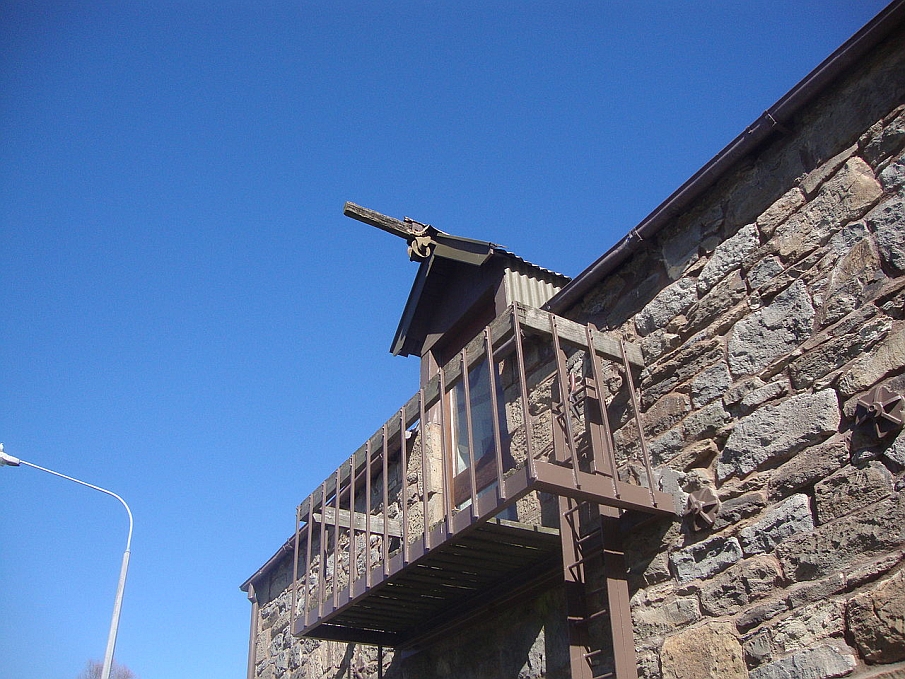
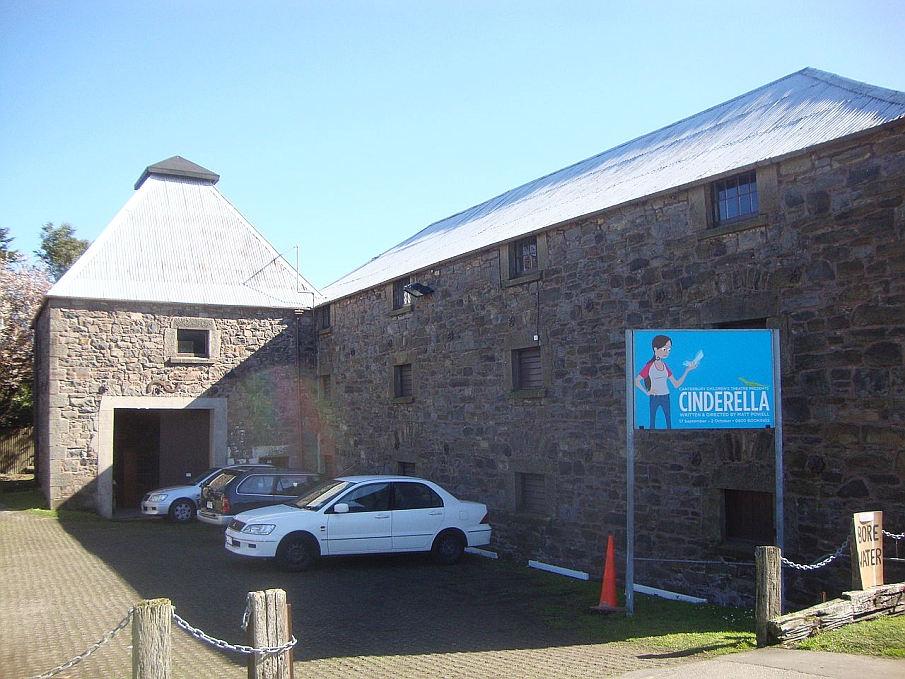
A large rectangular three-level stone industrial building, with two oasthouses projecting from the southern wall. Each oasthouse has a pavilion roof. The walls of the building sit on concrete foundations, and are 28 inches thick at the base, decreasing to 18 inches at the top. Most openings have dressed quoins and lintels. The flat lintels are supported from above by solid relieving arches. The interior was originally plastered throughout. Rafters are totara. A corrugated iron extension was added to the north elevation in c1887, and a concrete block addition to the west between 1966 and 1969. The roof of the c1887 addition was raised in 2000 and 2003 to provide more space.
A large rectangular three-level stone industrial building, with two oasthouses projecting from the southern wall. Each oasthouse has a pavilion roof. The walls of the building sit on concrete foundations, and are 28 inches thick at the base, decreasing to 18 inches at the top. Most openings have dressed quoins and lintels. The flat lintels are supported from above by solid relieving arches. The interior was originally plastered throughout. Rafters are totara. A corrugated iron extension was added to the north elevation in c1887, and a concrete block addition to the west between 1966 and 1969. The roof of the c1887 addition was raised in 2000 and 2003 to provide more space.
Historical and Associated Iwi / Hapū / Whānau
Completion Date
20th August 2001
Report Written By
Melanie Lovell-Smith
Information Sources
Christchurch City Council
Christchurch City Council
Collins, 1981
E. Collins, Malting in the Heathcote Valley 1871-1981 The Canterbury Malting Co Ltd, 1981.
Land Information New Zealand (LINZ)
Land Information New Zealand
MacDonald Biographies
G.R. MacDonald, Dictionary of Canterbury Biographies, Canterbury Museum, n.d.
McLauchlan, 1994
Gordon McLauchlan, The Story of Beer: Beer and Brewing - A New Zealand History, Auckland, 1994
New Zealand Historic Places Trust (NZHPT)
New Zealand Historic Places Trust
Thornton, 1982
Geoffrey G. Thornton, New Zealand's Industrial Heritage, A.H. & A.W. Reed, Wellington, 1982
Other Information
A fully referenced version of this report is available from the NZHPT Southern Region Office. Please note that entry on the New Zealand Heritage List/Rarangi Korero identifies only the heritage values of the property concerned, and should not be construed as advice on the state of the property, or as a comment of its soundness or safety, including in regard to earthquake risk, safety in the event of fire, or insanitary conditions.
Historical and Associated Iwi / Hapū / Whānau
Completion Date
20th August 2001
Report Written By
Melanie Lovell-Smith
Information Sources
Christchurch City Council
Christchurch City Council
Collins, 1981
E. Collins, Malting in the Heathcote Valley 1871-1981 The Canterbury Malting Co Ltd, 1981.
Land Information New Zealand (LINZ)
Land Information New Zealand
MacDonald Biographies
G.R. MacDonald, Dictionary of Canterbury Biographies, Canterbury Museum, n.d.
McLauchlan, 1994
Gordon McLauchlan, The Story of Beer: Beer and Brewing - A New Zealand History, Auckland, 1994
New Zealand Historic Places Trust (NZHPT)
New Zealand Historic Places Trust
Thornton, 1982
Geoffrey G. Thornton, New Zealand's Industrial Heritage, A.H. & A.W. Reed, Wellington, 1982
Other Information
A fully referenced version of this report is available from the NZHPT Southern Region Office. Please note that entry on the New Zealand Heritage List/Rarangi Korero identifies only the heritage values of the property concerned, and should not be construed as advice on the state of the property, or as a comment of its soundness or safety, including in regard to earthquake risk, safety in the event of fire, or insanitary conditions.
Current Usages
Uses: Civic Facilities
Specific Usage: Theatre
Current Usages
Uses: Civic Facilities
Specific Usage: Theatre
Location
Get the latest heritage news, features and events delivered
straight to your inbox.
