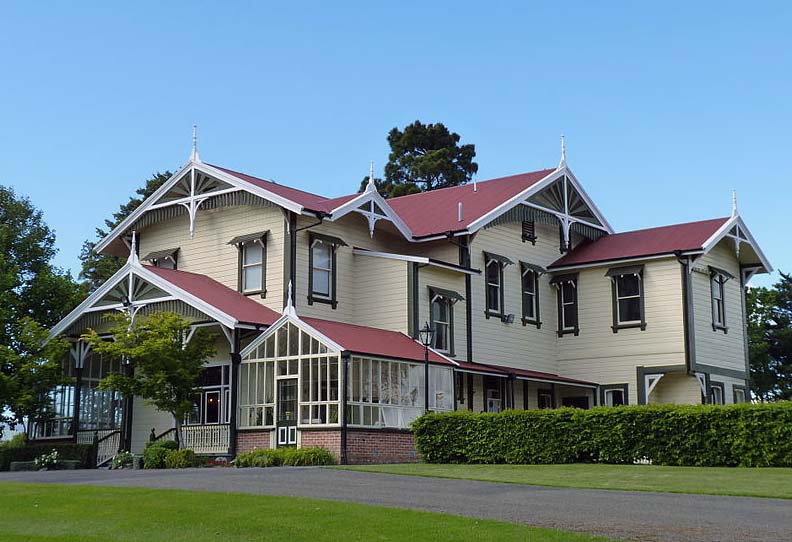
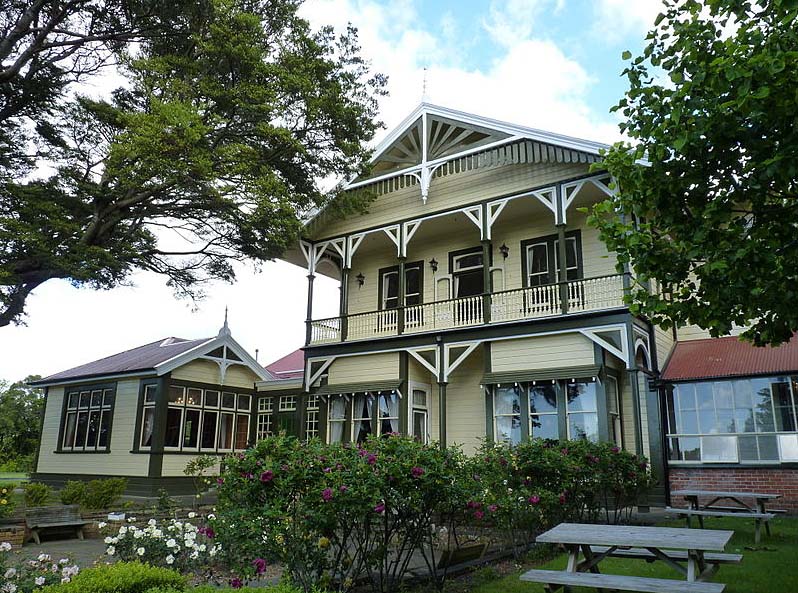
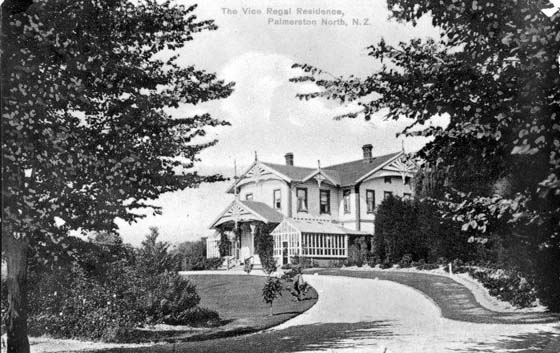
On a majestic site overlooking the Hokowhitu Lagoon in Palmerston North is Caccia-Birch House, an elegant homestead that housed the Governor of New Zealand, Lord William Lee Plunket (1864-1920) between 1908 and 1910.
In 1893 the managers of the highly successful sawmilling company, Richter, Nannestad & Co., purchased 144 hectares (355 acres) of land in Hokowhitu from the principal families of the Rangitane iwi who had occupied the block. Two years later, a founding member of the company, Jacob Nannestad, purchased a portion of the property and commissioned Danish born architect Ludolph Georg West to construct the dwelling that would later become known as Caccia-Birch House.
Valued at £875 in 1897, the house was a simple, two-storey building constructed of native timber weatherboards with a corrugated iron roof. The plain exterior was enlivened with sunburst designs, a decorative motif that may reflect Nannestad's Norwegian origins. Finely crafted wooden panelling was a feature of the interior, which incorporated a drawing room, study, dining room, and kitchen on the ground floor, and four bedrooms on the second storey.
By the turn of the century the timber that had fed the four sawmills of Richter, Nannestad & Co. began to run out. By 1903 Nannestad's fortunes had declined, and he sold his desirably situated Hokowhitu house to an 'English gentleman' named John Henderson Pollock Strang.
Strang renamed the building 'Woodhey' and commissioned West, the original architect of the building, to transform the house into an elegant residence. As well as two large conservatories at the front of the house, Strang added two nurseries, servants' quarters, and a coach house. In 1907, the Strangs offered Woodhey to the New Zealand Governor William Plunket who, following a disastrous fire that destroyed Parliament Buildings, had offered his own residence to the 80 displaced Members of Parliament. Concerns that the building was too small to serve as a vice-regal residence were allayed with additions that cost £1500. The additions included a billiard room and extra quarters for staff. Warmly welcomed by the Palmerston North public, Governor Lord William Plunket and Lady Victoria Plunket, patron of the Plunket Society, remained in the house between 1908 and 1910.
The Strangs sold the house in 1921 to retired farmer William Charles Caccia-Birch and his wife Maude Keiller. The last private owners of Woodhey, the Caccia-Birch's were responsible for developing the grounds around the house. In 1936 William Caccia-Birch died. Two years later the Second World War began, and Maude Caccia-Birch gifted Woodhey to the Government to house children evacuated from England. After a ship carrying children was torpedoed, the evacuation scheme was abandoned, and Woodhey, renamed 'Caccia-Birch House', was used by the army to accommodate directing and general staff of the newly established Army Staff College at Massey University College. After the war, Caccia-Birch House was converted into a convalescent home for nurses who had served overseas. Officially opened in 1946, the gracious 28-room residence with its peaceful, landscaped gardens was considered perfectly adapted to promoting recovery.
The Convalescent Home functioned until 1960, when the Education Department acquired the property. It was used briefly by the Palmerston North University College for offices and classrooms until the renovations to what is now Massey University campus were completed. The Caccia-Birch Preservation Society was formed during the Education Department's tenancy, yet the building became increasingly dilapidated. Without tenants from 1976, the house was declared surplus to Government requirements in 1983. The neglected building was gifted to the Palmerston North City Council the following year but doubt over its possible use prevented a much-needed upgrade of the building from taking place. After several years of discussion the building was carefully restored and opened as a function centre in 1993.
Caccia-Birch House has national significance for its association with people and events of importance in New Zealand history. The building is closely linked to Lord and Lady Plunket, both of whom made important contributions to New Zealand's development. As a vice-regal residence it has historical significance and provides a unique insight into the domestic and social needs of the New Zealand Governor at the turn of the century. Used as a military training centre and convalescent home for nurses, the building played an essential part in New Zealand's preparation for, and response to, the Second World War, and has considerable potential to provide further insight into this period in the country's history. The building is of local significance for its association with Jacob Nannestad whose firm was a major, early employer and was instrumental in clearing the Palmerston North area of bush for settlement. As an example of one of the early, larger homes in the area, Caccia-Birch House has architectural merit and considerable aesthetic appeal. Recognised early on for its significance by the community, Caccia-Birch is held in high esteem by the public.
In 1893 the managers of the highly successful sawmilling company, Richter, Nannestad & Co., purchased 144 hectares (355 acres) of land in Hokowhitu from the principal families of the Rangitane iwi who had occupied the block. Two years later, a founding member of the company, Jacob Nannestad, purchased a portion of the property and commissioned Danish born architect Ludolph Georg West to construct the dwelling that would later become known as Caccia-Birch House.
Valued at £875 in 1897, the house was a simple, two-storey building constructed of native timber weatherboards with a corrugated iron roof. The plain exterior was enlivened with sunburst designs, a decorative motif that may reflect Nannestad's Norwegian origins. Finely crafted wooden panelling was a feature of the interior, which incorporated a drawing room, study, dining room, and kitchen on the ground floor, and four bedrooms on the second storey.
By the turn of the century the timber that had fed the four sawmills of Richter, Nannestad & Co. began to run out. By 1903 Nannestad's fortunes had declined, and he sold his desirably situated Hokowhitu house to an 'English gentleman' named John Henderson Pollock Strang.
Strang renamed the building 'Woodhey' and commissioned West, the original architect of the building, to transform the house into an elegant residence. As well as two large conservatories at the front of the house, Strang added two nurseries, servants' quarters, and a coach house. In 1907, the Strangs offered Woodhey to the New Zealand Governor William Plunket who, following a disastrous fire that destroyed Parliament Buildings, had offered his own residence to the 80 displaced Members of Parliament. Concerns that the building was too small to serve as a vice-regal residence were allayed with additions that cost £1500. The additions included a billiard room and extra quarters for staff. Warmly welcomed by the Palmerston North public, Governor Lord William Plunket and Lady Victoria Plunket, patron of the Plunket Society, remained in the house between 1908 and 1910.
The Strangs sold the house in 1921 to retired farmer William Charles Caccia-Birch and his wife Maude Keiller. The last private owners of Woodhey, the Caccia-Birch's were responsible for developing the grounds around the house. In 1936 William Caccia-Birch died. Two years later the Second World War began, and Maude Caccia-Birch gifted Woodhey to the Government to house children evacuated from England. After a ship carrying children was torpedoed, the evacuation scheme was abandoned, and Woodhey, renamed 'Caccia-Birch House', was used by the army to accommodate directing and general staff of the newly established Army Staff College at Massey University College. After the war, Caccia-Birch House was converted into a convalescent home for nurses who had served overseas. Officially opened in 1946, the gracious 28-room residence with its peaceful, landscaped gardens was considered perfectly adapted to promoting recovery.
The Convalescent Home functioned until 1960, when the Education Department acquired the property. It was used briefly by the Palmerston North University College for offices and classrooms until the renovations to what is now Massey University campus were completed. The Caccia-Birch Preservation Society was formed during the Education Department's tenancy, yet the building became increasingly dilapidated. Without tenants from 1976, the house was declared surplus to Government requirements in 1983. The neglected building was gifted to the Palmerston North City Council the following year but doubt over its possible use prevented a much-needed upgrade of the building from taking place. After several years of discussion the building was carefully restored and opened as a function centre in 1993.
Caccia-Birch House has national significance for its association with people and events of importance in New Zealand history. The building is closely linked to Lord and Lady Plunket, both of whom made important contributions to New Zealand's development. As a vice-regal residence it has historical significance and provides a unique insight into the domestic and social needs of the New Zealand Governor at the turn of the century. Used as a military training centre and convalescent home for nurses, the building played an essential part in New Zealand's preparation for, and response to, the Second World War, and has considerable potential to provide further insight into this period in the country's history. The building is of local significance for its association with Jacob Nannestad whose firm was a major, early employer and was instrumental in clearing the Palmerston North area of bush for settlement. As an example of one of the early, larger homes in the area, Caccia-Birch House has architectural merit and considerable aesthetic appeal. Recognised early on for its significance by the community, Caccia-Birch is held in high esteem by the public.