

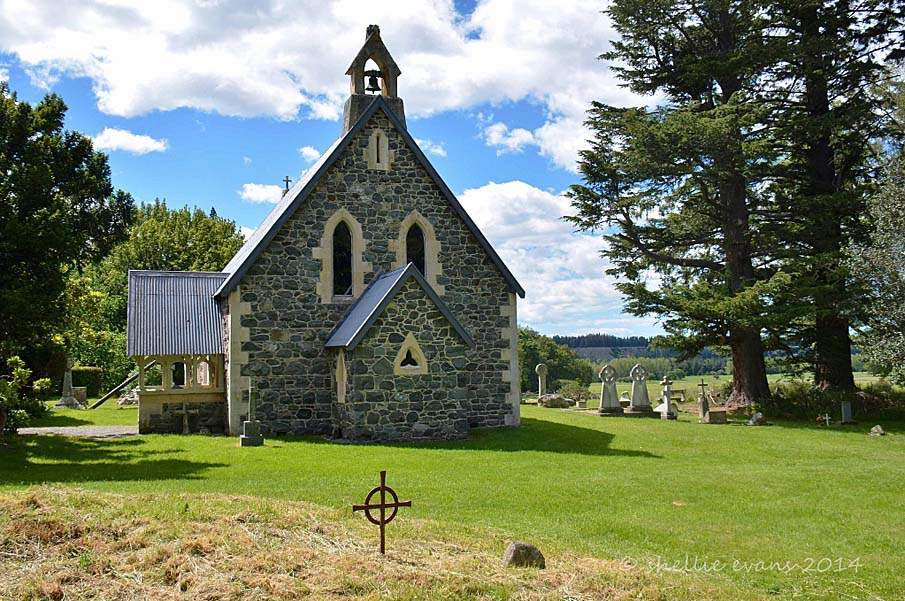
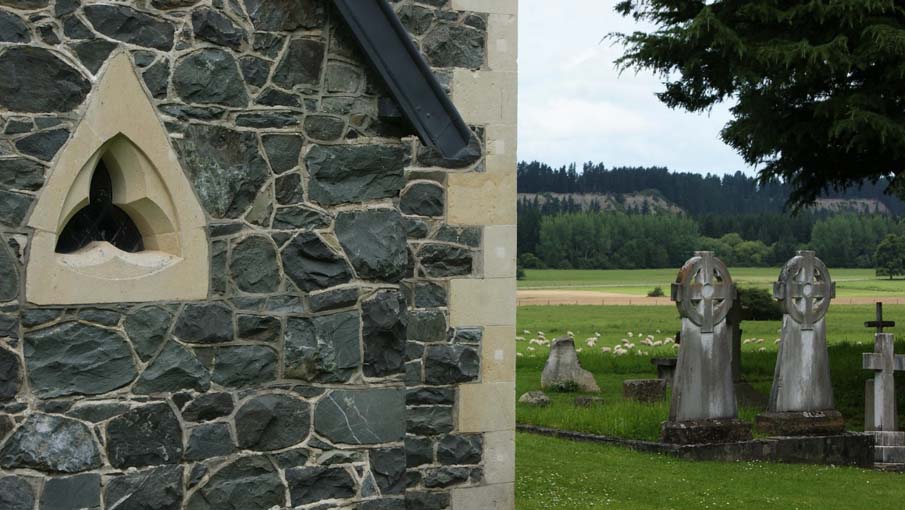
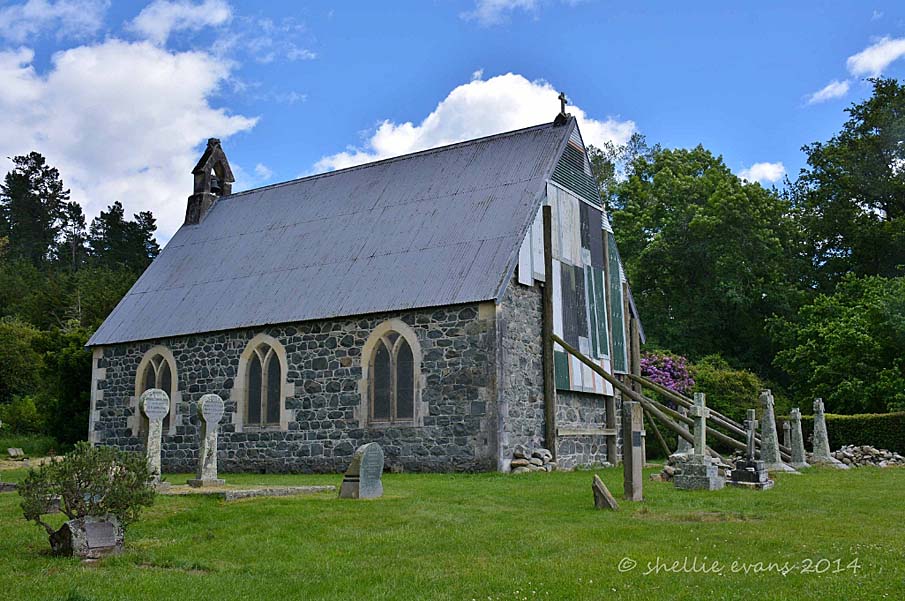
At Mt. Peel church services conducted by John Acland, who was licensed as a lay reader, were regularly held at the homestead. In 1866 he gave land near the homestead to the Church Property Trustees for a church and burial ground. Plans and specifications prepared by Edward Ashworth of Exeter were donated by Rev. P.L.D. Acland , vicar of Broadclyst and Sub-dean of the Exeter Cathedral. On December 14th 1868, Emily Acland, John's wife, laid the foundation stone for the church. William Brassington, the highly regarded Christchurch stone mason whose sculptural work is seen at the Provincial Council Buildings (1865) and the Canterbury Museum (1876-7), was responsible for the construction. He used large stones gathered from the nearby Rangitata riverbed with Mt. Somers limestone for quoins and dressings and had the church completed for its first service on May 30th 1869 when Bishop Harper was present to preach the first sermon. On December 12th that year the Bishop returned, once more welcomed by his grandchildren, daughter and son-in-law, for the consecration. The name, "the Church of the Holy Innocents" was chosen to commemorate the four small children, including an Acland daughter, who were buried nearby.
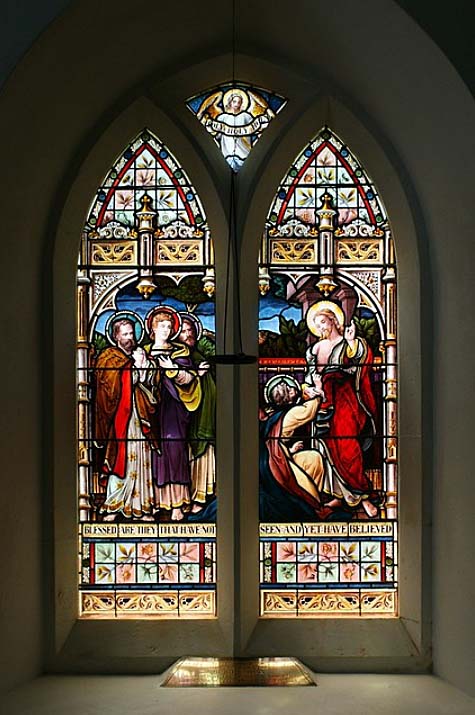
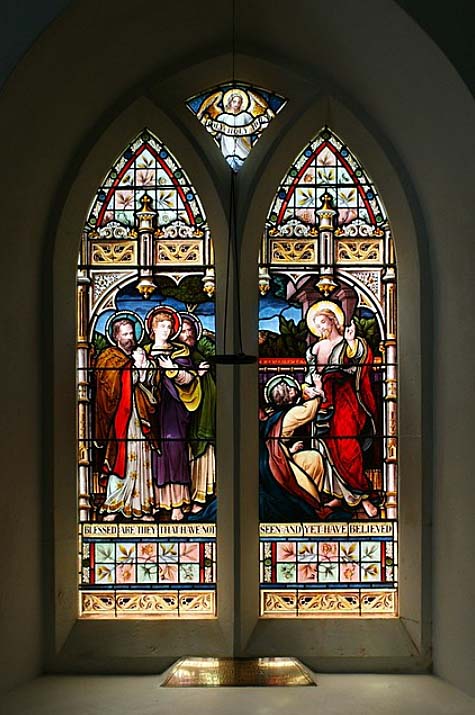
The church's interior is graced by a fine range of stained glass. A memorial window over the altar commemorates John and Emily Acland and the north-west window was installed in 1889 as a memorial to Michael Mitten who served for 15 years as the manager of Mt. Peel Station. In 1943 a window was donated by the Sheepowners Federation of New Zealand in recognition of Henry Dyke Acland's contribution to the sheep industry. An Acland tradition has evolved since 1882, with a family member tolling the church bell to ring in the New Year.
List Entry Information
Status
Listed
List Entry Status
Historic Place Category 2
Access
Private/No Public Access
List Number
1976
Date Entered
11th December 2003
Date of Effect
11th December 2003
City/District Council
Timaru District
Region
Canterbury Region
Extent of List Entry
Registration includes church on its site.
Legal description
Pt RS 7953 and 12804 (RT CB406/288), Canterbury Land District
Status
Listed
List Entry Status
Historic Place Category 2
Access
Private/No Public Access
List Number
1976
Date Entered
11th December 2003
Date of Effect
11th December 2003
City/District Council
Timaru District
Region
Canterbury Region
Extent of List Entry
Registration includes church on its site.
Legal description
Pt RS 7953 and 12804 (RT CB406/288), Canterbury Land District
Why is this place significant?
Historic Significance
Historical Significance or Value The Church of the Holy Innocents was built in 1869 by the Acland family of Mt. Peel Station to serve their own community and neighbouring settlers. John Acland envisaged the creation of a rural village, centred on the church, similar to those he knew in Devon. Its historic and cultural values relate to its association with this notable South Canterbury pioneer family and the original settlement of this part of the South Island.
Physical Significance
It is architecturally and aesthetically significant as the design of an English architect, Edward Ashworth, skilfully constructed from local materials in Gothic revival style and enhanced by a fine range of memorial stained glass windows
Why is this place Category 1 / Category 2?
Detail Of Assessed Criteria
The Church of the Holy Innocents, 1869, merits Category II registration as it meets many criteria. It can be seen as part of the complex of historic buildings at Mt. Peel Station, first settled in 1855 by Acland and Tripp and then the home of the Acland family. (The present homestead [Cat.I] was built in 1865.) The church was built for the family's needs, but also, typically, because the prominent land owner John Acland felt a paternalistic obligation to provide for the spiritual well being of workers on his and neighbouring properties. It is thus representative of an aspect of New Zealand history and is associated with Bishop Harper and notable early settlers. It has technical vales as it is a particularly fine structure, filled with elements which relate its history and the achievements of those who are commemorated. These provide symbolic and commemorative value. Built in 1865 the church dates from the earliest years of South Canterbury's settlement and is part of the historic group of building at Mt. Peel Station.
Why is this place significant?
Historic Significance
Historical Significance or Value The Church of the Holy Innocents was built in 1869 by the Acland family of Mt. Peel Station to serve their own community and neighbouring settlers. John Acland envisaged the creation of a rural village, centred on the church, similar to those he knew in Devon. Its historic and cultural values relate to its association with this notable South Canterbury pioneer family and the original settlement of this part of the South Island.
Physical Significance
It is architecturally and aesthetically significant as the design of an English architect, Edward Ashworth, skilfully constructed from local materials in Gothic revival style and enhanced by a fine range of memorial stained glass windows
Why is this place Category 1 / Category 2?
Detail Of Assessed Criteria
The Church of the Holy Innocents, 1869, merits Category II registration as it meets many criteria. It can be seen as part of the complex of historic buildings at Mt. Peel Station, first settled in 1855 by Acland and Tripp and then the home of the Acland family. (The present homestead [Cat.I] was built in 1865.) The church was built for the family's needs, but also, typically, because the prominent land owner John Acland felt a paternalistic obligation to provide for the spiritual well being of workers on his and neighbouring properties. It is thus representative of an aspect of New Zealand history and is associated with Bishop Harper and notable early settlers. It has technical vales as it is a particularly fine structure, filled with elements which relate its history and the achievements of those who are commemorated. These provide symbolic and commemorative value. Built in 1865 the church dates from the earliest years of South Canterbury's settlement and is part of the historic group of building at Mt. Peel Station.
Construction Professional
Name
Ashworth, Edward
Type
Architect
Biography
No biography is currently available for this construction professional
Name
Brassington, William
Type
Sculptor
Biography
William Brassington (1837-41?-1905) is described as being Canterbury's most notable early stonemason and craftsman. Born at Nottingham, England he and his family arrived in Lyttelton in 1863. Brassington established a stonemason's yard near the Barbadoes Street cemetery and his talent as a headstone carver was soon noticed by Benjamin Mountfort, the noted Canterbury architect. Mountfort commissioned Brassington to carve the decorative stonework in the Canterbury Provincial Council Buildings stone chamber and this is seen as Brassington's finest work. Between 1866 and 1867 Brassington carved the pulpit at St John the Baptist, Latimer Square, the font at Flaxton Church, and was responsible for the construction of the pedestal for the statue of John Robert Godley erected in Cathedral Square. He was also responsible for the portico of the Canterbury Museum. When the opportunities for decorative carving declined, he turned to stonebuilding, and constructed a number of private residences as well as the Church of the Holy Innocents at Mt Peel (1869) and the Timeball Station at Lyttelton (1876). It is assumed that he was employed in the construction of the nave and tower of Christ Church Cathedral during the 1870s. He moved to Australia around 1889 and died there in 1905. (DNZB, vol.1, pp.38-39)
Construction Details
Start Year
1869
Type
Original Construction
Construction Materials
Local river stone and Mt. Somers limestone exterior, timber interior.
Construction Professional
Name
Ashworth, Edward
Type
Architect
Biography
No biography is currently available for this construction professional
Name
Brassington, William
Type
Sculptor
Biography
William Brassington (1837-41?-1905) is described as being Canterbury's most notable early stonemason and craftsman. Born at Nottingham, England he and his family arrived in Lyttelton in 1863. Brassington established a stonemason's yard near the Barbadoes Street cemetery and his talent as a headstone carver was soon noticed by Benjamin Mountfort, the noted Canterbury architect. Mountfort commissioned Brassington to carve the decorative stonework in the Canterbury Provincial Council Buildings stone chamber and this is seen as Brassington's finest work. Between 1866 and 1867 Brassington carved the pulpit at St John the Baptist, Latimer Square, the font at Flaxton Church, and was responsible for the construction of the pedestal for the statue of John Robert Godley erected in Cathedral Square. He was also responsible for the portico of the Canterbury Museum. When the opportunities for decorative carving declined, he turned to stonebuilding, and constructed a number of private residences as well as the Church of the Holy Innocents at Mt Peel (1869) and the Timeball Station at Lyttelton (1876). It is assumed that he was employed in the construction of the nave and tower of Christ Church Cathedral during the 1870s. He moved to Australia around 1889 and died there in 1905. (DNZB, vol.1, pp.38-39)
Construction Details
Start Year
1869
Type
Original Construction
Construction Materials
Local river stone and Mt. Somers limestone exterior, timber interior.
The church has a steeply pitched gabled roof over a vaulted nave, topped with small bell turret at the eastern end. The design for the bell turret was suggested by Emily Acland. The chancel is a lower, separately roofed space. Internally, the roof structure features timber beams with alternating totara and white pine panelling. Stained glass memorial windows have been installed over the years.
The church has a steeply pitched gabled roof over a vaulted nave, topped with small bell turret at the eastern end. The design for the bell turret was suggested by Emily Acland. The chancel is a lower, separately roofed space. Internally, the roof structure features timber beams with alternating totara and white pine panelling. Stained glass memorial windows have been installed over the years.
Historical and Associated Iwi / Hapū / Whānau
Completion Date
6th September 2004
Report Written By
Pam Wilson
Information Sources
Williamson, 1978
E Williamson, Hearts, Hands and Voices, Geraldine: St Mary's Anglican Church, 1978
New Zealand Historic Places Trust (NZHPT)
New Zealand Historic Places Trust
Other Information
A fully referenced version of this report is available from the NZHPT Southern Region Office. Please note that entry on the New Zealand Heritage List/Rarangi Korero identifies only the heritage values of the property concerned, and should not be construed as advice on the state of the property, or as a comment of its soundness or safety, including in regard to earthquake risk, safety in the event of fire, or insanitary conditions.
Historical and Associated Iwi / Hapū / Whānau
Completion Date
6th September 2004
Report Written By
Pam Wilson
Information Sources
Williamson, 1978
E Williamson, Hearts, Hands and Voices, Geraldine: St Mary's Anglican Church, 1978
New Zealand Historic Places Trust (NZHPT)
New Zealand Historic Places Trust
Other Information
A fully referenced version of this report is available from the NZHPT Southern Region Office. Please note that entry on the New Zealand Heritage List/Rarangi Korero identifies only the heritage values of the property concerned, and should not be construed as advice on the state of the property, or as a comment of its soundness or safety, including in regard to earthquake risk, safety in the event of fire, or insanitary conditions.
Current Usages
Uses: Religion
Specific Usage: Church
Former Usages
General Usage: Religion
Specific Usage: Church
Current Usages
Uses: Religion
Specific Usage: Church
Former Usages
General Usage: Religion
Specific Usage: Church
Location
Sign up to hear more
Get the latest heritage news, features and events delivered
straight to your inbox.
