The information below is from the original report considered at the time of registration. Minor, subsequent changes are noted in square brackets.
Two of the first runs in the Geraldine district were taken up by John Acland and George Tripp, two lawyers who arrived from England in 1855 and initially worked in partnership. By 1862 Acland had settled on the Mt. Peel Station while Tripp was established at Orari Gorge. Apart from the community which clustered around Mt. Peel an associated township developed at Peel Forest with settlers involved in farming as well as felling and milling timber in the region.
In 1868 Acland [provided] a piece of land for the erection of a small church in the developing Mt. Peel village as he had had strong views about his responsibilities to the community, as the largest landowner in the district. St. Stephen's, a small timber building, was completed that year. It was never consecrated as it was available for all denominational services. On 14th May 1884 a whirlwind struck Peel Forest and St. Stephen's was completely demolished. However, the sturdy harmonium survived, being blown over an adjoining gorse fence and it continued in use until 1897.
The new church designed by Mr. Marley, a Christchurch architect, was built on the same site which had been transferred by Acland to the Church Property Trustees in 1881. A tender was accepted in 1885 for a wooden church with a concrete foundation for £272. Totara and black [and or white] pine timber was supplied by the local mill. The new St. Stephens first service was held in June 1885 and it was consecrated by Bishop Harper on 16 January 1887.
The church is described in Hearts Hands and Voices:
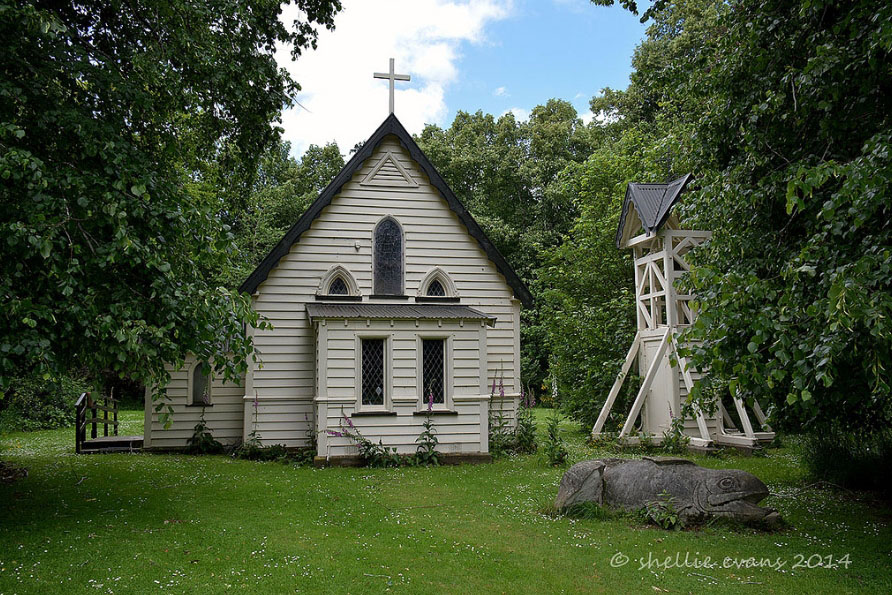
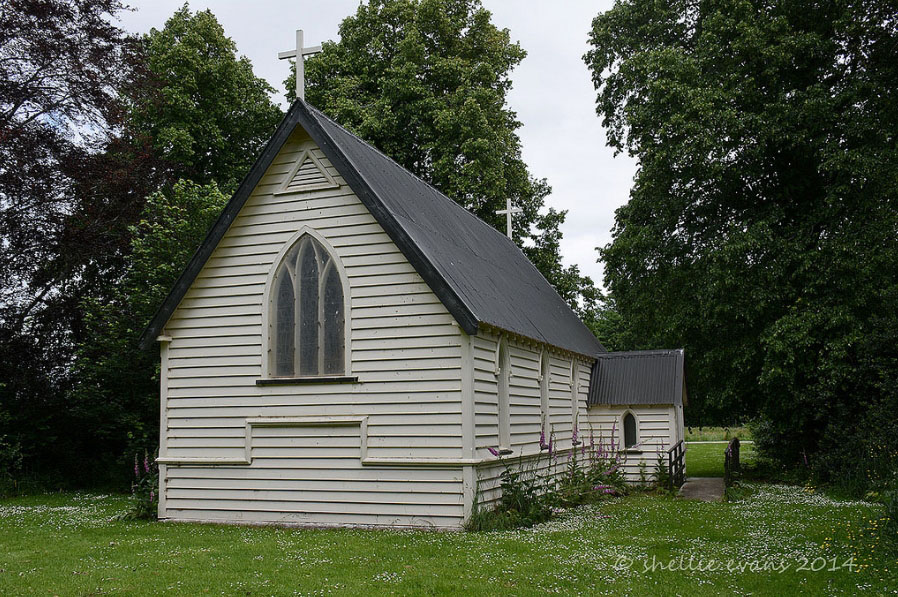
The new church was 38 feet [c. 11.6 m] long and 18 feet [ c. 5.5 m] wide, the walls above the foundation 10 feet [c. 3 m] with the elevation to the gable 24 feet [c. 7.3 m]. On the east end was a small wooden cross and on the west a bell turret topped with a neat iron cross. The Sacrarium floor was raised 6 inches [c. 15 cms] and the rail enclosing it was moulded black pine with a hinged portion. The church was ventilated by pipes built up the walls to a height of 7 feet [c. 2.1 m] and these allowed fore sliding ventilation inside.
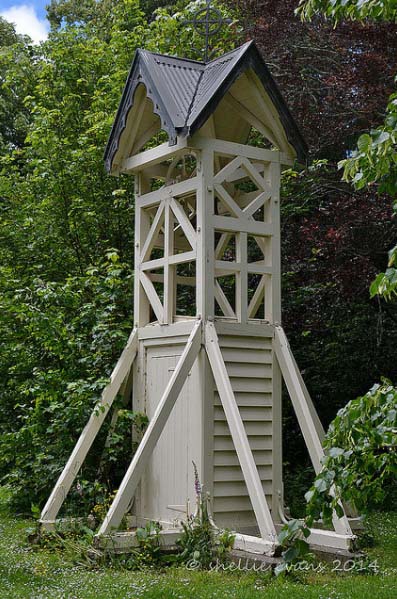
There are 4 casement windows in the north and 3 on the south side with diamond shaped frames of cathedral green and white glass... Outwardly the appearance of St. Stephen's as it stands today is altered by the removal of the bell tower. This proved too light for the weight of the bell and was blown down in October 1914. In 1915 a separate and most attractive bell tower was built to the right of the church... (Page 22)
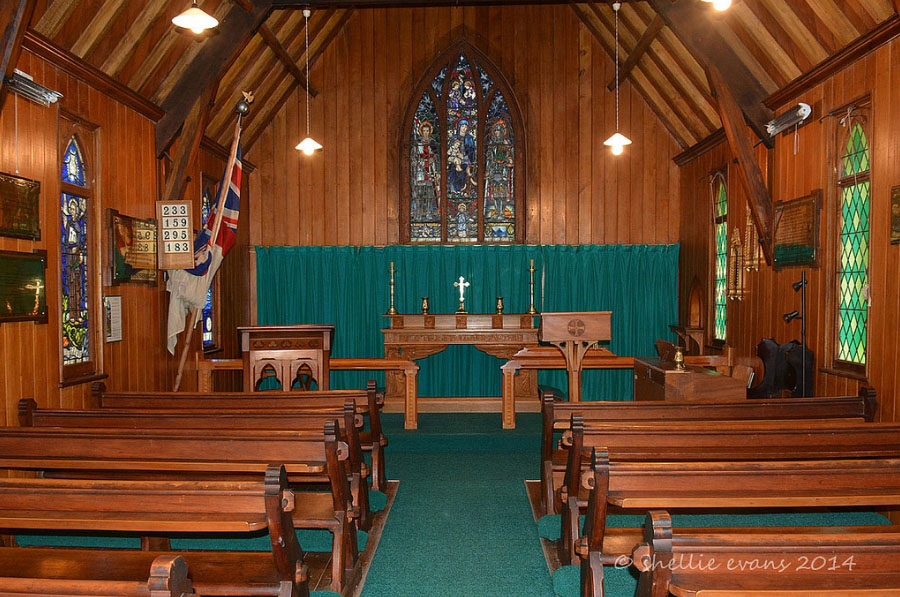
The long history of the church is marked by the interior plaques and memorials. The community support for it has always been generous. Like many of the churches in the Geraldine parish, it features some notable examples of stained glass. In 1923 Mrs G. J. Dennistoun from the Peel Forest Station commissioned Joseph Nuttgens to design and execute the triple lancet window in the sanctuary. This is a memorial to her recently deceased husband, George, and her son James, who had died in W.W. I. Nuttgens, a renowned English stained glass artist, depicted St. Mary the Virgin and the Christ Child with St. John the Baptist as a child. They are flanked by St. George and the Archangel Michael with the face of St. Michael copied from a photograph of [James] Dennistoun.
[James Dennistoun] was a well respected mountaineer, recorded as the first white settler to climb Mitre Peak and Nuttgens has included an image of the mountain at the base of St. Michael's figure. At the church's west end is a depiction of St. Francis of Assisi designed by Roy Entwistle, a Geraldine parishioner, and made by Miller Studios of Dunedin. Completed in 1977 it is a memorial to the Barker family. St. Francis is seen against a background of New Zealand foliage, ferns and kowhai with accompanying native birds together with a lamb and sheep dog. A depiction of St. Brendan was designed by Roy Entwistle in 1995 to commemorate G. H. and B. Dennistoun. Executed by Graham Stewart it is a contemporary image with references to Captain Dennistoun's service in the Royal Navy.
St. Stephen's is a highly regarded church, central to the small Peel Forest community and a significant feature of the rural townscape. The various memorial features which have been installed document aspects of the district's development.
Two of the first runs in the Geraldine district were taken up by John Acland and George Tripp, two lawyers who arrived from England in 1855 and initially worked in partnership. By 1862 Acland had settled on the Mt. Peel Station while Tripp was established at Orari Gorge. Apart from the community which clustered around Mt. Peel an associated township developed at Peel Forest with settlers involved in farming as well as felling and milling timber in the region.
In 1868 Acland [provided] a piece of land for the erection of a small church in the developing Mt. Peel village as he had had strong views about his responsibilities to the community, as the largest landowner in the district. St. Stephen's, a small timber building, was completed that year. It was never consecrated as it was available for all denominational services. On 14th May 1884 a whirlwind struck Peel Forest and St. Stephen's was completely demolished. However, the sturdy harmonium survived, being blown over an adjoining gorse fence and it continued in use until 1897.
The new church designed by Mr. Marley, a Christchurch architect, was built on the same site which had been transferred by Acland to the Church Property Trustees in 1881. A tender was accepted in 1885 for a wooden church with a concrete foundation for £272. Totara and black [and or white] pine timber was supplied by the local mill. The new St. Stephens first service was held in June 1885 and it was consecrated by Bishop Harper on 16 January 1887.
The church is described in Hearts Hands and Voices:
The new church was 38 feet [c. 11.6 m] long and 18 feet [ c. 5.5 m] wide, the walls above the foundation 10 feet [c. 3 m] with the elevation to the gable 24 feet [c. 7.3 m]. On the east end was a small wooden cross and on the west a bell turret topped with a neat iron cross. The Sacrarium floor was raised 6 inches [c. 15 cms] and the rail enclosing it was moulded black pine with a hinged portion. The church was ventilated by pipes built up the walls to a height of 7 feet [c. 2.1 m] and these allowed fore sliding ventilation inside.
There are 4 casement windows in the north and 3 on the south side with diamond shaped frames of cathedral green and white glass... Outwardly the appearance of St. Stephen's as it stands today is altered by the removal of the bell tower. This proved too light for the weight of the bell and was blown down in October 1914. In 1915 a separate and most attractive bell tower was built to the right of the church... (Page 22)
The long history of the church is marked by the interior plaques and memorials. The community support for it has always been generous. Like many of the churches in the Geraldine parish, it features some notable examples of stained glass. In 1923 Mrs G. J. Dennistoun from the Peel Forest Station commissioned Joseph Nuttgens to design and execute the triple lancet window in the sanctuary. This is a memorial to her recently deceased husband, George, and her son James, who had died in W.W. I. Nuttgens, a renowned English stained glass artist, depicted St. Mary the Virgin and the Christ Child with St. John the Baptist as a child. They are flanked by St. George and the Archangel Michael with the face of St. Michael copied from a photograph of [James] Dennistoun.
[James Dennistoun] was a well respected mountaineer, recorded as the first white settler to climb Mitre Peak and Nuttgens has included an image of the mountain at the base of St. Michael's figure. At the church's west end is a depiction of St. Francis of Assisi designed by Roy Entwistle, a Geraldine parishioner, and made by Miller Studios of Dunedin. Completed in 1977 it is a memorial to the Barker family. St. Francis is seen against a background of New Zealand foliage, ferns and kowhai with accompanying native birds together with a lamb and sheep dog. A depiction of St. Brendan was designed by Roy Entwistle in 1995 to commemorate G. H. and B. Dennistoun. Executed by Graham Stewart it is a contemporary image with references to Captain Dennistoun's service in the Royal Navy.
St. Stephen's is a highly regarded church, central to the small Peel Forest community and a significant feature of the rural townscape. The various memorial features which have been installed document aspects of the district's development.