

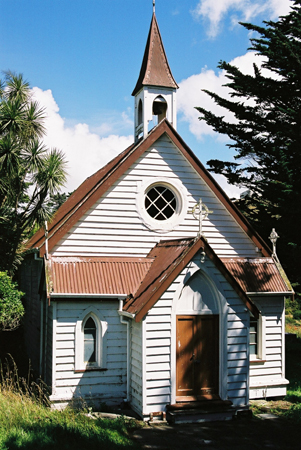
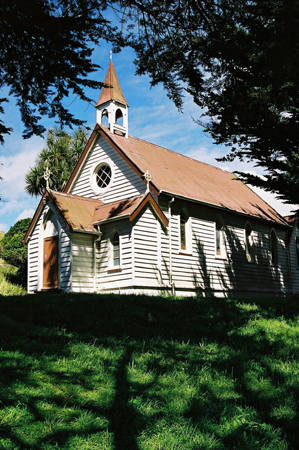
The new church was designed by Thomas Turnbull, a significant Wellington-based architect. Turnbull's design was a simple timber Gothic church measuring 18 ft. x 38 ft. [5.5m x 11.5m] and containing seating for 100 people. It was built by Blackie and Foster, and completed in 1878. The church was consecrated by Bishop Francis Redwood (later Archbishop) on 28 April 1878. The first priest was Father John Joseph Lane, who was appointed parish priest of the Hutt in 1886. Father Lane, later Dean Lane, continued to serve the Hutt Valley and Porirua Basin until his death in the 1920s.
St Joseph's is noted for the use of 'poor man's stained glass', a form of printed, coloured transparent paper, imitating the forms and colours of glass. Adjacent to the church is a graveyard where a number of early settlers to the Pauatahanui area are buried.
St Joseph's is significant as it is the oldest Catholic Church building still in use in Wellington and the first Catholic Church in the Porirua basin. It was designed by notable architect Thomas Turnbull, and is a perfectly realised simple Gothic church.
List Entry Information
Status
Listed
List Entry Status
Historic Place Category 1
Access
Private/No Public Access
List Number
205
Date Entered
2nd July 1982
Date of Effect
2nd July 1982
City/District Council
Porirua City
Region
Wellington Region
Extent of List Entry
Extent is the land described as Pt Sec 63 Pauatahanui Dist (RT WN353/230), Wellington Land District and the building known as St Joseph's Church (Catholic) thereon.
Legal description
Pt Sec 63 Pauatahanui Dist (RT WN353/230), Wellington Land District
Status
Listed
List Entry Status
Historic Place Category 1
Access
Private/No Public Access
List Number
205
Date Entered
2nd July 1982
Date of Effect
2nd July 1982
City/District Council
Porirua City
Region
Wellington Region
Extent of List Entry
Extent is the land described as Pt Sec 63 Pauatahanui Dist (RT WN353/230), Wellington Land District and the building known as St Joseph's Church (Catholic) thereon.
Legal description
Pt Sec 63 Pauatahanui Dist (RT WN353/230), Wellington Land District
Construction Professional
Name
Turnbull, Thomas
Type
Architect
Biography
Thomas Turnbull (1824-1907) was born and educated in Scotland and trained under David Bryce, Her Majesty's Architect. He travelled to Melbourne in 1851 and after nine years there moved to San Francisco. He arrived in New Zealand in 1871 and soon established a thriving business. His son William, a distinguished architect in his own right, became a partner in the firm in 1891. Turnbull was a member of the Royal Institute of British Architects. He was a pioneer in the design of buildings to withstand earthquakes and he was responsible for breaking down prejudice against the use of permanent materials for building construction. He specialised in masonry construction for commercial purposes but was also responsible for some fine houses. Among his most important buildings were the Willis Street churches of St Peter (1879) and St John (1885), the former National Mutual Building (1883-84), the General Assembly Library (1899) and the former Bank of New Zealand Head Office (1901), all in Wellington.
Construction Details
Start Year
1878
Type
Original Construction
Construction Professional
Name
Turnbull, Thomas
Type
Architect
Biography
Thomas Turnbull (1824-1907) was born and educated in Scotland and trained under David Bryce, Her Majesty's Architect. He travelled to Melbourne in 1851 and after nine years there moved to San Francisco. He arrived in New Zealand in 1871 and soon established a thriving business. His son William, a distinguished architect in his own right, became a partner in the firm in 1891. Turnbull was a member of the Royal Institute of British Architects. He was a pioneer in the design of buildings to withstand earthquakes and he was responsible for breaking down prejudice against the use of permanent materials for building construction. He specialised in masonry construction for commercial purposes but was also responsible for some fine houses. Among his most important buildings were the Willis Street churches of St Peter (1879) and St John (1885), the former National Mutual Building (1883-84), the General Assembly Library (1899) and the former Bank of New Zealand Head Office (1901), all in Wellington.
Construction Details
Start Year
1878
Type
Original Construction
Historical and Associated Iwi / Hapū / Whānau
Public NZAA Number
R27/320
Information Sources
Fearnley, 1977
Charles Fearnley, Early Wellington Churches, Wellington, 1977
Other Information
This place was identified as significant under previous legislation with different information requirements. It remains significant under the current legislation. There is opportunity under our legislation and policies to add to this information. Further information about this place may be available from the Central Regional Office of Heritage New Zealand Pouhere Taonga. Please note that entry on the New Zealand Heritage List/Rarangi Korero identifies only the heritage values of the property concerned, and should not be construed as advice on the state of the property, or as a comment of its soundness or safety, including in regard to earthquake risk, safety in the event of fire, or insanitary conditions.
Historical and Associated Iwi / Hapū / Whānau
Public NZAA Number
R27/320
Information Sources
Fearnley, 1977
Charles Fearnley, Early Wellington Churches, Wellington, 1977
Other Information
This place was identified as significant under previous legislation with different information requirements. It remains significant under the current legislation. There is opportunity under our legislation and policies to add to this information. Further information about this place may be available from the Central Regional Office of Heritage New Zealand Pouhere Taonga. Please note that entry on the New Zealand Heritage List/Rarangi Korero identifies only the heritage values of the property concerned, and should not be construed as advice on the state of the property, or as a comment of its soundness or safety, including in regard to earthquake risk, safety in the event of fire, or insanitary conditions.
Current Usages
Uses: Religion
Specific Usage: Church
Former Usages
General Usage: Religion
Specific Usage: Church
Current Usages
Uses: Religion
Specific Usage: Church
Former Usages
General Usage: Religion
Specific Usage: Church
