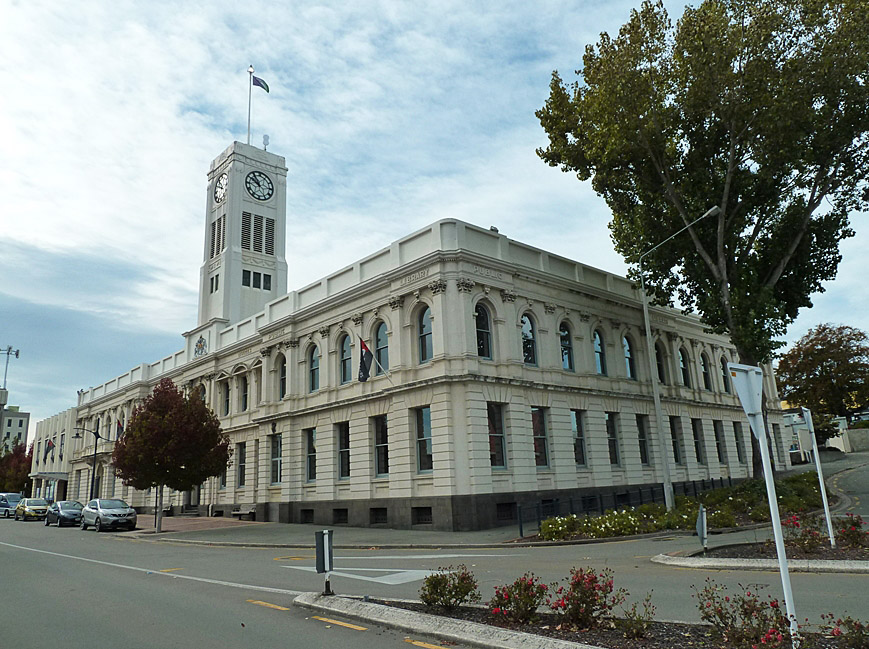
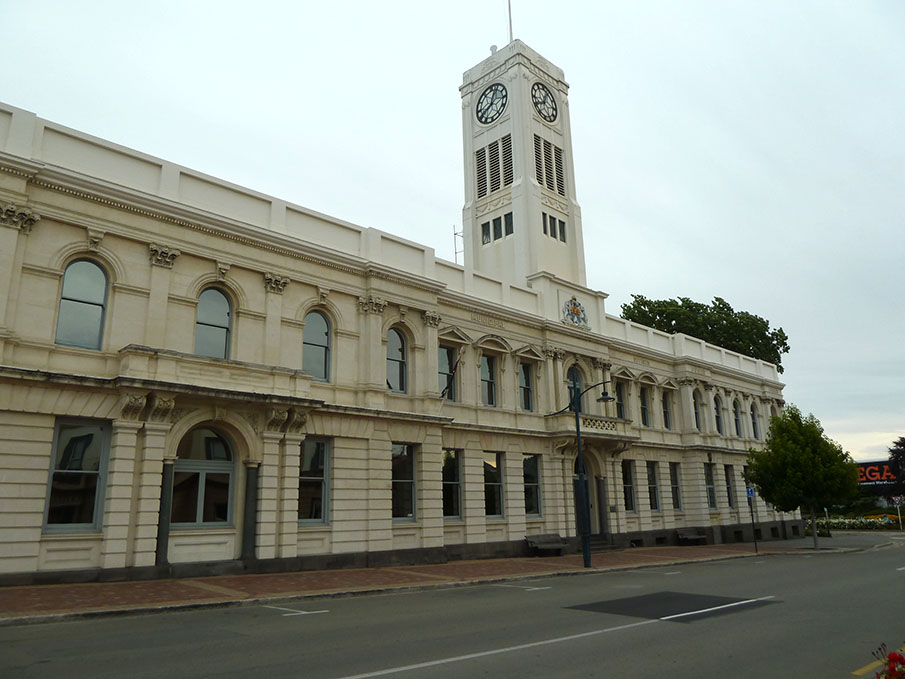
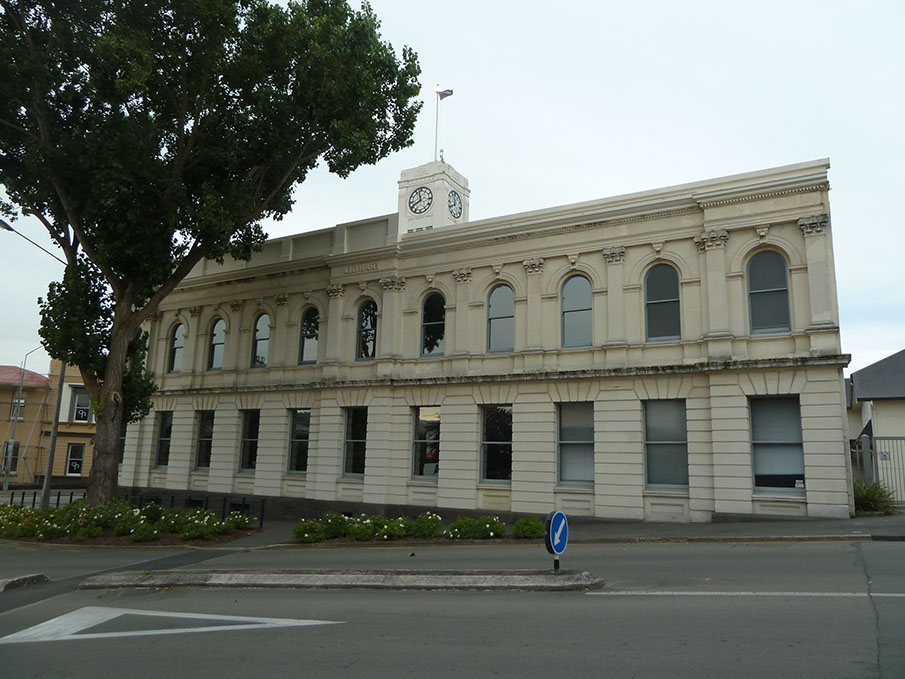
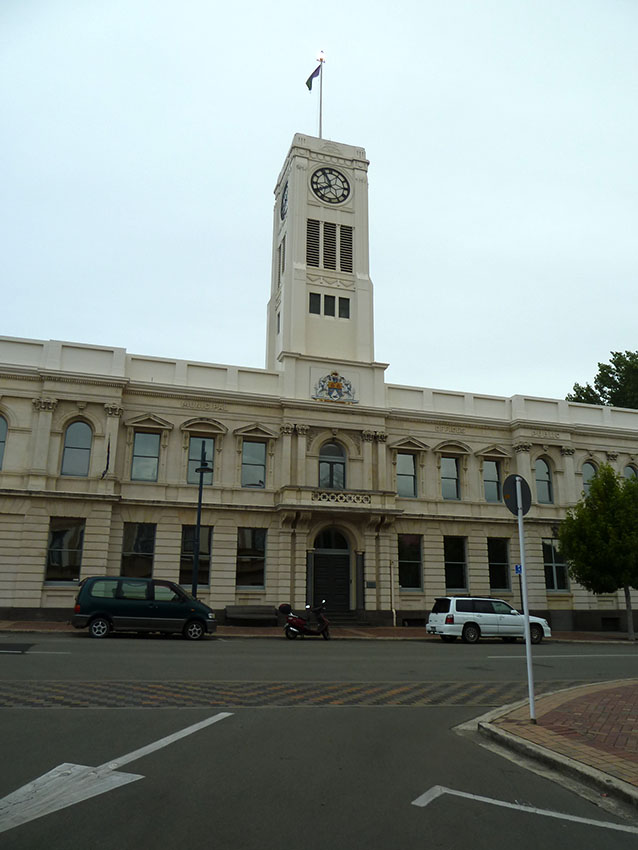
Sited on the corner of 2 King George Place and Latter Street in central Timaru, the Timaru Council Offices and Former Public Library (Façade) building, built in stages between 1908 and 1933, is a recognisable remnant of a well-crafted, architecturally significant work by architects Walter Panton and Son, and is notable as part of the history of local government in Timaru and as a Carnegie Library. It has aesthetic, architectural, historical and social significance or value. Its key physical elements are its north and west façades, war memorial lamp of remembrance, and clocktower with associated bells and mechanisms.
Situated south of the prominent Te Waiateruati pā near Temuka, the Timaru pakainga was a well-known tauranga waka (landing place) and mahinga kai. In the 1830s, whalers had been attracted to Timaru and some stayed to settle on the land. The colonial town developed in the 1850s and maps from this time show the area where the Timaru Council Offices and Former Public Library (Façade) building now stands as being open hilly land, less than 300 metres from what was then the foreshore.
In 1904 the Timaru Borough Council purchased a site on George Street from Dr Gabites for £1150 to allow for municipal buildings and library to be erected for the Council. An architectural competition was held and the selected design by Walter Panton and Son was constructed in two phases. The first half completed was the public library, as a result of Mayor James Craigie securing funding from Andrew Carnegie for such a purpose. The library was constructed in 1908 and opened in 1909. The second half of the original design – the municipal buildings – was built soon after in 1911-1912.
The Timaru Council Offices and Former Public Library (Façade) is a two storeyed classically designed frontage, in a palazzo style, with pilasters and Corinthian capitals, keystones and medallions. The foundations are grey Timaru ‘bluestone’, while the main part of the west and north façades are built of Ōamaru stone. The main entrance, fronting King George Place, is accessed by seven bluestone steps and a vestibule leading to a pair of doors. Above the main entrance is a balcony and the plain pediment contains the Council’s coat of arms. Inscribed in the stonework of the frieze, are the words ‘Municipal’, ‘Offices’, ‘Public’ and ‘Library’. A tall concrete clocktower rises centrally from the roof line. As well having glazed clock faces, the tower also contains bells behind louvres, and is surmounted by a 7.6 metre flagpole and topped with a lamp. The building fabric behind the north and west façades is modern, the south façade containing rows of fenestration and a light grey coloured cladding. Below is a renovated basement. The roof is corrugated steel.
Several major additions were made to the building in the two decades following initial completion. The library was extended to the south-west in 1914 and the council buildings were extended to the east in 1927. An impressive addition in 1933 was the clocktower, designed by Victor H Panton, which reuses a clock mechanism previously in the Post Office clocktower and given to the city by former Mayor, James Craigie, in 1913. In early 1946 a permanent Lamp of Remembrance was installed at the top of the clocktower’s flagpole, at the instigation of the then mayor, A E S Hanan, as a memorial to the men who served in World War Two. In 1962 the parapet, including pediments and finials, was removed during a general facelift of the façade. From 1979 the library part of the building was converted to offices. A major redevelopment programme in circa 2003-2005 involved the demolition and rebuilding of most of the building whilst retaining the north and west facades and the clocktower. In its new modern interior, the building continues to function as the Timaru District Council offices. Despite the major rebuild behind the north and west façades, the street-facing exterior looks largely the same as it did for much of the twentieth century, and it is an appreciated architectural feature of the town.
Situated south of the prominent Te Waiateruati pā near Temuka, the Timaru pakainga was a well-known tauranga waka (landing place) and mahinga kai. In the 1830s, whalers had been attracted to Timaru and some stayed to settle on the land. The colonial town developed in the 1850s and maps from this time show the area where the Timaru Council Offices and Former Public Library (Façade) building now stands as being open hilly land, less than 300 metres from what was then the foreshore.
In 1904 the Timaru Borough Council purchased a site on George Street from Dr Gabites for £1150 to allow for municipal buildings and library to be erected for the Council. An architectural competition was held and the selected design by Walter Panton and Son was constructed in two phases. The first half completed was the public library, as a result of Mayor James Craigie securing funding from Andrew Carnegie for such a purpose. The library was constructed in 1908 and opened in 1909. The second half of the original design – the municipal buildings – was built soon after in 1911-1912.
The Timaru Council Offices and Former Public Library (Façade) is a two storeyed classically designed frontage, in a palazzo style, with pilasters and Corinthian capitals, keystones and medallions. The foundations are grey Timaru ‘bluestone’, while the main part of the west and north façades are built of Ōamaru stone. The main entrance, fronting King George Place, is accessed by seven bluestone steps and a vestibule leading to a pair of doors. Above the main entrance is a balcony and the plain pediment contains the Council’s coat of arms. Inscribed in the stonework of the frieze, are the words ‘Municipal’, ‘Offices’, ‘Public’ and ‘Library’. A tall concrete clocktower rises centrally from the roof line. As well having glazed clock faces, the tower also contains bells behind louvres, and is surmounted by a 7.6 metre flagpole and topped with a lamp. The building fabric behind the north and west façades is modern, the south façade containing rows of fenestration and a light grey coloured cladding. Below is a renovated basement. The roof is corrugated steel.
Several major additions were made to the building in the two decades following initial completion. The library was extended to the south-west in 1914 and the council buildings were extended to the east in 1927. An impressive addition in 1933 was the clocktower, designed by Victor H Panton, which reuses a clock mechanism previously in the Post Office clocktower and given to the city by former Mayor, James Craigie, in 1913. In early 1946 a permanent Lamp of Remembrance was installed at the top of the clocktower’s flagpole, at the instigation of the then mayor, A E S Hanan, as a memorial to the men who served in World War Two. In 1962 the parapet, including pediments and finials, was removed during a general facelift of the façade. From 1979 the library part of the building was converted to offices. A major redevelopment programme in circa 2003-2005 involved the demolition and rebuilding of most of the building whilst retaining the north and west facades and the clocktower. In its new modern interior, the building continues to function as the Timaru District Council offices. Despite the major rebuild behind the north and west façades, the street-facing exterior looks largely the same as it did for much of the twentieth century, and it is an appreciated architectural feature of the town.