

The first Dunedin branch was opened on Stafford Street in 1857, on what is now the site of the Provincial Hotel. One early colonist noted that the branch opening made Dunedin "a member of the affiliated communities of industry and commerce all the world over."
The Bank leased some of its upper floor space to private individuals. Architect Edmund Anscombe leased part of that floor for a period form 1912 to the mid 1920s, presumably as his office.
The Union Bank merged with the Bank of Australasia in 1951, creating the ANZ Bank. This became the ANZ Banking Group Limited in 1971 following the merger in Australia of the ANZ Bank and the English, Scottish and Australian Bank. When structural problems were identified in the mid-1970s the ANZ proposed demolition of the building, but after a public outcry relented, and instead undertook a massive strengthening and interior refit. Work began in October 1975.
List Entry Information
Status
Listed
List Entry Status
Historic Place Category 2
Access
Private/No Public Access
List Number
2138
Date Entered
14th April 2005
Date of Effect
14th April 2005
City/District Council
Dunedin City
Region
Otago Region
Extent of List Entry
Registration includes the land in Certificate of Title OT147/153 and the building, thereon (see plan in Appendix 4 of registration report).
Legal description
Secs 1-2 Blk XLIII DP 1896 (RT OT147/153), Otago Land District
Status
Listed
List Entry Status
Historic Place Category 2
Access
Private/No Public Access
List Number
2138
Date Entered
14th April 2005
Date of Effect
14th April 2005
City/District Council
Dunedin City
Region
Otago Region
Extent of List Entry
Registration includes the land in Certificate of Title OT147/153 and the building, thereon (see plan in Appendix 4 of registration report).
Legal description
Secs 1-2 Blk XLIII DP 1896 (RT OT147/153), Otago Land District
Why is this place significant?
Historic Significance
Historical Significance or Value The Union Bank has historical significance both through its association with the Union Bank of Australia, one of the earliest banks established in the country, and as a representation of Lawson's architecture. The building housed a bank for 118 years, and is an important reminder of the pivotal role banking played in the colonial economy and of the changing nature of the finance industry over that time. The Union Bank represents the period where the institution emphasised its status and function, its upstanding nature reflected in its architectural detailing, a very different image from the community-friendly image presented in 2004.
Physical Significance
The former Union Bank of Australia has architectural significance. It is an imposing design by prominent Dunedin architect R.A. Lawson representing the grandeur and solidity favoured by nineteenth century banks in their buildings. The scale and detailing make a significant contribution to the townscape of Princes Street, an area noted for its grand commercial buildings.
Why is this place Category 1 / Category 2?
Detail Of Assessed Criteria
The former Union Bank represents the history of financial institutions in colonial history. While the banks presented images of solidity and grandeur through their architecture, the history of banking collapses, merges and other realignments says much about the nature of the nineteenth century economy. In Dunedin the bank and its grandness represent the prosperity associated with the gold mining period and its on-going contribution to the economy in Otago. The Union Bank has an association with prominent Dunedin architect Robert Arthur Lawson. Lawson is mainly known for his church architecture, but the Union Bank is a fine example of commercial banking architecture, and an important element in his oeuvre. The design of the Union Bank is an impressive, with the grand façade and the elegant detailing excellent examples of nineteenth century commercial architecture. It is an important element in the townscape of Princes Street and the Exchange, which was the central business area of Dunedin, with this important history reflected in the grand scale of many of the buildings.
Why is this place significant?
Historic Significance
Historical Significance or Value The Union Bank has historical significance both through its association with the Union Bank of Australia, one of the earliest banks established in the country, and as a representation of Lawson's architecture. The building housed a bank for 118 years, and is an important reminder of the pivotal role banking played in the colonial economy and of the changing nature of the finance industry over that time. The Union Bank represents the period where the institution emphasised its status and function, its upstanding nature reflected in its architectural detailing, a very different image from the community-friendly image presented in 2004.
Physical Significance
The former Union Bank of Australia has architectural significance. It is an imposing design by prominent Dunedin architect R.A. Lawson representing the grandeur and solidity favoured by nineteenth century banks in their buildings. The scale and detailing make a significant contribution to the townscape of Princes Street, an area noted for its grand commercial buildings.
Why is this place Category 1 / Category 2?
Detail Of Assessed Criteria
The former Union Bank represents the history of financial institutions in colonial history. While the banks presented images of solidity and grandeur through their architecture, the history of banking collapses, merges and other realignments says much about the nature of the nineteenth century economy. In Dunedin the bank and its grandness represent the prosperity associated with the gold mining period and its on-going contribution to the economy in Otago. The Union Bank has an association with prominent Dunedin architect Robert Arthur Lawson. Lawson is mainly known for his church architecture, but the Union Bank is a fine example of commercial banking architecture, and an important element in his oeuvre. The design of the Union Bank is an impressive, with the grand façade and the elegant detailing excellent examples of nineteenth century commercial architecture. It is an important element in the townscape of Princes Street and the Exchange, which was the central business area of Dunedin, with this important history reflected in the grand scale of many of the buildings.
Construction Professional
Name
Lawson, Robert Arthur
Type
Architect
Biography
Born in Scotland, Lawson (1833-1902) began his professional career in Perth. At the age of 25 he moved to Melbourne and was engaged in goldmining and journalism before resuming architectural practice. In 1862 Lawson sailed for Dunedin, where his sketch plans had won the competition for the design of First Church. This was built 1867-73. Lawson went on to become one of the most important architects in New Zealand. First Church is regarded as his masterpiece and one of the finest nineteenth century churches in New Zealand. He was also responsible for the design of the Trinity Church (now Fortune Theatre), Dunedin (1869-70), the East Taieri Presbyterian Church (1870), and Knox Church, Dunedin (1874). He designed Park's School (1864) and the ANZ Bank (originally Union Bank, 1874). In Oamaru he designed the Bank of Otago (later National Bank building, 1870) and the adjoining Bank of New South Wales (now Forrester Gallery, 1881). See also: Ledgerwood, Norman, 2013. 'R.A. Lawson: Victorian Architect of Dunedin'. Historic Cemeteries Conservation NZ.
Name
Gore, James
Type
Builder
Biography
No biography is currently available for this construction professional
Construction Details
Start Year
1974
Finish Year
1977
Type
Modification
Description
Interior refit and strengthening work
Construction Materials
Basalt foundation, Oamaru stone cladding.
Construction Professional
Name
Lawson, Robert Arthur
Type
Architect
Biography
Born in Scotland, Lawson (1833-1902) began his professional career in Perth. At the age of 25 he moved to Melbourne and was engaged in goldmining and journalism before resuming architectural practice. In 1862 Lawson sailed for Dunedin, where his sketch plans had won the competition for the design of First Church. This was built 1867-73. Lawson went on to become one of the most important architects in New Zealand. First Church is regarded as his masterpiece and one of the finest nineteenth century churches in New Zealand. He was also responsible for the design of the Trinity Church (now Fortune Theatre), Dunedin (1869-70), the East Taieri Presbyterian Church (1870), and Knox Church, Dunedin (1874). He designed Park's School (1864) and the ANZ Bank (originally Union Bank, 1874). In Oamaru he designed the Bank of Otago (later National Bank building, 1870) and the adjoining Bank of New South Wales (now Forrester Gallery, 1881). See also: Ledgerwood, Norman, 2013. 'R.A. Lawson: Victorian Architect of Dunedin'. Historic Cemeteries Conservation NZ.
Name
Gore, James
Type
Builder
Biography
No biography is currently available for this construction professional
Construction Details
Start Year
1974
Finish Year
1977
Type
Modification
Description
Interior refit and strengthening work
Construction Materials
Basalt foundation, Oamaru stone cladding.
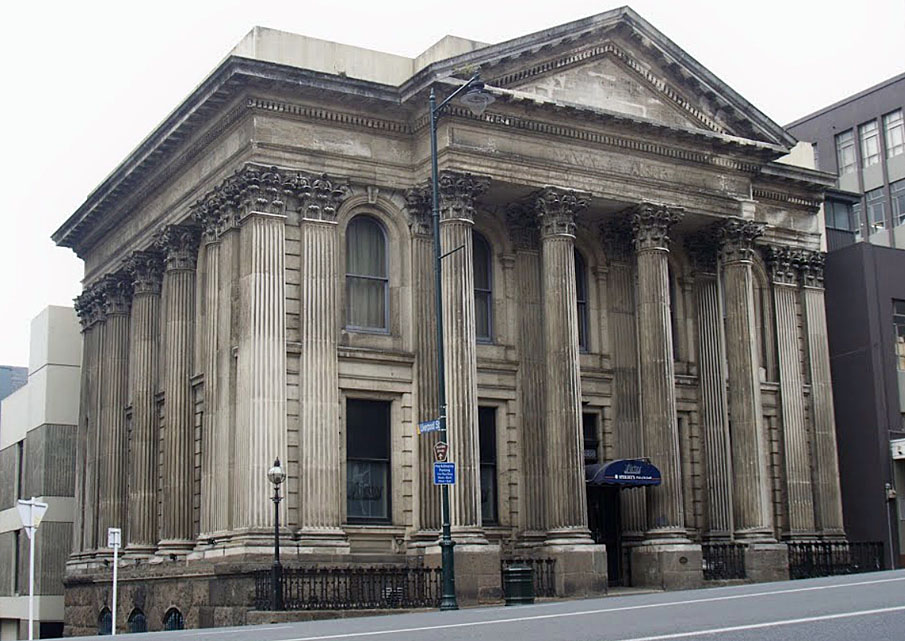
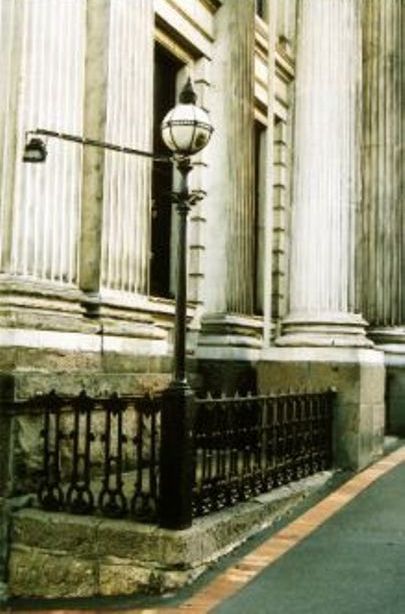
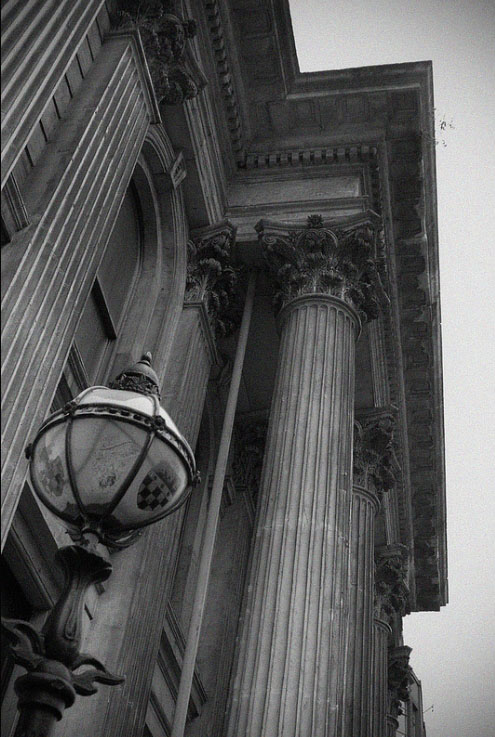
The Union Bank of Australia is situated at the corner of Princes and Liverpool Streets. It opened in September 1874. The building has a 60ft (18m) frontage to Princes Street, and a 54ft (16m) frontage to Liverpool Street. The three-storey building is constructed of Oamaru stone with classical detailing. The two-storey frontage to Princes Street has a grand pedimented portico with two-storey Corinthian order columns set on a symmetrical façade. The façade behind the portico has paired pilasters, square-headed windows on the ground floor, arched windows with false keystones on the first floor, and plain but elegant entablature above. The style was that expressing the corporate values of respectability and permanence desired by nineteenth century banks. When completed the business portion of the premises, contained on the Princes Street level, consisted of banking hall, safe rooms and manager's office, and cloak room. An elegant stair case led to the floor above. The banking hall was 44ft by 29ft (13m by 10m), one half of which was behind the counter. The basement and upper floor were occupied as dwelling apartments for officers of the bank. The building is one of the most massive and solid construction and street presence. The interior fitout was colonial red pine, Oregon and Cedar. By the early 1970s the interior had deteriorated, and the double pitch internal valley slate roof and framing were in poor repair. Signs of cracking were evident throughout the structure, particularly at the east (back) wall. These problems led the ANZ Bank to consider demolition and redevelopment on an adjacent site. At the time this was being considered Dunedin suffered a strong earthquake, and the lack of further damage led to the decision to reinstate rather than demolish. Structural consultants Brickell, Moss, Rankine and Hill worked through strengthening proposals. Due to fire code issues the decision was made to maintain the basement and ground floor only of the existing building. The first floor space was used as bracing space for trusses. The damaged east wall was demolished and replaced with a concrete frame tied into the side wall. Concrete beams were used on the first floor for additional strengthening. The original timber first floor was removed and replaced with a light steel framed and plaster-lined ceiling. A mezzanine floor was added. The new extension to the rear was concrete, and designed to as a foil to the richness of the original building.
The Union Bank of Australia is situated at the corner of Princes and Liverpool Streets. It opened in September 1874. The building has a 60ft (18m) frontage to Princes Street, and a 54ft (16m) frontage to Liverpool Street. The three-storey building is constructed of Oamaru stone with classical detailing. The two-storey frontage to Princes Street has a grand pedimented portico with two-storey Corinthian order columns set on a symmetrical façade. The façade behind the portico has paired pilasters, square-headed windows on the ground floor, arched windows with false keystones on the first floor, and plain but elegant entablature above. The style was that expressing the corporate values of respectability and permanence desired by nineteenth century banks. When completed the business portion of the premises, contained on the Princes Street level, consisted of banking hall, safe rooms and manager's office, and cloak room. An elegant stair case led to the floor above. The banking hall was 44ft by 29ft (13m by 10m), one half of which was behind the counter. The basement and upper floor were occupied as dwelling apartments for officers of the bank. The building is one of the most massive and solid construction and street presence. The interior fitout was colonial red pine, Oregon and Cedar. By the early 1970s the interior had deteriorated, and the double pitch internal valley slate roof and framing were in poor repair. Signs of cracking were evident throughout the structure, particularly at the east (back) wall. These problems led the ANZ Bank to consider demolition and redevelopment on an adjacent site. At the time this was being considered Dunedin suffered a strong earthquake, and the lack of further damage led to the decision to reinstate rather than demolish. Structural consultants Brickell, Moss, Rankine and Hill worked through strengthening proposals. Due to fire code issues the decision was made to maintain the basement and ground floor only of the existing building. The first floor space was used as bracing space for trusses. The damaged east wall was demolished and replaced with a concrete frame tied into the side wall. Concrete beams were used on the first floor for additional strengthening. The original timber first floor was removed and replaced with a light steel framed and plaster-lined ceiling. A mezzanine floor was added. The new extension to the rear was concrete, and designed to as a foil to the richness of the original building.
Historical and Associated Iwi / Hapū / Whānau
Information Sources
Anon.
Anon.
New Zealand Historic Places Trust (NZHPT)
New Zealand Historic Places Trust
Otago Daily Times
Otago Daily Times, 1 Jun 1915, p.10.
Other Information
A fully referenced registration report is available from the NZHPT Otago/Southland Area Office Please note that entry on the New Zealand Heritage List/Rarangi Korero identifies only the heritage values of the property concerned, and should not be construed as advice on the state of the property, or as a comment of its soundness or safety, including in regard to earthquake risk, safety in the event of fire, or insanitary conditions.
Historical and Associated Iwi / Hapū / Whānau
Information Sources
Anon.
Anon.
New Zealand Historic Places Trust (NZHPT)
New Zealand Historic Places Trust
Otago Daily Times
Otago Daily Times, 1 Jun 1915, p.10.
Other Information
A fully referenced registration report is available from the NZHPT Otago/Southland Area Office Please note that entry on the New Zealand Heritage List/Rarangi Korero identifies only the heritage values of the property concerned, and should not be construed as advice on the state of the property, or as a comment of its soundness or safety, including in regard to earthquake risk, safety in the event of fire, or insanitary conditions.
Current Usages
Uses: Trade
Specific Usage: Retail and Commercial - other
Former Usages
General Usage: Finance
Specific Usage: Bank
Current Usages
Uses: Trade
Specific Usage: Retail and Commercial - other
Former Usages
General Usage: Finance
Specific Usage: Bank
