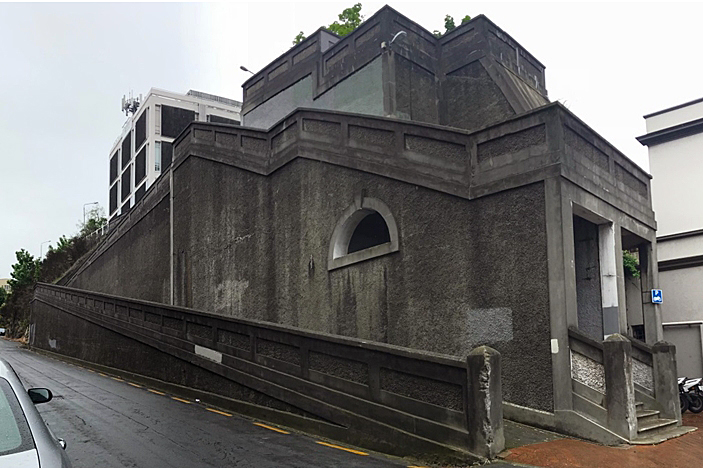
The Dowling Street Steps in Dunedin are located at the western intersection of Dowling and Princes Streets, on what remains of Bell Hill, and serve as a thoroughfare between Princes and Tennyson Streets. Steps were first constructed at the site in 1863 and the extant steps were designed and built in 1926 by noted City Engineer Joseph George Alexander. They replaced the open, exposed and troublesome wooden stairs that had been a source of public annoyance and anxiety for decades. The Dowling Street Steps have been used for over 150 years and have historical and technological significance as well as aesthetic significance as a grand and imposing historic concrete structure.
Steps were first built at the site after complaints were made by the Wesleyan Church, once situated at the top half of Dowling Street. The steps were a relief to the difficult pedestrian access the cutting in Church Hill (now known as Bell Hill) provided the people of Dunedin. Sources indicate that the steps were completed in April 1863 by the City Engineer, John Millar. They were subsequently removed after works began demolishing the cliff that was of interference to the junction of Upper Dowling Street and Princes Street. The steps were re-instated by August 1886, if not earlier by S. H. Mirams, the City Engineer at the time. The wooden steps were described as a ‘constant subject of annoyance’, being hard to locate in the dark and to women they were an ‘added vexation’ as they were open and exposed. It was thought that any respectable woman would not use them, especially as there were issues with sanitation and intoxicated men could always be found there. Unsurprisingly new steps were proposed by the City Engineer in 1923 (William McCurdie) but nothing came of these until a new City Engineer, Joseph George Alexander (1873-1974), was appointed in November 1923. Alexander was a very skilful engineer when he moved to Dunedin after gaining knowledge and experience in Great Britain and India. Alexander held the role of City Engineer for 15 years and is renowned for his contribution to the great improvements of Dunedin streets.
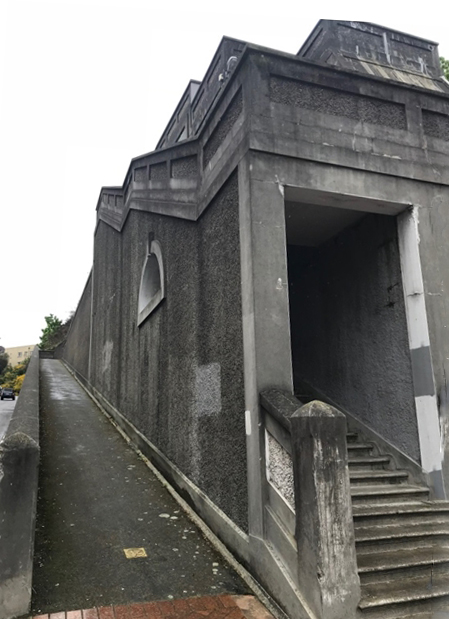
The extant modifications of the Dowling Street steps began in March 1926 and were carried out by a small labour force. Over the top of the ramp, steps of 6 feet, 6 inches wide (2 metres) were constructed at a gradient of 1 in 5. The surface of the ramp was covered with tarmacadam and the walls of the steps were finished in cement plaster with rough cast panels. The new concrete steps and ramp were completed by October 1927 and described as one of the Council’s most ‘‘conspicuous works’. They were used not only as a pedestrian thoroughfare, but as an outdoor arena for public addresses. Originally, a German trophy gun sat atop the abutment but this was removed in 1943, after a letter from the Chief Postmaster to the City Engineer suggested the removal of the gun, fearing that if Japanese saw it they would believe it was for defensive purposes and bomb the vicinity.
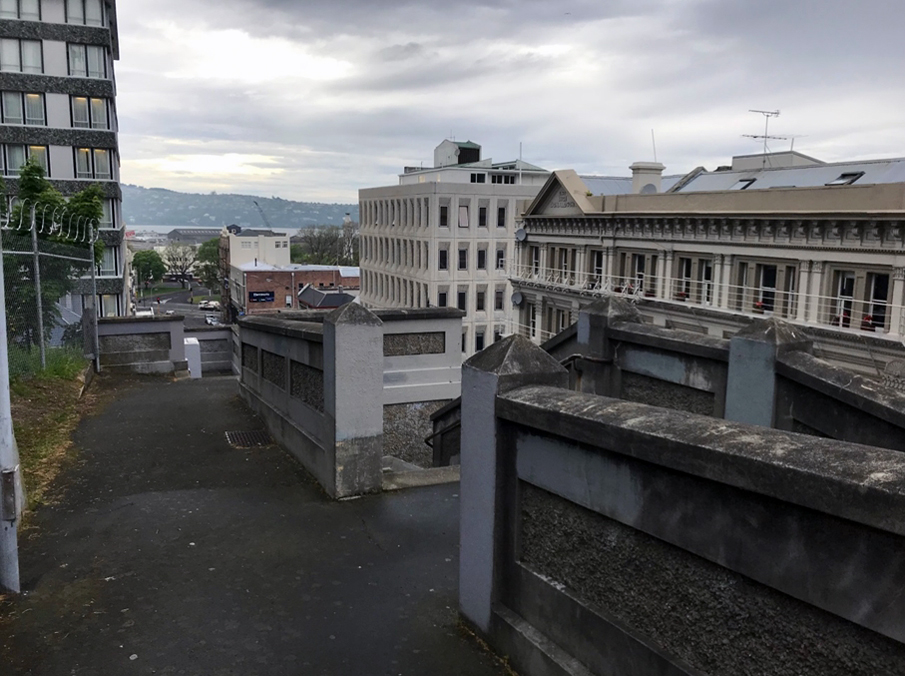
Today the steps sit camouflaged by the buildings around them but they are still well utilised, and serve as a reminder of the pedestrian access issues Dunedin once had. The steps now feature on Dunedin’s Engineering Heritage Trail portraying their significance, not only to the history of Dunedin, but to our engineering heritage as well.
Steps were first built at the site after complaints were made by the Wesleyan Church, once situated at the top half of Dowling Street. The steps were a relief to the difficult pedestrian access the cutting in Church Hill (now known as Bell Hill) provided the people of Dunedin. Sources indicate that the steps were completed in April 1863 by the City Engineer, John Millar. They were subsequently removed after works began demolishing the cliff that was of interference to the junction of Upper Dowling Street and Princes Street. The steps were re-instated by August 1886, if not earlier by S. H. Mirams, the City Engineer at the time. The wooden steps were described as a ‘constant subject of annoyance’, being hard to locate in the dark and to women they were an ‘added vexation’ as they were open and exposed. It was thought that any respectable woman would not use them, especially as there were issues with sanitation and intoxicated men could always be found there. Unsurprisingly new steps were proposed by the City Engineer in 1923 (William McCurdie) but nothing came of these until a new City Engineer, Joseph George Alexander (1873-1974), was appointed in November 1923. Alexander was a very skilful engineer when he moved to Dunedin after gaining knowledge and experience in Great Britain and India. Alexander held the role of City Engineer for 15 years and is renowned for his contribution to the great improvements of Dunedin streets.
The extant modifications of the Dowling Street steps began in March 1926 and were carried out by a small labour force. Over the top of the ramp, steps of 6 feet, 6 inches wide (2 metres) were constructed at a gradient of 1 in 5. The surface of the ramp was covered with tarmacadam and the walls of the steps were finished in cement plaster with rough cast panels. The new concrete steps and ramp were completed by October 1927 and described as one of the Council’s most ‘‘conspicuous works’. They were used not only as a pedestrian thoroughfare, but as an outdoor arena for public addresses. Originally, a German trophy gun sat atop the abutment but this was removed in 1943, after a letter from the Chief Postmaster to the City Engineer suggested the removal of the gun, fearing that if Japanese saw it they would believe it was for defensive purposes and bomb the vicinity.
Today the steps sit camouflaged by the buildings around them but they are still well utilised, and serve as a reminder of the pedestrian access issues Dunedin once had. The steps now feature on Dunedin’s Engineering Heritage Trail portraying their significance, not only to the history of Dunedin, but to our engineering heritage as well.