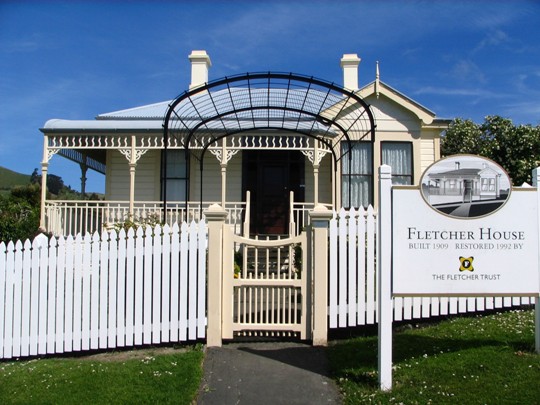
Scottish-born James Fletcher arrived in New Zealand in 1908 with a bag of tools and a few pounds in his pocket and a determination to make good. He had been apprenticed as a carpenter before he came to Dunedin. After first working as a foreman for a building firm, he set up a house-building partnership with Bert Morris in 1909. They moved onto construction work, taking on large projects. Fletcher’s brothers joined him, the company known as Fletcher Brothers. By 1919, the company was known as Fletcher Construction, and was established in Dunedin, Auckland and Wellington. The company expanded through ‘vertical integration’ establishing a joinery factory, buying timber mills, and a significant shareholding in the brickmaking industry. He also established a concrete production business. The company was publicly listed in 1940 as Fletcher Holdings. James Fletcher retired in 1967 and died in Auckland in August 1974.
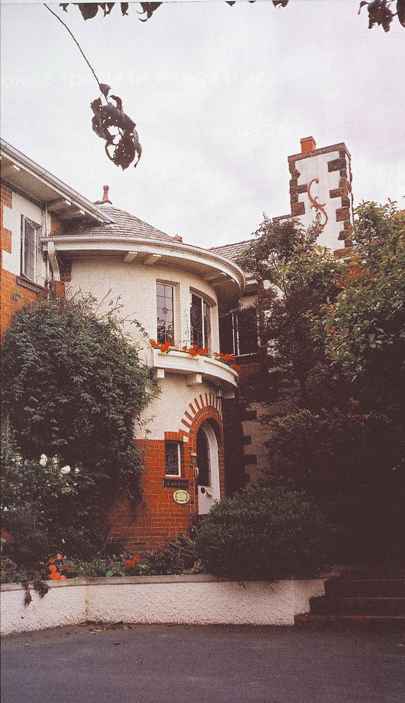
The house was designed by William H. Dunning. Dunning was a Tasmanian-born architect whose other work in Dunedin included the National Bank in Princes Street, Ross Home in North East Valley, the RSA Buildings in Moray Place, and Barton’s Buildings. Plans show a generous residence with a grand entrance hall and lobby, drawing room, dining room and breakfast room (as well as service rooms) on the first floor and five bedrooms on the first floor. The exterior is brick and rough cast with flared gables, a semi-circular entrance hall, multi-pane windows and decorative brickwork.
In later years the house has been modified to allow for boutique accommodation and in 2016, the house is known as Fletcher Lodge.
List Entry Information
Status
Listed
List Entry Status
Historic Place Category 2
Access
Private/No Public Access
List Number
2171
Date Entered
2nd July 1982
Date of Effect
2nd July 1982
City/District Council
Dunedin City
Region
Otago Region
Extent of List Entry
Extent includes the land described as Pt Sec 34 Blk VII Town of Dunedin (RT OT356/8), Otago Land District, and the building known as James Fletcher’s Residence (Former), thereon.
Legal description
Pt Sec 34 Blk VII Town of Dunedin (RT OT356/8), Otago Land District
Status
Listed
List Entry Status
Historic Place Category 2
Access
Private/No Public Access
List Number
2171
Date Entered
2nd July 1982
Date of Effect
2nd July 1982
City/District Council
Dunedin City
Region
Otago Region
Extent of List Entry
Extent includes the land described as Pt Sec 34 Blk VII Town of Dunedin (RT OT356/8), Otago Land District, and the building known as James Fletcher’s Residence (Former), thereon.
Legal description
Pt Sec 34 Blk VII Town of Dunedin (RT OT356/8), Otago Land District
Construction Professional
Name
Fletcher, James
Type
Builder
Biography
No biography is currently available for this construction professional
Name
William H. Dunning
Type
Architect
Biography
William H. Dunning, was a Tasmanian-born architect whose other work in Dunedin included the National Bank in Princes Street, Ross Home in North East Valley, the RSA Buildings in Moray Place, and Barton’s Buildings.
Construction Details
Start Year
1923
Type
Original Construction
Construction Professional
Name
Fletcher, James
Type
Builder
Biography
No biography is currently available for this construction professional
Name
William H. Dunning
Type
Architect
Biography
William H. Dunning, was a Tasmanian-born architect whose other work in Dunedin included the National Bank in Princes Street, Ross Home in North East Valley, the RSA Buildings in Moray Place, and Barton’s Buildings.
Construction Details
Start Year
1923
Type
Original Construction
Historical and Associated Iwi / Hapū / Whānau
Completion Date
6th December 2016
Report Written By
Heather Bauchop
Information Sources
Dictionary of New Zealand Biography
Dictionary of New Zealand Biography
Other Information
This place was identified as significant under previous legislation with different information requirements. It remains significant under the current legislation. There is opportunity under our legislation and policies to add to this information. Further information about this place may be available from the Otago/Southland Office of Heritage New Zealand Pouhere Taonga. Please note that entry on the New Zealand Heritage List/Rarangi Korero identifies only the heritage values of the property concerned, and should not be construed as advice on the state of the property, or as a comment of its soundness or safety, including in regard to earthquake risk, safety in the event of fire, or insanitary conditions. A fully referenced upgrade report is available on request from the Otago/Southland Area Office of Heritage New Zealand.
Historical and Associated Iwi / Hapū / Whānau
Completion Date
6th December 2016
Report Written By
Heather Bauchop
Information Sources
Dictionary of New Zealand Biography
Dictionary of New Zealand Biography
Other Information
This place was identified as significant under previous legislation with different information requirements. It remains significant under the current legislation. There is opportunity under our legislation and policies to add to this information. Further information about this place may be available from the Otago/Southland Office of Heritage New Zealand Pouhere Taonga. Please note that entry on the New Zealand Heritage List/Rarangi Korero identifies only the heritage values of the property concerned, and should not be construed as advice on the state of the property, or as a comment of its soundness or safety, including in regard to earthquake risk, safety in the event of fire, or insanitary conditions. A fully referenced upgrade report is available on request from the Otago/Southland Area Office of Heritage New Zealand.
Current Usages
Uses: Accommodation
Specific Usage: House
Former Usages
General Usage: Accommodation
Specific Usage: House
Current Usages
Uses: Accommodation
Specific Usage: House
Former Usages
General Usage: Accommodation
Specific Usage: House