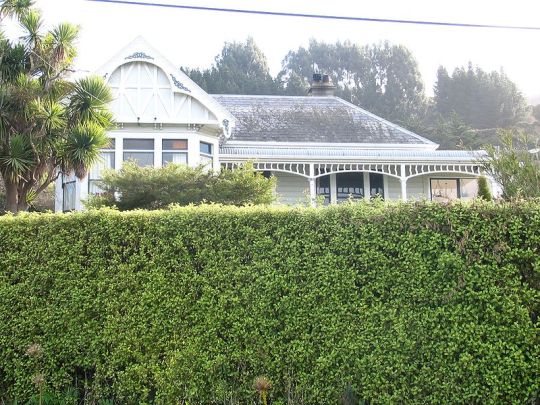
Normanston, located at 5 Robin Lane, was built circa 1908 in the Dunedin harbourside suburb of St Leonards. The building has historic and architectural significance as a fine example of a residential building of the time, built for a Dunedin merchant who became a local councillor.
St Leonards is located close to the northern shore of the Otago Harbour. Originally Ōtākou was the name of the waterway that spans the area from Te Rae o Tupa, the northern part of Pukekura extending up to the Dunedin port area (where Dunedin now is). Today, Ōtākou is more widely recognised in the Otago area as the name for the entire harbour and the settlement at the lower end of the Otago Peninsula. During the 1879 Smith-Nairn Royal Commission of Inquiry into the Ngāi Tahu land claims, Ngāi Tahu kaumātua recorded nearby Kōpūtai (Port Chalmers) as a kāinga nohoanga, urupā, and wāhi tapu. St Leonards was named and owned by early settler David Carey for the birthplace of his wife, the English town of St Leonards-on-Sea, on the Sussex coast. The Careys arrived at Waikouaiti in March 1840. After 2 years the Careys moved to Ōtākou in 1843 and were well established by the time the New Zealand Company settlers reached Otago in 1848. David had developed many skills and was able to make a living by farming, trading and timber-felling. By the mid-1850s the family was settled at Careys Bay (named after him). David Carey died at Careys Bay in 1896, aged 82.
No information has been discovered about the architect or builder of Normanston but the house was built for Charles R Gooch who owned the land from 1908. He arrived in Dunedin in 1900 and was a tea merchant for Neill and Co. Merchants. There is one possible tender advertisement for a house in St Leonards in 1911. However, the handwriting on the original drawings suggests they could have been drawn by architect J.D. Woods, not for Burnside who advertised the permit. The house is a wooden one storey villa with bay window and carved barge boards, with a verandah with wooden fretwork and the front door has top and side lights. The chimney is brick and plaster. Gooch put the property up for sale in 1920 after accepting a manager’s position for Lipton’s Tea in Auckland. The house was described as a “modern 6 roomed house with bathrooms, scullery, pantry, linen press, cupboards, washhouse, copper tubs and coal house all under one roof”.
William Julian Bardsley purchased the property in date following his role as secretary and treasurer of the Timaru Harbour Board. He took over the office as Secretary of Otago Harbour Board in 1914 and was a well-known authority on harbour legislation and for his skill in financial transactions. In 1932, due to failing health, Mr Bardsley retired from the service of the Harbour Board, and moved to the North Island. He was a prominent member of the Baptist Church, and actively associated with the Y.M.C.A. He founded the Burkes and St. Leonards Progress League and was prominent in the local regatta club. The Bardsley’s were great entertainers with many events held at the house. The house was let in July 1932 as the Bardsley’s travelled overseas for a year. They attempted to sell it in 1935 and again in 1937, 1940 and 1941. The naming of Normanston remains a mystery and is only used from the time of the Bardsley’s ownership.
Subsequent owners have added a carport and made additions to the dwelling. In 1951 the kitchen was moved and renovated with original fireplaces being removed and tile and chrome added. These additions were removed in the 1970s and replaced with marble in the dining and drawing rooms. The toilet was brought inside and put into the passage. Today Normanston remains a family home.
St Leonards is located close to the northern shore of the Otago Harbour. Originally Ōtākou was the name of the waterway that spans the area from Te Rae o Tupa, the northern part of Pukekura extending up to the Dunedin port area (where Dunedin now is). Today, Ōtākou is more widely recognised in the Otago area as the name for the entire harbour and the settlement at the lower end of the Otago Peninsula. During the 1879 Smith-Nairn Royal Commission of Inquiry into the Ngāi Tahu land claims, Ngāi Tahu kaumātua recorded nearby Kōpūtai (Port Chalmers) as a kāinga nohoanga, urupā, and wāhi tapu. St Leonards was named and owned by early settler David Carey for the birthplace of his wife, the English town of St Leonards-on-Sea, on the Sussex coast. The Careys arrived at Waikouaiti in March 1840. After 2 years the Careys moved to Ōtākou in 1843 and were well established by the time the New Zealand Company settlers reached Otago in 1848. David had developed many skills and was able to make a living by farming, trading and timber-felling. By the mid-1850s the family was settled at Careys Bay (named after him). David Carey died at Careys Bay in 1896, aged 82.
No information has been discovered about the architect or builder of Normanston but the house was built for Charles R Gooch who owned the land from 1908. He arrived in Dunedin in 1900 and was a tea merchant for Neill and Co. Merchants. There is one possible tender advertisement for a house in St Leonards in 1911. However, the handwriting on the original drawings suggests they could have been drawn by architect J.D. Woods, not for Burnside who advertised the permit. The house is a wooden one storey villa with bay window and carved barge boards, with a verandah with wooden fretwork and the front door has top and side lights. The chimney is brick and plaster. Gooch put the property up for sale in 1920 after accepting a manager’s position for Lipton’s Tea in Auckland. The house was described as a “modern 6 roomed house with bathrooms, scullery, pantry, linen press, cupboards, washhouse, copper tubs and coal house all under one roof”.
William Julian Bardsley purchased the property in date following his role as secretary and treasurer of the Timaru Harbour Board. He took over the office as Secretary of Otago Harbour Board in 1914 and was a well-known authority on harbour legislation and for his skill in financial transactions. In 1932, due to failing health, Mr Bardsley retired from the service of the Harbour Board, and moved to the North Island. He was a prominent member of the Baptist Church, and actively associated with the Y.M.C.A. He founded the Burkes and St. Leonards Progress League and was prominent in the local regatta club. The Bardsley’s were great entertainers with many events held at the house. The house was let in July 1932 as the Bardsley’s travelled overseas for a year. They attempted to sell it in 1935 and again in 1937, 1940 and 1941. The naming of Normanston remains a mystery and is only used from the time of the Bardsley’s ownership.
Subsequent owners have added a carport and made additions to the dwelling. In 1951 the kitchen was moved and renovated with original fireplaces being removed and tile and chrome added. These additions were removed in the 1970s and replaced with marble in the dining and drawing rooms. The toilet was brought inside and put into the passage. Today Normanston remains a family home.