

Schooling in Dunedin had been undertaken in the block formed by Great King, Union and Cumberland Streets since at least 1862, when a stone building was erected on Great King Street. Later, in 1879, the earlier ‘wretched apology for school buildings’ were replaced by a large building fronting Union Street; this new building, known as the Union Street School, could hold 1200 children. By 1908, the buildings ancillary to this school building (and sitting at the site of the future Teachers’ Training College) included a gymnasium and janitor’s residence. The rising population of the Otago Province in the latter decades of the 19th century led to the necessity for acquiring a greater throughput of well-trained teaching professionals to service the rapidly expanding schools. This led to the establishment of the Training Department of the Otago Normal School, situated at Moray Place, Dunedin from 1876. However, by the beginning of the 20th century the building was found to be ‘too small and completely unsuitable’ with ‘gloomy and uninviting’ and ‘dungeon-like’ workspaces.
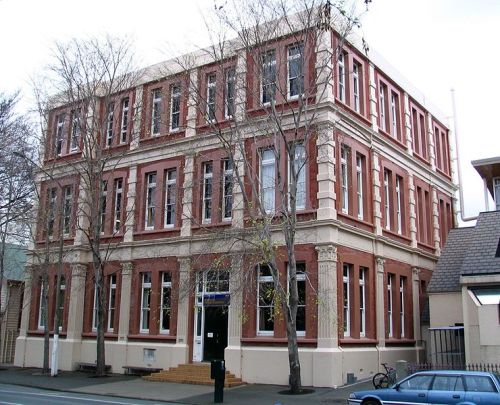
In 1906 the Otago Education Board made the decision to ‘convert the Union Street School into a Normal School, and to erect a new Training College on the Cumberland Street side of the…site’ with Board architect James Rodger commissioned for the design. Opened in April 1909, the original building was of two storeys, built mainly of brick with Corinthian plaster pilasters on its lower level façade and quoining at the edges and between the window bays of the upper storey. The original Cumberland Street façade displayed gable ends to the roofs running back from each end bay; the gable ends were enhanced with delicate iron finials. The roof was decorated with two thin horizontal bands of lighter coloured tiles. The construction cost £7,692 ($1,330,677).
In 1920, pressure caused by the ever higher number of trainee teachers was being felt and an addition storey was added to the building, mirroring the design of the original, but replacing the roof with a flat one; this was constructed by Fletcher Brothers. Shortly before the Second World War, the Teacher Training College moved to Logan Park. During the war, the building was mostly unutilised, save for the top storey, which was converted into an addition to the Otago Dental School. By 1948 the building had been acquired by the Physical Education Department of the University of Otago. The interior was remodelled just prior to this. The former Teachers’ Training College building still remains with this department, with little outward change to its appearance; however, much of the land surrounding the building has been further developed, most notably in 1985 and 1992.
List Entry Information
Status
Listed
List Entry Status
Historic Place Category 2
Access
Private/No Public Access
List Number
2228
Date Entered
2nd July 1982
Date of Effect
2nd July 1982
City/District Council
Dunedin City
Region
Otago Region
Extent of List Entry
Extent includes part of the land described as Lot 4 DP 10554 (University Purposes Sec 21 Reserves and Other Lands Disposal Act 1963), Otago Land District and the building known as Dunedin Teachers' Training College (Former), thereon. Refer to the extent map tabled at the Heritage List/ Rārangi Kōrero Committee meeting on 29 October 2020.
Legal description
Lot 4 DP 10554 (University Purposes Sec 21 Reserves and Other Lands Disposal Act 1963), Otago Land District
Status
Listed
List Entry Status
Historic Place Category 2
Access
Private/No Public Access
List Number
2228
Date Entered
2nd July 1982
Date of Effect
2nd July 1982
City/District Council
Dunedin City
Region
Otago Region
Extent of List Entry
Extent includes part of the land described as Lot 4 DP 10554 (University Purposes Sec 21 Reserves and Other Lands Disposal Act 1963), Otago Land District and the building known as Dunedin Teachers' Training College (Former), thereon. Refer to the extent map tabled at the Heritage List/ Rārangi Kōrero Committee meeting on 29 October 2020.
Legal description
Lot 4 DP 10554 (University Purposes Sec 21 Reserves and Other Lands Disposal Act 1963), Otago Land District
Construction Professional
Name
James Rodger
Type
Architect
Biography
Born in Dunedin in 1867, James Rodger served apprenticeship in the building trade with Guthrie and Larnarch. As early as 1886 his is known to have been working as a carpenter, based in St David Street, Dunedin, whilst at the same time training in architectural drawing at the Dunedin School of Art. He worked for many years in his father’s carpentry and joinery firm, James Rodger and Son. He started working for the Otago Education Board in about 1900, where he was noted as the designer of many of the school buildings of the Otago district, including the Schoolhouse at Maclennan (a contributing building to the Maclennan Historic Area, List No. 9295). He retired from the Board’s service in 1933. He died on 21 March 1941.
Construction Details
Start Year
1908
Finish Year
1909
Type
Original Construction
Description
Ground Floor and First Storey
Start Year
1862
Type
Other
Description
Construction of North Dunedin School on Great King Street frontage
Start Year
1879
Type
Other
Description
Construction of the Union Street School on Union Street Frontage
Start Year
1879
Finish Year
1908
Type
Other
Description
Gymnasium and Janitor’s Residence constructed on the future site of the Teachers’ Training College
Start Year
1920
Finish Year
1921
Type
Addition
Description
Second Storey added
Start Year
1945
Type
Modification
Description
Second Storey converted to accommodate addition to Dental School
Start Year
1947
Type
Modification
Description
Interior re-model to accommodate the University of Otago Department of Physical Education
Start Year
1985
Type
Additional building added to site
Description
Large-scale development of the corner of Union and Cumberland Streets
Start Year
1992
Type
Additional building added to site
Description
Physical Education laboratory building constructed
Construction Professional
Name
James Rodger
Type
Architect
Biography
Born in Dunedin in 1867, James Rodger served apprenticeship in the building trade with Guthrie and Larnarch. As early as 1886 his is known to have been working as a carpenter, based in St David Street, Dunedin, whilst at the same time training in architectural drawing at the Dunedin School of Art. He worked for many years in his father’s carpentry and joinery firm, James Rodger and Son. He started working for the Otago Education Board in about 1900, where he was noted as the designer of many of the school buildings of the Otago district, including the Schoolhouse at Maclennan (a contributing building to the Maclennan Historic Area, List No. 9295). He retired from the Board’s service in 1933. He died on 21 March 1941.
Construction Details
Start Year
1908
Finish Year
1909
Type
Original Construction
Description
Ground Floor and First Storey
Start Year
1862
Type
Other
Description
Construction of North Dunedin School on Great King Street frontage
Start Year
1879
Type
Other
Description
Construction of the Union Street School on Union Street Frontage
Start Year
1879
Finish Year
1908
Type
Other
Description
Gymnasium and Janitor’s Residence constructed on the future site of the Teachers’ Training College
Start Year
1920
Finish Year
1921
Type
Addition
Description
Second Storey added
Start Year
1945
Type
Modification
Description
Second Storey converted to accommodate addition to Dental School
Start Year
1947
Type
Modification
Description
Interior re-model to accommodate the University of Otago Department of Physical Education
Start Year
1985
Type
Additional building added to site
Description
Large-scale development of the corner of Union and Cumberland Streets
Start Year
1992
Type
Additional building added to site
Description
Physical Education laboratory building constructed
Historical and Associated Iwi / Hapū / Whānau
Completion Date
30th July 2020
Report Written By
Andrew Winter
Information Sources
Morrell, 1969
W P Morrell, The University of Otago: A Centennial History, Otago University Press, Dunedin, 1969
Johnson and Morton, 1976
Carol Morton Johnston and Harry Morton (1976) Dunedin Teachers College: The First Hundred Years, Dunedin: Dunedin Teachers College Publications Committee 1976
Other Information
This place was identified as significant under previous legislation with different information requirements. It remains significant under the current legislation. There is opportunity under our legislation and policies to add to this information. Further information about this place may be available from the Otago/Southland Office of Heritage New Zealand Pouhere Taonga. Please note that entry on the New Zealand Heritage List/Rarangi Korero identifies only the heritage values of the property concerned, and should not be construed as advice on the state of the property, or as a comment of its soundness or safety, including in regard to earthquake risk, safety in the event of fire, or insanitary conditions. A fully referenced upgrade report is available on request from the Otago/Southland Office of Heritage New Zealand.
Historical and Associated Iwi / Hapū / Whānau
Completion Date
30th July 2020
Report Written By
Andrew Winter
Information Sources
Morrell, 1969
W P Morrell, The University of Otago: A Centennial History, Otago University Press, Dunedin, 1969
Johnson and Morton, 1976
Carol Morton Johnston and Harry Morton (1976) Dunedin Teachers College: The First Hundred Years, Dunedin: Dunedin Teachers College Publications Committee 1976
Other Information
This place was identified as significant under previous legislation with different information requirements. It remains significant under the current legislation. There is opportunity under our legislation and policies to add to this information. Further information about this place may be available from the Otago/Southland Office of Heritage New Zealand Pouhere Taonga. Please note that entry on the New Zealand Heritage List/Rarangi Korero identifies only the heritage values of the property concerned, and should not be construed as advice on the state of the property, or as a comment of its soundness or safety, including in regard to earthquake risk, safety in the event of fire, or insanitary conditions. A fully referenced upgrade report is available on request from the Otago/Southland Office of Heritage New Zealand.
Current Usages
Uses: Education
Specific Usage: University
Former Usages
General Usage: Education
Specific Usage: Teachers College
Current Usages
Uses: Education
Specific Usage: University
Former Usages
General Usage: Education
Specific Usage: Teachers College
Location
Sign up to hear more
Get the latest heritage news, features and events delivered
straight to your inbox.
