The first Presbyterian service in the Milton area of South Otago was at Janefield, the home of Alexander Duthie on Christmas Day, 1851, preached by Rev. Dr Thomas Burns. At this time there were 20 Presbyterians, nine Episcopalians, and 13 children, noted in an anniversary publication. The next service was held on Christmas Day in 1853. In 1854 Rev. William Bannerman was appointed to the Clutha District, with three preaching stations under his care: South Clutha, Inch Clutha and Tokomairiro. In 1858 Tokomairiro and Waihola were made a separate charge, and in June 1859 Tokomairiro was made an independent parish, with Rev. Alexander Bruce Todd chosen as the first settled minister. The first Presbyterian Church in the Milton area was on Fairfax Hill at Tokoiti (now the site of the cemetery), and was opened by prominent Presbyterian Minister Rev. William Bannerman.
A town developed around the flour mill established near the main road south by Peter McGill, which gave its name to Mill-town, now Milton. Churches developed with the settlement. By the early 1870s all the main denominations had permanent places of worship: St John's Anglican Church (1867, still standing but with belfry demolished); Weslayan Methodist Church (1873, new church built 1923); and the Roman Catholic St Mary's (1863, new church built 1891). With the gold rush of the early 1860s Milton found itself on the main route to Tuapeka, and became a centre of increasing importance. McGill donated a half acre site for the Presbyterian Church. The second church was built on the site, and opened 17 May 1863. The wooden church seated 540 and cost £2,300. The bell was presented to the parish by John Gillies, after an adventurous journey on The Hanbury, where it was not delivered to Port Chalmers, returned 'Home', was re-sent, arrived at Port Chalmers again, where the ship was burnt out, and the bell sold as salvage. Gillies had to re-purchase it. The Church was known as the Tokomairiro Presbyterian Church, taking its name from the surrounding district named for the swampy nature of the surrounding land.
By the end of the 1870s the parish in the Tokomairiro district had grown to the extent that there was agitation at the synod level for the parish to be split in two, or to have two ministers. Minister Rev Todd explained that there were 4000 people looking to him as pastor, and that this was too much for one person to carry satisfactorily. With the centre at Milton, but with outlying parishioners some miles from Milton, and the expectation of services twice a day on Sunday in Milton, the job was impossible to perform. Rev Todd thought the creation of a parish vital if the church was to hold onto its congregation, as the Episcopalians, Methodists, Congregationalists and Baptists were all 'working harmoniously together' and could draw people into their ambit. In 1870 James Chisholm (1843-1916) became the minister, remaining so for 28 years, and overseeing the developing parish.
The sense of cooperation between denominations was notable, with the Right Reverend Bishop of Dunedin on his visit to his parishioners in Milton welcoming the presence of Rev. James Chisholm of the Presbyterian Church, and commenting that the Presbyterians had 'wrought hard and harmoniously together, and his aim would be to assist them in their good work.' James Chisholm replied with similar sentiments.
A manse was built in 1882, and by the 1880s the congregation was calling for a new church building, as attendance at services increased. In February 1886 James Gray moved at the Deacon's Court that 'steps be taken to erect a new church.' The wooden church was considered 'but a poor pile to represent so strong a religious body.' A buildings committee was appointed, which printed a circular declaring:
'We reckon that there are altogether about 460 members and adherents in connection with the congregation. If 250 of these give 1d each working day, 100 2d, 50 3d, 30 4d, 20 6d, and 10 1s for two years, a sum of £2500 would be raised. This, along with the grant of £1000 from the synod and accruing interest, would render £3553 available for the erection of a new church free of debt.'
John Chisholm, son of the Rev. James, recalled the fundraising:
'All the money for the new Church was raised before the building was started. I remember the monthly social evenings at the manse, when all the collectors, young and old, met, reported, and handed in their amounts for the month. That was a year of socials. They knew how to organise in those days.'
Chisholm considered it significant that the money was given freely by parishioners: 'No sale of work or bazaar was held, the money was freely given, and the building of beautiful architecture stands with its tall spire as if pointing men to God.'
After the building committee had got definite promises for £1260, pre-eminent Dunedin architect Robert Arthur Lawson (1833-1902) was instructed to prepare the plans. Lawson was the pre-eminent designer of Dunedin's outstanding Presbyterian churches, having already designed First Church (constructed between 1867 and 1872) and Knox Church (1876) in an ornate Gothic style. After the plans were approved, the building was tendered, and that of Messrs Gore was accepted, and James Dickson supervised the construction. A committee of '41 young ladies' then undertook the task of collecting the promised funds and over a two year period collected nearly all of that promised. A fresh appeal raised a further £500, and the synod granted £1000. The Church was erected with a debt of only £167.
In October 1888 the old Presbyterian Church was moved 'amid cheers and laughing, the church was dragged about half-way across to the new foundation, 20 or 30 men eagerly volunteering their services.' A few days later the building was set on its new foundations, with the roof still to be replaced, and the porch re-erected.
Building was well underway by early March 1889, although opinion was divided on the appearance of the new building:
'At first the public were rather disappointed with the appearance of the church, as the ground work of the facings, which are of brick, gave it rather a 'tartan' appearance. However, now that some of the gables are finished and the lower part of the spire has been commenced the whole presents rather an attractive appearance.'
The Presbyterian Church was opened on Sunday 13 October 1889 with services in the morning and evening preached by visiting minister Rev. Dr D. M. Stuart of Knox Church in Dunedin. The Sunday worship was followed by a soiree on the following Tuesday in the old church, attended by settlers from the surrounding districts.
The Otago Witness described the new building, which seated 600 worshippers:
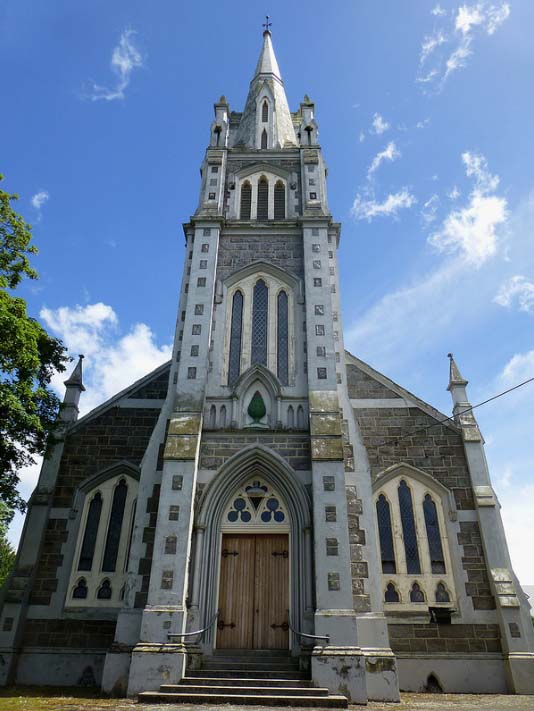
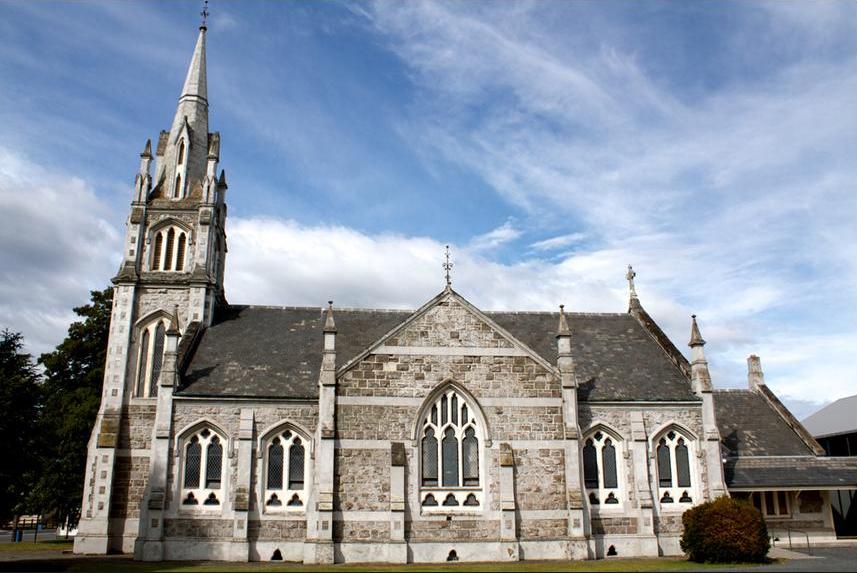
'The most conspicuous and striking feature in the building is the spire which crowns the centrally situated tower in the front elevation. The tower is in three storeys, finishing with four angle-grouped pinnacles at a height of 68ft, and the spire rising to a height of 105ft, the whole being in good proportion, and forming a prominent object in the landscape. The principal entrance doorway is situated in the lower portion of the tower, and with its deeply-cut Gothic mouldings and characteristic emblematic burning bush and motto over archway is a very effective piece of work. The upper floor of the tower is fitted as a belfry, and the bell, which is a very successful recast by Messrs A. and T. Burt, of Dunedin, of that so long in use in the old building, is again hung in position and ready for its special duties.'
The detail of the structure was paid particular attention:
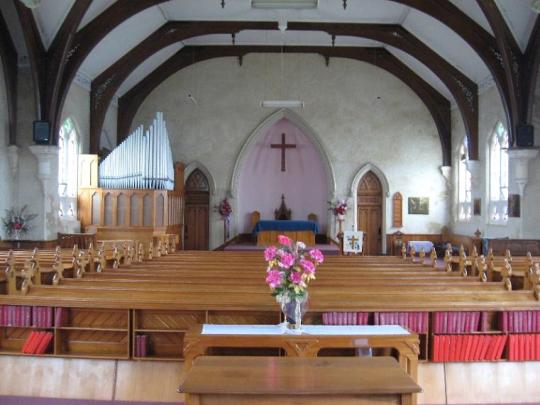
'its dimension on a plan being 74ft by 43ft interior measurement, The central projecting gables with their angle and subdividing buttresses form strong and sufficient stays and support to the massive moulded rafters which carry the slated roof in one span over the building. The ceiling is plaster finished between rafters and above line of tie beams, which, with circular ribs springing from stone corbels, are dressed and moulded; spandrils being also filled in with cut fretwork of Gothic pattern. The main portion of the exposed woodwork is varnished, but in parts colour has been introduced for contrast, and with good effect. In the ceiling, and arranged in alternating spaces, five ventilators are introduced, from the drops of which are suspended the chandeliers for lighting purposes.
The interior was considered most handsome:
'The interior effect of the building is very satisfactory. It is amply lighted through five mullioned windows on each side; windows being filled in with ground glass in centres, and having margins variously coloured. The view looking from main entrance towards the choir seat and raised railed platform, with its octagonally-domed and moulded recess, flanked on either side by the doors leading outwards towards hall at back, is, perhaps, the most effective.'
In 1890 £220 was spent fencing and laying out the grounds of the new Church.
James Chisholm resigned in 1898, and was replaced by Rev. George Miller. Chisholm has been a significant figure in the Presbyterian Church of Otago. He was a man of 'great influence', an author of a history of the Church in Otago, and a lecturer at the Knox Theological Hall.
Into the twentieth century Presbyterian congregation performed a social as well as religious function for parishioners; with Rev. George Miller recording that the Church was in 'good heart' with the congregation 'quite filling the Church.' Socials were held, with programmes of music, uplifting addresses, and suppers.
The role of women, always significant with the role of the Presbyterian Women's Missionary Union in 1897 (with the Tokomairiro Church forming their own independent Young Women's Social Club in 1905), was strengthened in 1915 with the appointment of the first deaconess, Sister Agnes McMillan. The women aimed to help the church at home and abroad, and to provide a social centre for young women. They made significant contributions to the Church environment, including gifting a communion table and chairs and baptismal font.
In 1910 there was discussion about the poor lighting in the Church. The report of the Deacon's Court noted 'the inefficiency of the lighting on Sabbath evenings had become a matter of comment, and it was a question as to whether it was advisable to renew the kerosene lamps, or to connect the Church with the borough gas supply.' The unanimous vote saw the latter course adopted.
After World War One a memorial to those who fell, in the form of a brass tablet, was mounted in the Church.
In 1918 the Church building was in need of repair. The Annual Report records that 'a considerable sum' was spent 'repairing and renovating the Church, work which experts considered was imperatively necessary if the building was to be kept in proper order.'
By the end of the 1920s there was concern about the condition of the roof, and the inadequacy of the heating. The Deacon's Court commissioned Dunedin architectural partnership Mandeno and Fraser to report on the roof, and received a 'reassuring report' that the issue could be resolved for around £200. Fundraising for strengthening the roof, and for the installation of a new heating system was underway by the end of the decade. The 1930 Annual Report saw the exterior of the Church repaired and renovated at the cost of a little over £330. The clerk of the court expressed gratitude at the generosity of the congregation in their contributions to the building work. The Deacon's Court undertook to maintain the buildings in a 'good state of repair' to avoid large expenditure in any one year.
The old Church building was used as a Sunday School Hall, and was extended in the early twentieth century (it has since been demolished). In 1935 a new brick building was erected to the north and west of the Church, to house Bible classes, for the over 300 strong congregation. The foundation stone was laid in that year by senior elder James Bruce.
In December 1938 the spire suffered 'serious damage' caused by an electrical storm. While scaffolding was in place it was decided to 'completely renovate the Church externally.' Contractors Ashton and Sons carried out the work. A grant from the Synod was made because of the unusual nature of incident. Heating was still an issue in the 1940s, when fundraising for a new Tubular Heating System was underway. In his pastoral letter in the Annual Report of 1947 Rev. S.T. Nicholls, looking forward to the centenary of the Presbyterian Church in Otago, recorded the value of the Church building:
'Our own historic parish, we are reaping what others have sown. Our beautiful stone Church, a structure of architectural charm and Spiritual significance, comes to us as a priceless legacy from our fathers. A noble tradition has been handed down to us. We are pioneers of a new century. What shall we hand down to our children?'
In the early 1950s the interior of the Church was replastered and redecorated at a cost of £900, and a new Sunday School Block was built. On the opening of the Sunday School, the good condition of the Church was greeted with relief by moderator Allan Cardno, and it was 'a joy' to see 'our beloved Church looking so dignified for the occasion.' The interior walls had been cement plastered, the ceiling painted, the beams stained, and the woodwork varnished. The position of the choir was altered, with newly raised seats in the North West corner of the building, and the former position now occupied by the communion table and elders' pews.
By the end of the 1950s there was a problem with water penetration on the south wall. The cause was identified as the poor quality of some of the stones used. Dunedin architect Arthur Salmond inspected the building and suggested that it was generally 'in good order.' He considered that the greatest expense for repairs would be the replacement of windows in the north elevation, and some on the steeple, as the leadlights would need to be replaced with new material, and coloured glass was not available in New Zealand at that time. The Deacon's Court recorded that 'in order to preserve the character of the Church, it is desirable to have the new windows match the remaining windows, which are still in good order.' In 1962 the windows in the north wall were replaced.
In 1965 the front fence was removed and replaced with a concrete strip.
The costs of repairing the building were an issue for the Church. In 1966 the minister raised the issue in the Annual Report. Rev. W.B. Gilmour recalled the great contribution made to the parish by those who had gone before, and the heaviness of the loss of such support, as a community and financially. He mused:
'This is a problem that faces our Deacon's Court at the present time for with the passing of our stalwarts in the faith, we lose the generous offerings they were so faithful in making and our lack is underlined by the increasing expenses that face us in the Church as in every other field. This problem becomes a challenge when we face it squarely, and see our selves as their successors, today. We have to fill the gaps they leave, or the life and work of the Church will suffer and decline.'
Rev. Gilmour's office looked towards the Church, a view he found comforting:
'The view from my study window is an impressive one, for I look out on the building of our Church, with its spire soaring towards the heavens and as one lets one's eyes climb that architectural finger, one is drawn upwards toward God. So one's thoughts are lifted up by the very closeness of this beautiful mounting building. There is no doubt that our church is the striking feature of the whole town. People approaching Milton from either end though more particularly from the North, are caught with its striking beauty. It stands a constant witness to the farther [sic] that has been the background of strength of this district for well over a century of time.'
But there were stresses on the parish, and Rev. Gilmour's musings went on to challenge parishioners on their commitment to the church, as the budget had not been balanced for that year, and he asked that people imagine what it would be like, not only without the church building, but without the worship of God. He continued: 'After all, the Church is not this building however beautiful and imposing it maybe [sic] - it is the people who fill its pews; who worship their God there.' The financial deficit 'represent the faithful souls of the past whose work here has been done, and is represented by the stone fabric on our Church, and their love in their bequest...The parents of today's children owe it to the past generations, as well as to the future one, that they face, seriously, the questions which this building poses to them, day by day.'
In 2001 NZHPT's Otago/Southland Area Office heritage advisor Guy Williams visited the Church, noting that there were problems with moisture penetration as indicated by the efflorescence on interior walls. He recommended that a condition report and specifications for work be prepared, and there were discussions about putting in a funding application to the Lotteries Grants Board.
A 150th anniversary service was held in the Presbyterian Church in October 2004, celebrating the first Presbyterian service in the Milton area. The parish now operated as the Tokomairiro Co-operating Parish which includes both Methodist and Presbyterian churches. The condition of the Church was still a concern, with discussion continuing on funding the work required.
The fate of the Presbyterian Church has been discussed in local newspapers in early 2008. The Otago Daily Times reported in April 2008 that the congregation at Milton and Waihola had been asked to comment on a Tokomairiro Co-operating Parish council suggestion that the Church be closed. The paper reported that a decision was expected within a couple of months. Parish finance and works spokesman Graeme Flett was reported as saying that it was 'economic matters' rather than falling parish numbers that was the problem. With a congregation of 40 people attending Sunday services, it was too much to expect them to provide money every time the building needed work, added to the monthly expenses of keeping the building going. The cost of the substantial repair and maintenance work was an additional concern.
Art historian Peter Entwisle came to the defence of the building describing it as 'striking', and one of Lawson's largest parish churches. Entwisle writes 'It serves to identify Milton visibly and epitomises the Otago country town where the Presbyterian form of worship was pre-eminent. Milton without this church would not be the same. It would lose the principal signifier of its history and identity.' Many townspeople from Milton would appear to feel the same; when the proposal to register the Church was notified over 500 people submitted in support of the registration via a locally organised petition, around 375 of these arguing that the Church was worthy of Category I registration. This outstanding show of public support shows the special esteem the Church holds for the local community and as an Otago landmark.