BRIEF HISTORY:
The history of the town of Clyde is intrinsically linked with the history of the discovery and mining of gold in Central Otago. The first post office building dates to the beginning of the town in 1863. Although it was officially named Clyde in 1864, the town was first known as Dunstan in the 1850s and as Hartley's township after his discovery of gold in 1862.
Gold mining began in Central Otago with Gabriel Read's discovery of gold in Gabriel's Gully, near present-day Lawrence, in 1861. The following year Hartley and Reilly left this gully and travelled further into Central Otago. They spent the winter prospecting in the now-flooded Clutha Gorge between present day Clyde and Cromwell, finding enough gold in the area to travel back to Dunedin and lodge 87 pounds with the Gold Receiver.
The 1862 discovery precipitated a rush to the area, with the first passenger-carrying coach travelling from Dunedin to Clyde in November of that year. Six weeks earlier, the first gold escort had left Clyde for Dunedin with packhorses. Subsequent gold escorts consisted of a solid covered wagon with armed guards. A ragged canvas town quickly sprang up, and by December of that year between six and seven thousand miners and settlers occupied Clyde and the surrounding areas. Sunday afternoons would see up to 4000 men congregate in the town. At Christmas 1862, 320 people sat down to dinner at one of the "innumerable" hotels, the cost of the meal being 10s 6d. While Clyde was itself the centre of mining activity in 1862, as gold was quickly discovered in other parts of Central Otago such as Arrowtown and Queenstown it was also the source of supplies for those travelling on to other areas.
A photograph dated c.1862 shows a profile of canvas and wooden buildings along the terrace above the river where the town now stands, and a small collection of wooden structures on the lower beach. McCraw gives a date of 1865 for the same photograph, a more likely date given the number of structures and roads visible, and has annotated it with details of the infrastructure used to mine a seam of coal along the riverbank. By the late 1860s photographs show a row of single-storied wooden buildings running cheek-by-jowl along the main street, now known as Sunderland St. The buildings all feature flat-fronted facades with business signs, among them one named the Dunstan Hotel, and the Hartley Arms Hotel can be seen several doors along. These were just two of many hotels in the town.
Catholic advances into the Presbyterian stronghold of Dunedin began in 1861, when Father Delphin Moreau made a four-week visit to Otago. This coincided with the announcement of the first gold strike in Central Otago, and the consequent increase in the number of Irish Catholics amongst the digger population, perhaps as many as 13 percent according to Catholic historian Michael King. In 1862 Father Phillipe Martin joined Father Moreau in Dunedin before moving to his base at Tuapeka, and the following year visited Catholic families at Clyde, evidently without a church at this time as Martin baptised a number of infants in their homes, as well as in the Shamrock and Galway Hotels, and in a restaurant. By 1864 four more priests had joined Moreau at work in Dunedin, and in this year a Catholic church was standing at Clyde. In August 1864 a number of baptisms are recorded in the church registry.
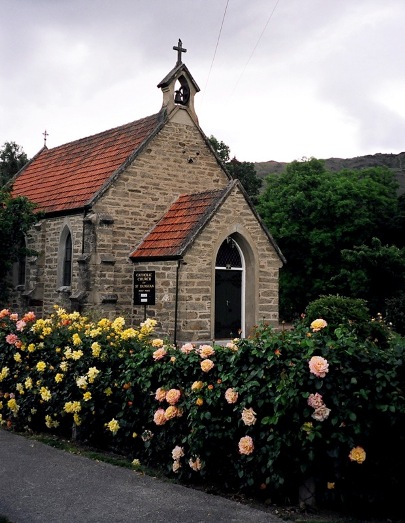
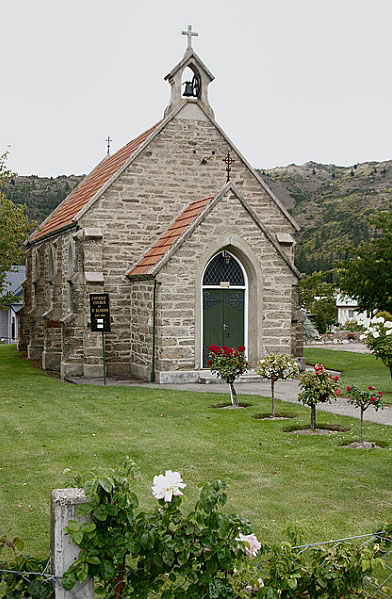
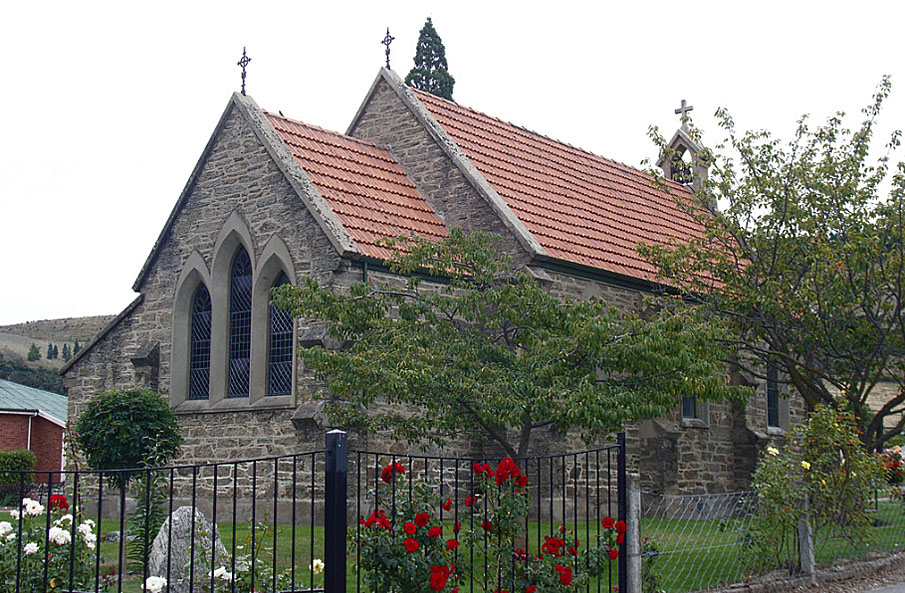
In November Bishop Viard of Wellington arrived in Clyde during a tour of Otago with attendants including his vicar, chaplain and forty horsemen to bless the new St. Mary's Church. Unfortunately the building only stood for four years. In 1869 it disintegrated in a storm. After this event parishioners heard mass in the school until the more substantial stone St. Dunstan's church was opened in October 1903 by Bishop Verdon.
The architect of St. Dunstan's, Francis William Petre, known as Frank, was born at Petone on 27 August 1847, the third of 16 children of Henry William Petre and his wife, Mary Anne Ellen Walmsley. His father, one of the founders of Wellington and colonial treasurer of New Munster, was the second son of the 11th Baron Petre, a director of the New Zealand Company. The Petres were one of England's oldest and most influential Catholic families, and Francis Petre's Catholic faith played a major role in his career. Petre designed a number of significant Catholic churches including the simplified Gothic style St. Dominic's Priory and St. Joseph's Cathedral in Dunedin and the Basilica (later Cathedral) of the Sacred Heart, Wellington. Petre's best-known work is the Cathedral of the Blessed Sacrament, Christchurch. The work of Petre was also significant for his innovative use of concrete, and he is considered a pioneer in the development of this material. Petre also designed houses and commercial buildings in Dunedin and
Christchurch.
The builder and stonemason of St. Dunstan's, Thomas Wilkinson and John Holloway, were local men responsible for the construction of a number of stone buildings in Clyde, including the Dunstan Hotel (now known as Dunstan House) and the Commercial Hotel (now known as the Dunstan Hotel), as well as buildings in other towns in the region. St. Dunstan's was built with shallow foundations common for the period. The altar end of the building, sited on rock, was firm while the entrance, standing on sandy soil, subsided. This resulted in cracking in the walls, broken windows on both sides of the church and warping of the leadlights. These problems were remedied with a grant from the Dam Amenity Fund in 1989, allowing restoration work to be carried out.
In November 2003 St. Dunstan's celebrated its centenary, when over 120 people attended mass. For this event, the organ was restored, a new altar was built and the bell, broken since 1967, was repaired. As there is no longer a priest located permanently at Clyde, mass is now held at St. Dunstan's during holidays and when additional priests are staying at Alexandra.
The history of the town of Clyde is intrinsically linked with the history of the discovery and mining of gold in Central Otago. The first post office building dates to the beginning of the town in 1863. Although it was officially named Clyde in 1864, the town was first known as Dunstan in the 1850s and as Hartley's township after his discovery of gold in 1862.
Gold mining began in Central Otago with Gabriel Read's discovery of gold in Gabriel's Gully, near present-day Lawrence, in 1861. The following year Hartley and Reilly left this gully and travelled further into Central Otago. They spent the winter prospecting in the now-flooded Clutha Gorge between present day Clyde and Cromwell, finding enough gold in the area to travel back to Dunedin and lodge 87 pounds with the Gold Receiver.
The 1862 discovery precipitated a rush to the area, with the first passenger-carrying coach travelling from Dunedin to Clyde in November of that year. Six weeks earlier, the first gold escort had left Clyde for Dunedin with packhorses. Subsequent gold escorts consisted of a solid covered wagon with armed guards. A ragged canvas town quickly sprang up, and by December of that year between six and seven thousand miners and settlers occupied Clyde and the surrounding areas. Sunday afternoons would see up to 4000 men congregate in the town. At Christmas 1862, 320 people sat down to dinner at one of the "innumerable" hotels, the cost of the meal being 10s 6d. While Clyde was itself the centre of mining activity in 1862, as gold was quickly discovered in other parts of Central Otago such as Arrowtown and Queenstown it was also the source of supplies for those travelling on to other areas.
A photograph dated c.1862 shows a profile of canvas and wooden buildings along the terrace above the river where the town now stands, and a small collection of wooden structures on the lower beach. McCraw gives a date of 1865 for the same photograph, a more likely date given the number of structures and roads visible, and has annotated it with details of the infrastructure used to mine a seam of coal along the riverbank. By the late 1860s photographs show a row of single-storied wooden buildings running cheek-by-jowl along the main street, now known as Sunderland St. The buildings all feature flat-fronted facades with business signs, among them one named the Dunstan Hotel, and the Hartley Arms Hotel can be seen several doors along. These were just two of many hotels in the town.
Catholic advances into the Presbyterian stronghold of Dunedin began in 1861, when Father Delphin Moreau made a four-week visit to Otago. This coincided with the announcement of the first gold strike in Central Otago, and the consequent increase in the number of Irish Catholics amongst the digger population, perhaps as many as 13 percent according to Catholic historian Michael King. In 1862 Father Phillipe Martin joined Father Moreau in Dunedin before moving to his base at Tuapeka, and the following year visited Catholic families at Clyde, evidently without a church at this time as Martin baptised a number of infants in their homes, as well as in the Shamrock and Galway Hotels, and in a restaurant. By 1864 four more priests had joined Moreau at work in Dunedin, and in this year a Catholic church was standing at Clyde. In August 1864 a number of baptisms are recorded in the church registry.
In November Bishop Viard of Wellington arrived in Clyde during a tour of Otago with attendants including his vicar, chaplain and forty horsemen to bless the new St. Mary's Church. Unfortunately the building only stood for four years. In 1869 it disintegrated in a storm. After this event parishioners heard mass in the school until the more substantial stone St. Dunstan's church was opened in October 1903 by Bishop Verdon.
The architect of St. Dunstan's, Francis William Petre, known as Frank, was born at Petone on 27 August 1847, the third of 16 children of Henry William Petre and his wife, Mary Anne Ellen Walmsley. His father, one of the founders of Wellington and colonial treasurer of New Munster, was the second son of the 11th Baron Petre, a director of the New Zealand Company. The Petres were one of England's oldest and most influential Catholic families, and Francis Petre's Catholic faith played a major role in his career. Petre designed a number of significant Catholic churches including the simplified Gothic style St. Dominic's Priory and St. Joseph's Cathedral in Dunedin and the Basilica (later Cathedral) of the Sacred Heart, Wellington. Petre's best-known work is the Cathedral of the Blessed Sacrament, Christchurch. The work of Petre was also significant for his innovative use of concrete, and he is considered a pioneer in the development of this material. Petre also designed houses and commercial buildings in Dunedin and
Christchurch.
The builder and stonemason of St. Dunstan's, Thomas Wilkinson and John Holloway, were local men responsible for the construction of a number of stone buildings in Clyde, including the Dunstan Hotel (now known as Dunstan House) and the Commercial Hotel (now known as the Dunstan Hotel), as well as buildings in other towns in the region. St. Dunstan's was built with shallow foundations common for the period. The altar end of the building, sited on rock, was firm while the entrance, standing on sandy soil, subsided. This resulted in cracking in the walls, broken windows on both sides of the church and warping of the leadlights. These problems were remedied with a grant from the Dam Amenity Fund in 1989, allowing restoration work to be carried out.
In November 2003 St. Dunstan's celebrated its centenary, when over 120 people attended mass. For this event, the organ was restored, a new altar was built and the bell, broken since 1967, was repaired. As there is no longer a priest located permanently at Clyde, mass is now held at St. Dunstan's during holidays and when additional priests are staying at Alexandra.