DonateMembershipVisit Heritage
  • Tūrangawaewae
    Places
  • Tira Māori
    Māori Heritage
  • Poutairangahia
    Archaeology
  • Rauemi
    Resources
  • Mō Tātou
    About Us
  • New Zealand Heritage List
  • Nominate and submit
  • Explore the List
  • National Historic Landmarks
  • Plaques
  • Rainbow List Project
  • Lost heritage
  • Visit Heritage
  • Our properties
  • Turnbull House Project
  • Collections
  • Shop
  • Tohu Whenua
  • Tira Māori
  • Conserving Māori heritage
  • Marae built heritage
  • Māori heritage on the List
  • Hinemihi—Te Hokinga Mai
  • What is archaeology?
  • Is there a site on my property?
  • What are my legal requirements?
  • Affecting an archaeological site
  • Declaring an archaeological site
  • Archaeology FAQs
  • Archaeology Digital Library
  • Archaeology guidelines and templates
  • Resources
  • Funding
  • Publications
  • Sustainable management guides
  • Disaster recovery
  • Podcasts & digital resources
  • Education Hub
  • Conservation plans
  • About
  • Board
  • Māori Heritage Council
  • Senior Staff
  • Offices
  • Contact us
  • Careers
  • Covenants
  • Fast-track
  • Corporate documents
  • Currently consulting on
  • Our submissions
  • News
  • Covid-19 response
Quick links
Rārangi Kōrero | The List
Explore the List
National Historic Landmarks
Ngā Manawhenua o Aotearoa me ōna Kōrero Tūturu
Quick links
Tapuwae
A Vision for Places of Māori Heritage
Funding for Māori Heritage
Resources
Quick links
Archaeological Authority Portal
Applying for an archaeological authority
Archaeology FAQs
Browse the most frequently asked questions about archaeological authorities and the archaeological process.
Quick links
Quick links
News
News Keep up to date with Heritage New Zealand Pouhere Taonga
Membership
Membership Find out more and sign up today
DonateMembershipVisit Heritage
  • Tūrangawaewae
    Places
  • Tira Māori
    Māori Heritage
  • Poutairangahia
    Archaeology
  • Rauemi
    Resources
  • Mō Tātou
    About Us
  • New Zealand Heritage List
  • Nominate and submit
  • Explore the List
  • National Historic Landmarks
  • Plaques
  • Rainbow List Project
  • Lost heritage
  • Visit Heritage
  • Our properties
  • Turnbull House Project
  • Collections
  • Shop
  • Tohu Whenua
  • Tira Māori
  • Conserving Māori heritage
  • Marae built heritage
  • Māori heritage on the List
  • Hinemihi—Te Hokinga Mai
  • What is archaeology?
  • Is there a site on my property?
  • What are my legal requirements?
  • Affecting an archaeological site
  • Declaring an archaeological site
  • Archaeology FAQs
  • Archaeology Digital Library
  • Archaeology guidelines and templates
  • Resources
  • Funding
  • Publications
  • Sustainable management guides
  • Disaster recovery
  • Podcasts & digital resources
  • Education Hub
  • Conservation plans
  • About
  • Board
  • Māori Heritage Council
  • Senior Staff
  • Offices
  • Contact us
  • Careers
  • Covenants
  • Fast-track
  • Corporate documents
  • Currently consulting on
  • Our submissions
  • News
  • Covid-19 response
Quick links
Rārangi Kōrero | The List
Explore the List
National Historic Landmarks
Ngā Manawhenua o Aotearoa me ōna Kōrero Tūturu
Quick links
Tapuwae
A Vision for Places of Māori Heritage
Funding for Māori Heritage
Resources
Quick links
Archaeological Authority Portal
Applying for an archaeological authority
Archaeology FAQs
Browse the most frequently asked questions about archaeological authorities and the archaeological process.
Quick links
Quick links
News
News Keep up to date with Heritage New Zealand Pouhere Taonga
Membership
Membership Find out more and sign up today
  • Places
  • Nominate and submit
  • National Historic Landmarks
  • Places
  • Nominate and submit
  • National Historic Landmarks
  • Tira Māori
  • Conserving Māori heritage
  • Marae built heritage
  • Tira Māori
  • Conserving Māori heritage
  • Marae built heritage
  • Archaeological authorities
  • Archaeology Digital Library
  • Archaeological authorities
  • Archaeology Digital Library
  • All resources
  • Publications
  • Funding
  • All resources
  • Publications
  • Funding
  • FAQs
  • FAQs
Follow us on:
Places
  • Places
  • Nominate and submit
  • National Historic Landmarks
Tira Māori
  • Tira Māori
  • Conserving Māori heritage
  • Marae built heritage
Archaeology
  • Archaeological authorities
  • Archaeology Digital Library
Resources
  • All resources
  • Publications
  • Funding
FAQs
  • FAQs
Follow us on
HomePrivacyTerms and conditionsAbout this site
© Heritage New Zealand Pouhere Taonga 2026.
 
Enfield Presbyterian Church

805 Weston-Ngapara Road, ENFIELD

Private

Historic Place Category 2

List No. 2417

Quick links:
List GalleryLocationDetails
Set in the rich rolling North Otago hinterland, Enfield Presbyterian Church designed by pre-eminent church architect Robert Lawson in 1878, represents the significance of faith in nineteenth century New Zealand and illustrates the role of the landed gentry in supporting the establishment of the church. The Enfield Presbyterian Church has architectural, aesthetic, historic and spiritual significance.
The township of Enfield was originally named Teaneraki, but to avoid confusion with the North Island’s Taranaki it was renamed in 1878 for the English town, birthplace of the Enfield rifle. The streets are named after British Generals with an emphasis on the India campaign. The settlement grew up around the flour mill.

Presbyterianism in North Otago dated back to 1860 when the Reverend William Johnstone of Port Chalmers delivered a sermon in Oamaru. The first resident minister was Reverend Charles Connor who was ordained in November 1863. The area around John Reid’s substantial Elderslie Estate was first part of the Lower Waitaki and received supply preaching from there. By 1875 the church considered that the Upper and Lower Waiareka should be a separate charge and to this end the Oamaru Presbytery appointed the Reverends A. B. Todd and John Steven to visit the country between Weston and Marewhenua. The two men recommended a separate Charge and a subscription list accompanied the request showing that some £200 had been promised to the Sustenation Fund. The Presbytery recommended to the Synod that the memorial be agreed, which they did in January 1876. Services were held in buildings at Weston, Teanaraki and Elderslie, but the community recognised that they needed a church, and the congregation passed a motion to this effect in August 1876. The congregation extended a call to the Reverend J.H. Cameron of Lawrence and he accepted and was inducted to the charge in 1877.

The Enfield Presbyterian Church was opened for worship on 11 August 1878 on part of the Elderslie Estate. The land for the church was given by John Reid of Elderslie. At the opening soiree the Reverend Todd congratulated the people on their church: ‘It was beautiful in its architecture and beautiful in its surroundings, and he hoped that the beauty of the structure would be but the outward symbol of the symmetry and beauty of the church within; that it would be in every sense a prosperous church, and that it would in the years to come be said of this man and that man that he was born there.’ The incumbent minister, Reverend Cameron mentioned the generosity of the congregation and noted that Mrs Menlove had donated a pulpit bible and hymn-book, while Mr Menlove had presented a harmonium. A later report indicated the church cost £1420 to build.

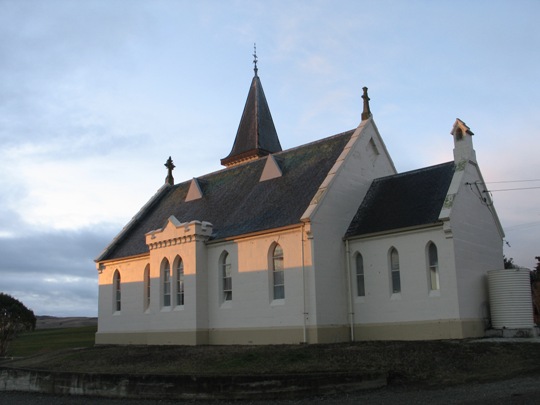
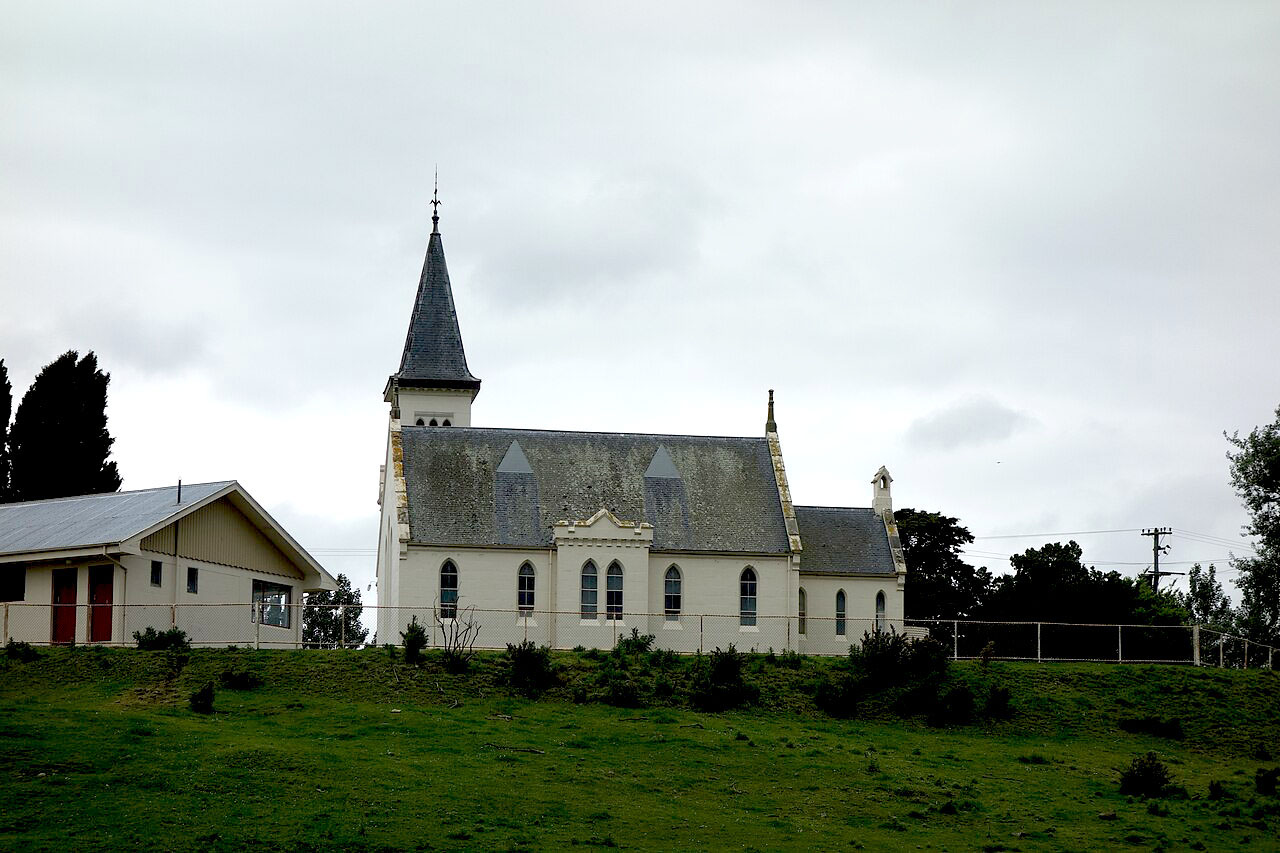
The church sits amid the rich farmland of North Otago at the head of a slight rise that emphasises the position of the church. Notionally cruciform in plan, with truncated transcepts, the church has a layout and design typical of the period – nave, porch and bell tower and spire. The church built of Oamaru stone and has a slate roof. The detailing is restrained, as befitting a country church – with lancet windows, dentils and a string course providing the decorative details.

In 1901 The Waiareka parish was formed – made up of the Enfield, Ngapara and Windsor churches. Reflecting further changes in the district, the parishes of Weston and Waiareka were amalgamated in 1964. In 2001 the 125th Anniversary of the Parish was celebrated in the Enfield church. The church website records that there was a’ large gathering of people who remembered the hard work so many people have put into establishing the church and sharing the love of Christ with the community.’

In 2016, the Enfield Presbyterian Church, along with the church at Weston, remains a focus of worship for the Waiareka-Weston district.
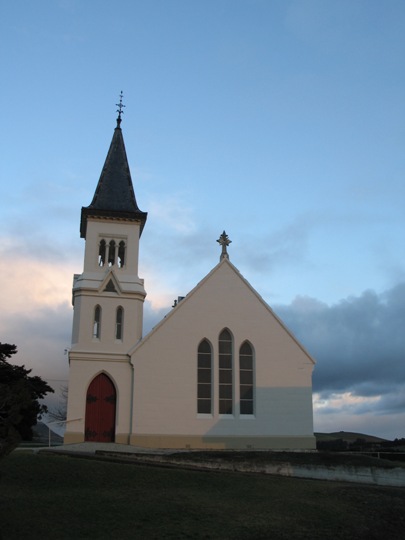
Enfield Presbyterian Church, Enfield. c.2017 Image courtesy of Southernpresbyterians.nz | Unknown | Presbyterian Church Trustees
Enfield Presbyterian Church, Enfield. c.2017 Image courtesy of Southernpresbyterians.nz | Unknown | Southern Presbyterians
Enfield Presbyterian Church, Enfield. CC BY-SA 4.0 Image courtesy of commons.wikimedia.org | Schwede66 | 04/12/2016 | Schwede66 - Wikimedia Commons
Enfield Presbyterian Church, Enfield. c.2017 Image courtesy of Southernpresbyterians.nz | Unknown | Presbyterian Church Trustees
Enfield Presbyterian Church, Enfield. c.2017 Image courtesy of Southernpresbyterians.nz | Unknown | Southern Presbyterians
Enfield Presbyterian Church, Enfield. CC BY-SA 4.0 Image courtesy of commons.wikimedia.org | Schwede66 | 04/12/2016 | Schwede66 - Wikimedia Commons

List Entry Information

Overview

Status
Listed

List Entry Status
Historic Place Category 2

Access
Private/No Public Access

List Number
2417

Date Entered
7th April 1983

Date of Effect
7th April 1983

City/District Council
Waitaki District

Region
Otago Region

Extent of List Entry

Extent includes part of the land described as Pt Sec 2 Blk XVI Oamaru SD (RT OT8D/287), Otago Land District, and the building known as Enfield Presbyterian Church, thereon. Refer to the extent map tabled at the Rarangi Korero Committee meeting on 9 March 2017.

Legal description

Pt Sec 2 Blk XVI Oamaru SD (RT OT8D/287), Otago Land District

Detailed List Entry

Construction Professional

Name

Lawson, Robert Arthur

Type

Architect

Biography

Born in Scotland, Lawson (1833-1902) began his professional career in Perth. At the age of 25 he moved to Melbourne and was engaged in goldmining and journalism before resuming architectural practice. In 1862 Lawson sailed for Dunedin, where his sketch plans had won the competition for the design of First Church. This was built 1867-73. Lawson went on to become one of the most important architects in New Zealand. First Church is regarded as his masterpiece and one of the finest nineteenth century churches in New Zealand. He was also responsible for the design of the Trinity Church (now Fortune Theatre), Dunedin (1869-70), the East Taieri Presbyterian Church (1870), and Knox Church, Dunedin (1874). He designed Park's School (1864) and the ANZ Bank (originally Union Bank, 1874). In Oamaru he designed the Bank of Otago (later National Bank building, 1870) and the adjoining Bank of New South Wales (now Forrester Gallery, 1881). See also: Ledgerwood, Norman, 2013. 'R.A. Lawson: Victorian Architect of Dunedin'. Historic Cemeteries Conservation NZ.

Construction Details

Start Year

1878

Type

Original Construction

Reference

Completion Date

13th February 2017

Report Written By

Heather Bauchop

Information Sources

Muirhead, 1990

Syd Muirhead, Historic North Otago, Oamaru Mail, 1990

Report Written By

This place was identified as significant under previous legislation with different information requirements. It remains significant under the current legislation. There is opportunity under our legislation and policies to add to this information. Further information about this place may be available from the Otago/Southland Office of Heritage New Zealand Pouhere Taonga. Please note that entry on the New Zealand Heritage List/Rarangi Korero identifies only the heritage values of the property concerned, and should not be construed as advice on the state of the property, or as a comment of its soundness or safety, including in regard to earthquake risk, safety in the event of fire, or insanitary conditions. A fully referenced upgrade report is available on request from the Otago/Southland Office of Heritage New Zealand.

Further Information

Current Usages

Uses: Religion

Specific Usage: Church

Former Usages

General Usage:: Religion

Specific Usage: Church

Themes

Web Links

Overview

Status

Listed

List Entry Status

Historic Place Category 2

Access

Private/No Public Access

List Number

2417

Date Entered

7th April 1983

Date of Effect

7th April 1983

City/District Council

Waitaki District

Region

Otago Region

Extent of List Entry

Extent includes part of the land described as Pt Sec 2 Blk XVI Oamaru SD (RT OT8D/287), Otago Land District, and the building known as Enfield Presbyterian Church, thereon. Refer to the extent map tabled at the Rarangi Korero Committee meeting on 9 March 2017.

Legal description

Pt Sec 2 Blk XVI Oamaru SD (RT OT8D/287), Otago Land District

Status

Listed

List Entry Status

Historic Place Category 2

Access

Private/No Public Access

List Number

2417

Date Entered

7th April 1983

Date of Effect

7th April 1983

City/District Council

Waitaki District

Region

Otago Region

Extent of List Entry

Extent includes part of the land described as Pt Sec 2 Blk XVI Oamaru SD (RT OT8D/287), Otago Land District, and the building known as Enfield Presbyterian Church, thereon. Refer to the extent map tabled at the Rarangi Korero Committee meeting on 9 March 2017.

Legal description

Pt Sec 2 Blk XVI Oamaru SD (RT OT8D/287), Otago Land District

Construction Information

Construction Professional

Name

Lawson, Robert Arthur

Type

Architect

Biography

Born in Scotland, Lawson (1833-1902) began his professional career in Perth. At the age of 25 he moved to Melbourne and was engaged in goldmining and journalism before resuming architectural practice. In 1862 Lawson sailed for Dunedin, where his sketch plans had won the competition for the design of First Church. This was built 1867-73. Lawson went on to become one of the most important architects in New Zealand. First Church is regarded as his masterpiece and one of the finest nineteenth century churches in New Zealand. He was also responsible for the design of the Trinity Church (now Fortune Theatre), Dunedin (1869-70), the East Taieri Presbyterian Church (1870), and Knox Church, Dunedin (1874). He designed Park's School (1864) and the ANZ Bank (originally Union Bank, 1874). In Oamaru he designed the Bank of Otago (later National Bank building, 1870) and the adjoining Bank of New South Wales (now Forrester Gallery, 1881). See also: Ledgerwood, Norman, 2013. 'R.A. Lawson: Victorian Architect of Dunedin'. Historic Cemeteries Conservation NZ.

Construction Details

Start Year

1878

Type

Original Construction

Construction Professional

Name

Lawson, Robert Arthur

Type

Architect

Biography

Born in Scotland, Lawson (1833-1902) began his professional career in Perth. At the age of 25 he moved to Melbourne and was engaged in goldmining and journalism before resuming architectural practice. In 1862 Lawson sailed for Dunedin, where his sketch plans had won the competition for the design of First Church. This was built 1867-73. Lawson went on to become one of the most important architects in New Zealand. First Church is regarded as his masterpiece and one of the finest nineteenth century churches in New Zealand. He was also responsible for the design of the Trinity Church (now Fortune Theatre), Dunedin (1869-70), the East Taieri Presbyterian Church (1870), and Knox Church, Dunedin (1874). He designed Park's School (1864) and the ANZ Bank (originally Union Bank, 1874). In Oamaru he designed the Bank of Otago (later National Bank building, 1870) and the adjoining Bank of New South Wales (now Forrester Gallery, 1881). See also: Ledgerwood, Norman, 2013. 'R.A. Lawson: Victorian Architect of Dunedin'. Historic Cemeteries Conservation NZ.

Construction Details

Start Year

1878

Type

Original Construction

Reference

Historical and Associated Iwi / Hapū / Whānau

Completion Date

13th February 2017

Report Written By

Heather Bauchop

Information Sources

Muirhead, 1990

Syd Muirhead, Historic North Otago, Oamaru Mail, 1990

Other Information

This place was identified as significant under previous legislation with different information requirements. It remains significant under the current legislation. There is opportunity under our legislation and policies to add to this information. Further information about this place may be available from the Otago/Southland Office of Heritage New Zealand Pouhere Taonga. Please note that entry on the New Zealand Heritage List/Rarangi Korero identifies only the heritage values of the property concerned, and should not be construed as advice on the state of the property, or as a comment of its soundness or safety, including in regard to earthquake risk, safety in the event of fire, or insanitary conditions. A fully referenced upgrade report is available on request from the Otago/Southland Office of Heritage New Zealand.

Historical and Associated Iwi / Hapū / Whānau

Completion Date

13th February 2017

Report Written By

Heather Bauchop

Information Sources

Muirhead, 1990

Syd Muirhead, Historic North Otago, Oamaru Mail, 1990

Other Information

This place was identified as significant under previous legislation with different information requirements. It remains significant under the current legislation. There is opportunity under our legislation and policies to add to this information. Further information about this place may be available from the Otago/Southland Office of Heritage New Zealand Pouhere Taonga. Please note that entry on the New Zealand Heritage List/Rarangi Korero identifies only the heritage values of the property concerned, and should not be construed as advice on the state of the property, or as a comment of its soundness or safety, including in regard to earthquake risk, safety in the event of fire, or insanitary conditions. A fully referenced upgrade report is available on request from the Otago/Southland Office of Heritage New Zealand.

Further Information

Current Usages

Uses: Religion

Specific Usage: Church

Former Usages

General Usage: Religion

Specific Usage: Church

Current Usages

Uses: Religion

Specific Usage: Church

Former Usages

General Usage: Religion

Specific Usage: Church

Location

Loading
Stay up to date with Heritage this month