Ancient stories tell the origins of southern Maori, with the waka of Aoraki becoming Te Wai Pounamu (the South Island), and its sternpost, Te Taurapa a Te Waka o Aoraki becoming Bluff Hill (also known as Motupohue).The early generations learnt about the land and its resources: stone sources were found, and stone (especially pounamu) became an important trading item. Kaika were established close to resources. Rights and resources and places were established, and traditions established which protected the manawhenua.
According to the statutory acknowledgments in the Ngai Tahu Settlement, important villages along the south coast included: Te Wae Wae (Waiau), Taunoa (Orepuki), Kawakaputaputa (Wakapatu), Oraka (Colac bay), Aparima, Turangiteuaru, Awarua (Bluff), Te Whera, Toe Toe (mouth of the Mataura River) and Waikawa. Mokamoka (also known as Mokemoke or Mokomoko) was a settlement at the Invercargill estuary sustained by the rich resources found there. Tauranga waka occur up and down the coast linking land and sea trails with mahinga kai resources. Whaling boats plied the waters from the 1820s leading to changes in settlement patterns and resource use.
1853 saw the Murihiku purchase which left Maori south of the Waitaki (excluding the Otakou Block) with only 4,630 acres, the start of a long quest by southern Maori for justice questioning the legality of the purchase as well as the inadequacy of the land reserved.
Early Pakeha Settlement
Invercargill Township was laid out by chief surveyor John Turnbull Thomson in 1856, Thomson choosing the location for its centrality for both sea-based and land-based traffic, though the surrounding low lying swampy ground made the new settlement practically inaccessible. As with Dunedin further north, the development of the town was given an enormous boost with the gold rushes of the early 1860s. The fledgling settlement put down more substantial roots. With the bursting of the gold bubble in the mid 1860s it was realised that the wealth of the province was to rest more on the land itself rather than the precious metal extracted from it.
Flour milling
Wheat was an unknown crop in New Zealand until Europeans introduced it to the country and to Maori. Wheat came to be grown throughout New Zealand but by the 1870s was concentrated in the areas most conducive to it: South Canterbury, North Otago and eastern Southland. By the end of 1866, 11,000 acres were cropped in North Otago, and by 1878 the figure was 142,000 acres, of which 33,000 acres represented wheat cultivation.
The earliest flour milling in New Zealand was done by hand, using a hand-operated mill such as the one Samuel Marsden had with him in 1814. In 1834 the first mill was built at the Te Waimate Mission Station’s farm, overseen by Rev. Richard Davis. The first Otago flour mill was built by the Somerville family in 1849 at Andersons Bay, Dunedin.
By the 1860s Invercargill’s population numbered around 1000 and continued to flourish, reaching 2400 over the next 15 year period, by which time Invercargill had overtaken Riverton as the main town in Southland. Invercargill was not highly industrialised, but its early economy did rely on the processing of primary produce, and even in the mid twentieth century it was mainly known for its brick and pottering making, iron foundries, sawmilling and joinery enterprises, food processing, and flour-making.
It has been said that because oats and wheat were the base for staple foods, such as porridge and bread, life without these crops would have ‘been unthinkable for Southland’s early European settlers.’ Indeed, in the late nineteenth century Southland was the main oat-producing region in New Zealand, which was a highly lucrative market while the dependence on horses for transport lasted. For instance, by 1871 9,720 hectares of oats and wheat were in production in Southland, which lead to a growth in the construction of flourmills.
Broadly speaking, there are two defining aspects to the technology of flour mills: power and grinding. The nineteenth-century mills were generally powered by water, steam or wind. Traditionally, water-powered mills used mill wheels, whose power was determined by the flow of the water, and the size of the wheel. These are described as ‘overshot’, ‘undershot’ or ‘breastshot’ depending on whether the water strikes the wheel at the top, bottom, or near the centre. Greater power could be achieved by water turbines, and through the 1880s and 1890s traditional water wheels were phased out in favour of turbines. In the mid-twentieth century electricity rendered these obsolete too.
The process of grinding the grain to separate the husk from the flour traditionally involved using pairs of millstones aligned on a central shaft. The top (‘runner’) stone rotated, while the bottom (‘bedstone’) remained still. Grooves in the stones left sharp edges that ground the grain, sending the flour outwards centrifugally through the grooves. It was important to ‘dress’ or clean out the grooves to ensure the edges ground the grain cleanly, or the flour would be brown. From the 1880s roller technology began to replace the traditional method of grinding. Under this system wheat was picked over for chaff, then passed through steel break rollers. The bran was collected for animal feed, and the grain went through sieves, purifiers and reduction rollers, after which wheatgerm was collected. The flour was then further refined through more rollers. The specific sequence of processes that a mill’s machinery produces is known as its ‘flow diagram’. The flour produced by roller milling is ‘sharper’ or less soft than that produced by grinding, so that stoneground flour continues to have a specialist market today, despite the efficiencies of the roller method. Through the 1880s and 1890s mills were increasingly converted to roller technology, including Clark’s Mill at Kakanui, in 1890.
Roller mills tumbled the grains of wheat in rollers which separated the different particles of the grains. The moistened grain is first passed through the series of break rollers which shear off (rather than crush) the outer casing. The grains are then sieved to separate out the fine particles that make up white flour. The products left are farina and coarse particles of bran and germ. The farina or middling product then makes multiple passes through the reduction rolls, and is again sieved after each pass to maximize extraction of white flour from the endosperm, while removing coarser bran and germ particles.
Thomas Fleming’s Flourmills
While the flour industry developed naturally as a result of demand and suitable growing conditions, Thomas Fleming (1848-1930) has been identified as the driving force behind it becoming predominant within Southland’s economy from the late nineteenth century. Fleming immigrated to New Zealand with his parents and nine siblings in 1862. Several years after their arrival the family had acquired large farms but, while most of the Flemings continued to farm in Southland, Thomas Fleming seems to have moved around and worked in a variety of different jobs. However, in his early twenties Fleming stumbled into his career path, firstly harvesting wheat before moving onto work in, and then manage, the Maheno Valley flourmill (now the NZ Historic Places Trust property known as Clarks Flourmill; Category I historic place, Record no. 356) near Oamaru.
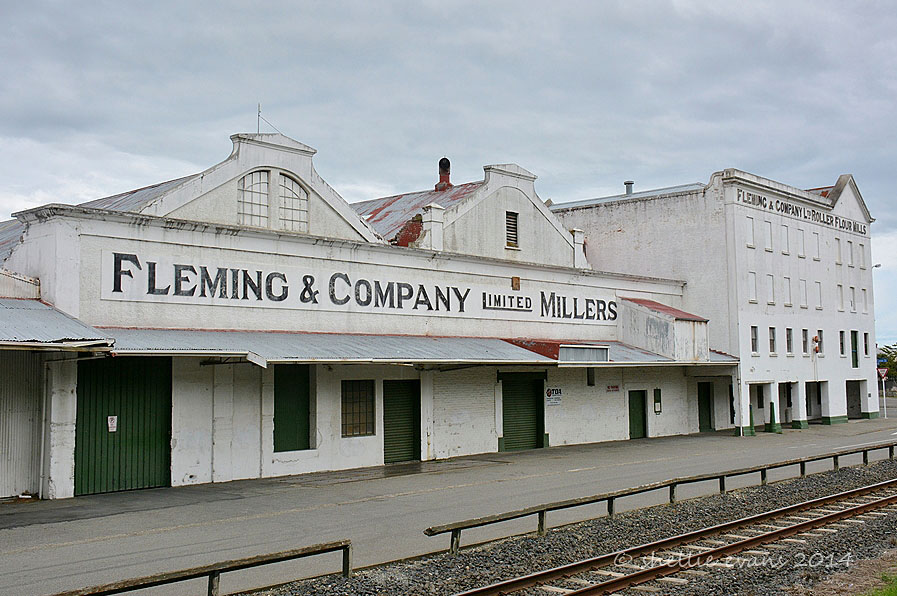
Fleming moved back to Invercargill to take up a position as manager of John Murdoch’s new flourmill. This flourmill was ideally located slightly south of the main business district and directly opposite the railway line, which meant raw and processed product could be transported directly to and from the mill by way of a railway siding. The nearby Otepuni Stream also supplied the factory’s water. After a few years as an employee, Fleming then formed a partnership called Fleming Gray and Company in 1879 which purchased Murdoch’s mill.
This was the beginnings of the company which went on to become a household name in New Zealand, and create such cultural icons as Sergeant Dan the Creamoata Man. Then in 1882 Peter Lindsay Gilkison (1846-1924), Fleming’s brother-in-law, joined Fleming in creating the company of Fleming and Gilkison. Within Invercargill this company, operating Murdoch’s mill as its Southland Roller Flourmill, was described as a ‘popular firm of flour millers and grain merchants’. This partnership consolidated the company’s and the flourmill’s importance locally and both seem to have flourished. In 1887 the coal-fired engines driving the processing plant were described as ‘probably the most heavily taxed in Southland, the building being, like a modern Atlantic steamer, a complete box of machinery.’
Fleming and Gilkison began extending their Southland-based flour-milling empire early on, buying and extending mills in places such as Gore, Mataura and Winton. The company’s expansion was fortunate because the timber portion, comprising the original 1877 mill, of their base of operations in Invercargill was destroyed by fire in 1889. With their group of company flourmills Fleming and Gilkison were able to increase production at each to compensate for the loss of use of their Invercargill mill, and all of the company’s contracts were still able to be filled.
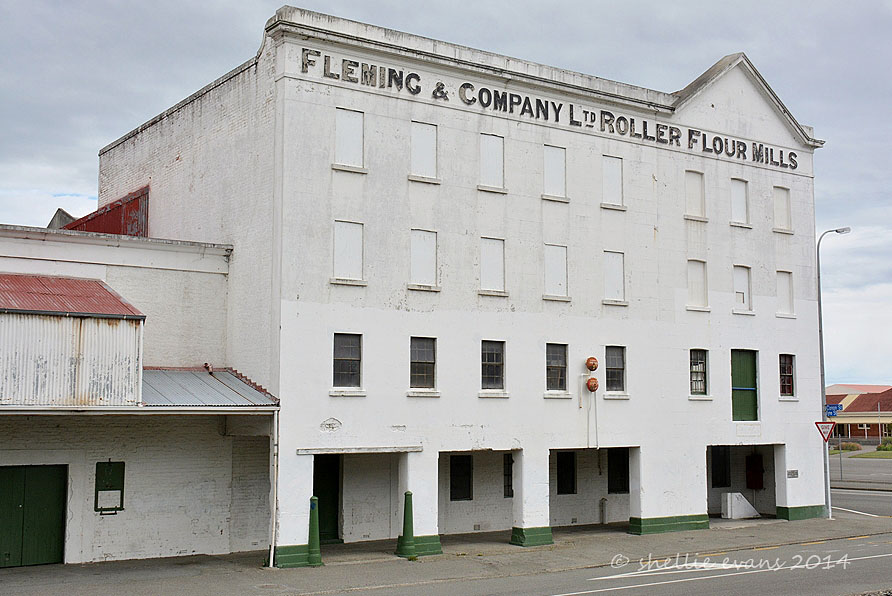
It was the timber construction, combined with the flammable product the flourmill processed, and factory machinery including an oat kiln, which made the Invercargill mill particularly susceptible to fire. Indeed, fire seems to have been a common hazard in timber constructed mills, and their Gore flourmill was similarly partially destroyed in 1912. This high fire risk is no doubt the reason why Fleming Gray and Company, followed by Fleming and Gilkison, had built extensions to the 1877 Invercargill building in brick, and they then also rebuilt the mill section of the same material.
The late 1880s seem to have been a busy time for Fleming. During this period he was not only Vice-President of the Caledonian Society of Southland, but after serving for many years on the Borough Council, in November 1888 Fleming was elected Mayor. Among Fleming’s first duties as Mayor-elect was the laying of one of the foundation stones of Invercargill’s landmark watertower. This improved water supply was instrumental in the fire-fighting efforts that kept the damage to the Flemings and Gilkison flourmill to a minimum, however, the damage was still substantial. Therefore, for the better part of 1889 Fleming was also occupied with the rebuilding of the flourmill.
The basic form of the previous building seems to have been adhered to, primarily because the 1877 timber section had been hemmed in by later brick sections, including a large addition to the wooden mill section along Conon Street (1881), and a grain store (1882-83) that went unscathed by the fire. The rebuilding appears to have gotten underway reasonably quickly after the fire, but was setback at one stage because a large portion of the remaining fire damaged fabric collapsed causing damage to the new work. Further delays occurred when the plant from England was held up due to overseas dockworkers strikes.
Fleming is said to have been an enthusiast of innovation, and the fire seems to have become an opportunity to introduce more state-of-the-art technologies into the replacement flourmill, which he had investigated while on one of his trips to England. When this new imported machinery eventually arrived it gave Fleming and Gilkison an advantage over competitors because it enabled them to produce an increased amount of flour that was also finer and of better quality. Another innovation at the mill was the introduction of electricity. Having invested in a substantial gasworks, the Invercargill Borough Council was loathe to then expend in order to set up electric power supplies. Therefore, the Southland Roller Flourmill building was one of the first in Invercargill to be lit electrically, the electricity being privately generated on site. Later, in 1895 Fleming even applied to the Council to be able to erect poles to carry electricity wires from the mill to his house, which was nearby on Forth Street.
The partnership of Fleming and Gilkison was dissolved in early 1902. Gilkison’s retirement was apparently prompted by disagreements between himself and Fleming. While Gilkison went on to establish Southland Frozen Meat Company, Fleming continued to run their various mills and entered into a partnership, under the name of Fleming and Company, with his second son, William Herbert Pollock Fleming (1881-1927), and John Rennie (b.1866), who had been accountant for Fleming and Gilkison and also became Flemings son-in-law in 1895. In 1905 the Invercargill flourmill employed 12 men and was capable of producing six sacks of flour per hour, compared with the Winton flourmill which could only average three. Fleming must have felt that the firm was progressing nicely under this new arrangement because he had embarked on another of his lengthy trips abroad, spending several years visiting England and the United States of America before returning to New Zealand 1906.
In 1912 Fleming retired, selling his shares in the company to his sons William and Andrew Scoular Fleming (1888-1935), as well as to Rennie. Despite the retention of the Fleming brand name, after the deaths of William and Andrew subsequent generations of Flemings seem to have moved away from careers in the family business. Eventually the company was sold to the Auckland-based Northern Rolling Mills (NRM) in 1953. This new parent company had been established in 1899 as the result of the merger of several smaller mill companies, and in late twentieth century it was a subsidiary of Watties Industries, although it has now evolved into Champion Flour Mills.
Like the Creamoata Mill Complex in Gore (Category I, Record No. 7470), another of Fleming’s concerns, the history of the Fleming’s Flour Mill in Invercargill illustrates the changing fortunes of New Zealand's agricultural and primary processing industries. Flour milling was one of Southland’s most enduring industries and it played a major role in the development of both the Invercargill and the economy of Southland. Subsequent forces of economic rationalisation and globalisation have had a largely negative impact on these industries.
Clark’s Mill in Maheno (Category I, Record No. 346) is another outstanding example of milling technology, being the only surviving water-powered flour mill with some machinery still intact. Clark’s Mill represents the rural flour mills that were built in the 1860s when wheat production was at its peak. Fleming was trained in his trade at Clark’s Mill, an important link with the establishment of Fleming’s Invercargill Mill.
Fleming’s Flour Mill in Invercargill is an important urban survivor of the flour milling industry. Like Wakelin's Flourmill in Carterton (Category I, Record No.7634), and the Crown Milling Company Building in Dunedin (Category I, Record Number 366), Fleming’s Flour Mill is a landmark in its community. Such mill buildings are special survivors as many were destroyed by fire, a fate that the combustion of wheat made them prone.
While still important to the Southland economy, by the mid twentieth century oat and wheat production had been surpassed by agricultural industries such as lamb and dairy production. Despite being supplanted by other industries locally, in the late 1970s Southland was still producing the highest yields of wheat and oats nationally. However, after a peak 80 years earlier when there were 12 flourmills operating in Southland, by the 1960s the former Fleming and Company Flourmill was the only flourmill left operating due to its owners acquiring competing mills and gradually centralising.
In the late 1970s the future of the Fleming and Company Flourmill was also under threat because the building was thought to be at the end of its economic life. This proposed 1977 closure and relocation of activities to Auckland, drew strong community reaction, with numerous articles appearing in the Southland Times and a ‘flour mill action committee’ being established. Affected parties also staged meetings that included people such as N. P. H. Jones, Member of Parliament for Invercargill, as well as representatives from ‘mercantile firms, grain merchants, poultry producers, grocery wholesalers, the Railways Department, the Ministry for Agriculture and Fisheries, the Southland Trade Council, and bakers.’ These actions seem to have bought the mill a slight reprieve because its directors promised to continue operations until at least the end of 1980.
In the mid 1980s the wheat industry was deregulated and as such New Zealand flour production began to drop in the face of cheaper imported product from Australia. Statistics demonstrate the effect of this clearly: in 1981 Southland alone accounted for 23 per cent of national wheat production, but within 20 years the combined total production in Southland, Otago and Marlborough was 15 per cent. It was around this time that NRM sold the flourmill in Invercargill to local company, South Flour Limited. The new owners of the former Fleming and Company Flourmill, continued to produce flour for the local market, but by 2006 this had become uneconomic and as such the company discontinued production. This was part of a nationwide trend, for example, in the early 2000s Goodman Fielder closed all of its flourmills except those in Mt Maunganui and Christchurch. Earlier in 1992 NRM also stopped flour production, and the former Flemings Creamoata factory in Gore eventually closed in 2008.
In 2011 the Flemings brand has largely been subsumed into Uncle Tobys. A range of snack bars, distributed by Bluebird, are still available under the Flemings name. The former Fleming and Company Mill, used largely for storage, stands on its landmark site, a reminder of this important New Zealand industry.