Quick links


Quick links
Quick links
Quick links
Quick links
Quick links
Hardy Street, NELSON
Private
Historic Place Category 1
List No. 257
List Entry Information
Status
Listed
List Entry Status
Historic Place Category 1
Access
Private/No Public Access
List Number
257
Date Entered
6th September 1984
Date of Effect
6th September 1984
City/District Council
Nelson City
Region
Nelson Region
Legal description
Secs 201 203 Pt Secs 179 180 181 200 202 -Historic Reserve
Location Description
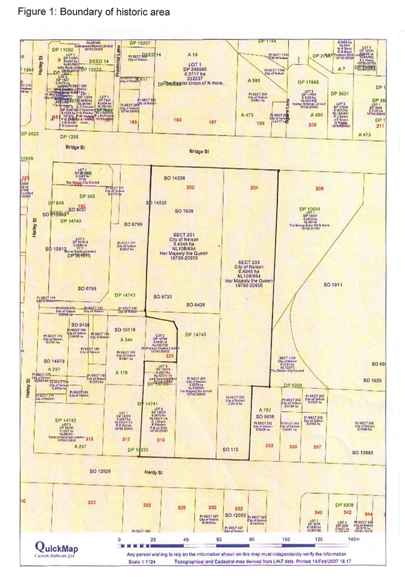
Located in Albion Square Historic Area which is bounded on the north and south side by Hardy Street and Bridge Street in Nelson.
Why is this place significant?
Historic Significance
Historical Significance or Value This assessment was prepared in 2003 with reference to the criteria of the Historic Places Act 1993. aesthetic, architectural, historical, social Fire Engine House is historically significant as an example of an early, purpose-built fire station. The building is an important marker in the development of Nelson's fire fighting services and is the only remaining physical link with Nelson's Provincial Council Buildings. The Provincial Council Buildings were an important part of Nelson's history and the use of similar materials and the same architectural detail in Fire Engine House gives the structure aesthetic and architectural importance. The site has social value as it is intimately connected in the community mind with the notorious Maungatapu murders that caused a sensation in the district.
Why is this place Category 1 / Category 2?
Detail Of Assessed Criteria
This assessment was prepared in 2003 with reference to the criteria of the Historic Places Act 1993. a, b, c, e, g, h, k Fire Engine House reflects the constant danger of fire faced by wooden buildings, and reflects an early, innovative solution to this problem. The structure's association with the Provincial Council, an important part of early New Zealand government, adds to its historic significance. Fire Engine House's similarity to the architectural design used in the now demolished Provincial Council Buildings gives it both design and commemorative value and increases its potential to provide knowledge of New Zealand history. The esteem in which it is held by the public is exemplified by the building's inclusion in the Albion Square Historic Reserve that was gazetted in 1990. Located in the Albion Square Historic Area, the building is an integral part of a wider historical and cultural complex that stands in memory of the Provincial Council and its associated activities.
Construction Professional
Name
Handyside, Henry
Type
Builder
Biography
No biography is currently available for this construction professional
Name
McDonald, Robert
Type
Architect
Biography
No biography is currently available for this construction professional
Construction Details
Start Year
1865
Finish Year
1866
Type
Original Construction
Description
Building constructed
Start Year
1974
Finish Year
1976
Type
Modification
Description
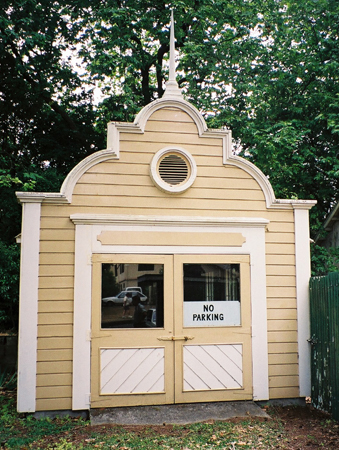
Two new doors attached to front of building; parapets capped with lead; concrete floor laid; new glazed window installed; fence and gates repositioned
Construction Materials
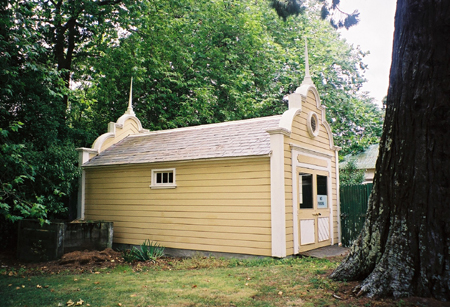
Single storey building built on a concrete foundation slab. Constructed around a timber frame, the walls are lined with timber and the interior is covered with lime plaster over mesh. The ceiling is tongue and groove match lining. The roof was originally covered with slate tiles
Notable Features
The registration covers the building, its fittings and fixtures, and the land on which it rests. The gable design featured at each end of the building recalls the now demolished Jacobean-styled Provincial Council Buildings
A simple, single storey structure with large double doors at either end. The rectangular structure measures 3.7 metres by 5.5 metres (12 foot by 18 foot). Built on a concrete base, the building has weather-board walls, a timber ceiling and a roof of slate. The concrete floor and the double doors were replaced between 1974 and 1976. The architecture of Fire Engine House imitated the architecture of the government buildings. This is particularly noticeable in its distinctive gables, which were replicas of the gables that adorned the government buildings.
A simple, single storey structure with large double doors at either end. The rectangular structure measures 3.7 metres by 5.5 metres (12 foot by 18 foot). Built on a concrete base, the building has weather-board walls, a timber ceiling and a roof of slate. The concrete floor and the double doors were replaced between 1974 and 1976. The architecture of Fire Engine House imitated the architecture of the government buildings. This is particularly noticeable in its distinctive gables, which were replicas of the gables that adorned the government buildings.
Historical and Associated Iwi / Hapū / Whānau
Completion Date
28th February 2003
Report Written By
Rebecca O'Brien
Information Sources
Broad, 1892 (1976)
L. Broad, 'Jubilee History of Nelson', Nelson, 1892 (reprinted by Capper Press, Christchurch1976)
Hanson, 1978
E. Hanson, 'The Old Engine House at Nelson', The Records of the New Zealand Historic Places Trust, vol.2, April 1978, pp.7-13
Other Information
A fully referenced version of this report is available from the NZHPT Central Region Office Please note that entry on the New Zealand Heritage List/Rarangi Korero identifies only the heritage values of the property concerned, and should not be construed as advice on the state of the property, or as a comment of its soundness or safety, including in regard to earthquake risk, safety in the event of fire, or insanitary conditions.
Current Usages
Uses: Civic Facilities
Specific Usage: Historic or recreation reserve
Former Usages
General Usage: Funerary Sites
Specific Usage: Morgue/mortuary
General Usage: Utilities
Specific Usage: Fire Station
Current Usages
Uses: Civic Facilities
Specific Usage: Historic or recreation reserve
Former Usages
General Usage: Funerary Sites
Specific Usage: Morgue/mortuary
General Usage: Utilities
Specific Usage: Fire Station
Get the latest heritage news, features and events delivered
straight to your inbox.