DonateMembershipVisit Heritage
  • Tūrangawaewae
    Places
  • Tira Māori
    Māori Heritage
  • Poutairangahia
    Archaeology
  • Rauemi
    Resources
  • Mō Tātou
    About Us
  • New Zealand Heritage List
  • Nominate and submit
  • Explore the List
  • National Historic Landmarks
  • Plaques
  • Rainbow List Project
  • Lost heritage
  • Visit Heritage
  • Our properties
  • Turnbull House Project
  • Collections
  • Shop
  • Tohu Whenua
  • Tira Māori
  • Conserving Māori heritage
  • Marae built heritage
  • Māori heritage on the List
  • Hinemihi—Te Hokinga Mai
  • What is archaeology?
  • Is there a site on my property?
  • What are my legal requirements?
  • Affecting an archaeological site
  • Declaring an archaeological site
  • Archaeology FAQs
  • Archaeology Digital Library
  • Archaeology guidelines and templates
  • Resources
  • Funding
  • Publications
  • Sustainable management guides
  • Disaster recovery
  • Podcasts & digital resources
  • Education Hub
  • Conservation plans
  • About
  • Board
  • Māori Heritage Council
  • Senior Staff
  • Offices
  • Contact us
  • Careers
  • Covenants
  • Fast-track
  • Corporate documents
  • Currently consulting on
  • Our submissions
  • News
  • Covid-19 response
Quick links
Rārangi Kōrero | The List
Explore the List
National Historic Landmarks
Ngā Manawhenua o Aotearoa me ōna Kōrero Tūturu
Quick links
Tapuwae
A Vision for Places of Māori Heritage
Funding for Māori Heritage
Resources
Quick links
Archaeological Authority Portal
Applying for an archaeological authority
Archaeology FAQs
Browse the most frequently asked questions about archaeological authorities and the archaeological process.
Quick links
Quick links
News
News Keep up to date with Heritage New Zealand Pouhere Taonga
Membership
Membership Find out more and sign up today
DonateMembershipVisit Heritage
  • Tūrangawaewae
    Places
  • Tira Māori
    Māori Heritage
  • Poutairangahia
    Archaeology
  • Rauemi
    Resources
  • Mō Tātou
    About Us
  • New Zealand Heritage List
  • Nominate and submit
  • Explore the List
  • National Historic Landmarks
  • Plaques
  • Rainbow List Project
  • Lost heritage
  • Visit Heritage
  • Our properties
  • Turnbull House Project
  • Collections
  • Shop
  • Tohu Whenua
  • Tira Māori
  • Conserving Māori heritage
  • Marae built heritage
  • Māori heritage on the List
  • Hinemihi—Te Hokinga Mai
  • What is archaeology?
  • Is there a site on my property?
  • What are my legal requirements?
  • Affecting an archaeological site
  • Declaring an archaeological site
  • Archaeology FAQs
  • Archaeology Digital Library
  • Archaeology guidelines and templates
  • Resources
  • Funding
  • Publications
  • Sustainable management guides
  • Disaster recovery
  • Podcasts & digital resources
  • Education Hub
  • Conservation plans
  • About
  • Board
  • Māori Heritage Council
  • Senior Staff
  • Offices
  • Contact us
  • Careers
  • Covenants
  • Fast-track
  • Corporate documents
  • Currently consulting on
  • Our submissions
  • News
  • Covid-19 response
Quick links
Rārangi Kōrero | The List
Explore the List
National Historic Landmarks
Ngā Manawhenua o Aotearoa me ōna Kōrero Tūturu
Quick links
Tapuwae
A Vision for Places of Māori Heritage
Funding for Māori Heritage
Resources
Quick links
Archaeological Authority Portal
Applying for an archaeological authority
Archaeology FAQs
Browse the most frequently asked questions about archaeological authorities and the archaeological process.
Quick links
Quick links
News
News Keep up to date with Heritage New Zealand Pouhere Taonga
Membership
Membership Find out more and sign up today
  • Places
  • Nominate and submit
  • National Historic Landmarks
  • Places
  • Nominate and submit
  • National Historic Landmarks
  • Tira Māori
  • Conserving Māori heritage
  • Marae built heritage
  • Tira Māori
  • Conserving Māori heritage
  • Marae built heritage
  • Archaeological authorities
  • Archaeology Digital Library
  • Archaeological authorities
  • Archaeology Digital Library
  • All resources
  • Publications
  • Funding
  • All resources
  • Publications
  • Funding
  • FAQs
  • FAQs
Follow us on:
Places
  • Places
  • Nominate and submit
  • National Historic Landmarks
Tira Māori
  • Tira Māori
  • Conserving Māori heritage
  • Marae built heritage
Archaeology
  • Archaeological authorities
  • Archaeology Digital Library
Resources
  • All resources
  • Publications
  • Funding
FAQs
  • FAQs
Follow us on
HomePrivacyTerms and conditionsAbout this site
© Heritage New Zealand Pouhere Taonga 2026.
 
St Barnabas' Chapel

44-46 Margot Street, Epsom, AUCKLAND

Private

Historic Place Category 2

List No. 2646

Quick links:
List GalleryLocationDetails
St Barnabas' Chapel and Bishopscourt, Parnell

Built between 1863 and 1866, St Barnabas' Chapel was originally erected as Bishop Selwyn's private chapel at Bishopscourt in Parnell, but was moved to the Diocesan High School for Girls in 1910. Bishopscourt (now known as Selwyn Court) was constructed as a permanent residence for the Anglican Bishop, George Selwyn (1809-1878) and his successors. The complex, which included a house, library, baptistry and bell tower as well as the chapel, was designed by architect Frederick Thatcher under the direction of Bishop Selwyn. It was built in a form of Gothic Revival style later known as 'Selwyn Gothic', which is considered the first attempt to develop a vernacular architectural style in colonial New Zealand.

Bishop Selwyn arrived in New Zealand in 1842 with the responsibility of overseeing the formation of the Anglican Church in New Zealand. His major achievement was the creation of the Constitution of the Church of the Province of New Zealand, but part of his task was also to oversee the erection of substantial church buildings. Selwyn moved to Auckland in 1844 where he began to commission works in the Gothic Revival style, beginning with St John's College at Tamaki. The style was heavily influenced by the ideals of the Camden Society (later known as the Ecclesiological Society), of which Selwyn was a member. On his consecration as Bishop of New Zealand, Selwyn was also made a patron of the Society. Based in England, the Society aimed to revive medieval forms of architecture as a reaction to the perceived 'decadence' of Georgian church architecture. The Society's beliefs can be seen as part of a conservative response to widespread social discontent in Britain at the time. The preferred architectural style of the Camden Society was fourteenth-century Gothic, which emphasised the roots of the Anglican faith in medieval High Church worship. Other features considered important were a steeply pitched roof, a raised chancel and a simple functional interior, which included exposed internal beams. Many of these features were translated into the Selwyn Gothic Style, whose major point of difference from Gothic Revival buildings in Britain was the use of timber rather than stone.

Bishopscourt was built between 1863 and 1866 and has been described as 'the most ambitious secular building of the Selwyn series.' Architectural historian, John Stacpoole, describes the style of the complex:

'Bishopscourt, or Selwyn Court as it is known today, is a most remarkable piece of planning. Thatcher's felicities of ingeniously controlled roofs, introduced gables, and windows based mainly on multiplications of the lancet form relieved by an occasional trefoil or quatrefoil, were by this time to be expected. At Selwyn Court he made full use of roofs of broken pitch - roofs which flatten out towards the eaves - and he also introduced generously-dimensioned casement windows to the north-facing living rooms.'

The chapel was an integral part of Bishopscourt, being centrally positioned in the complex. It was erected between the study and the office, protruding at right angles to the main building. The back of the church served as a corridor between these spaces, while the main body of the chapel was screened. Its architect, the Reverend Frederick Thatcher (1814-1890), was a designer of note, whose masterpiece is considered to be Old St Paul's in Wellington. Like Selwyn, he was a vigorous proponent of what was termed 'colonial Gothic'. St Barnabas' Chapel exemplified the Selwyn Gothic style of architecture, in particular its steeply pitched roof, vertical cladding, exposed structural members, latticed glass panels and rose window. The sparse furnishings and dark brown interior were also typical of this style. The building is considered to have been built by Alexander Hunter.

Following its construction, Bishopscourt became the centre of Diocesan work and many special services were held in the chapel from 1864-1910 during the occupancy of Bishops Selwyn, Cowie and Neligan. The first baptism was held on 29 June 1865, when the son of Captain Betty of the Royal Artillery was baptised. The first marriage in the chapel occurred in 1866. The chapel also has connections with Bishop J.C. Patteson (1827-1871), the first Bishop of Melanesia who was martyred in 1871. Patteson was a close associate of Selwyn who stayed at Bishopscourt when his mission boat, the Southern Cross, was in Auckland.

By 1900, there were serious problems with dampness at Bishopscourt and in 1908 a new brick residence was erected alongside the old timber buildings. In 1910 the Synod announced the decision to move St Barnabas' Chapel to Diocesan School, so that it 'might be used for such purposes as were in conformity with the past use of the Building'. Previous modifications to the chapel had included boarding up some of the lancet windows in the eastern wall of the structure. This had occurred prior to 1891.


St Barnabas' Chapel and the Diocesan School for Girls

The Diocesan High School for Girls was established by Bishop Neligan in June 1903 as an Anglican educational institution. It initially evolved under the guidance of Mary Pulling (1871-1951), the school's first headmistress, who had taught in some of Britain's premier private colleges. Pulling aimed to provide standards that equalled the best of those of the state sector, while promoting education of a religious nature. She went on to play a prominent role in raising the professional standards of church schools throughout New Zealand.

The institution was established on land previously known as St John's Wood, which had been owned by Edwin Hesketh, a wealthy lawyer and active member of the Anglican Church. Hesketh and his family had occupied a large Italianate residence on the site, surrounded by substantial grounds. The school opened in 1904 with a roll of 25 pupils. It contained two classrooms, housed in the converted residence (now known as School House).

As an Anglican school, religious services formed an important part of school life. These were initially held in an upstairs room of the main residence that had been set aside as a chapel. The relocation of St Barnabas' Chapel in 1910 not only provided a more suitable religious setting for such services, but also reflected Pulling's aim to create an institution that drew from a specifically New Zealand Anglican inheritance. Pulling herself lived at Bishopscourt throughout her tenure as headmistress, and was particularly interested in design and architecture. She also put on historical pageants at the school, including one based on the life of Bishop Patteson, with whom the building had links.

For more than a decade, the building was the main focus of the school's religious life. The Chapel was positioned a short distance from the main school building, close to the former site of Edwin Hesketh's stables and laundry. From the outset, it was only just large enough to accommodate the school, but Pulling believed its smallness was more than compensated for by its architectural merits and historical associations. The first service on the new site was held on St Barnabas' Day on 11 June 1910.

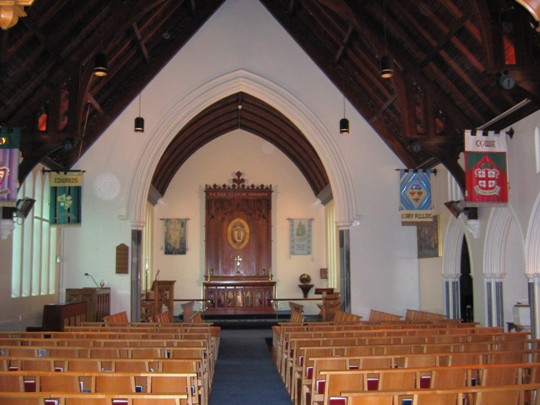
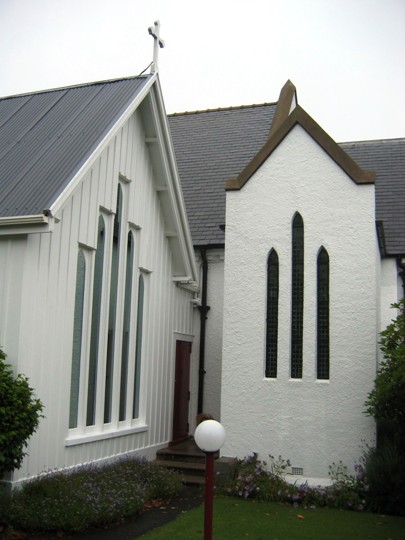
A porch on the south west of the building appears to have been added shortly after its relocation. The chapel, however, quickly became too small to accommodate all school members. A new structure, the Chapel of Our Glorified Lord, was built in 1922 against the western side of St Barnabas'. The western wall of the chapel had previously held a pair of lancet windows towards its northern end, mirroring the windows on the eastern side of the chapel. The new chapel retained the east and south walls of the porch, while the western wall of St Barnabas' was replaced by an open arcade, allowing a visual connection between the two spaces.

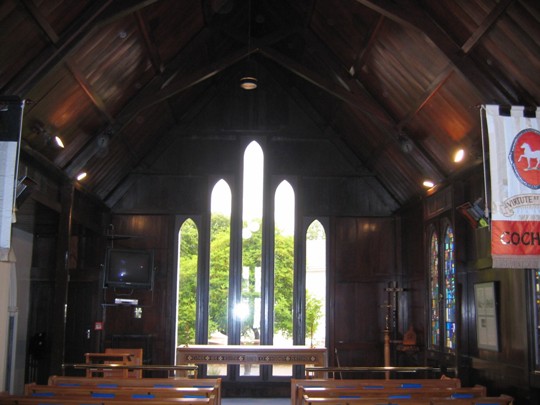
Sometime after the mid 1980s, two pairs of lancet windows were added to the eastern side of the chapel (in the middle and south end of the wall) and all three pairs of lancet windows were fitted with stained glass. A decade later, parts of the lancet windows in the eastern wall boarded up prior to 1891 were uncovered. In some respects this was a compromise. The pointed arches installed by Mrs Cowie were retained and a similar treatment was given to the outer windows. Plate glass was installed right down to the floor and the Selwyn lattice was not reinstated. Today, the chapel remains in use as part of the larger place of worship. Various houses take turns at having Sunday services there and wedding services are also held for old girls.
St Barnabas' Chapel | NZ Historic Places Trust
null | J McKenzie | 18/01/2005 | NZ Historic Places Trust
St Barnabas' Chapel | NZ Historic Places Trust
null | J McKenzie | 18/01/2005 | NZ Historic Places Trust

List Entry Information

Overview

Status
Listed

List Entry Status
Historic Place Category 2

Access
Private/No Public Access

List Number
2646

Date Entered
24th June 2005

Date of Effect
24th June 2005

City/District Council
Auckland Council

Region
Auckland Council

Extent of List Entry

The registration includes part of the of the land in RT NA763/288 (as shown on Map C in Appendix 4) and the buidling, its fittings and fixtures, thereon. The area of registration extends one metre beyond the outer walls of the chapel on its northern, eastern and southern sides.

Legal description

Part of Allot 11 Sec 11 Suburbs of Auckland (RT NA763/288)

Detailed List Entry
Significance

Cultural Significance

The chapel has some social significance as a place of gathering within the Diocesan School for over ninety years. It has strong spiritual significance as a place of worship for 140 years.

Historic Significance

Historical Significance or Value It is historically important as one of Auckland's early surviving buildings and for having strong associations with important religious personalities in the history of New Zealand and Auckland province, including Bishop Selwyn, Bishop Cowie and Bishop Patteson.

Physical Significance

St Barnabas' Chapel is architecturally significant as an example of the Gothic Revival style of architecture of Selwyn type, which has been considered New Zealand's earliest colonial vernacular architecture.

Detail Of Assessed Criteria

(a) The extent to which the place reflects important or representative aspects of New Zealand history St Barnabas' Chapel reflects important aspects of New Zealand history, notably the early development of the Anglican Church in Auckland, and the roles of history and worship in early twentieth-century Anglican girls' schools. (b) The association of the place with events, persons, or ideas of importance in New Zealand history The building has strong associations with persons of importance in New Zealand history, including Bishop George Selwyn (the first Bishop of New Zealand), Bishop J.C. Patteson (the earliest Bishop of Melanesia), Bishop W.G. Cowie (the first Bishop of Auckland), the Reverend Frederick Thatcher and Mary Pulling (a notable figure in the history of religious education and headmistress of the Diocesan School for more than twenty years). (c) The potential of the place to provide knowledge of New Zealand history The Chapel's fabric has high potential to provide information about mid nineteenth-century construction materials, techniques and religious use. (e)The community association with, or public esteem for, the place The building was closely associated with the Anglican community for many years, and since 1910 has been central to the Diocesan School community. (g) The technical accomplishment or value, or design of the place The chapel has a significant design, as a timber Gothic Revival structure that exemplifies the Selwyn Gothic style, one of the first distinctive styles of architecture in colonial New Zealand. i) The importance of identifying historic places known to date from early periods of New Zealand settlement The chapel dates to an early period of Auckland's colonial history, being built within the first 25 years of the city's development. (k) The extent to which the place forms part of a wider historical and cultural complex or historical and cultural landscape The Chapel forms an integral part of a nineteenth and early twentieth-century historical landscape. This incorporates the site of a colonial residence and garden, and elements that reflect the landscape's initial conversion to a religious institution of significance. Significant elements of this landscape other than the Chapel include School House (formerly Hesketh House), a nineteenth-century gazebo, and nineteenth-century plantings and landscaping.

Construction Professional

Name

Hunter, Alexander Hamilton

Type

Builder

Biography

No biography is currently available for this construction professional

Name

Thatcher, Frederick

Type

Architect

Biography

No biography is currently available for this construction professional

Construction Details

Start Year

1863

Finish Year

1866

Type

Original Construction

Description

Constructed at Bishopscourt, Parnell

Type

Modification

Description

Outer two lancet windows and lower portion of inner three windows in northern wall behind altar boarded up; wooden mitred lancet frame placed inside top of windows and lattice glass removed

Period

pre-1891

Start Year

1910

Type

Relocation

Description

May 1910 - Chapel moved to Diocesan School for Girls

Start Year

1922

Type

Modification

Description

West side of chapel removed and replaced with a colonnade, linking it with the Chapel of Our Glorified Lord

Type

Modification

Description

Two pairs of memorial windows inserted in east wall of chapel

Period

1980s (circa)

Type

Modification

Description

Boarded up lights in window on north wall uncovered

Period

mid 1990s

Construction Materials

Timber, with corrugated iron roof

Physical Description

St Barnabas' Chapel is located in the grounds of Diocesan School for Girls, in the eastern suburb of Epsom, Auckland. It forms part of a larger chapel complex and is surrounded by other school buildings. It sits on flat ground to the northeast of School House, formerly known as Hesketh House, which had been a gentry residence in the late nineteenth century. The chapel has been on the site since 1910, having previously been located at Bishopscourt, Parnell. The Chapel is a small, rectangular timber building of simple external appearance, designed in the Gothic Revival style. Orientated with its main axis north-south, it measures 11.5 m long x 5.2 m wide (38 x 17 feet), and is 6.7 m (22 feet) high from base to eaves. The northern and southern ends of the structure are gabled, supporting a steep 60-degree angle roof. The chapel is physically connected on its western side to the newer Chapel of Our Glorified Lord, designed in a sympathetic style. Constructed in kauri timber, St Barnabas' Chapel is externally clad with vertical board and batten weatherboards. Narrow wooden battens have been nailed over the joints to weatherproof the building. The planks are attached to a wooden frame. Internally, the walls are lined with 230 mm (9 inch) wide vertical timber boards. The roof sarking is supported by four timber trusses. The northern end of the chapel contains a raised altar, while a door with original fittings near the southern end of the eastern wall provides external access. A set of five tall mitred lancet windows, with plain glass and rectangular framing, are located above the altar. In the eastern wall of the chapel there are three pairs of smaller lancet windows, with stained glass and steel mesh on the exterior. The southern elevation contains a square-headed window of Tudor Revival style, containing six lights, divided into two groups of three by a horizontal mullion. The windows are of the distinctive Selwyn lattice type. Above is a rose window. The western wall consists of an open arcade, created in 1922, providing open access into the adjacent chapel. The chapel is furnished with wooden pews and a modern free-standing altar. Electric lights and heaters hang from the walls and ceiling. A portrait of Bishop Neligan hangs at the eastern end of the southern wall. To the right of the photograph there are three closely spaced original timber pegs. A wheel in the roof at the rear of the chapel survives, once used to hoist an 'elaborate candelabra' to the roof to provide more light. A carved wooden book rest/lectern, which reputably belonged to Bishop Selwyn, remains in the chapel.

Reference

Information Sources

Art New Zealand

Art New Zealand

Hammer, 2003

Margaret Hammer, Follow Your Star: Diocesan School for Girls, Auckland 1903-2003, Auckland, 2003.

Johnson, 1969

Valeria Johnson & Honor Jensen, A History of Diocesan High School for Girls, Auckland 1903-1953, Auckland, 1969

Knight, 1972

Cyril Knight, The Selwyn Churches of Auckland, Auckland, 1972.

Shaw, P., 1991

Peter Shaw, New Zealand Architecture: From Polynesian Beginnings to 1990, Auckland, Hodder & Stoughton, 1991.

Porter, 1983 (2)

Frances Porter (ed.), Historic Buildings of New Zealand: North Island (2nd edn.), Auckland, 1983

Report Written By

A fully referenced registration report is available from the NZHPT Northern Region Office. Please note that entry on the New Zealand Heritage List/Rarangi Korero identifies only the heritage values of the property concerned, and should not be construed as advice on the state of the property, or as a comment of its soundness or safety, including in regard to earthquake risk, safety in the event of fire, or insanitary conditions.

Further Information

Current Usages

Uses: Religion

Specific Usage: Church

Former Usages

General Usage:: Religion

Specific Usage: Church

Themes

Web Links

Overview

Status

Listed

List Entry Status

Historic Place Category 2

Access

Private/No Public Access

List Number

2646

Date Entered

24th June 2005

Date of Effect

24th June 2005

City/District Council

Auckland Council

Region

Auckland Council

Extent of List Entry

The registration includes part of the of the land in RT NA763/288 (as shown on Map C in Appendix 4) and the buidling, its fittings and fixtures, thereon. The area of registration extends one metre beyond the outer walls of the chapel on its northern, eastern and southern sides.

Legal description

Part of Allot 11 Sec 11 Suburbs of Auckland (RT NA763/288)

Status

Listed

List Entry Status

Historic Place Category 2

Access

Private/No Public Access

List Number

2646

Date Entered

24th June 2005

Date of Effect

24th June 2005

City/District Council

Auckland Council

Region

Auckland Council

Extent of List Entry

The registration includes part of the of the land in RT NA763/288 (as shown on Map C in Appendix 4) and the buidling, its fittings and fixtures, thereon. The area of registration extends one metre beyond the outer walls of the chapel on its northern, eastern and southern sides.

Legal description

Part of Allot 11 Sec 11 Suburbs of Auckland (RT NA763/288)

Significance

Why is this place significant?

Cultural Significance

The chapel has some social significance as a place of gathering within the Diocesan School for over ninety years. It has strong spiritual significance as a place of worship for 140 years.

Historic Significance

Historical Significance or Value It is historically important as one of Auckland's early surviving buildings and for having strong associations with important religious personalities in the history of New Zealand and Auckland province, including Bishop Selwyn, Bishop Cowie and Bishop Patteson.

Physical Significance

St Barnabas' Chapel is architecturally significant as an example of the Gothic Revival style of architecture of Selwyn type, which has been considered New Zealand's earliest colonial vernacular architecture.

Why is this place Category 1 / Category 2?

Detail Of Assessed Criteria

(a) The extent to which the place reflects important or representative aspects of New Zealand history St Barnabas' Chapel reflects important aspects of New Zealand history, notably the early development of the Anglican Church in Auckland, and the roles of history and worship in early twentieth-century Anglican girls' schools. (b) The association of the place with events, persons, or ideas of importance in New Zealand history The building has strong associations with persons of importance in New Zealand history, including Bishop George Selwyn (the first Bishop of New Zealand), Bishop J.C. Patteson (the earliest Bishop of Melanesia), Bishop W.G. Cowie (the first Bishop of Auckland), the Reverend Frederick Thatcher and Mary Pulling (a notable figure in the history of religious education and headmistress of the Diocesan School for more than twenty years). (c) The potential of the place to provide knowledge of New Zealand history The Chapel's fabric has high potential to provide information about mid nineteenth-century construction materials, techniques and religious use. (e)The community association with, or public esteem for, the place The building was closely associated with the Anglican community for many years, and since 1910 has been central to the Diocesan School community. (g) The technical accomplishment or value, or design of the place The chapel has a significant design, as a timber Gothic Revival structure that exemplifies the Selwyn Gothic style, one of the first distinctive styles of architecture in colonial New Zealand. i) The importance of identifying historic places known to date from early periods of New Zealand settlement The chapel dates to an early period of Auckland's colonial history, being built within the first 25 years of the city's development. (k) The extent to which the place forms part of a wider historical and cultural complex or historical and cultural landscape The Chapel forms an integral part of a nineteenth and early twentieth-century historical landscape. This incorporates the site of a colonial residence and garden, and elements that reflect the landscape's initial conversion to a religious institution of significance. Significant elements of this landscape other than the Chapel include School House (formerly Hesketh House), a nineteenth-century gazebo, and nineteenth-century plantings and landscaping.

Why is this place significant?

Cultural Significance

The chapel has some social significance as a place of gathering within the Diocesan School for over ninety years. It has strong spiritual significance as a place of worship for 140 years.

Historic Significance

Historical Significance or Value It is historically important as one of Auckland's early surviving buildings and for having strong associations with important religious personalities in the history of New Zealand and Auckland province, including Bishop Selwyn, Bishop Cowie and Bishop Patteson.

Physical Significance

St Barnabas' Chapel is architecturally significant as an example of the Gothic Revival style of architecture of Selwyn type, which has been considered New Zealand's earliest colonial vernacular architecture.

Why is this place Category 1 / Category 2?

Detail Of Assessed Criteria

(a) The extent to which the place reflects important or representative aspects of New Zealand history St Barnabas' Chapel reflects important aspects of New Zealand history, notably the early development of the Anglican Church in Auckland, and the roles of history and worship in early twentieth-century Anglican girls' schools. (b) The association of the place with events, persons, or ideas of importance in New Zealand history The building has strong associations with persons of importance in New Zealand history, including Bishop George Selwyn (the first Bishop of New Zealand), Bishop J.C. Patteson (the earliest Bishop of Melanesia), Bishop W.G. Cowie (the first Bishop of Auckland), the Reverend Frederick Thatcher and Mary Pulling (a notable figure in the history of religious education and headmistress of the Diocesan School for more than twenty years). (c) The potential of the place to provide knowledge of New Zealand history The Chapel's fabric has high potential to provide information about mid nineteenth-century construction materials, techniques and religious use. (e)The community association with, or public esteem for, the place The building was closely associated with the Anglican community for many years, and since 1910 has been central to the Diocesan School community. (g) The technical accomplishment or value, or design of the place The chapel has a significant design, as a timber Gothic Revival structure that exemplifies the Selwyn Gothic style, one of the first distinctive styles of architecture in colonial New Zealand. i) The importance of identifying historic places known to date from early periods of New Zealand settlement The chapel dates to an early period of Auckland's colonial history, being built within the first 25 years of the city's development. (k) The extent to which the place forms part of a wider historical and cultural complex or historical and cultural landscape The Chapel forms an integral part of a nineteenth and early twentieth-century historical landscape. This incorporates the site of a colonial residence and garden, and elements that reflect the landscape's initial conversion to a religious institution of significance. Significant elements of this landscape other than the Chapel include School House (formerly Hesketh House), a nineteenth-century gazebo, and nineteenth-century plantings and landscaping.

Construction Information

Construction Professional

Name

Hunter, Alexander Hamilton

Type

Builder

Biography

No biography is currently available for this construction professional

Name

Thatcher, Frederick

Type

Architect

Biography

No biography is currently available for this construction professional

Construction Details

Start Year

1863

Finish Year

1866

Type

Original Construction

Description

Constructed at Bishopscourt, Parnell

Type

Modification

Description

Outer two lancet windows and lower portion of inner three windows in northern wall behind altar boarded up; wooden mitred lancet frame placed inside top of windows and lattice glass removed

Period

pre-1891

Start Year

1910

Type

Relocation

Description

May 1910 - Chapel moved to Diocesan School for Girls

Start Year

1922

Type

Modification

Description

West side of chapel removed and replaced with a colonnade, linking it with the Chapel of Our Glorified Lord

Type

Modification

Description

Two pairs of memorial windows inserted in east wall of chapel

Period

1980s (circa)

Type

Modification

Description

Boarded up lights in window on north wall uncovered

Period

mid 1990s

Construction Materials

Timber, with corrugated iron roof

Construction Professional

Name

Hunter, Alexander Hamilton

Type

Builder

Biography

No biography is currently available for this construction professional

Name

Thatcher, Frederick

Type

Architect

Biography

No biography is currently available for this construction professional

Construction Details

Start Year

1863

Finish Year

1866

Type

Original Construction

Description

Constructed at Bishopscourt, Parnell

Type

Modification

Description

Outer two lancet windows and lower portion of inner three windows in northern wall behind altar boarded up; wooden mitred lancet frame placed inside top of windows and lattice glass removed

Period

pre-1891

Start Year

1910

Type

Relocation

Description

May 1910 - Chapel moved to Diocesan School for Girls

Start Year

1922

Type

Modification

Description

West side of chapel removed and replaced with a colonnade, linking it with the Chapel of Our Glorified Lord

Type

Modification

Description

Two pairs of memorial windows inserted in east wall of chapel

Period

1980s (circa)

Type

Modification

Description

Boarded up lights in window on north wall uncovered

Period

mid 1990s

Construction Materials

Timber, with corrugated iron roof

Physical Description

St Barnabas' Chapel is located in the grounds of Diocesan School for Girls, in the eastern suburb of Epsom, Auckland. It forms part of a larger chapel complex and is surrounded by other school buildings. It sits on flat ground to the northeast of School House, formerly known as Hesketh House, which had been a gentry residence in the late nineteenth century. The chapel has been on the site since 1910, having previously been located at Bishopscourt, Parnell. The Chapel is a small, rectangular timber building of simple external appearance, designed in the Gothic Revival style. Orientated with its main axis north-south, it measures 11.5 m long x 5.2 m wide (38 x 17 feet), and is 6.7 m (22 feet) high from base to eaves. The northern and southern ends of the structure are gabled, supporting a steep 60-degree angle roof. The chapel is physically connected on its western side to the newer Chapel of Our Glorified Lord, designed in a sympathetic style. Constructed in kauri timber, St Barnabas' Chapel is externally clad with vertical board and batten weatherboards. Narrow wooden battens have been nailed over the joints to weatherproof the building. The planks are attached to a wooden frame. Internally, the walls are lined with 230 mm (9 inch) wide vertical timber boards. The roof sarking is supported by four timber trusses. The northern end of the chapel contains a raised altar, while a door with original fittings near the southern end of the eastern wall provides external access. A set of five tall mitred lancet windows, with plain glass and rectangular framing, are located above the altar. In the eastern wall of the chapel there are three pairs of smaller lancet windows, with stained glass and steel mesh on the exterior. The southern elevation contains a square-headed window of Tudor Revival style, containing six lights, divided into two groups of three by a horizontal mullion. The windows are of the distinctive Selwyn lattice type. Above is a rose window. The western wall consists of an open arcade, created in 1922, providing open access into the adjacent chapel. The chapel is furnished with wooden pews and a modern free-standing altar. Electric lights and heaters hang from the walls and ceiling. A portrait of Bishop Neligan hangs at the eastern end of the southern wall. To the right of the photograph there are three closely spaced original timber pegs. A wheel in the roof at the rear of the chapel survives, once used to hoist an 'elaborate candelabra' to the roof to provide more light. A carved wooden book rest/lectern, which reputably belonged to Bishop Selwyn, remains in the chapel.

St Barnabas' Chapel is located in the grounds of Diocesan School for Girls, in the eastern suburb of Epsom, Auckland. It forms part of a larger chapel complex and is surrounded by other school buildings. It sits on flat ground to the northeast of School House, formerly known as Hesketh House, which had been a gentry residence in the late nineteenth century. The chapel has been on the site since 1910, having previously been located at Bishopscourt, Parnell. The Chapel is a small, rectangular timber building of simple external appearance, designed in the Gothic Revival style. Orientated with its main axis north-south, it measures 11.5 m long x 5.2 m wide (38 x 17 feet), and is 6.7 m (22 feet) high from base to eaves. The northern and southern ends of the structure are gabled, supporting a steep 60-degree angle roof. The chapel is physically connected on its western side to the newer Chapel of Our Glorified Lord, designed in a sympathetic style. Constructed in kauri timber, St Barnabas' Chapel is externally clad with vertical board and batten weatherboards. Narrow wooden battens have been nailed over the joints to weatherproof the building. The planks are attached to a wooden frame. Internally, the walls are lined with 230 mm (9 inch) wide vertical timber boards. The roof sarking is supported by four timber trusses. The northern end of the chapel contains a raised altar, while a door with original fittings near the southern end of the eastern wall provides external access. A set of five tall mitred lancet windows, with plain glass and rectangular framing, are located above the altar. In the eastern wall of the chapel there are three pairs of smaller lancet windows, with stained glass and steel mesh on the exterior. The southern elevation contains a square-headed window of Tudor Revival style, containing six lights, divided into two groups of three by a horizontal mullion. The windows are of the distinctive Selwyn lattice type. Above is a rose window. The western wall consists of an open arcade, created in 1922, providing open access into the adjacent chapel. The chapel is furnished with wooden pews and a modern free-standing altar. Electric lights and heaters hang from the walls and ceiling. A portrait of Bishop Neligan hangs at the eastern end of the southern wall. To the right of the photograph there are three closely spaced original timber pegs. A wheel in the roof at the rear of the chapel survives, once used to hoist an 'elaborate candelabra' to the roof to provide more light. A carved wooden book rest/lectern, which reputably belonged to Bishop Selwyn, remains in the chapel.

Reference

Historical and Associated Iwi / Hapū / Whānau

Information Sources

Art New Zealand

Art New Zealand

Hammer, 2003

Margaret Hammer, Follow Your Star: Diocesan School for Girls, Auckland 1903-2003, Auckland, 2003.

Johnson, 1969

Valeria Johnson & Honor Jensen, A History of Diocesan High School for Girls, Auckland 1903-1953, Auckland, 1969

Knight, 1972

Cyril Knight, The Selwyn Churches of Auckland, Auckland, 1972.

Shaw, P., 1991

Peter Shaw, New Zealand Architecture: From Polynesian Beginnings to 1990, Auckland, Hodder & Stoughton, 1991.

Porter, 1983 (2)

Frances Porter (ed.), Historic Buildings of New Zealand: North Island (2nd edn.), Auckland, 1983

Other Information

A fully referenced registration report is available from the NZHPT Northern Region Office. Please note that entry on the New Zealand Heritage List/Rarangi Korero identifies only the heritage values of the property concerned, and should not be construed as advice on the state of the property, or as a comment of its soundness or safety, including in regard to earthquake risk, safety in the event of fire, or insanitary conditions.

Historical and Associated Iwi / Hapū / Whānau

Information Sources

Art New Zealand

Art New Zealand

Hammer, 2003

Margaret Hammer, Follow Your Star: Diocesan School for Girls, Auckland 1903-2003, Auckland, 2003.

Johnson, 1969

Valeria Johnson & Honor Jensen, A History of Diocesan High School for Girls, Auckland 1903-1953, Auckland, 1969

Knight, 1972

Cyril Knight, The Selwyn Churches of Auckland, Auckland, 1972.

Shaw, P., 1991

Peter Shaw, New Zealand Architecture: From Polynesian Beginnings to 1990, Auckland, Hodder & Stoughton, 1991.

Porter, 1983 (2)

Frances Porter (ed.), Historic Buildings of New Zealand: North Island (2nd edn.), Auckland, 1983

Other Information

A fully referenced registration report is available from the NZHPT Northern Region Office. Please note that entry on the New Zealand Heritage List/Rarangi Korero identifies only the heritage values of the property concerned, and should not be construed as advice on the state of the property, or as a comment of its soundness or safety, including in regard to earthquake risk, safety in the event of fire, or insanitary conditions.

Further Information

Current Usages

Uses: Religion

Specific Usage: Church

Former Usages

General Usage: Religion

Specific Usage: Church

Current Usages

Uses: Religion

Specific Usage: Church

Former Usages

General Usage: Religion

Specific Usage: Church

Location

Loading
Stay up to date with Heritage this month