DonateMembershipVisit Heritage
  • Tūrangawaewae
    Places
  • Tira Māori
    Māori Heritage
  • Poutairangahia
    Archaeology
  • Rauemi
    Resources
  • Mō Tātou
    About Us
  • New Zealand Heritage List
  • Nominate and submit
  • Explore the List
  • National Historic Landmarks
  • Plaques
  • Rainbow List Project
  • Lost heritage
  • Visit Heritage
  • Our properties
  • Turnbull House Project
  • Collections
  • Shop
  • Tohu Whenua
  • Tira Māori
  • Conserving Māori heritage
  • Marae built heritage
  • Māori heritage on the List
  • Hinemihi—Te Hokinga Mai
  • What is archaeology?
  • Is there a site on my property?
  • What are my legal requirements?
  • Affecting an archaeological site
  • Declaring an archaeological site
  • Archaeology FAQs
  • Archaeology Digital Library
  • Archaeology guidelines and templates
  • Resources
  • Funding
  • Publications
  • Sustainable management guides
  • Disaster recovery
  • Podcasts & digital resources
  • Education Hub
  • Conservation plans
  • About
  • Board
  • Māori Heritage Council
  • Senior Staff
  • Offices
  • Contact us
  • Careers
  • Covenants
  • Fast-track
  • Corporate documents
  • Currently consulting on
  • Our submissions
  • News
  • Covid-19 response
Quick links
Rārangi Kōrero | The List
Explore the List
National Historic Landmarks
Ngā Manawhenua o Aotearoa me ōna Kōrero Tūturu
Quick links
Tapuwae
A Vision for Places of Māori Heritage
Funding for Māori Heritage
Resources
Quick links
Archaeological Authority Portal
Applying for an archaeological authority
Archaeology FAQs
Browse the most frequently asked questions about archaeological authorities and the archaeological process.
Quick links
Quick links
News
News Keep up to date with Heritage New Zealand Pouhere Taonga
Membership
Membership Find out more and sign up today
DonateMembershipVisit Heritage
  • Tūrangawaewae
    Places
  • Tira Māori
    Māori Heritage
  • Poutairangahia
    Archaeology
  • Rauemi
    Resources
  • Mō Tātou
    About Us
  • New Zealand Heritage List
  • Nominate and submit
  • Explore the List
  • National Historic Landmarks
  • Plaques
  • Rainbow List Project
  • Lost heritage
  • Visit Heritage
  • Our properties
  • Turnbull House Project
  • Collections
  • Shop
  • Tohu Whenua
  • Tira Māori
  • Conserving Māori heritage
  • Marae built heritage
  • Māori heritage on the List
  • Hinemihi—Te Hokinga Mai
  • What is archaeology?
  • Is there a site on my property?
  • What are my legal requirements?
  • Affecting an archaeological site
  • Declaring an archaeological site
  • Archaeology FAQs
  • Archaeology Digital Library
  • Archaeology guidelines and templates
  • Resources
  • Funding
  • Publications
  • Sustainable management guides
  • Disaster recovery
  • Podcasts & digital resources
  • Education Hub
  • Conservation plans
  • About
  • Board
  • Māori Heritage Council
  • Senior Staff
  • Offices
  • Contact us
  • Careers
  • Covenants
  • Fast-track
  • Corporate documents
  • Currently consulting on
  • Our submissions
  • News
  • Covid-19 response
Quick links
Rārangi Kōrero | The List
Explore the List
National Historic Landmarks
Ngā Manawhenua o Aotearoa me ōna Kōrero Tūturu
Quick links
Tapuwae
A Vision for Places of Māori Heritage
Funding for Māori Heritage
Resources
Quick links
Archaeological Authority Portal
Applying for an archaeological authority
Archaeology FAQs
Browse the most frequently asked questions about archaeological authorities and the archaeological process.
Quick links
Quick links
News
News Keep up to date with Heritage New Zealand Pouhere Taonga
Membership
Membership Find out more and sign up today
  • Places
  • Nominate and submit
  • National Historic Landmarks
  • Places
  • Nominate and submit
  • National Historic Landmarks
  • Tira Māori
  • Conserving Māori heritage
  • Marae built heritage
  • Tira Māori
  • Conserving Māori heritage
  • Marae built heritage
  • Archaeological authorities
  • Archaeology Digital Library
  • Archaeological authorities
  • Archaeology Digital Library
  • All resources
  • Publications
  • Funding
  • All resources
  • Publications
  • Funding
  • FAQs
  • FAQs
Follow us on:
Places
  • Places
  • Nominate and submit
  • National Historic Landmarks
Tira Māori
  • Tira Māori
  • Conserving Māori heritage
  • Marae built heritage
Archaeology
  • Archaeological authorities
  • Archaeology Digital Library
Resources
  • All resources
  • Publications
  • Funding
FAQs
  • FAQs
Follow us on
HomePrivacyTerms and conditionsAbout this site
© Heritage New Zealand Pouhere Taonga 2026.
 
Ivey Hall

85 Ellesmere Junction Road and 1467 Springs Road, Lincoln University, LINCOLN

Private

Historic Place Category 1

List No. 273

Quick links:
List GalleryLocationDetails
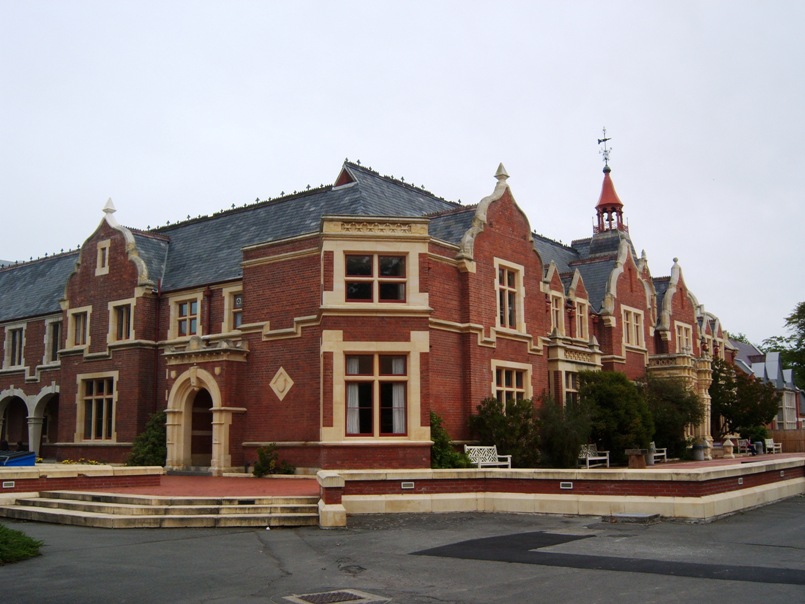
Completed in 1878-80, the original building at Lincoln College, known as Ivey Hall, was designed by Frederick Strouts and served as accommodation for twenty students and the Director of the School of Agriculture.

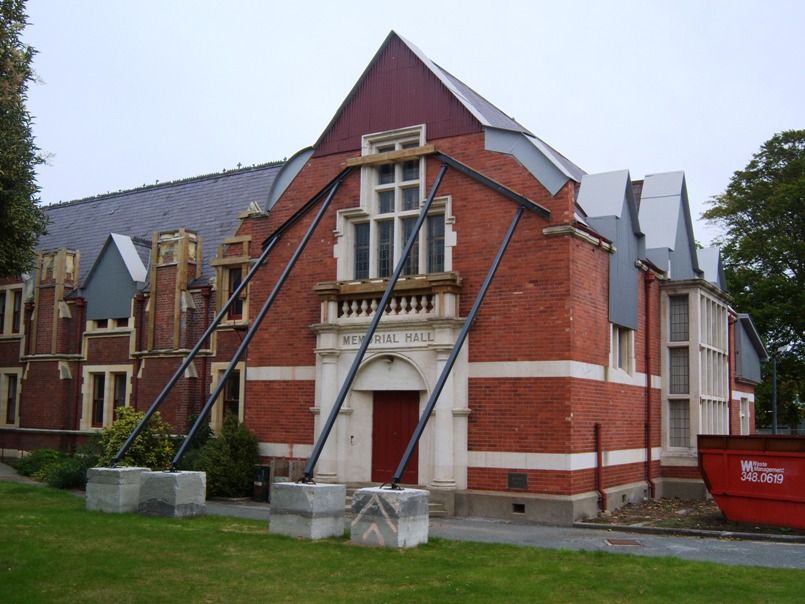
It is the oldest part of a complex designed by three architects between 1878 and 1923. Strouts designed the west wing extension in 1881. In 1918 John Guthrie designed the east wing which features an Italian Style loggia, while Cecil Wood, a pupil of Strouts, designed the Memorial Hall in 1923.

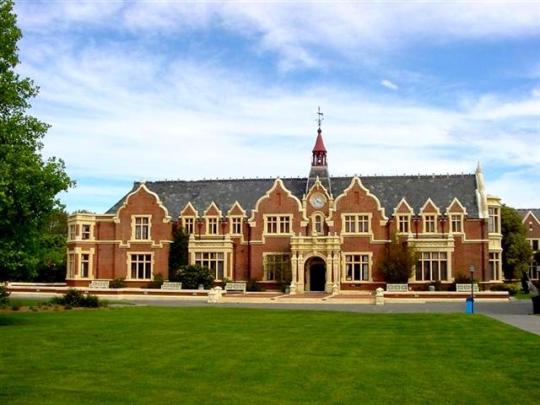
Ivey Hall is one of the earliest large Canterbury buildings to be erected in permanent materials. It is Jacobean in style with features characteristic of Flemish design.
It is notable for the contrast established between the pale red bricks thought to have been brought out to New Zealand as ballast for ships, and cream Oamaru stone used for window and gable dressings. The contrasts between materials and the variety of motifs used gives the building a very picturesque appearance. This quality is further enhanced by the expanses of lawn and trees which surround the campus.

In 1954 the building was named after W.E. Ivey, the Director of the College from 1878 until 1892.

The College has international importance and plays a central role in the agricultural development of Canterbury through its function as an institution for agricultural teaching, extension work and research. It is the third oldest agricultural college in the British Commonwealth and the first in the Southern Hemisphere to offer a course leading to a degree in agriculture.

Ivey Hall has very great architectural significance as the earliest remaining large-scale Jacobean building in New Zealand.
Ivey Hall, Lincoln University, Lincoln CC BY-SA 4.0 Image courtesy of commons.wikimedia.org | Michal Klajban | 09/12/2019 | Michal Klajban - Wikimedia Commons
Ivey Hall, Lincoln University, Lincoln | Robyn Burgess | 02/03/2012 | Heritage New Zealand Pouhere Taonga
Ivey Hall, Lincoln University, Lincoln. Memorial Hall Wing | Robyn Burgess | 02/03/2012 | Heritage New Zealand Pouhere Taonga
Ivey Hall, Lincoln University, Lincoln CC BY-SA 4.0 Image courtesy of commons.wikimedia.org | Michal Klajban | 09/12/2019 | Michal Klajban - Wikimedia Commons
Ivey Hall, Lincoln University, Lincoln | Robyn Burgess | 02/03/2012 | Heritage New Zealand Pouhere Taonga
Ivey Hall, Lincoln University, Lincoln. Memorial Hall Wing | Robyn Burgess | 02/03/2012 | Heritage New Zealand Pouhere Taonga

List Entry Information

Overview

Status
Listed

List Entry Status
Historic Place Category 1

Access
Private/No Public Access

List Number
273

Date Entered
1st September 1983

Date of Effect
1st September 1983

City/District Council
Selwyn District

Region
Canterbury Region

Legal description

Pt Lot 4 DP 6070 (RT 299902), Canterbury Land District

Location Description

North of Farm Road and east of Calder Drive

Detailed List Entry

Construction Professional

Name

Strouts, Frederick

Type

Architect

Biography

It is thought that Frederick Strouts (1834-1919) was born at Hothfield, Kent, England in 1834. He trained as an architect with John Whichcord and Son in Maidstone and then under the partnership of Arthur Ashpitel and John Whichcord junior. He arrived in New Zealand in 1859 and set up business in Christchurch with his future brother-in-law as 'General Importers & Ironmongers, Architects, Surveyors & Land Agents'. Strouts and his family returned to England, in 1868, where Strouts was elected an associate of the Royal Institute of British Architects. Upon his return to New Zealand Strouts resumed his architectural practice. He became noted for his houses, which he designed for the elite of Canterbury, including a number for Robert Heaton Rhodes. In 1871 he was appointed supervising architect for the Church of St Michael and All Angels.Two years later he acquired the commission for the Canterbury Club, after W.B. Armson fell ill. Other commissions included the former Lyttelton Harbour Board building (1880) and the Rhodes Convalescent Home in Cashmere (1885--87). He is described as being a versatile and prolific architect, and one who helped to raise the professional status of architecture in Canterbury. One of his most notable Canterbury buildings was Ivey Hall, now refurbished as part of Lincoln University. Strouts seems to have retired from practice in 1905. He died in Christchurch on 18 December 1919. (Jonathan Mane-Wheoki, 'Strouts, Frederick 1834-1919' in Dictionary of New Zealand Biography, Vol 2, 1870-1900, Wellington 1993)

Construction Details

Start Year

1878

Type

Designed

Start Year

1881

Type

Addition

Description

West wing

Start Year

1918

Type

Addition

Description

East wing

Start Year

1923

Type

Addition

Description

Memorial hall

Reference

Report Written By

This place was identified as significant under previous legislation with different information requirements. It remains significant under the current legislation. There is opportunity under our legislation and policies to add to this information. Further information about this place may be available from the Southern Regional Office of Heritage New Zealand Pouhere Taonga. Please note that entry on the New Zealand Heritage List/Rarangi Korero identifies only the heritage values of the property concerned, and should not be construed as advice on the state of the property, or as a comment of its soundness or safety, including in regard to earthquake risk, safety in the event of fire, or insanitary conditions. This historic place was registered under the Historic Places Act 1980. The following text is the original citation considered by the NZHPT Board at the time of registration. Information in square brackets indicate modifications made after the paper was considered by the NZHPT Board.

Further Information

Current Usages

Former Usages

General Usage:: Education

Specific Usage: School

Themes

Web Links

Overview

Status

Listed

List Entry Status

Historic Place Category 1

Access

Private/No Public Access

List Number

273

Date Entered

1st September 1983

Date of Effect

1st September 1983

City/District Council

Selwyn District

Region

Canterbury Region

Legal description

Pt Lot 4 DP 6070 (RT 299902), Canterbury Land District

Location Description

North of Farm Road and east of Calder Drive

Status

Listed

List Entry Status

Historic Place Category 1

Access

Private/No Public Access

List Number

273

Date Entered

1st September 1983

Date of Effect

1st September 1983

City/District Council

Selwyn District

Region

Canterbury Region

Legal description

Pt Lot 4 DP 6070 (RT 299902), Canterbury Land District

Location Description

North of Farm Road and east of Calder Drive

Construction Information

Construction Professional

Name

Strouts, Frederick

Type

Architect

Biography

It is thought that Frederick Strouts (1834-1919) was born at Hothfield, Kent, England in 1834. He trained as an architect with John Whichcord and Son in Maidstone and then under the partnership of Arthur Ashpitel and John Whichcord junior. He arrived in New Zealand in 1859 and set up business in Christchurch with his future brother-in-law as 'General Importers & Ironmongers, Architects, Surveyors & Land Agents'. Strouts and his family returned to England, in 1868, where Strouts was elected an associate of the Royal Institute of British Architects. Upon his return to New Zealand Strouts resumed his architectural practice. He became noted for his houses, which he designed for the elite of Canterbury, including a number for Robert Heaton Rhodes. In 1871 he was appointed supervising architect for the Church of St Michael and All Angels.Two years later he acquired the commission for the Canterbury Club, after W.B. Armson fell ill. Other commissions included the former Lyttelton Harbour Board building (1880) and the Rhodes Convalescent Home in Cashmere (1885--87). He is described as being a versatile and prolific architect, and one who helped to raise the professional status of architecture in Canterbury. One of his most notable Canterbury buildings was Ivey Hall, now refurbished as part of Lincoln University. Strouts seems to have retired from practice in 1905. He died in Christchurch on 18 December 1919. (Jonathan Mane-Wheoki, 'Strouts, Frederick 1834-1919' in Dictionary of New Zealand Biography, Vol 2, 1870-1900, Wellington 1993)

Construction Details

Start Year

1878

Type

Designed

Start Year

1881

Type

Addition

Description

West wing

Start Year

1918

Type

Addition

Description

East wing

Start Year

1923

Type

Addition

Description

Memorial hall

Construction Professional

Name

Strouts, Frederick

Type

Architect

Biography

It is thought that Frederick Strouts (1834-1919) was born at Hothfield, Kent, England in 1834. He trained as an architect with John Whichcord and Son in Maidstone and then under the partnership of Arthur Ashpitel and John Whichcord junior. He arrived in New Zealand in 1859 and set up business in Christchurch with his future brother-in-law as 'General Importers & Ironmongers, Architects, Surveyors & Land Agents'. Strouts and his family returned to England, in 1868, where Strouts was elected an associate of the Royal Institute of British Architects. Upon his return to New Zealand Strouts resumed his architectural practice. He became noted for his houses, which he designed for the elite of Canterbury, including a number for Robert Heaton Rhodes. In 1871 he was appointed supervising architect for the Church of St Michael and All Angels.Two years later he acquired the commission for the Canterbury Club, after W.B. Armson fell ill. Other commissions included the former Lyttelton Harbour Board building (1880) and the Rhodes Convalescent Home in Cashmere (1885--87). He is described as being a versatile and prolific architect, and one who helped to raise the professional status of architecture in Canterbury. One of his most notable Canterbury buildings was Ivey Hall, now refurbished as part of Lincoln University. Strouts seems to have retired from practice in 1905. He died in Christchurch on 18 December 1919. (Jonathan Mane-Wheoki, 'Strouts, Frederick 1834-1919' in Dictionary of New Zealand Biography, Vol 2, 1870-1900, Wellington 1993)

Construction Details

Start Year

1878

Type

Designed

Start Year

1881

Type

Addition

Description

West wing

Start Year

1918

Type

Addition

Description

East wing

Start Year

1923

Type

Addition

Description

Memorial hall

Reference

Historical and Associated Iwi / Hapū / Whānau

Other Information

This place was identified as significant under previous legislation with different information requirements. It remains significant under the current legislation. There is opportunity under our legislation and policies to add to this information. Further information about this place may be available from the Southern Regional Office of Heritage New Zealand Pouhere Taonga. Please note that entry on the New Zealand Heritage List/Rarangi Korero identifies only the heritage values of the property concerned, and should not be construed as advice on the state of the property, or as a comment of its soundness or safety, including in regard to earthquake risk, safety in the event of fire, or insanitary conditions. This historic place was registered under the Historic Places Act 1980. The following text is the original citation considered by the NZHPT Board at the time of registration. Information in square brackets indicate modifications made after the paper was considered by the NZHPT Board.

Historical and Associated Iwi / Hapū / Whānau

Other Information

This place was identified as significant under previous legislation with different information requirements. It remains significant under the current legislation. There is opportunity under our legislation and policies to add to this information. Further information about this place may be available from the Southern Regional Office of Heritage New Zealand Pouhere Taonga. Please note that entry on the New Zealand Heritage List/Rarangi Korero identifies only the heritage values of the property concerned, and should not be construed as advice on the state of the property, or as a comment of its soundness or safety, including in regard to earthquake risk, safety in the event of fire, or insanitary conditions. This historic place was registered under the Historic Places Act 1980. The following text is the original citation considered by the NZHPT Board at the time of registration. Information in square brackets indicate modifications made after the paper was considered by the NZHPT Board.

Further Information

Former Usages

General Usage: Education

Specific Usage: School

Former Usages

General Usage: Education

Specific Usage: School

Location

Loading
Stay up to date with Heritage this month