The Moawhango region has long Maori historical associations established when Tamatea-pokaiwhenua (Tamatea land explorer), grandson of the Takitimu canoe’s commander, travelled into the district and claimed it. Within a few generations Tamatea’s descendants came to the region, displacing Ngati Hotu. Following this, Ngati Whitikaupeka migrated there from northern Hawke’s Bay and forced Ngati Hotu out in the mid seventeenth century, with the aid of Ngati Tama and Tanakopiri allies. The ancestor Whitikaupeka was born in this upper Rangitikei area, known as Inland Patea, and upon his return he married and settled there. However, the inland high country between the Kaimanawa and Ruahine Ranges was sparsely populated. This was primarily because of the harsh winter conditions, although local Maori and those from around Hawke’s Bay and Taupo are said to have set up seasonal fishing and hunting camps in the hills. There are two carved houses in Moawhango. The whare called Oruamatua was constructed in the 1870s and nearby Whitikaupeka was built in the closing decade of that century.
Missionaries first ventured into the district in the mid to late 1840s, including the Reverend Richard Taylor (1805-1873) in 1845. William Colenso (1811-1899) also passed through the region on his way back to Hawke’s Bay in 1847, but it was not until 20 years later that European settlers began to farm in the vicinity. This region was relatively isolated with the main access to Inland Patea being from the Hawke’s Bay.
In the late 1860s brothers Captain Azim Salvator (1837-1923) and William John Birch (1842-1920) came to Inland Patea from the east, along with approximately 4,000 merino sheep. It was the younger of the two, William, who had immigrated to New Zealand first in 1860, from England. This was spurred by the need to carve out a new life after an investment went badly for both William and his father. William settled in Hawke’s Bay acquiring his own sheep and for a time acting as a station manager. Azim’s army career was curtailed because his father could no longer financially support this. Therefore, upon hearing of William’s enthusiasm for the opportunities in New Zealand, Azim followed a few years later and they went into partnership together, farming near Hastings. However, they soon desired to expand their activities.
After some exploratory work by Azim, it was in January 1868 that the Birch brothers created their large sheep run northeast of Moawhango by leasing part of the Kaimanawa-Oruamatua Block from Maori. Reportedly the brothers had originally wanted to lease the Owhaoko Block further east. The ownership of the Owhaoko and Kaimanawa-Oruamatua Blocks and related Native Land Court decisions were later contested, and eventually referred to Premier Robert Stout (1844-1930) in his role as Attorney-General. Walter Buller (1838-1906) had been involved in the dealings which, as several headlines stated, amounted to a ‘scandal.’ Acting on Stout’s advice, the Government passed the Owhaoko and Kaimanawa-Oruamatua Reinvestigation of Title Act 1886, which ‘returned the land to its pre-court status as native land and protected the extant leases – those of the Studholmes on Owhaoko and the Birches on Kaimanawa-Oruamatua.’
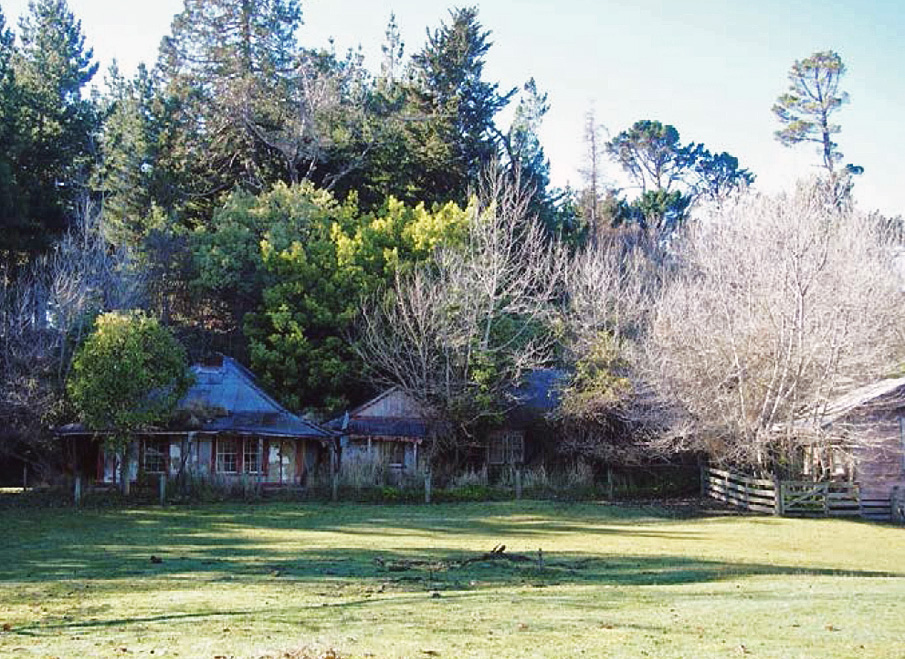
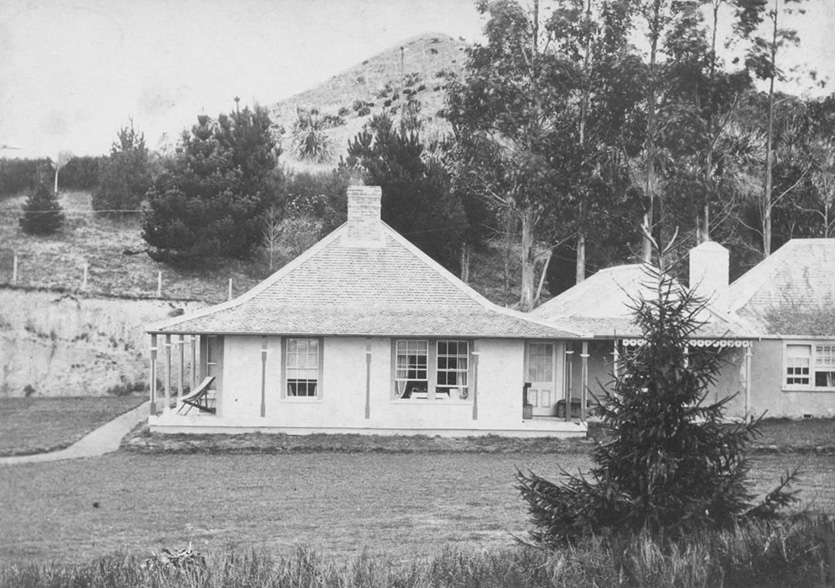
In establishing their station in 1868, the Birch brothers were the first European residents in this area, and they immediately constructed a cob house as their initial homestead. Maori Land Court evidence from Hiraka te Rango, son of Ngati Whitikaupeka rangatira Ihakara te Raro, stated that he was amongst those who assisted in constructing the homestead. Referencing Samuel Butler’s 1872 satire, the station became known as Erehwon. During William Birch’s lifetime this original spelling was upheld, which was ‘nowhere’ spelt backwards. The Birch family was from Pudlicote in Oxfordshire (central southern England), whereas cob construction is said to have been most typical amongst New Zealand settlers from south-west England. Therefore, a stronger motivation for using cob, or a cob-like mixture, seems to have been the lack of suitable timber in this high country area characterised by alpine vegetation such as tussock and bracken. Timber would have had to be carted from Hawke’s Bay up an arduous track, making it a comparatively expensive option to use for the entire building. The Birch brothers’ station was relatively isolated until the 1880s when the dray road from Hawke’s Bay reached it. Access options from the west increased in the late nineteenth and early twentieth century with the development of the North Island Main Trunk railway through Taihape.
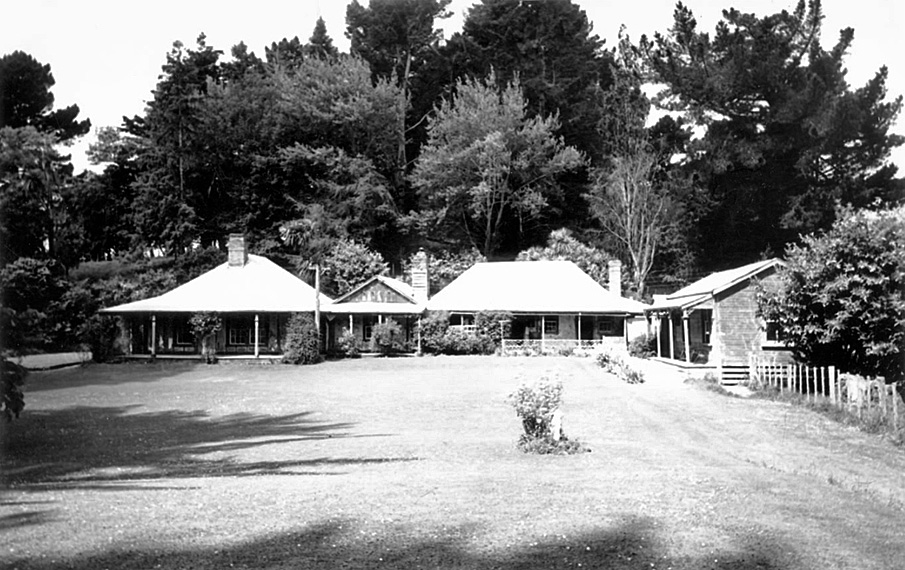
Initially the brothers seem to have shared the house. Because of these living arrangements the building was eventually expanded to 11 rooms, again in what is thought to be cob. While William and his wife Ethel did not have any children, Azim and Dora had several from the late 1870s onwards.
However, the original station was divided in 1896 and the Birch brothers’ partnership was formally dissolved the following year. Apparently the brothers had a violent quarrel, which prompted a dice throwing competition to determine which part of the station each would operate. Azim won and retained the first homestead and associated farm, Oruamatua, while William, keeping the name Erehwon, developed his farm and its residence built around 1884. At the time it seems that William Caccia-Birch, adopted son of his uncle William Birch, was living at the station. Caccia-Birch was annoyed at Azim’s decision to keep the homestead portion, musing that:
‘No words or writing can express my feelings, so perhaps silence is golden. The relief of my dear Uncle Willie having got free from such a partner will I feel sure compensate us for our sentiment.’
William and Ethel seem to have been living at the cob homestead at the time, so had to vacate, which was done by the end of March 1897.
The size of the original run is indicated by the fact that the main woolshed was five miles away from the homestead. When it was divided Azim had to build new facilities for the operation of Oruamatua. Therefore, in 1897 the stables, blacksmith’s workshop, and shed, close to the house were completed as well as a new woolshed with capacity for 2000 sheep, and staff quarters further away. At this time Mr Stoddart was the station’s manager, and he supervised the construction work undertaken by Hastings contractor, Mr Melville, and his labourers.
Aside from his farming activities, Azim was also a prominent member of the local community. For instance, he was the Patea representative on the Hawke’s Bay County Council in the 1880s and 1890s, serving alongside the likes of Thomas Tanner (1830-1918) and Robert Donald Douglas McLean (1852-1929). He was also on the Patea Road Board in the 1880s.
In the early twentieth century Azim was referred to as being of ‘South Kensington, and Oruamatua, New Zealand,’ although after the Erehwon split he is said to have predominately resided in England. Azim’s son William Reginald Birch (1881-1957) lived on site, managing the station, from 1903. When Oruamatua was sold in 1905, to Thomas Henry Lowry (1865-1944) and his brother-in-law Edward James Watt, it consisted of ‘4000 acres freehold, and 64,000 acres [of] leasehold [land], together with 32,000 sheep and 350 head of cattle…’. Earlier that year the land had been transferred to Azim, ending the almost 40 year old lease arrangement.
Lowry was from a well-established Hawke’s Bay farming family who had the Okawa station from the 1850s. He was known as ‘one of New Zealand’s leading pastoralists.’ Furthermore, Lowry was described as ‘one of the most widely-known men in New Zealand through his love of sport, his position as a breeder of cattle and racehorses, and his many patriotic gifts….’ Watt was also from a wealthy and successful family of Hawke’s Bay landowners and horse breeders from their Longlands stud. The Lowrys are known to have visited Oruamatua and stayed in the homestead. One bedroom’s ceiling was specially lined with a thin tin because Mrs Lowry is said to have been worried that rats would be able to push their way through its calico lining while she slept. Lowry and Watt later subdivided and sold off parts of the station in 1920, at which time Oruamatua was described as having ‘a comfortable residence.’
The station was one of the largest in Rangitikei County at the time in terms of the numbers of sheep it supported. For example, there were 27,500 sheep and lambs at Oruamatua in 1914. The only other local station with comparable numbers was William John Birch and Son’s Erehwon station. By 1920 Oruamatua and Robert Batley’s estate at Moawhango had similar stock numbers, placing them in the county’s top 5. Lowry and Watt initially offered land to the Government for post-First World War soldier re-settlement, but the asking price was not met. Subsequently, 23,000 acres was divided into 9 farms for private sale. The Government had established a number of soldier settlements in the Rangitikei following the First World War. However, the resulting farmlets were predominantly dedicated to dairying, which could be a reason why the high country land, better suited to sheep farming, was not as desirable to them for their re-settlement programme.
The subdivided section with the original homestead carried on the former station’s name and was purchased by Frederick Randall Cottrell in 1920. However, it seems that huge high country Rangitikei sheep stations were becoming a thing of the past by the mid-1920s. With a few exceptions, most properties in the district were like Oruamatua, having less than 5,000 sheep. This is reflective of a general trend in New Zealand in the late nineteenth and early twentieth centuries, encouraged by government policy, to break up large stations and estates.
The Cottrells have become a well-known Rangitikei farming family through their long association with Oruamatua. Frederick Cottrell and his family had a connection to Oruamatua prior to purchasing the Birch Homestead section, because Frederick had been the station manager there for several years. Frederick’s youngest son Derek Lyndsey Cottrell (1925-1992) followed as the next owner of Oruamatua. Known as Derry, he was also involved with local politics, being Erewhon Riding’s representative on the Rangitikei County Council in the mid-1970s and later a Rangitikei District councillor until his death. The family have continued to farm at Oruamatua through Derry’s son Mark.
The farm’s 1860s cob homestead continued to be used by the Cottrell family until a brick residence was constructed closer to the Taihape-Napier Road in 1960. The Birch Homestead’s residence and outbuildings have been abandoned since then and in 2013 are in a dilapidated state as a result.