DonateMembershipVisit Heritage
  • Tūrangawaewae
    Places
  • Tira Māori
    Māori Heritage
  • Poutairangahia
    Archaeology
  • Rauemi
    Resources
  • Mō Tātou
    About Us
  • New Zealand Heritage List
  • Nominate and submit
  • Explore the List
  • National Historic Landmarks
  • Plaques
  • Rainbow List Project
  • Lost heritage
  • Visit Heritage
  • Our properties
  • Turnbull House Project
  • Collections
  • Shop
  • Tohu Whenua
  • Tira Māori
  • Conserving Māori heritage
  • Marae built heritage
  • Māori heritage on the List
  • Hinemihi—Te Hokinga Mai
  • What is archaeology?
  • Is there a site on my property?
  • What are my legal requirements?
  • Affecting an archaeological site
  • Declaring an archaeological site
  • Archaeology FAQs
  • Archaeology Digital Library
  • Archaeology guidelines and templates
  • Resources
  • Funding
  • Publications
  • Sustainable management guides
  • Disaster recovery
  • Podcasts & digital resources
  • Education Hub
  • Conservation plans
  • About
  • Board
  • Māori Heritage Council
  • Senior Staff
  • Offices
  • Contact us
  • Careers
  • Covenants
  • Fast-track
  • Corporate documents
  • Currently consulting on
  • Our submissions
  • News
  • Covid-19 response
Quick links
Rārangi Kōrero | The List
Explore the List
National Historic Landmarks
Ngā Manawhenua o Aotearoa me ōna Kōrero Tūturu
Quick links
Tapuwae
A Vision for Places of Māori Heritage
Funding for Māori Heritage
Resources
Quick links
Archaeological Authority Portal
Applying for an archaeological authority
Archaeology FAQs
Browse the most frequently asked questions about archaeological authorities and the archaeological process.
Quick links
Quick links
News
News Keep up to date with Heritage New Zealand Pouhere Taonga
Membership
Membership Find out more and sign up today
DonateMembershipVisit Heritage
  • Tūrangawaewae
    Places
  • Tira Māori
    Māori Heritage
  • Poutairangahia
    Archaeology
  • Rauemi
    Resources
  • Mō Tātou
    About Us
  • New Zealand Heritage List
  • Nominate and submit
  • Explore the List
  • National Historic Landmarks
  • Plaques
  • Rainbow List Project
  • Lost heritage
  • Visit Heritage
  • Our properties
  • Turnbull House Project
  • Collections
  • Shop
  • Tohu Whenua
  • Tira Māori
  • Conserving Māori heritage
  • Marae built heritage
  • Māori heritage on the List
  • Hinemihi—Te Hokinga Mai
  • What is archaeology?
  • Is there a site on my property?
  • What are my legal requirements?
  • Affecting an archaeological site
  • Declaring an archaeological site
  • Archaeology FAQs
  • Archaeology Digital Library
  • Archaeology guidelines and templates
  • Resources
  • Funding
  • Publications
  • Sustainable management guides
  • Disaster recovery
  • Podcasts & digital resources
  • Education Hub
  • Conservation plans
  • About
  • Board
  • Māori Heritage Council
  • Senior Staff
  • Offices
  • Contact us
  • Careers
  • Covenants
  • Fast-track
  • Corporate documents
  • Currently consulting on
  • Our submissions
  • News
  • Covid-19 response
Quick links
Rārangi Kōrero | The List
Explore the List
National Historic Landmarks
Ngā Manawhenua o Aotearoa me ōna Kōrero Tūturu
Quick links
Tapuwae
A Vision for Places of Māori Heritage
Funding for Māori Heritage
Resources
Quick links
Archaeological Authority Portal
Applying for an archaeological authority
Archaeology FAQs
Browse the most frequently asked questions about archaeological authorities and the archaeological process.
Quick links
Quick links
News
News Keep up to date with Heritage New Zealand Pouhere Taonga
Membership
Membership Find out more and sign up today
  • Nominate and submit
  • National Historic Landmarks
  • Nominate and submit
  • National Historic Landmarks
  • Conserving Māori heritage
  • Marae built heritage
  • Conserving Māori heritage
  • Marae built heritage
  • Archaeological authorities
  • Archaeology Digital Library
  • Archaeological authorities
  • Archaeology Digital Library
  • All resources
  • Publications
  • Funding
  • All resources
  • Publications
  • Funding
  • FAQs
  • FAQs
Follow us on:
Places
  • Nominate and submit
  • National Historic Landmarks
Tira Māori
  • Conserving Māori heritage
  • Marae built heritage
Archaeology
  • Archaeological authorities
  • Archaeology Digital Library
Resources
  • All resources
  • Publications
  • Funding
FAQs
  • FAQs
Follow us on
HomePrivacyTerms and conditionsAbout this site
© Heritage New Zealand Pouhere Taonga 2026.
 
Inveresk

17 Armagh Street, CHRISTCHURCH

Private

Historic Place Category 2

List No. 3117

Quick links:
List GalleryLocationDetails
The site of Inveresk, 17 Armagh St, was originally granted to Church Property Trustees in 1858. In 1863 the site was transferred to Withnall, to George Roberts in 1872, and then to Violet Cobb in 1875. Between 1863 and 1878, a small single storey cottage was built on the site. In 1879 the property was sold to John Anderson Jnr.

John Anderson Jnr. (1850-1934) was the son of John Anderson (1820-97), pioneer, second mayor of Christchurch (1869), and founder of the Canterbury Iron Foundry (1857) - the first in the city. Born in Edinburgh in 1850, John Jnr. came to Christchurch later that year with his parents aboard the 'Sir George Seymour', one of the First Four Ships. Returning to Scotland in 1866 with his brother Andrew, he was educated at Merchiston Castle, Edinburgh, and studied mechanical engineering with the firm of P & W McLellan in Glasgow. John Jnr. joined his father in the family foundry following his return to Christchurch in 1873, took over the business with his brother in 1881, and assumed joint ownership following his father's death in 1897. After the foundry became a limited company in 1903, John Jnr. served as chairman of the board of directors until his death. Like his father, John Jnr. was civic minded. He served on the Christchurch City Council, was president of the Canterbury Agricultural and Pastoral Association, a director of the New Zealand Shipping Company, a member of the Chamber of Commerce, and a member of the Board of Governors of Canterbury College. In 1879 he married Frances Pratt, and they were to have five children. Frances was the daughter of William Pratt, whose drapery business 'Dunstable House' formed the basis of Canterbury institution, Ballantyne's, in 1872.

Anderson's Foundry played a vital role in the early development of engineering in the colony. The firm constructed many early bridges in the colony, and built mining dredges, cranes, boilers, and other heavy machinery. Anderson's was also involved in constructing sections of the main trunk railway in the North Island. The foundry, one of Christchurch's oldest and most successful businesses, closed in 1986 after 136 years of operation. The original foundry buildings were subsequently demolished.

During the 1870s John Snr. built a new home for his family in Cashel St, close to St Paul's Presbyterian church. This house he named 'Inveresk' after his birthplace in Midlothian, near Edinburgh. Inveresk was sold in 1907, and it was presumably at this time that John Jnr. adopted the name for his Armagh St property.

As John and Frances's family grew, the Armagh St Inveresk was enlarged. In about 1880, a two storey domestic gothic portion was added to the south and west of the original cottage. Then in 1890, an ornate single storey villa was added to the south of the gothic portion. Inveresk was the fifth house in Christchurch to be connected to the sewer, and one of the first twelve houses to be connected to electricity.

The Anderson's used Inveresk and its once extensive gardens as a 'centre of much entertainment'. In 1900 an Anniversary Day function was attended by most of the surviving passengers of the First Four Ships. Sixty years later, Pilgrim and Early Settlers Association members gathered at the house for a garden party.

One of the Anderson's daughters, Dorothy, cared for her parents, and remained at Inveresk until her death in 1967. The house was then sold by the family to the Church Property Trustees, who transferred it to the Cathedral Grammar School Trust Board in 1972. Inveresk subsequently served as the headmasters' residence. Internal alterations were carried out in 1973 and 1986. During one of these alterations, the house was divided into two flats; one upstairs, and one down. By the 1990s some rooms were unoccupied, and being used for storage.

In 1994 Cathedral Grammar School announced the formation of a new girls' school, and that Inveresk would be removed or demolished to provide a site for the necessary new premises. After intervention by the Christchurch City Council and NZHPT, the school decided in 1995 that the house could be renovated to serve this purpose. Architects Trengrove and Blunt carried out the alterations. Although the exterior remained substantially unchanged - with the exception of a new bay window on the west elevation - the ground floor interior was significantly modified. A number of walls and chimneys were removed to provide classroom space. Upstairs, a self-contained flat was initially maintained, but later integrated into the school as a classroom in 1997.

In 2001 Cathedral Grammar applied for resource consent to demolish the rear sections of Inveresk, and replace them with a new two-storey structure to provide more classroom space for the Girls' School. The demolition was opposed and after consultation the application was withdrawn. The Girls' School remained in Inveresk until the end of 2003, after which they moved to a purpose-built building elsewhere in the Cathedral Grammar grounds. The vacant house was subsequently leased to E-time, a new company established to provide electronic learning opportunities to Canterbury schoolchildren. Internal alterations were again carried out by Trengrove and Blunt, and E-time opened for business at the beginning of 2004.
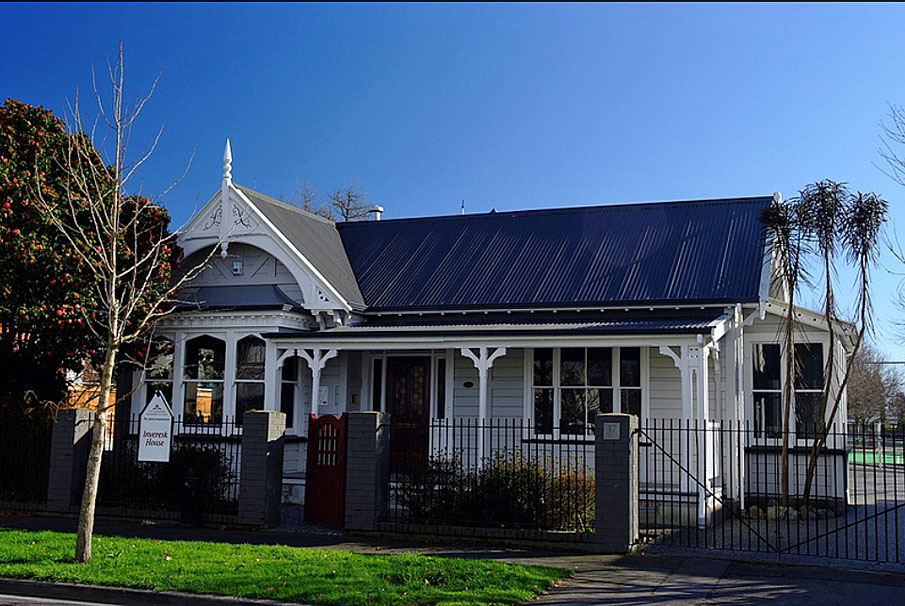
Inveresk. Image courtesy of vallance.photography@xtra.co.nz | Francis Vallance | 01/09/2013 | Francis Vallance
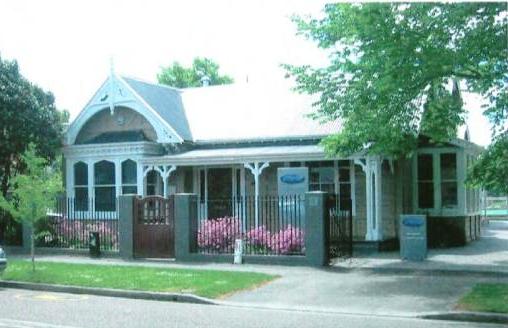
Inveresk. South elevation | Pam Wilson | 01/10/2004 | NZ Historic Places Trust
Inveresk. Image courtesy of vallance.photography@xtra.co.nz | Francis Vallance | 01/09/2013 | Francis Vallance
Inveresk. South elevation | Pam Wilson | 01/10/2004 | NZ Historic Places Trust

List Entry Information

Overview

Status
Listed

List Entry Status
Historic Place Category 2

Access
Private/No Public Access

List Number
3117

Date Entered
14th April 2005

Date of Effect
14th April 2005

City/District Council
Christchurch City

Region
Canterbury Region

Extent of List Entry

Registration includes the building, its fittings and fixtures, and the site on RT CB12B/738.

Legal description

Lot 1 DP 29859 (RT CB12B/738), Canterbury Land District

Detailed List Entry
Significance

Cultural Significance

Social significance as a built reflection of the changing economic, social, and family circumstances of the Andersons over less than two decades.

Historic Significance

Historical Significance or Value It has historical significance as the home of prominent businessman John Anderson Jnr. and his family.

Physical Significance

Inveresk has architectural significance as an illustration of changing architectural styles in New Zealand over the late nineteenth century. This is illustrated by the additions made to the house as the family's need for space increased.

Detail Of Assessed Criteria

(a) it charts the growth and development of a socially aspirant Victorian family. (b) it is associated with John Anderson, a proprietor of once nationally prominent company, Anderson's Foundry. (g) it reflects in one building, three phases in the development of domestic architecture in New Zealand in the later nineteenth century. (k) forms part of the very significant historical landscape of inner city west Christchurch.

Construction Professional

Name

Tengrove & Blunt

Type

Architectural Partnership

Biography

No biography is currently available for this construction professional

Construction Details

Start Year

1863

Type

Original Construction

Description

Probable construction of original cottage.

Start Year

1880

Type

Modification

Description

Addition of two storey domestic gothic portion.

Start Year

1890

Type

Modification

Description

Addition of single storey villa portion.

Start Year

1997

Type

Modification

Description

Conversion of upstairs flat to classrooms.

Start Year

2003

Type

Modification

Description

Internal alterations for lease to E-time, a private learning centre.

Construction Materials

Timber with an iron roof.

Physical Description

A large timber residence built in three distinct stages; the original and much modified small cottage at rear, a simple two storey domestic gothic portion wrapping around the south and west sides of the cottage, and a more elaborate gothic-influenced single storey villa facing Armagh St. The latter has square bay windows and timber fretwork.

Reference

Information Sources

Andersons, 1950

100 Years: Being an Account of the Founding, Development and Progress of Andersons 1850-1950, Christchurch: Caxton Press, 1950.

Anderson, 1977

H. Anderson, The Days Run, Christchurch: Caxton Press, 1977.

Christchurch City Council

Christchurch City Council

New Zealand Historic Places Trust (NZHPT)

New Zealand Historic Places Trust

Report Written By

A fully referenced version of this report is available from the NZHPT Southern Region Office. Please note that entry on the New Zealand Heritage List/Rarangi Korero identifies only the heritage values of the property concerned, and should not be construed as advice on the state of the property, or as a comment of its soundness or safety, including in regard to earthquake risk, safety in the event of fire, or insanitary conditions.

Further Information

Current Usages

Uses: Education

Specific Usage: School

Former Usages

General Usage:: Accommodation

Specific Usage: House

Themes

Web Links

Overview

Status

Listed

List Entry Status

Historic Place Category 2

Access

Private/No Public Access

List Number

3117

Date Entered

14th April 2005

Date of Effect

14th April 2005

City/District Council

Christchurch City

Region

Canterbury Region

Extent of List Entry

Registration includes the building, its fittings and fixtures, and the site on RT CB12B/738.

Legal description

Lot 1 DP 29859 (RT CB12B/738), Canterbury Land District

Status

Listed

List Entry Status

Historic Place Category 2

Access

Private/No Public Access

List Number

3117

Date Entered

14th April 2005

Date of Effect

14th April 2005

City/District Council

Christchurch City

Region

Canterbury Region

Extent of List Entry

Registration includes the building, its fittings and fixtures, and the site on RT CB12B/738.

Legal description

Lot 1 DP 29859 (RT CB12B/738), Canterbury Land District

Significance

Why is this place significant?

Cultural Significance

Social significance as a built reflection of the changing economic, social, and family circumstances of the Andersons over less than two decades.

Historic Significance

Historical Significance or Value It has historical significance as the home of prominent businessman John Anderson Jnr. and his family.

Physical Significance

Inveresk has architectural significance as an illustration of changing architectural styles in New Zealand over the late nineteenth century. This is illustrated by the additions made to the house as the family's need for space increased.

Why is this place Category 1 / Category 2?

Detail Of Assessed Criteria

(a) it charts the growth and development of a socially aspirant Victorian family. (b) it is associated with John Anderson, a proprietor of once nationally prominent company, Anderson's Foundry. (g) it reflects in one building, three phases in the development of domestic architecture in New Zealand in the later nineteenth century. (k) forms part of the very significant historical landscape of inner city west Christchurch.

Why is this place significant?

Cultural Significance

Social significance as a built reflection of the changing economic, social, and family circumstances of the Andersons over less than two decades.

Historic Significance

Historical Significance or Value It has historical significance as the home of prominent businessman John Anderson Jnr. and his family.

Physical Significance

Inveresk has architectural significance as an illustration of changing architectural styles in New Zealand over the late nineteenth century. This is illustrated by the additions made to the house as the family's need for space increased.

Why is this place Category 1 / Category 2?

Detail Of Assessed Criteria

(a) it charts the growth and development of a socially aspirant Victorian family. (b) it is associated with John Anderson, a proprietor of once nationally prominent company, Anderson's Foundry. (g) it reflects in one building, three phases in the development of domestic architecture in New Zealand in the later nineteenth century. (k) forms part of the very significant historical landscape of inner city west Christchurch.

Construction Information

Construction Professional

Name

Tengrove & Blunt

Type

Architectural Partnership

Biography

No biography is currently available for this construction professional

Construction Details

Start Year

1863

startYearCirca

Type

Original Construction

Description

Probable construction of original cottage.

Start Year

1880

startYearCirca

Type

Modification

Description

Addition of two storey domestic gothic portion.

Start Year

1890

startYearCirca

Type

Modification

Description

Addition of single storey villa portion.

Start Year

1997

Type

Modification

Description

Conversion of upstairs flat to classrooms.

Start Year

2003

Type

Modification

Description

Internal alterations for lease to E-time, a private learning centre.

Construction Materials

Timber with an iron roof.

Construction Professional

Name

Tengrove & Blunt

Type

Architectural Partnership

Biography

No biography is currently available for this construction professional

Construction Details

Start Year

1863

startYearCirca

Type

Original Construction

Description

Probable construction of original cottage.

Start Year

1880

startYearCirca

Type

Modification

Description

Addition of two storey domestic gothic portion.

Start Year

1890

startYearCirca

Type

Modification

Description

Addition of single storey villa portion.

Start Year

1997

Type

Modification

Description

Conversion of upstairs flat to classrooms.

Start Year

2003

Type

Modification

Description

Internal alterations for lease to E-time, a private learning centre.

Construction Materials

Timber with an iron roof.

Physical Description

A large timber residence built in three distinct stages; the original and much modified small cottage at rear, a simple two storey domestic gothic portion wrapping around the south and west sides of the cottage, and a more elaborate gothic-influenced single storey villa facing Armagh St. The latter has square bay windows and timber fretwork.

A large timber residence built in three distinct stages; the original and much modified small cottage at rear, a simple two storey domestic gothic portion wrapping around the south and west sides of the cottage, and a more elaborate gothic-influenced single storey villa facing Armagh St. The latter has square bay windows and timber fretwork.

Reference

Historical and Associated Iwi / Hapū / Whānau

Information Sources

Andersons, 1950

100 Years: Being an Account of the Founding, Development and Progress of Andersons 1850-1950, Christchurch: Caxton Press, 1950.

Anderson, 1977

H. Anderson, The Days Run, Christchurch: Caxton Press, 1977.

Christchurch City Council

Christchurch City Council

New Zealand Historic Places Trust (NZHPT)

New Zealand Historic Places Trust

Other Information

A fully referenced version of this report is available from the NZHPT Southern Region Office. Please note that entry on the New Zealand Heritage List/Rarangi Korero identifies only the heritage values of the property concerned, and should not be construed as advice on the state of the property, or as a comment of its soundness or safety, including in regard to earthquake risk, safety in the event of fire, or insanitary conditions.

Historical and Associated Iwi / Hapū / Whānau

Information Sources

Andersons, 1950

100 Years: Being an Account of the Founding, Development and Progress of Andersons 1850-1950, Christchurch: Caxton Press, 1950.

Anderson, 1977

H. Anderson, The Days Run, Christchurch: Caxton Press, 1977.

Christchurch City Council

Christchurch City Council

New Zealand Historic Places Trust (NZHPT)

New Zealand Historic Places Trust

Other Information

A fully referenced version of this report is available from the NZHPT Southern Region Office. Please note that entry on the New Zealand Heritage List/Rarangi Korero identifies only the heritage values of the property concerned, and should not be construed as advice on the state of the property, or as a comment of its soundness or safety, including in regard to earthquake risk, safety in the event of fire, or insanitary conditions.

Further Information

Current Usages

Uses: Education

Specific Usage: School

Former Usages

General Usage: Accommodation

Specific Usage: House

Current Usages

Uses: Education

Specific Usage: School

Former Usages

General Usage: Accommodation

Specific Usage: House

Location

Loading
Stay up to date with Heritage this month