Constructed in 1935-36 as a large complex of flats, the building known as Victoria Mansions at 91 Victoria Street and Montreal Street in central Christchurch has architectural and aesthetic significance as a reinforced concrete Moderne style building designed by noted inter-war Christchurch architect, Heathcote Helmore. The building has historical and social significance as a new type of central city accommodation, demonstrating the way of life of past residents, including that of country visitors requiring short-term stays.
From the mid nineteenth century, Victoria Street (known as Whately Road until after the late 1870s) was a major thoroughfare and a centre of commercial and other activity. Early town maps show that there were structures on this specific site by 1877. During the 1930s there was a significant increase in the number of flats built in the city and tenants were beginning to demand a high standard of comfort from landlords. The Victoria Mansions building was a large and up-to-date block of 21 flats, designed by Heathcote Helmore, principal of Helmore and Cotterill architects. Although designed in 1931, construction did not begin until June 1935 and was completed about a year later, at a cost of approximately ₤20,000. At the time, the Victoria Mansions building was described as being ‘on almost an island site … there will be only five flats on each of the four floors, and another flat of the penthouse type on the roof. The flats will be of the three-room, two-room, and bed-sitting room type … the rooms will be larger than those of the usual flat. The larger rooms will have fireplaces, and most of the flats will have balconies. All the flats will have a hot-water service, and central heating…’. The new style accommodation was in high demand and all the flats were already let several months in advance of the building’s completion. A caretaker’s flat was included within the building. Adjoining the shorter east elevation there was originally a single storey annex housing a café, and next to this fronting Victoria Street were garages for those residents with a motorcar.
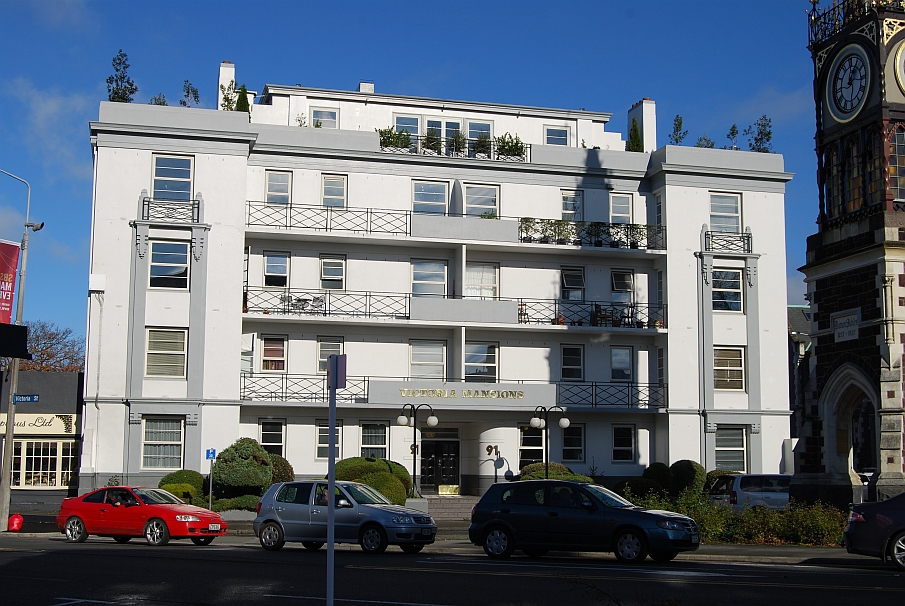
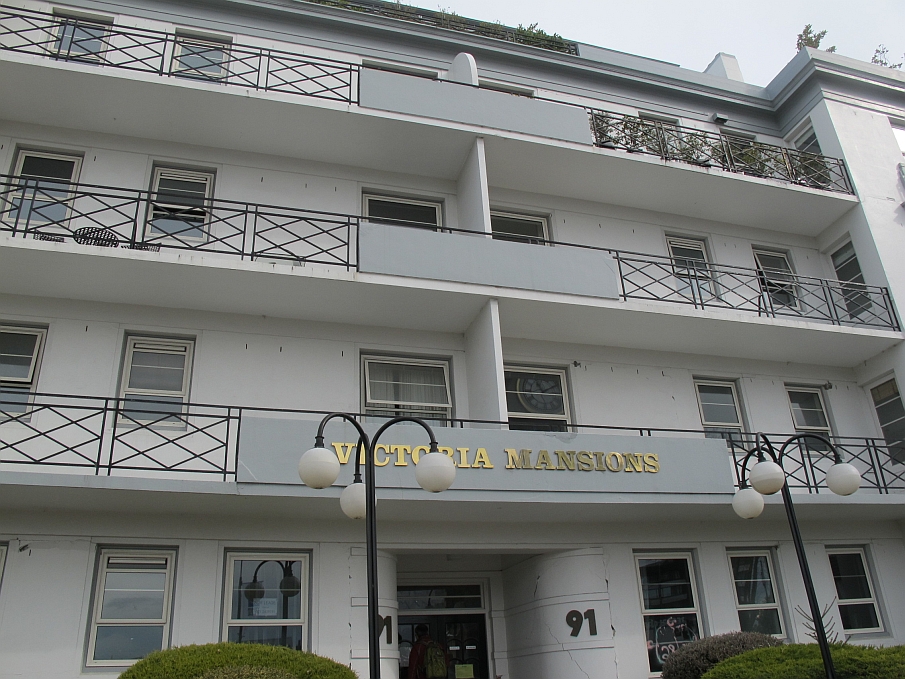
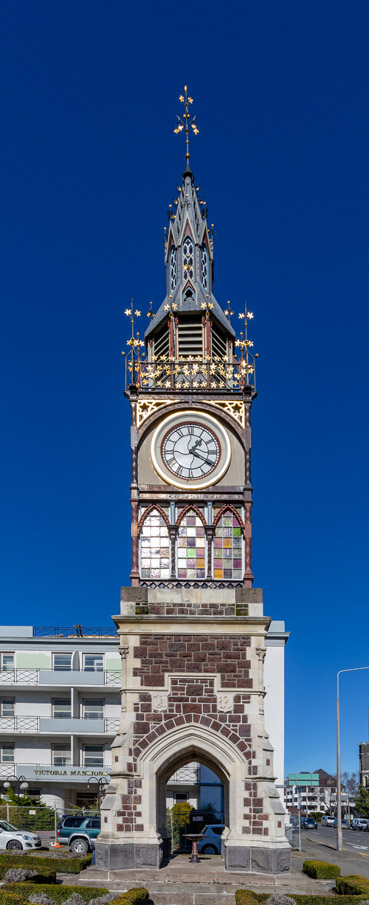
With an L-shaped footprint, the Moderne style Victoria Mansions appears as a corner building, with the main façade fronting north towards an adjoining triangular reserve land parcel containing the Victoria Clock Tower. The other main façade fronts Montreal Street to the west and the shorter eastern side fronts Victoria Street. The building has four storeys and a penthouse apartment atop a flat roof. The building is constructed of reinforced concrete, with brick in-fill and a cement finish. Windows are simple rectilinear forms and detailing incorporates simplified classical elements. Many of the flats possess a balcony, and on the west façade these are cantilevered.
Although essentially utilised as residential accommodation, on occasion some flats have operated as a business. One part, for example, operated as a doctor’s surgery for over a decade. Internal changes have been made to some of the apartments over time but some original fixtures and fittings still remain in the building, including an Art Deco style Otis lift to service each of the floors. Victoria Mansions was damaged in the Canterbury earthquakes of 2010-11. The single storeyed annex was subsequently demolished. The building is currently being repaired and seismically upgraded in 2017, with financial assistance from the Christchurch City Council.
From the mid nineteenth century, Victoria Street (known as Whately Road until after the late 1870s) was a major thoroughfare and a centre of commercial and other activity. Early town maps show that there were structures on this specific site by 1877. During the 1930s there was a significant increase in the number of flats built in the city and tenants were beginning to demand a high standard of comfort from landlords. The Victoria Mansions building was a large and up-to-date block of 21 flats, designed by Heathcote Helmore, principal of Helmore and Cotterill architects. Although designed in 1931, construction did not begin until June 1935 and was completed about a year later, at a cost of approximately ₤20,000. At the time, the Victoria Mansions building was described as being ‘on almost an island site … there will be only five flats on each of the four floors, and another flat of the penthouse type on the roof. The flats will be of the three-room, two-room, and bed-sitting room type … the rooms will be larger than those of the usual flat. The larger rooms will have fireplaces, and most of the flats will have balconies. All the flats will have a hot-water service, and central heating…’. The new style accommodation was in high demand and all the flats were already let several months in advance of the building’s completion. A caretaker’s flat was included within the building. Adjoining the shorter east elevation there was originally a single storey annex housing a café, and next to this fronting Victoria Street were garages for those residents with a motorcar.
With an L-shaped footprint, the Moderne style Victoria Mansions appears as a corner building, with the main façade fronting north towards an adjoining triangular reserve land parcel containing the Victoria Clock Tower. The other main façade fronts Montreal Street to the west and the shorter eastern side fronts Victoria Street. The building has four storeys and a penthouse apartment atop a flat roof. The building is constructed of reinforced concrete, with brick in-fill and a cement finish. Windows are simple rectilinear forms and detailing incorporates simplified classical elements. Many of the flats possess a balcony, and on the west façade these are cantilevered.
Although essentially utilised as residential accommodation, on occasion some flats have operated as a business. One part, for example, operated as a doctor’s surgery for over a decade. Internal changes have been made to some of the apartments over time but some original fixtures and fittings still remain in the building, including an Art Deco style Otis lift to service each of the floors. Victoria Mansions was damaged in the Canterbury earthquakes of 2010-11. The single storeyed annex was subsequently demolished. The building is currently being repaired and seismically upgraded in 2017, with financial assistance from the Christchurch City Council.