

Māori connection to Te Whanganui-a-Tara reaches back to the oral traditions of the Polynesian navigator, Kupe. There were numerous pā and kainga around the Wellington region and Te Aro Pā was one of the largest Māori settlements in the region when European colonisation began in 1840. William Mein Smith laid out what became Newtown as town acres in the New Zealand Company’s original plan. The suburb’s development burgeoned in the 1870s and this building sits on land subdivided in 1890s.
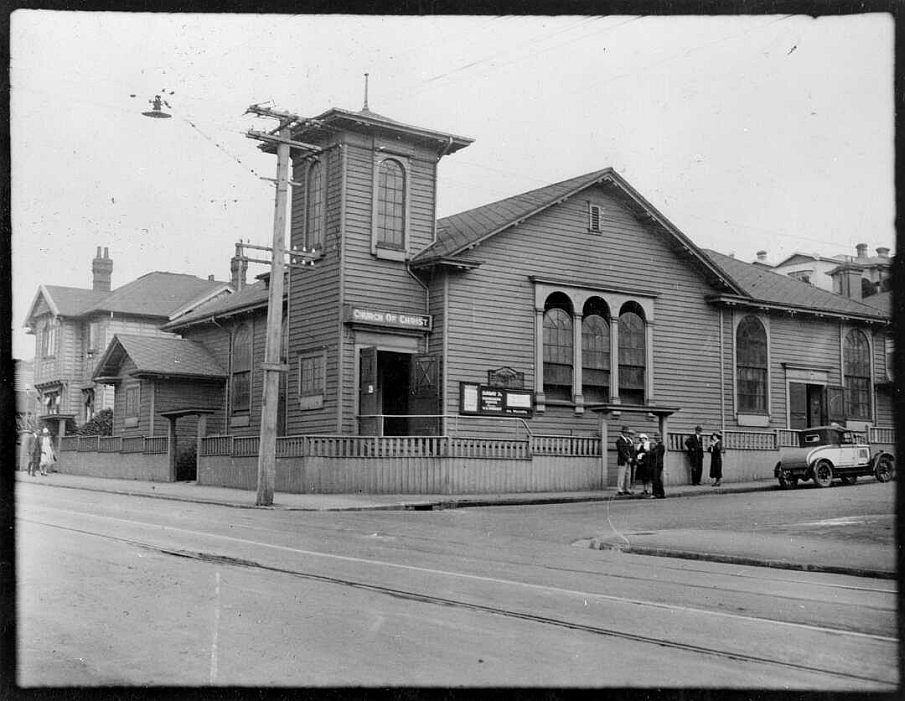
The Church of Christ was brought to New Zealand by Thomas Jackson, a Scottish migrant who began preaching in Nelson in March 1844. The Church was first formed in Europe during the Protestant Restoration Movement in 19th century, looking to the New Testament for spiritual guidance and striving to unify Christian denominations into a single church. The movement was established in Wellington in 1869 and in the early 1900s the Church of Christ purchased the site for their church. P. Watt undertook the build and it was completed in February 1915 at a cost £4,000. The congregation hosted meetings to promote cooperation between different Wellington denominations. It was also a dance venue.
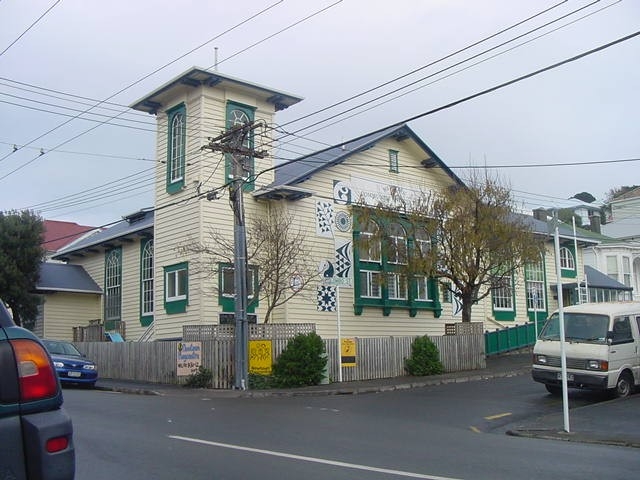
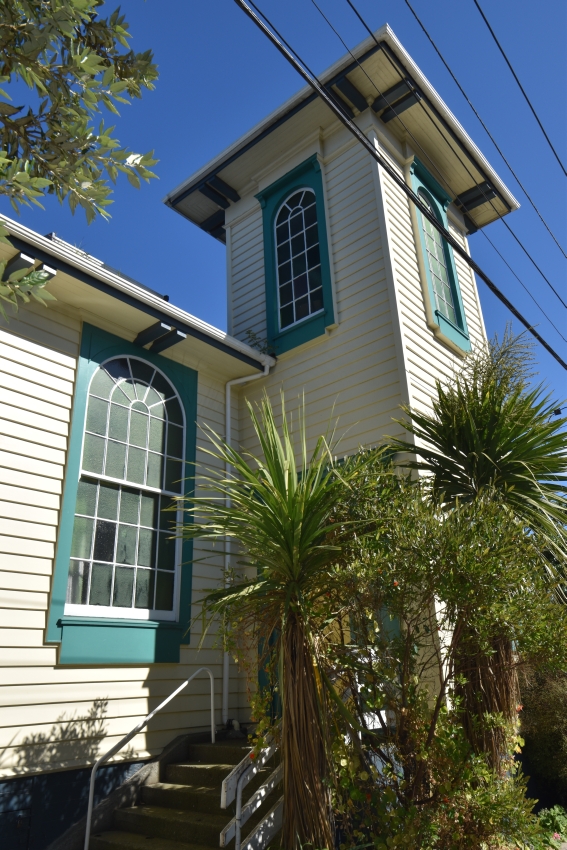
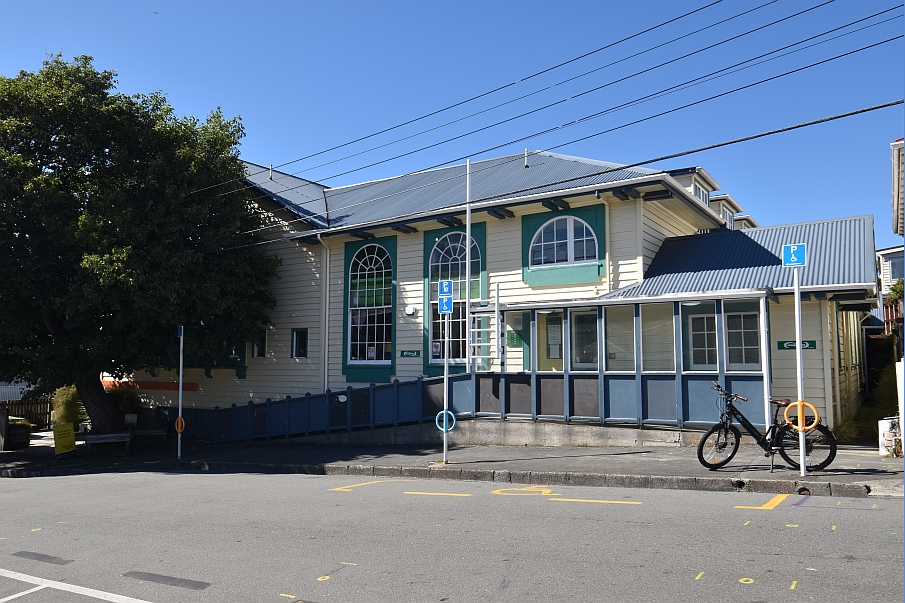
This is a representative example of an early 20th century ‘Non-Conformist’ church designed in Italianate style. It was one of the earliest designs of the versatile and nationally significant architect William Gray Young. The church was constructed in timber, with concrete foundations, a gabled roof and a tall, two-storey square tower.
It was damaged by fire twice - first in 1942 and again in 1970 by vandals with fire crackers. The building was purchased by the Wellington City Council in 1975. Renovations were undertaken, and it reopened in 1977 as a community centre. In the 1990s the building was re-piled, re-floored and the walls were re-lined.
The Community Centre is still well-used, hosting school holiday programmes and ‘a variety of concerts, gigs, theatrical performances, exercise and language classes, and cultural activities for our diverse Newtown community…and [is] home to a number of community services, including the Wellington Time Bank, the Newtown Citizens’ Advice Bureau and the Newtown Tool Library’.
List Entry Information
Status
Listed
List Entry Status
Historic Place Category 2
Access
Private/No Public Access
List Number
3597
Date Entered
28th June 1984
Date of Effect
28th June 1984
City/District Council
Wellington City
Region
Wellington Region
Extent of List Entry
Extent includes the land described as Pt Lots 1-2 DP 1312 (NZ Gazette 1978, p.2110), Wellington Land District and the building known as Newtown Community Centre thereon.
Legal description
Pt Lots 1-2 DP 1312 (NZ Gazette 1978, p.2110), Wellington Land District
Status
Listed
List Entry Status
Historic Place Category 2
Access
Private/No Public Access
List Number
3597
Date Entered
28th June 1984
Date of Effect
28th June 1984
City/District Council
Wellington City
Region
Wellington Region
Extent of List Entry
Extent includes the land described as Pt Lots 1-2 DP 1312 (NZ Gazette 1978, p.2110), Wellington Land District and the building known as Newtown Community Centre thereon.
Legal description
Pt Lots 1-2 DP 1312 (NZ Gazette 1978, p.2110), Wellington Land District
Construction Professional
Name
P Watt
Type
Builder
Biography
No biography is currently available for this construction professional
Name
Young, William G
Type
Architect
Biography
William Gray Young (1885-1962) was born in Oamaru. When he was a child his family moved to Wellington where he was educated. After leaving school he was articled to the Wellington architectural firm of Crichton and McKay. In 1906 he won a competition for the design of Knox College, Dunedin, and shortly after this he commenced practice on his own account. He became a prominent New Zealand architect and during a career of 60 years he designed over 500 buildings. His major buildings include the Wellington and Christchurch Railway Stations (1936 and 1954 respectively), Scot's College (1919), Phoenix Assurance Building (1930) and the Australian Mutual Provident Society (AMP) Chambers (1950). At Victoria University College of Wellington he was responsible for the Stout (1930), Kirk (1938), and Easterfield (1957) buildings, and Weir House (1930). Gray Young also achieved recognition for his domestic work such as the Elliott House Wellington, (1913). His design for the Wellesley Club (1925) earned him the Gold Medal of the New Zealand Institute of Architects in 1932. He was elected a Fellow of the Institute in 1913, served on the executive committee from 1914-35 and was President from 1935-36. He was also elected a Fellow of the Royal Institute of British Architects, and achieved prominence in public affairs.
Construction Details
Start Year
1913
Type
Original Construction
Start Year
1977
Type
Refurbishment/renovation
Start Year
2021
Type
Maintenance/repairs
Description
Repairs and Alterations
Construction Professional
Name
P Watt
Type
Builder
Biography
No biography is currently available for this construction professional
Name
Young, William G
Type
Architect
Biography
William Gray Young (1885-1962) was born in Oamaru. When he was a child his family moved to Wellington where he was educated. After leaving school he was articled to the Wellington architectural firm of Crichton and McKay. In 1906 he won a competition for the design of Knox College, Dunedin, and shortly after this he commenced practice on his own account. He became a prominent New Zealand architect and during a career of 60 years he designed over 500 buildings. His major buildings include the Wellington and Christchurch Railway Stations (1936 and 1954 respectively), Scot's College (1919), Phoenix Assurance Building (1930) and the Australian Mutual Provident Society (AMP) Chambers (1950). At Victoria University College of Wellington he was responsible for the Stout (1930), Kirk (1938), and Easterfield (1957) buildings, and Weir House (1930). Gray Young also achieved recognition for his domestic work such as the Elliott House Wellington, (1913). His design for the Wellesley Club (1925) earned him the Gold Medal of the New Zealand Institute of Architects in 1932. He was elected a Fellow of the Institute in 1913, served on the executive committee from 1914-35 and was President from 1935-36. He was also elected a Fellow of the Royal Institute of British Architects, and achieved prominence in public affairs.
Construction Details
Start Year
1913
Type
Original Construction
Start Year
1977
Type
Refurbishment/renovation
Start Year
2021
Type
Maintenance/repairs
Description
Repairs and Alterations
Historical and Associated Iwi / Hapū / Whānau
Completion Date
15th February 2021
Report Written By
Miranda Williamson
Information Sources
WCC Heritage Inventory, Wellington City Council
https://wellingtoncityheritage.org.nz/buildings/151-300/261-newtown-community-centre?q= accessed: 27 Jan 2021.
Other Information
This place was identified as significant under previous legislation with different information requirements. It remains significant under the current legislation. There is opportunity under our legislation and policies to add to this information. Further information about this place may be available from the Central Regional Office of Heritage New Zealand Pouhere Taonga. Please note that entry on the New Zealand Heritage List/Rarangi Korero identifies only the heritage values of the property concerned, and should not be construed as advice on the state of the property, or as a comment of its soundness or safety, including in regard to earthquake risk, safety in the event of fire, or insanitary conditions.
Historical and Associated Iwi / Hapū / Whānau
Completion Date
15th February 2021
Report Written By
Miranda Williamson
Information Sources
WCC Heritage Inventory, Wellington City Council
https://wellingtoncityheritage.org.nz/buildings/151-300/261-newtown-community-centre?q= accessed: 27 Jan 2021.
Other Information
This place was identified as significant under previous legislation with different information requirements. It remains significant under the current legislation. There is opportunity under our legislation and policies to add to this information. Further information about this place may be available from the Central Regional Office of Heritage New Zealand Pouhere Taonga. Please note that entry on the New Zealand Heritage List/Rarangi Korero identifies only the heritage values of the property concerned, and should not be construed as advice on the state of the property, or as a comment of its soundness or safety, including in regard to earthquake risk, safety in the event of fire, or insanitary conditions.
Current Usages
Uses: Civic Facilities
Specific Usage: Community centre
Former Usages
General Usage: Religion
Specific Usage: Church
Web Links
description: Newtown Community and Cultural Centre
description:
Current Usages
Uses: Civic Facilities
Specific Usage: Community centre
Former Usages
General Usage: Religion
Specific Usage: Church
Web Links
description: Newtown Community and Cultural Centre
description:
Location
Sign up to hear more
Get the latest heritage news, features and events delivered
straight to your inbox.
