

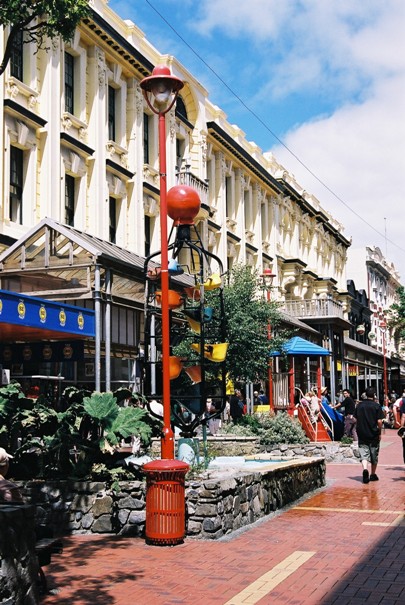
Te-Whanganui-ā-Tara has a long history of Māori settlement. Early inhabitants of the area were primarily iwi of Kurahaupō waka descent. By the late eighteenth century, Ngāti Ira of Hawke’s Bay had migrated south and intermarried with Ngāi Tara. Upheaval in the 1820s and 1830s prompted taua (war parties) and heke (migration) south into Wellington. Iwi associated with these heke include Te Ātiawa, Ngāti Toa, and Ngāti Tama. In 1824, Te Aro Pā, from which this area gains its name, was built on the foreshore by Ngāti Mutunga, with Taranaki iwi and Ngāti Ruanui subsequently occupying it (List No. 7771). In 1844, a deed was signed which effectively brought Te Aro Pā into the New Zealand Company’s purchase. In 1840, William Mein Smith, company surveyor, laid out the town plan. Cuba Street itself is located on what would have been cultivation land for Te Aro Kāinga. The street, named for the New Zealand Company Ship which arrived in Te Whanganui-a-Tara in January 1840, began to be developed in the 1840s. The first residence and shop–a drapers–was erected in 1845.
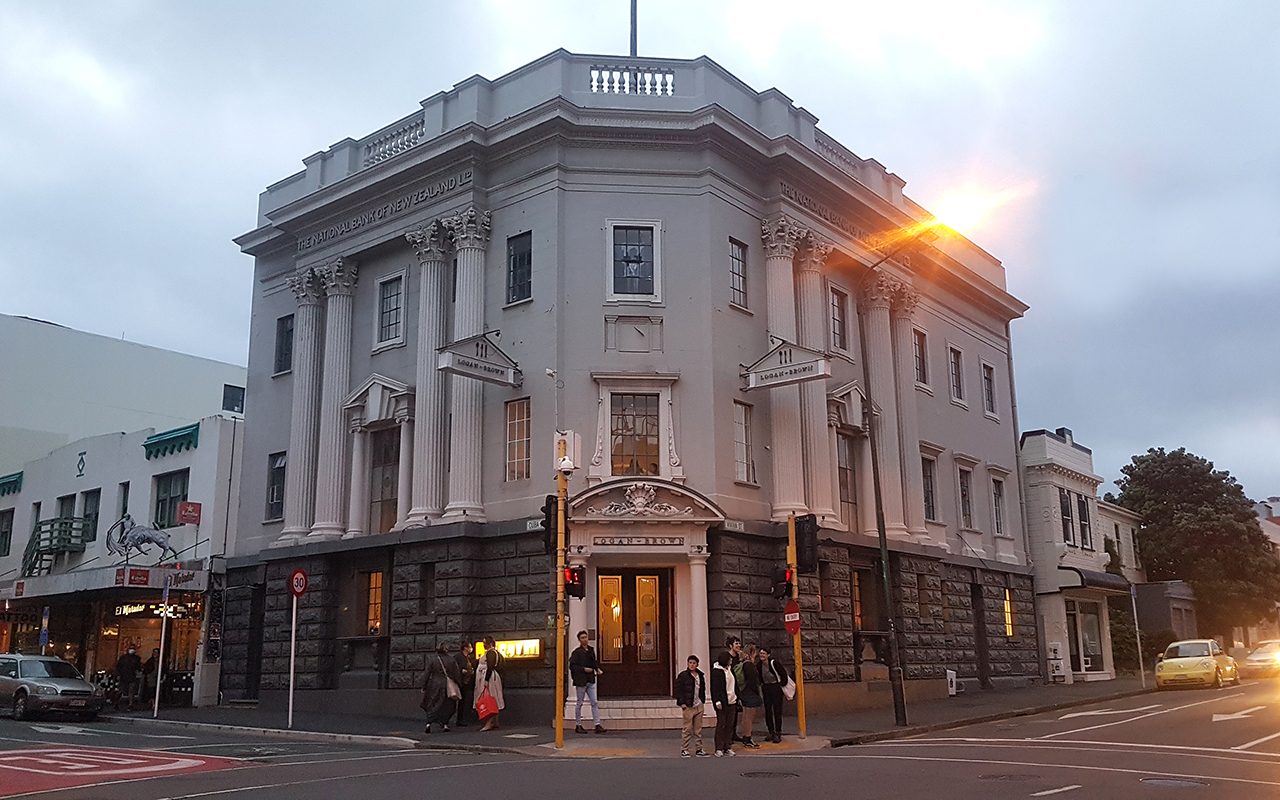
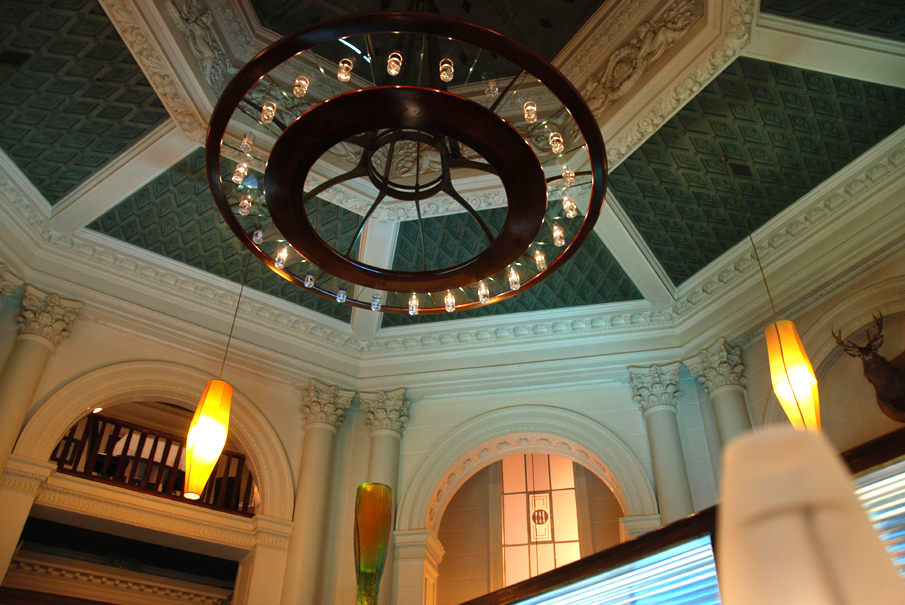
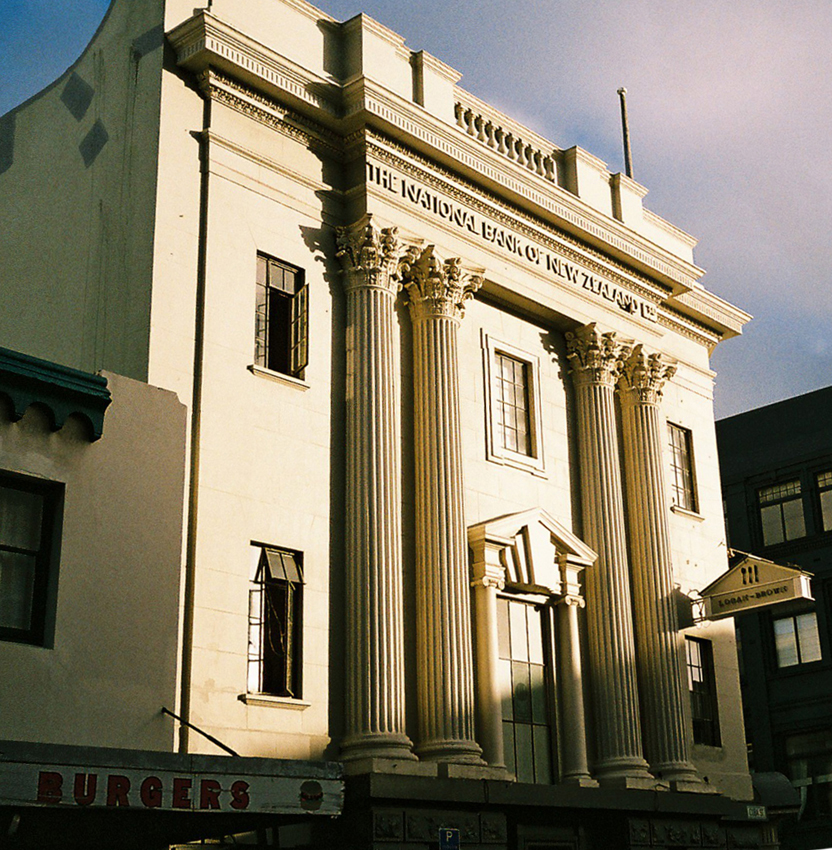
The National Bank Te Aro Branch was built directly opposite the bank’s former premises, which it had outgrown. The new building was purpose-built with more suitable accommodation, such as discrete apartments, incorporated upstairs for visiting staff. The building’s prominent location on the corner of Vivian Street and Cuba Street shows off its facade. The three-story exterior of the building is constructed with reinforced concrete, faced with Malmesbury stone on the rusticated base, Sandy Bay Marble at the entrance, and Sydney Sandstone for the levels above. The rectangular windows are small and multi-paned. Decorative features include eight giant-order attached Corinthian columns, which support an entablature inscribed with the words ‘National Bank of New Zealand’, and a balustraded parapet. The interior of the building retains the octagonal banking chamber and dome, with coupled Corinthian columns at each angle. A six-meter glazed dome further adds to the visual aesthetic of the interior space.
The building operated as a bank until 1996, almost 80 years after its construction. It has withstood numerous road alterations to the Vivian Street/Cuba Street intersection, including the removal of the electric tramlines in 1964 and the increased flow of traffic from the southbound motorway onto Vivian Street in 2006. In 1996, the National Bank Building was converted into the popular restaurant Logan Brown and, as of 2022, apartments are available to rent on the upper floors.
List Entry Information
Status
Listed
List Entry Status
Historic Place Category 1
Access
Private/No Public Access
List Number
3634
Date Entered
19th March 1986
Date of Effect
19th March 1986
City/District Council
Wellington City
Region
Wellington Region
Extent of List Entry
Extent includes the land described as Lot 1 DP 83518 (SRS WN50D/352), Wellington Land District, and the building known as National Bank Building (Te Aro Branch) (Former) thereon.
Legal description
Lot 1 DP 83518 (SRS WN50D/352), Wellington Land District
Status
Listed
List Entry Status
Historic Place Category 1
Access
Private/No Public Access
List Number
3634
Date Entered
19th March 1986
Date of Effect
19th March 1986
City/District Council
Wellington City
Region
Wellington Region
Extent of List Entry
Extent includes the land described as Lot 1 DP 83518 (SRS WN50D/352), Wellington Land District, and the building known as National Bank Building (Te Aro Branch) (Former) thereon.
Legal description
Lot 1 DP 83518 (SRS WN50D/352), Wellington Land District
Construction Professional
Name
McClellan, William
Type
Builder
Biography
William McLellan was one of three brothers (the others were James and Duncan) who formed a construction business with Louis Joel in Dunedin in 1910. William was the managing director, and the firm went on to become one of the city's most successful, gaining many significant contracts in Dunedin and further afield. The first major commission was the King Edward Technical College, completed in 1913. Following that came, among many others, St Paul's Cathedral, the Otago Medical Centre, Otago University Physics Block, the Sargood Wing of the Art Gallery, Mosgiel Knitwear Factory and the Rakaia Bridge. They worked on the upgrading of buildings such as the Octagon Theatre and the Empire Theatre. After securing the contract to build the Kew Hospital in 1933, the firm opened a branch in Invercargill. From this base, the firm secured work building the Invercargill Post Office, State Fire Office and the Kelvin Hotel. In Gore, the firm built the Gore High School, Nurses Home and Post Office. The firm undertook maintenance work and held a long-standing contract to maintain Speight's Brewery. The firm's last major contract was the State Fire Office on the corner of Rattray and Princes Streets. None of the family members had been trained for the building trade, and shortly after the death of Mr William McLellan, the last surviving member of the partnership, the company went into voluntary liquidation.
Name
Plimmer Jones, Claude
Type
Architect
Biography
No biography is currently available for this construction professional
Construction Details
Start Year
1917
Finish Year
1918
Type
Original Construction
Start Year
1950
Type
Modification
Description
Internal ground floor fit out.
Start Year
1975
Type
Modification
Description
Modification/ Internal alterations.
Start Year
1996
Type
Modification
Description
/ Ground floor converted into restaurant, upgrade of upper level.
Start Year
2000
Type
Refurbishment/renovation
Description
New bar area.
Start Year
2006
Type
Refurbishment/renovation
Description
Dwelling additions and alterations.
Start Year
2015
Type
Maintenance/repairs
Description
Steel struts to support existing parapet.
Construction Materials
Concrete faced with rusticated Malmesbury stone (ground floor), Sandy Bay marble (main doorway) and Sandstone (upper floors); three storey
Notable Features
First floor windows with keystones, small triangular pediments and flanked by Ionic columns, coupled Corinthian columns which extend to the top of the building, entablature and balustraded parapet
Construction Professional
Name
McClellan, William
Type
Builder
Biography
William McLellan was one of three brothers (the others were James and Duncan) who formed a construction business with Louis Joel in Dunedin in 1910. William was the managing director, and the firm went on to become one of the city's most successful, gaining many significant contracts in Dunedin and further afield. The first major commission was the King Edward Technical College, completed in 1913. Following that came, among many others, St Paul's Cathedral, the Otago Medical Centre, Otago University Physics Block, the Sargood Wing of the Art Gallery, Mosgiel Knitwear Factory and the Rakaia Bridge. They worked on the upgrading of buildings such as the Octagon Theatre and the Empire Theatre. After securing the contract to build the Kew Hospital in 1933, the firm opened a branch in Invercargill. From this base, the firm secured work building the Invercargill Post Office, State Fire Office and the Kelvin Hotel. In Gore, the firm built the Gore High School, Nurses Home and Post Office. The firm undertook maintenance work and held a long-standing contract to maintain Speight's Brewery. The firm's last major contract was the State Fire Office on the corner of Rattray and Princes Streets. None of the family members had been trained for the building trade, and shortly after the death of Mr William McLellan, the last surviving member of the partnership, the company went into voluntary liquidation.
Name
Plimmer Jones, Claude
Type
Architect
Biography
No biography is currently available for this construction professional
Construction Details
Start Year
1917
Finish Year
1918
Type
Original Construction
Start Year
1950
Type
Modification
Description
Internal ground floor fit out.
Start Year
1975
Type
Modification
Description
Modification/ Internal alterations.
Start Year
1996
Type
Modification
Description
/ Ground floor converted into restaurant, upgrade of upper level.
Start Year
2000
Type
Refurbishment/renovation
Description
New bar area.
Start Year
2006
Type
Refurbishment/renovation
Description
Dwelling additions and alterations.
Start Year
2015
Type
Maintenance/repairs
Description
Steel struts to support existing parapet.
Construction Materials
Concrete faced with rusticated Malmesbury stone (ground floor), Sandy Bay marble (main doorway) and Sandstone (upper floors); three storey
Notable Features
First floor windows with keystones, small triangular pediments and flanked by Ionic columns, coupled Corinthian columns which extend to the top of the building, entablature and balustraded parapet
Historical and Associated Iwi / Hapū / Whānau
Completion Date
29th April 2022
Report Written By
Jenna McNaughton and Blyss Wagstaff
Information Sources
Mew and Humphris, 2014
Geoff Mew and Adrian Humphris, Raupo to Deco: Wellington Styles and Architects, 1840-1940, Steele Roberts Aotearoa, Wellington, 2014.
Dominion
‘New City Bank’, Dominion, 17 February 1917, p.6
Hastings Standard
‘Untitled’, Hastings Standard, 15 February 1915, p. 3
Wellington City Council, 2013
Wellington City Council, ‘National Bank Te Aro (Former)’ Heritage Inventory Report, 2013, URL: https://wellingtoncityheritage.org.nz/buildings/1-150/88-national-bank-te-aro-building, accessed 04 Apr 2022
Other Information
This place was identified as significant under previous legislation with different information requirements. It remains significant under the current legislation. There is opportunity under our legislation and policies to add to this information. Further information about this place may be available from the Central Regional Office of Heritage New Zealand Pouhere Taonga. A fully referenced copy of the upgrade report is available on request from the Central Regional Office of Heritage New Zealand Pouhere Taonga Please note that entry on the New Zealand Heritage List/Rarangi Korero identifies only the heritage values of the property concerned, and should not be construed as advice on the state of the property, or as a comment of its soundness or safety, including in regard to earthquake risk, safety in the event of fire, or insanitary conditions.
Historical and Associated Iwi / Hapū / Whānau
Completion Date
29th April 2022
Report Written By
Jenna McNaughton and Blyss Wagstaff
Information Sources
Mew and Humphris, 2014
Geoff Mew and Adrian Humphris, Raupo to Deco: Wellington Styles and Architects, 1840-1940, Steele Roberts Aotearoa, Wellington, 2014.
Dominion
‘New City Bank’, Dominion, 17 February 1917, p.6
Hastings Standard
‘Untitled’, Hastings Standard, 15 February 1915, p. 3
Wellington City Council, 2013
Wellington City Council, ‘National Bank Te Aro (Former)’ Heritage Inventory Report, 2013, URL: https://wellingtoncityheritage.org.nz/buildings/1-150/88-national-bank-te-aro-building, accessed 04 Apr 2022
Other Information
This place was identified as significant under previous legislation with different information requirements. It remains significant under the current legislation. There is opportunity under our legislation and policies to add to this information. Further information about this place may be available from the Central Regional Office of Heritage New Zealand Pouhere Taonga. A fully referenced copy of the upgrade report is available on request from the Central Regional Office of Heritage New Zealand Pouhere Taonga Please note that entry on the New Zealand Heritage List/Rarangi Korero identifies only the heritage values of the property concerned, and should not be construed as advice on the state of the property, or as a comment of its soundness or safety, including in regard to earthquake risk, safety in the event of fire, or insanitary conditions.
Current Usages
Uses: Accommodation
Specific Usage: Apartment
Uses: Trade
Specific Usage: Restaurant/cafe/tearoom
Former Usages
General Usage: Finance
Specific Usage: Bank
Current Usages
Uses: Accommodation
Specific Usage: Apartment
Uses: Trade
Specific Usage: Restaurant/cafe/tearoom
Former Usages
General Usage: Finance
Specific Usage: Bank
Location
Sign up to hear more
Get the latest heritage news, features and events delivered
straight to your inbox.
