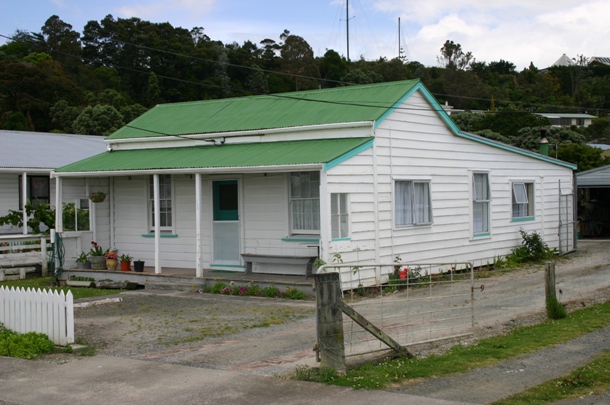
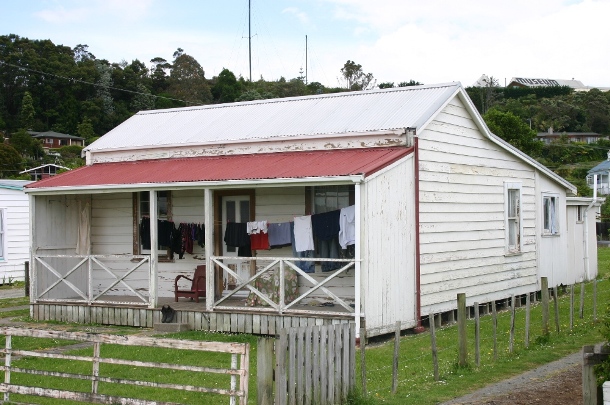
Situated at the southern end of River Road, Mangawhare, Dargaville, facing the Wairoa River, Workers’ Cottage is a well-preserved example of housing erected for local workers as Dargaville developed into an economic centre primarily serving farmers in the early twentieth century. One of several small timber residences likely relocated from the mill town of Aratapu as kauri logging declined, Workers’ Cottage represents an important regional phenomenon of building relocation around or between towns that reflects the historical evolution of Kaipara and its economic conditions. In contrast to the larger villas of the River Road Historic Area to the north, Workers’ Cottage also demonstrates the range of housing erected at Mangawhare during a period of intensive development in the years surrounding the formation of the Dargaville Borough in 1908, and remains an important example of workers’ accommodation from that time. From 1941, the long period of ownership of this place by Dalmatian migrant Ivan Perdija and his family further reflects the changing opportunities and ongoing impact arising from the kauri industry on the make-up of the Dargaville community.
The Northern Wairoa was extensively populated by Māori over many centuries with kāinga focused in the fertile river valleys between the Kaipara and Hokianga Harbours and pā and lookout points on the surrounding ridges and promontories. It was a complex landscape where interconnected iwi and hapū of the broad tribal confederations of Ngāpuhi and Ngāti Whātua, including Te Kuihi, Te Uri o Hau, Te Roroa and Te Parawhau, held overlapping rights and interests. The region had abundant resources that Māori utilised from the ngahere (forests), alluvial plains, and awa (rivers). Awa also formed an important part of the local transport network, particularly the Wairoa River which provided navigable access between Kaipara Harbour and Kaihu (now known as Dargaville). During the nineteenth century many small milling settlements were established in the region as Māori and Pākehā engaged in the kauri timber trade and gum digging. These extractive industries formed the backbone of the local economy during this period. At Mangawhare, situated by the confluence of the Kaihu and Wairoa rivers, a small Māori and Pākehā community grew around kauri extraction as early as the 1830s, and the Mangawhare block was purchased from Te Tirarau (Te Parawhau) and Paikea in 1839. With the conversion of former forestland into productive farms, the North Kaipara Dairy Company was formed in 1902. The company built its primary factory beside the river, towards the southern end of the Mangawhare block, and the settlement grew to service the rural community along with Dargaville on the northern side of the Kaihu River. In 1908 the settlements combined as Dargaville Borough – the regional centre of the Northern Wairoa.
The future site of Workers’ Cottage, Lot 6 DP 4918, was formally subdivided in 1910. During this period the land was owned by a succession of local businessmen. In 1913 Herbert Booth, an engineer living in Helensville on the south side of the Kaipara Harbour, purchased both Lot 6 and the neighbouring Lot 5. A small timber two-room cottage with a rear lean-to, a form known as a saltbox, was erected on the site during these early years. The building is locally understood to have been barged to Mangawhare from Aratapu – a nearby mill town where the kauri mill closed in 1908, although it had been the main centre of commerce in the Northern Wairoa during its heyday. Relocating extant buildings around Kaipara was a particular regional phenomenon where buildings were often moved to minimise the cost of rebuilding as population centres shifted to follow economic opportunities. The cottage has timber cladding, twelve pane windows on the front and south elevations, a corrugated iron, single ridge low-pitched gable roof, and an unadorned, full width front verandah.
Booth continued residing at Helensville and likely rented these houses to workers such as employees at the Dairy Factory and other local industries. In 1941 Workers’ Cottage was purchased by Ivan Perdija, a Dalmatian labourer who had been living in the area since at least 1925. A substantial number of Dalmatian migrants had been among the thousands of gum diggers who moved to the Dargaville area between the 1890s and 1940s to work the gumfields. Often working in family or community groups with others from their European homeland, many workers sent their earnings home to support their families, while others saved up to settle permanently in New Zealand. Dalmatian descendants continue to make up a considerable proportion of the Dargaville community in the twenty-first century. Perdija lived at Workers’ Cottage until 1966, and later owners undertook an extension and added a garage during the 1970s. In 2026 it remains a private residence.
The Northern Wairoa was extensively populated by Māori over many centuries with kāinga focused in the fertile river valleys between the Kaipara and Hokianga Harbours and pā and lookout points on the surrounding ridges and promontories. It was a complex landscape where interconnected iwi and hapū of the broad tribal confederations of Ngāpuhi and Ngāti Whātua, including Te Kuihi, Te Uri o Hau, Te Roroa and Te Parawhau, held overlapping rights and interests. The region had abundant resources that Māori utilised from the ngahere (forests), alluvial plains, and awa (rivers). Awa also formed an important part of the local transport network, particularly the Wairoa River which provided navigable access between Kaipara Harbour and Kaihu (now known as Dargaville). During the nineteenth century many small milling settlements were established in the region as Māori and Pākehā engaged in the kauri timber trade and gum digging. These extractive industries formed the backbone of the local economy during this period. At Mangawhare, situated by the confluence of the Kaihu and Wairoa rivers, a small Māori and Pākehā community grew around kauri extraction as early as the 1830s, and the Mangawhare block was purchased from Te Tirarau (Te Parawhau) and Paikea in 1839. With the conversion of former forestland into productive farms, the North Kaipara Dairy Company was formed in 1902. The company built its primary factory beside the river, towards the southern end of the Mangawhare block, and the settlement grew to service the rural community along with Dargaville on the northern side of the Kaihu River. In 1908 the settlements combined as Dargaville Borough – the regional centre of the Northern Wairoa.
The future site of Workers’ Cottage, Lot 6 DP 4918, was formally subdivided in 1910. During this period the land was owned by a succession of local businessmen. In 1913 Herbert Booth, an engineer living in Helensville on the south side of the Kaipara Harbour, purchased both Lot 6 and the neighbouring Lot 5. A small timber two-room cottage with a rear lean-to, a form known as a saltbox, was erected on the site during these early years. The building is locally understood to have been barged to Mangawhare from Aratapu – a nearby mill town where the kauri mill closed in 1908, although it had been the main centre of commerce in the Northern Wairoa during its heyday. Relocating extant buildings around Kaipara was a particular regional phenomenon where buildings were often moved to minimise the cost of rebuilding as population centres shifted to follow economic opportunities. The cottage has timber cladding, twelve pane windows on the front and south elevations, a corrugated iron, single ridge low-pitched gable roof, and an unadorned, full width front verandah.
Booth continued residing at Helensville and likely rented these houses to workers such as employees at the Dairy Factory and other local industries. In 1941 Workers’ Cottage was purchased by Ivan Perdija, a Dalmatian labourer who had been living in the area since at least 1925. A substantial number of Dalmatian migrants had been among the thousands of gum diggers who moved to the Dargaville area between the 1890s and 1940s to work the gumfields. Often working in family or community groups with others from their European homeland, many workers sent their earnings home to support their families, while others saved up to settle permanently in New Zealand. Dalmatian descendants continue to make up a considerable proportion of the Dargaville community in the twenty-first century. Perdija lived at Workers’ Cottage until 1966, and later owners undertook an extension and added a garage during the 1970s. In 2026 it remains a private residence.