

List Entry Information
Status
Listed
List Entry Status
Historic Place Category 1
Access
Private/No Public Access
List Number
4163
Date Entered
21st September 1989
Date of Effect
21st September 1989
City/District Council
Hamilton City
Region
Waikato Region
Legal description
Lot 1 DP 27295 (RT SA1021/289) and Sec 3 SO 60256 (RT SA62B/750), South Auckland Land District
Status
Listed
List Entry Status
Historic Place Category 1
Access
Private/No Public Access
List Number
4163
Date Entered
21st September 1989
Date of Effect
21st September 1989
City/District Council
Hamilton City
Region
Waikato Region
Legal description
Lot 1 DP 27295 (RT SA1021/289) and Sec 3 SO 60256 (RT SA62B/750), South Auckland Land District
Why is this place significant?
Historic Significance
HISTORICAL SIGNIFICANCE: 'Wairere' or Greenslade's house is historically significant for its association with Henry James Greenslade. Born in 1867 in Thames, Greenslade, a journalist, became Mayor of Thames in 1899, before standing unsuccessfully for the Parliamentary seat of Hauraki. In 1900 he bought land at Ohaupo and began dairy-farming, building a large dwelling, 'Glengarriff', on the property. In 1902 he unsuccessfully contested the Parliamentary seat of Waikato, but he was successful in that seat at the 1905 election. In 1910 he bought the property on which 'Wairere' stands from Isaac Coates, a former Mayor of Hamilton whose own house on the section 'Wairere', was deteriorating rapidly. Greenslade demolished Coates' house, and built a new structure. Greenslade was defeated in the 1911 Parliamentary election. He then bought the Waikato Times and began to manage the newspaper's production and distribution. Greenslade was actively connected with most of the public bodies in Thames - Thames High School Board of Governors, Harbour Board, public library, cemetery and hospital, and jockey club. His involvement in community affairs in Hamilton was less intense. His wealth derived from investments in the gold mining industry, and with the 1929 stock market crash his fortune evaporated, and his house in Hamilton was sold.
Physical Significance
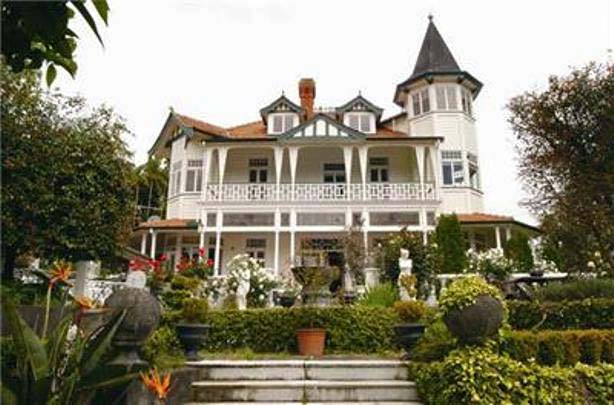
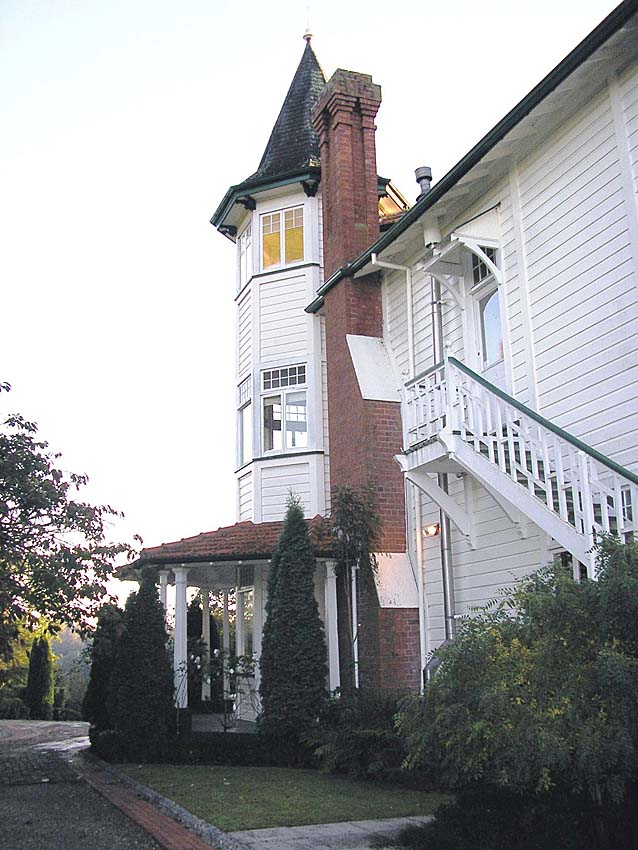
ARCHITECTURAL SIGNIFICANCE: The house incorporates typical Arts and Crafts traditional elements. The design is developed freely with irregular floor plans and projected 'feature rooms' arranged at either side of a main symmetrical facade. The handling of architectural forms is bold which shows the designer to have been abreast of contemporary developments in architecture in Britain which were moving towards a simpler, more modern architectural statement. In keeping with these forms architectural ornament is kept to a minimum and made to perform a functional role in many cases. Thus the leadlight panels shade the porch from the sun, and the paired cul-de-lampe columns perform a supportive function for the verandah. Warren has expressed the change in weight born by these columns with a change in form - the solid cubic forms with their simple capitals which are featured on the lower storey are continuous with the splayed inverted conical supports on the upper storey. This is consistent with a classical architectural treatment of the facade where a more decorative column is always placed on the upper level in a position expressive of the lighter load borne. The dormer windows on the upper storey have plain heads with slightly splayed gable ends, but no carving. The only ornamental carved features are the brackets below the eaves on the bay window upper storey, and these are very simple motifs. Dentils are apparent under the eaves of the upper storey and throughout there seems a predominance of vertical elements so that the house can be said to have been designed in a free and eclectic manner, with both classical and Queen Anne or Stick Style features with features such as scroll-shaped ante fixae incorporated at the end of the gable crests. TOWNSCAPE/LANDMARK SIGNIFICANCE: The house occupies a prominent position on the east bank of the Waikato River.
Why is this place significant?
Historic Significance
HISTORICAL SIGNIFICANCE: 'Wairere' or Greenslade's house is historically significant for its association with Henry James Greenslade. Born in 1867 in Thames, Greenslade, a journalist, became Mayor of Thames in 1899, before standing unsuccessfully for the Parliamentary seat of Hauraki. In 1900 he bought land at Ohaupo and began dairy-farming, building a large dwelling, 'Glengarriff', on the property. In 1902 he unsuccessfully contested the Parliamentary seat of Waikato, but he was successful in that seat at the 1905 election. In 1910 he bought the property on which 'Wairere' stands from Isaac Coates, a former Mayor of Hamilton whose own house on the section 'Wairere', was deteriorating rapidly. Greenslade demolished Coates' house, and built a new structure. Greenslade was defeated in the 1911 Parliamentary election. He then bought the Waikato Times and began to manage the newspaper's production and distribution. Greenslade was actively connected with most of the public bodies in Thames - Thames High School Board of Governors, Harbour Board, public library, cemetery and hospital, and jockey club. His involvement in community affairs in Hamilton was less intense. His wealth derived from investments in the gold mining industry, and with the 1929 stock market crash his fortune evaporated, and his house in Hamilton was sold.
Physical Significance
ARCHITECTURAL SIGNIFICANCE: The house incorporates typical Arts and Crafts traditional elements. The design is developed freely with irregular floor plans and projected 'feature rooms' arranged at either side of a main symmetrical facade. The handling of architectural forms is bold which shows the designer to have been abreast of contemporary developments in architecture in Britain which were moving towards a simpler, more modern architectural statement. In keeping with these forms architectural ornament is kept to a minimum and made to perform a functional role in many cases. Thus the leadlight panels shade the porch from the sun, and the paired cul-de-lampe columns perform a supportive function for the verandah. Warren has expressed the change in weight born by these columns with a change in form - the solid cubic forms with their simple capitals which are featured on the lower storey are continuous with the splayed inverted conical supports on the upper storey. This is consistent with a classical architectural treatment of the facade where a more decorative column is always placed on the upper level in a position expressive of the lighter load borne. The dormer windows on the upper storey have plain heads with slightly splayed gable ends, but no carving. The only ornamental carved features are the brackets below the eaves on the bay window upper storey, and these are very simple motifs. Dentils are apparent under the eaves of the upper storey and throughout there seems a predominance of vertical elements so that the house can be said to have been designed in a free and eclectic manner, with both classical and Queen Anne or Stick Style features with features such as scroll-shaped ante fixae incorporated at the end of the gable crests. TOWNSCAPE/LANDMARK SIGNIFICANCE: The house occupies a prominent position on the east bank of the Waikato River.
Construction Professional
Name
Warren, John Willing
Type
Architect
Biography
John Willing Warren (1859-1936) was a prominent Auckland architect who had an architectural office in Hamilton from the late nineteenth century until c.1920. His partner was engineer J Blechneyden and their commissions were largely for commercial buildings. The practice was also responsible for some remarkably individual designs such as Kauhanganui, (the Maori Parliament Building) Ngaruawahia, (1919), which is significant for its combination of Maori decorative features within a European architectural idiom. Warren was also responsible for the design of Henry Greenslade's house known as "Wairere", Hamilton (1911-12).
Construction Details
Start Year
1912
Type
Original Construction
Construction Materials
Concrete foundations; timber house with rimu framing, heart matai weatherboards and kauri fittings. Ceilings are mostly pressed metal (Wunderlich brand).
Construction Professional
Name
Warren, John Willing
Type
Architect
Biography
John Willing Warren (1859-1936) was a prominent Auckland architect who had an architectural office in Hamilton from the late nineteenth century until c.1920. His partner was engineer J Blechneyden and their commissions were largely for commercial buildings. The practice was also responsible for some remarkably individual designs such as Kauhanganui, (the Maori Parliament Building) Ngaruawahia, (1919), which is significant for its combination of Maori decorative features within a European architectural idiom. Warren was also responsible for the design of Henry Greenslade's house known as "Wairere", Hamilton (1911-12).
Construction Details
Start Year
1912
Type
Original Construction
Construction Materials
Concrete foundations; timber house with rimu framing, heart matai weatherboards and kauri fittings. Ceilings are mostly pressed metal (Wunderlich brand).
Builder: J McKinnon ARCHITECTURAL DESCRIPTION (STYLE): Greenslade's house is built in the Edwardian Free Style utilising massing of architectural forms around a basic rectangle to give the building picturesque asymmetry. Some of the features common to houses of the Edwardian period are to be found in Greenslade's house, such as the balustrade on the first-floor verandah which is made up of vertical and horizontal elements in a fretwork design, and also the lead lighting immediately below which is framed by timber and features geometric designs in coloured glass. Other aspects of the design look back to Victorian domestic architecture. In particular, the octagonal tower with its broach spire and ironwork cresting along the roof line are features of Victorian house design. MODIFICATIONS: These have been substantial over the years, as the house was adapted for use as a boarding establishment, and subdivided into flats, with extra kitchens and bathrooms being added. Since 1970 the present owners have been sympathetically restoring the house to its original internal structure. New kitchen and bathroom facilities have been fitted, and central heating installed.
Builder: J McKinnon ARCHITECTURAL DESCRIPTION (STYLE): Greenslade's house is built in the Edwardian Free Style utilising massing of architectural forms around a basic rectangle to give the building picturesque asymmetry. Some of the features common to houses of the Edwardian period are to be found in Greenslade's house, such as the balustrade on the first-floor verandah which is made up of vertical and horizontal elements in a fretwork design, and also the lead lighting immediately below which is framed by timber and features geometric designs in coloured glass. Other aspects of the design look back to Victorian domestic architecture. In particular, the octagonal tower with its broach spire and ironwork cresting along the roof line are features of Victorian house design. MODIFICATIONS: These have been substantial over the years, as the house was adapted for use as a boarding establishment, and subdivided into flats, with extra kitchens and bathrooms being added. Since 1970 the present owners have been sympathetically restoring the house to its original internal structure. New kitchen and bathroom facilities have been fitted, and central heating installed.
Historical and Associated Iwi / Hapū / Whānau
Information Sources
Hauraki Herald
Hauraki Herald
Land Information New Zealand (LINZ)
Land Information New Zealand
Waikato Museum of Art & History
Waikato Museum of Art & History
Waikato Times
Thames Star
Thames Star
Other Information
This historic place was registered under the Historic Places Act 1980. This report includes the text from the original Building Classification Committee report considered by the NZHPT Board at the time of registration. Please note that entry on the New Zealand Heritage List/Rarangi Korero identifies only the heritage values of the property concerned, and should not be construed as advice on the state of the property, or as a comment of its soundness or safety, including in regard to earthquake risk, safety in the event of fire, or insanitary conditions.
Historical and Associated Iwi / Hapū / Whānau
Information Sources
Hauraki Herald
Hauraki Herald
Land Information New Zealand (LINZ)
Land Information New Zealand
Waikato Museum of Art & History
Waikato Museum of Art & History
Waikato Times
Thames Star
Thames Star
Other Information
This historic place was registered under the Historic Places Act 1980. This report includes the text from the original Building Classification Committee report considered by the NZHPT Board at the time of registration. Please note that entry on the New Zealand Heritage List/Rarangi Korero identifies only the heritage values of the property concerned, and should not be construed as advice on the state of the property, or as a comment of its soundness or safety, including in regard to earthquake risk, safety in the event of fire, or insanitary conditions.
Current Usages
Uses: Accommodation
Specific Usage: House
Former Usages
General Usage: Accommodation
Specific Usage: House
Current Usages
Uses: Accommodation
Specific Usage: House
Former Usages
General Usage: Accommodation
Specific Usage: House
