

Aratapu, now almost a ghost town on the western bank of the Wairoa River south of Dargaville, was once busy and thriving, the busiest sawmilling centre on the River. Three large mills operated, employing 140 to 150 hands. All steamers running between Helensville and Dargaville called in at Aratapu.
The first large mill opened in 1865, but business took a major leap forward when the Kauri Timber Company began business there in 1888. At its peak 250,000 feet of timber a week was milled.
There was an active Anglican congregation in the Aratapu area in the 1870s. Services were held every Sunday in the public hall. In 1882 plans began to build a permanent church. The Church Gazette of March 1882 reported that drawings, plans and specifications had been drawn up for 'a pretty Church, to seat 150 worshippers'. This preparatory work was done by the Reverend P. Walsh of Waitara, who donated it to the Aratapu congregation. Efforts were then begun to raise money for the building.
In July 1882 the building fund stood at £155, a large amount of money but well short of the estimated £380 required. Fundraising was no easy task. The community was almost entirely made up of workingmen on meagre weekly wages, many of whom were transient, seasonal workers with no strong attachment to the district. The committee therefore broadcast its appeal more widely, soliciting 'the assistance of Christian people possessed of larger means'.
Construction started by the end of 1882. Built by W.A. Spiers, All Saints' Church, Aratapu was opened on Tuesday evening, 11 December 1883. The building was unfurnished, and it was not debt-free. Bishop Cowie promised that when the building was furnished and free of debts, he would be glad to consecrate it.
The opening of the church is said to have been a joyous affair. The church bazaar, held over the next two days, featured six stalls, draped with blue and pink and adorned with curtains. Many people from Dargaville and Mangawhare attended, travelling down the river. In the evening the public was entertained by the Fife and Drum Band and the Glee Club.
In the early 1900s the sawmills at Aratapu meant that the church served a large, thriving community of two thousand people. But the flourishing growth of the church contained the seeds of its own decay. In 1902, the same year that a stone font was installed in All Saints', St Peter's Church was opened in nearby Te Kopuru, to service the large community that had grown up around the sawmill there. Some parish¬ioners who might have come to Aratapu now chose to attend church at Te Kopuru. At the same time the sawmills at Aratapu began to decline. As the mills closed, the population dispersed, and support for All Saints' Church fell away. It was apparently closed and abandoned somewhere around 1918: it seems to have declined so much in importance that even the date of its closure has not been recorded.
In November 1919 parishioners in Mititai across the Wairoa River from Aratapu obtained Diocesan approval to build a stone church. The Building Committee subsequently abandoned plans for a stone church, and decided instead to investigate the possibility of removing the disused church building from Aratapu to Mititai. In February 1921 the Anglican General Trust Board gave its consent to the proposal. Mititai was another riverside settlement with its origins in timber milling, containing the site of the second mill established in the Northern Wairoa, opened in 1865. In the 1920s, the road between Dargaville and Matakohe through Mititai - now State Highway 12 - was improved, connecting the settlement more effectively to other parts of the district.
The new site was land donated by parishioner Robert Montgomery. The task of moving the church building by land and river to its present site was undertaken by Brown and Sons, overseen by their foreman Mr E.E. Burgess, in February 1922:
The building was loaded on three barges. We had to wait for a day for a suitable wind and tide. The barges were then towed out and across the river by two launches to a site up-river from the Mititai Wharf and there it was unloaded on to the bank. It was winched from there to its present site across what was then a rough paddock, and up a hill. The main labour of clearing the way of stumps and obstructions from the river, and reblocking the building, was done voluntarily by local men and supporters.
According to Young, winching the building up the hill was no easy job, and the project nearly ended in disaster.
A winch snapped as they were rolling it up the incline. The church started to roll backwards ... They all held their breath in horror. All eyes turned to Mr Brown, the contractor, to see his reaction. A member of the Brethren Church, he merely knelt and prayed. The movement stopped, and luckily no damage had been done; the men continued with their work.
Finally, the church was winched into position on to its new foundations, and after some renovations were complete, All Saints Church was ready to begin a new life, serving the needs of the congregation at Mititai.
A stained glass window by Carl Edwards of Apothecaries Hall, Blackfriar's Lane, London EC4, was installed in the sanctuary in 1964 as the gift of the Ladies' Guild of the church and dedicated to the pioneers of the district. This may be the same designer as Carl Edwards (1914-1985) who designed the east lancet window in The Temple Church, London and the west window of the Anglican cathedral, Liverpool.
In 2001, changing patterns of worship and changing parochial boundaries led to a proposal to remove the church to nearby Ruawai, or to sell it and use the funds to build another church in Ruawai. There was strong opposition to this suggestion by the people of Mititai, the local congregation and the Anglican parish of Dargaville. In August 2001 a meeting in the church chaired by Bishop John Patterson canvassed the issues, with the Bishop indicating that a proposal that did not have the strong support of the local community would be unlikely to receive his support. No further action was taken.
In 2004, a condition report was prepared for Diocesan Trust Board by John C. Wilson, with a view to raising funds to effect repairs.
The church continues to be used for worship, as well as for life cycle events such as weddings and funerals.
List Entry Information
Status
Listed
List Entry Status
Historic Place Category 2
Access
Private/No Public Access
List Number
425
Date Entered
30th June 2006
Date of Effect
30th June 2006
City/District Council
Kaipara District
Region
Northland Region
Extent of List Entry
Extent of registration includes all of the land in RT NA767/56 (as shown on Map B in Appendix 4 of the Registration Report) and the church, its fittings and fixtures thereon, including a stained glass window in the sanctuary, a First World War brass memorial tablet and a 1931-1937 Roll of Honour. The registration also incorporates the chattels listed on p.2 of the Registration Report, comprising a stone font and a wooden chair. The registration does not include a separate timber building in the southeastern part of the site, currently used as a kitchen and meeting room.
Legal description
Pt Allot 5 Parish of Arapohue (RT NA767/56), North Auckland Land District
Status
Listed
List Entry Status
Historic Place Category 2
Access
Private/No Public Access
List Number
425
Date Entered
30th June 2006
Date of Effect
30th June 2006
City/District Council
Kaipara District
Region
Northland Region
Extent of List Entry
Extent of registration includes all of the land in RT NA767/56 (as shown on Map B in Appendix 4 of the Registration Report) and the church, its fittings and fixtures thereon, including a stained glass window in the sanctuary, a First World War brass memorial tablet and a 1931-1937 Roll of Honour. The registration also incorporates the chattels listed on p.2 of the Registration Report, comprising a stone font and a wooden chair. The registration does not include a separate timber building in the southeastern part of the site, currently used as a kitchen and meeting room.
Legal description
Pt Allot 5 Parish of Arapohue (RT NA767/56), North Auckland Land District
Why is this place significant?
Cultural Significance
The Church has social and spiritual value because it has served as a centre for community worship and events such as weddings, christenings and funerals for over 120 years on its two Northern Wairoa sites. It serves as a memorial both to the pioneers of the district, and specifically to the men of the district who were killed in the First World War (1914-1918).
Historic Significance
Historical Significance or Value It has historical value for its long association with people and events in two settlements of the Northern Wairoa, one of them, Aratapu, being by far the largest town in the district at the time the church was built.
Physical Significance
All Saints' Church is architecturally significant because of its unusual, projected-gable roof, incorporating projected scissor trusses with king ties. Extended scissor trusses, integral to the original design, are uncommon in New Zealand buildings. The church is also architecturally significant because of its use of very high quality kauri timber, specifically selected for use in this prestige building.
Why is this place Category 1 / Category 2?
Detail Of Assessed Criteria
(a) The extent to which the place reflects important or representative aspects of New Zealand history All Saints' Church reflects important and representative aspects of New Zealand history, including Anglican religious affiliations in a major timber-milling community in Northland, and changing patterns of settlement in the Kaipara during the late nineteenth and early twentieth centuries. The efforts required to relocate the building in the 1920s reflect the importance accorded to retaining a place of spiritual value, as well as the community values and technical expertise of a tightly-knit rural population. (e) The community association with, or public esteem for, the place The church is held in high regard by its congregation and is closely associated with the local community, having been used as a place of worship and gathering for over 80 years. The church has been associated with the broader Northern Wairoa community as a place of gathering and worship for over 120 years. It is scheduled as an historic place of 'district' significance in the District Plan of the Kaipara District Council. (g) The technical accomplishment or value, or design of the place The church can be considered technically significant for elements such as its unusual, projected-gable roof, which incorporates projected scissor trusses with king ties. The church was the pride and joy of the timber men of Aratapu, and as such was built of the best heart kauri, its joists, studs and floor timbers exceeding the usual requirements for a building of this size, and its framework heavier than that used in other buildings in the district at that time. (h) The symbolic or commemorative value of the place The church has a very long association with the people of Aratapu and Mititai, specifically commemorated in the dedication of its window to the pioneers of the district. It also houses a memorial to six men of the parish who gave their lives in the First World War.
Why is this place significant?
Cultural Significance
The Church has social and spiritual value because it has served as a centre for community worship and events such as weddings, christenings and funerals for over 120 years on its two Northern Wairoa sites. It serves as a memorial both to the pioneers of the district, and specifically to the men of the district who were killed in the First World War (1914-1918).
Historic Significance
Historical Significance or Value It has historical value for its long association with people and events in two settlements of the Northern Wairoa, one of them, Aratapu, being by far the largest town in the district at the time the church was built.
Physical Significance
All Saints' Church is architecturally significant because of its unusual, projected-gable roof, incorporating projected scissor trusses with king ties. Extended scissor trusses, integral to the original design, are uncommon in New Zealand buildings. The church is also architecturally significant because of its use of very high quality kauri timber, specifically selected for use in this prestige building.
Why is this place Category 1 / Category 2?
Detail Of Assessed Criteria
(a) The extent to which the place reflects important or representative aspects of New Zealand history All Saints' Church reflects important and representative aspects of New Zealand history, including Anglican religious affiliations in a major timber-milling community in Northland, and changing patterns of settlement in the Kaipara during the late nineteenth and early twentieth centuries. The efforts required to relocate the building in the 1920s reflect the importance accorded to retaining a place of spiritual value, as well as the community values and technical expertise of a tightly-knit rural population. (e) The community association with, or public esteem for, the place The church is held in high regard by its congregation and is closely associated with the local community, having been used as a place of worship and gathering for over 80 years. The church has been associated with the broader Northern Wairoa community as a place of gathering and worship for over 120 years. It is scheduled as an historic place of 'district' significance in the District Plan of the Kaipara District Council. (g) The technical accomplishment or value, or design of the place The church can be considered technically significant for elements such as its unusual, projected-gable roof, which incorporates projected scissor trusses with king ties. The church was the pride and joy of the timber men of Aratapu, and as such was built of the best heart kauri, its joists, studs and floor timbers exceeding the usual requirements for a building of this size, and its framework heavier than that used in other buildings in the district at that time. (h) The symbolic or commemorative value of the place The church has a very long association with the people of Aratapu and Mititai, specifically commemorated in the dedication of its window to the pioneers of the district. It also houses a memorial to six men of the parish who gave their lives in the First World War.
Construction Details
Start Year
1882
Type
Original Construction
Description
Construction of new church at Aratapu commenced
Start Year
1922
Type
Relocation
Description
February. Church moved across the Wairoa River by barge and winched to its elevated new site. Renovations undertaken.
Start Year
1958
Type
Addition
Description
'Modern' pulpit installed in memory of Mrs Anna I. Ralph
Start Year
1965
Type
Addition
Description
19 December. Dedication of stained glass window in sanctuary, commissioned by the Ladies' Guild
Construction Materials
Kauri timber, corrugated iron roof, timber piles
Notable Features
Chattels: Wooden chair presented in memory of Mr and Mrs W.G. Webb 'who donated the property for the erection of this church' (may not relate to this site). Stone baptismal font (1902).
Construction Details
Start Year
1882
Type
Original Construction
Description
Construction of new church at Aratapu commenced
Start Year
1922
Type
Relocation
Description
February. Church moved across the Wairoa River by barge and winched to its elevated new site. Renovations undertaken.
Start Year
1958
Type
Addition
Description
'Modern' pulpit installed in memory of Mrs Anna I. Ralph
Start Year
1965
Type
Addition
Description
19 December. Dedication of stained glass window in sanctuary, commissioned by the Ladies' Guild
Construction Materials
Kauri timber, corrugated iron roof, timber piles
Notable Features
Chattels: Wooden chair presented in memory of Mr and Mrs W.G. Webb 'who donated the property for the erection of this church' (may not relate to this site). Stone baptismal font (1902).
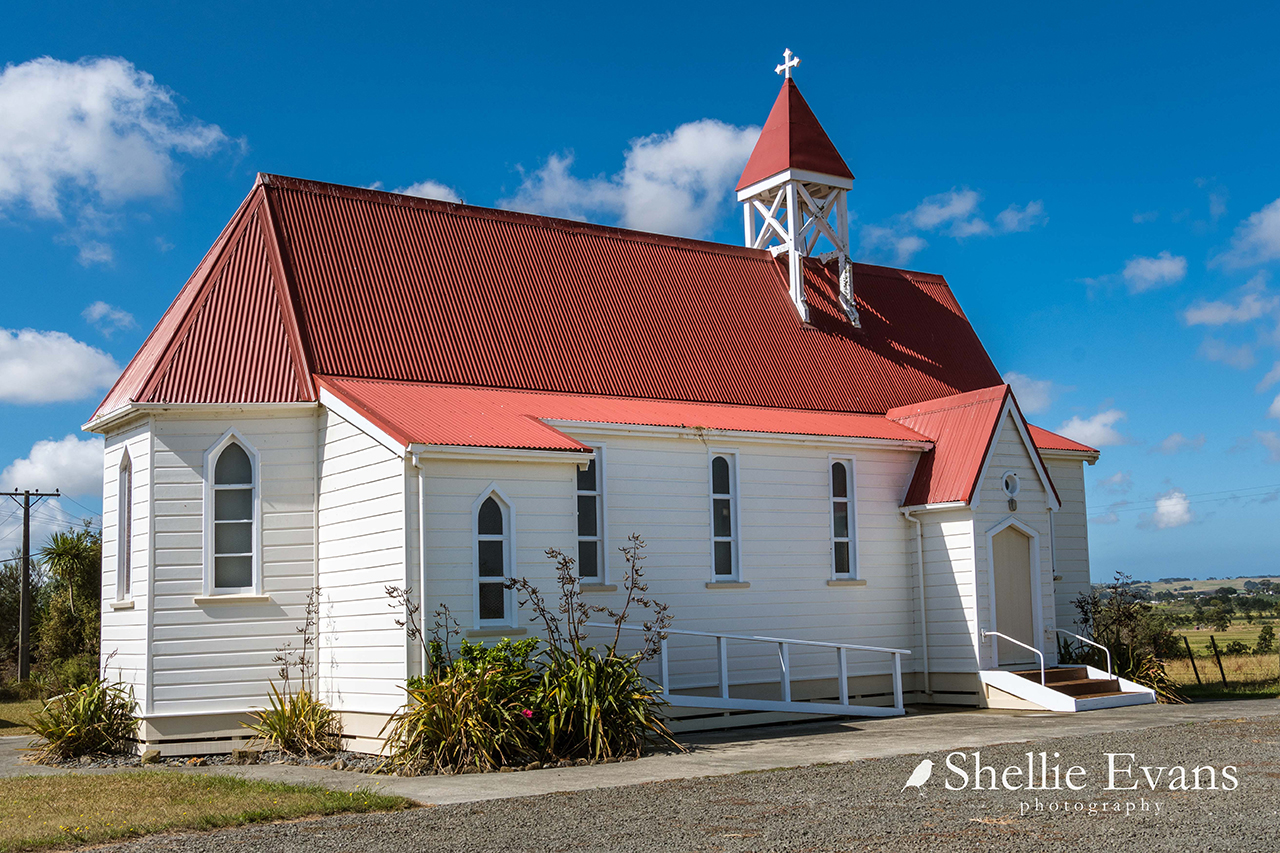
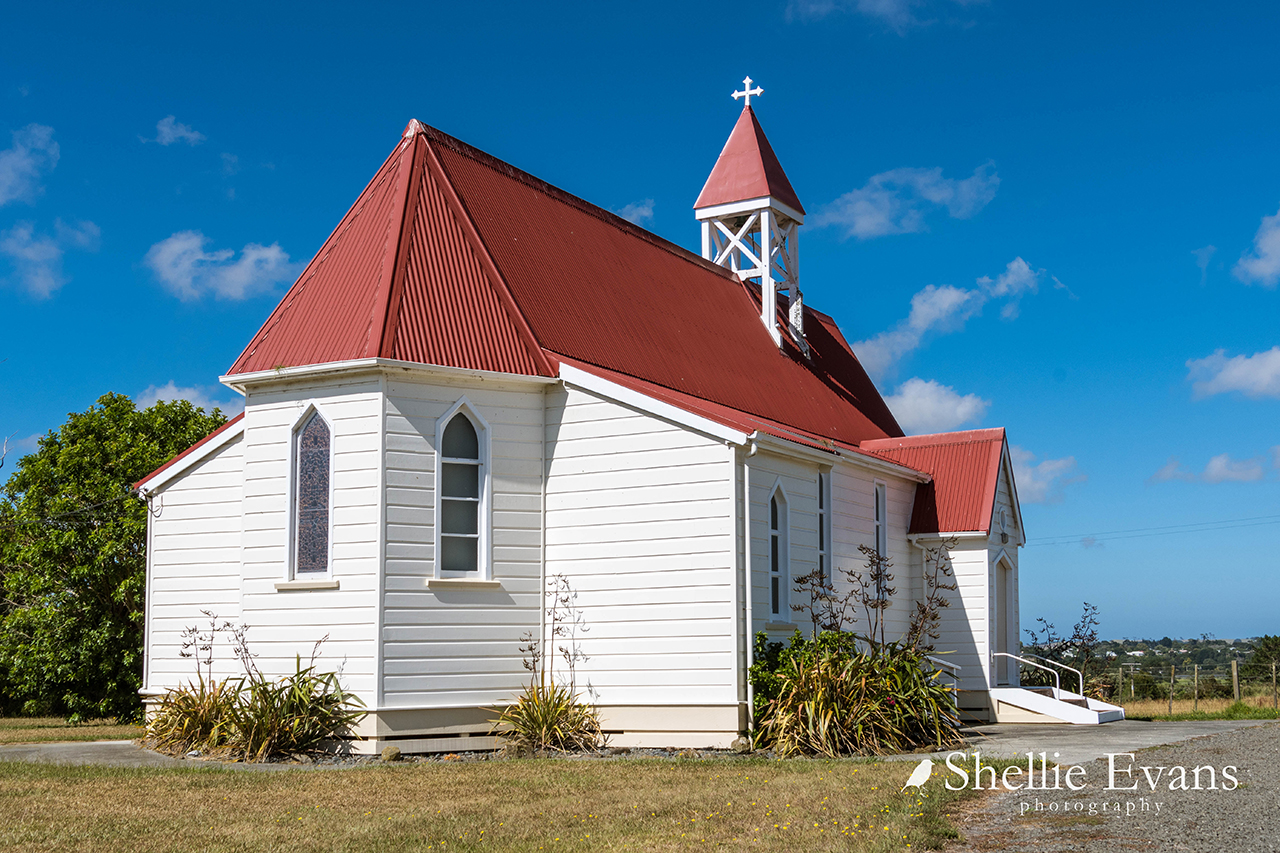
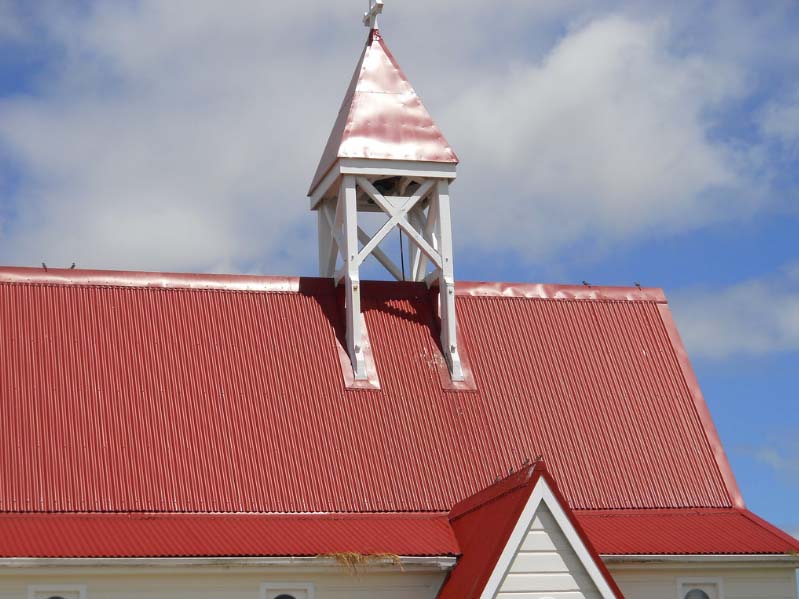
All Saints Church is located in Mititai, a rural setting in the Northern Wairoa. The timber church is situated on a rise, next to the Mititai Road. The building is positioned in the central part of a flat, rectangular plot of land, 0.404 ha (one acre) in size. A secondary structure (not included in the registration) lies some 20 m. to the east of the church and consists of a simple relocatable cabin with vertical weatherboard, aluminium joinery and flat iron roof. The church is of simple Gothic Revival style, and was described by architect John C. Wilson in 2004 as 'a charming and well-proportioned building with some unusual features - such as the roof structure and unusually long boards.' The church is rectangular with a hexagonal sanctuary at the east end. It has a projected-gable roof with steeply-pitched central section. The entrance porch is on the north side at the west end, and there is a small vestry porch at the east end of both the north and south sides. There is a square belfry with pyramidal roof, clad with flat iron and surmounted by wooden cross, on the gable apex in line with the entrance door. A bronze bell in the belfry has a rope to the church interior. Exterior The church has timber piles and timber framed walls with painted rebated weatherboards, 220-230 mm. wide [all measurements approximate]. The boards mostly extend the full length of the wall. The windows have timber joinery with opaque glazing and hopper sashes. There are two windows in the west end, five in the south side, four on the north side plus one in the vestry, and three in the sanctuary (one with stained glass). There is a circular window over the entrance doors. The entrance porch has narrow double doors, with single doors in other entrances. Interior The floorboards are kauri 100 mm. wide, with skirting 150 mm. wide. The walls are vertical match lining 150 mm. wide, mostly in single lengths - 3600 mm. at the side walls. These boards have been oiled. The ceiling consists of tongue and groove sarking, running with the roof pitch, not across. This has been painted. The roof form is a large projected scissor-truss with king ties. Extended scissor trusses, integral to the original design, are uncommon in buildings in New Zealand and give the building a roof form more often associated with the addition of side aisles to an existing structure. There is electric power connected, with incandescent lights in the body of the church and spots in the sanctuary, and infrared wall heaters. Notable features of the church are the stained glass window in the sanctuary, a brass memorial to those who died in the First World War, and a roll of honour dating from the 1930s. The lancet-shaped stained glass window by Carl Edwards of London portrays Christ in crucifixion and as ascended. The lower portion shows Jesus on the cross - flanked on either side by an angel with head bowed, serpent entwined around the foot of the cross. The upper, larger portion shows Christ risen, with flanking angels and the symbols alpha and omega. The name of the artist and studio address, in stained glass, are discreetly incorporated in the window's base. A brass Memorial tablet mounted on a substantial timber frame is dedicated to the memory of H.G. Clark, E.M. Clark, G.A. Slade, H. Montgomery, E. Montgomery and C.H. Simpkin who died in the First World War The church also contains the Roll of Honour 1931 - 1937 of Ruawai Methodist Circuit Old Folks and Settlers Gathering.
All Saints Church is located in Mititai, a rural setting in the Northern Wairoa. The timber church is situated on a rise, next to the Mititai Road. The building is positioned in the central part of a flat, rectangular plot of land, 0.404 ha (one acre) in size. A secondary structure (not included in the registration) lies some 20 m. to the east of the church and consists of a simple relocatable cabin with vertical weatherboard, aluminium joinery and flat iron roof. The church is of simple Gothic Revival style, and was described by architect John C. Wilson in 2004 as 'a charming and well-proportioned building with some unusual features - such as the roof structure and unusually long boards.' The church is rectangular with a hexagonal sanctuary at the east end. It has a projected-gable roof with steeply-pitched central section. The entrance porch is on the north side at the west end, and there is a small vestry porch at the east end of both the north and south sides. There is a square belfry with pyramidal roof, clad with flat iron and surmounted by wooden cross, on the gable apex in line with the entrance door. A bronze bell in the belfry has a rope to the church interior. Exterior The church has timber piles and timber framed walls with painted rebated weatherboards, 220-230 mm. wide [all measurements approximate]. The boards mostly extend the full length of the wall. The windows have timber joinery with opaque glazing and hopper sashes. There are two windows in the west end, five in the south side, four on the north side plus one in the vestry, and three in the sanctuary (one with stained glass). There is a circular window over the entrance doors. The entrance porch has narrow double doors, with single doors in other entrances. Interior The floorboards are kauri 100 mm. wide, with skirting 150 mm. wide. The walls are vertical match lining 150 mm. wide, mostly in single lengths - 3600 mm. at the side walls. These boards have been oiled. The ceiling consists of tongue and groove sarking, running with the roof pitch, not across. This has been painted. The roof form is a large projected scissor-truss with king ties. Extended scissor trusses, integral to the original design, are uncommon in buildings in New Zealand and give the building a roof form more often associated with the addition of side aisles to an existing structure. There is electric power connected, with incandescent lights in the body of the church and spots in the sanctuary, and infrared wall heaters. Notable features of the church are the stained glass window in the sanctuary, a brass memorial to those who died in the First World War, and a roll of honour dating from the 1930s. The lancet-shaped stained glass window by Carl Edwards of London portrays Christ in crucifixion and as ascended. The lower portion shows Jesus on the cross - flanked on either side by an angel with head bowed, serpent entwined around the foot of the cross. The upper, larger portion shows Christ risen, with flanking angels and the symbols alpha and omega. The name of the artist and studio address, in stained glass, are discreetly incorporated in the window's base. A brass Memorial tablet mounted on a substantial timber frame is dedicated to the memory of H.G. Clark, E.M. Clark, G.A. Slade, H. Montgomery, E. Montgomery and C.H. Simpkin who died in the First World War The church also contains the Roll of Honour 1931 - 1937 of Ruawai Methodist Circuit Old Folks and Settlers Gathering.
Historical and Associated Iwi / Hapū / Whānau
Information Sources
Wilson, 2004
John C Wilson, 'All Saints Church Mititai: Condition Report March 2004', Report to General Trust Board, Anglican Diocese of Auckland, 2004 (copy held by NZHPT, Kerikeri)
Young, 1982
David Young (ed.), All Saints' Parish Church Mititai: 100 years of worship 1882 - 1982, Times Print, Dargaville, 1982
Other Information
A fully referenced version of this report is available from the NZHPT Northern Region Office. Please note that entry on the New Zealand Heritage List/Rarangi Korero identifies only the heritage values of the property concerned, and should not be construed as advice on the state of the property, or as a comment of its soundness or safety, including in regard to earthquake risk, safety in the event of fire, or insanitary conditions.
Historical and Associated Iwi / Hapū / Whānau
Information Sources
Wilson, 2004
John C Wilson, 'All Saints Church Mititai: Condition Report March 2004', Report to General Trust Board, Anglican Diocese of Auckland, 2004 (copy held by NZHPT, Kerikeri)
Young, 1982
David Young (ed.), All Saints' Parish Church Mititai: 100 years of worship 1882 - 1982, Times Print, Dargaville, 1982
Other Information
A fully referenced version of this report is available from the NZHPT Northern Region Office. Please note that entry on the New Zealand Heritage List/Rarangi Korero identifies only the heritage values of the property concerned, and should not be construed as advice on the state of the property, or as a comment of its soundness or safety, including in regard to earthquake risk, safety in the event of fire, or insanitary conditions.
Current Usages
Uses: Religion
Specific Usage: Church
Former Usages
General Usage: Religion
Specific Usage: Church
Themes
War Memorial
Current Usages
Uses: Religion
Specific Usage: Church
Former Usages
General Usage: Religion
Specific Usage: Church
Themes
War Memorial
Location
Sign up to hear more
Get the latest heritage news, features and events delivered
straight to your inbox.
