Early History of the Site
Butler House and Trading Station (Former) is located on the tip of the peninsula previously known as Waikeke at the north side of the Mangonui Harbour within the rohe of Ngati Kahu. Stories connected with the eastern section of Muriwhenua of Doubtless Bay and Mangonui uncover a complex history for the tribe known as Ngati Kahu. A number of ancestral waka are associated with this area including: Ruakaramea, Mamari (Mamaru), Takitimu and Tinana. Ruakaramea was said to have landed at Mangonui. Mangonui was a strategically important place in the history of Ngati Kahu, being near the traditional pathway that linked the Mangonui Harbour to Whangaroa and inland travel networks.
Of the recorded Pā sites around Mangonui two are located at the tip of Waikeke, one of these is Rangitoto, on the north side and the other is located adjacent to the subject property overlooking the inner harbour. This is a reflection of the site’s location at the harbour mouth and the importance of controlling access from the coast. Excavations of well-preserved Pā at Waikeke have found evidence of Māori occupation from the fourteenth to the late eighteenth century during which period Mangonui was a satellite centre of commerce in the north with a wide range of abundant resources which were exploited by local Māori. There are a number of recorded midden and oven sites reflecting the extensive occupation at and around the subject property.
The area was once clothed in native trees used for utilitarian construction purposes by ancestral Māori. A number of local specimens retain immense cultural significance including a giant coastal Pohutukawa reputed to be over 500yo.
Coinciding with the arrival of increasing numbers of Europeans from around the turn of the 19th century, the local population declined due to the introduction of new diseases and the continued northward expansion of Ngapuhi who were equipped with firearms. Disputes also broke out between Ngapuhi and Te Rarawa from the south in the Ngati Kahu rohe. Local Māori developed highly successful direct trading relationships with the European settlers and whalers who came to Mangonui. In the early decades of the nineteenth century trade at Mangonui was primarily a barter system through which Māori exchanged a range of produce including firewood, pork, potatoes, kumara, pumpkin, corn, and fruit for goods such as gunpowder, flints, fishhooks, knives and metal tools, blankets, tobacco pipes, beads and mirrors with settlers and whalers. In 1840 it was noted that Māori settled at Oruru ‘supplied dozens of vessels, chiefly whalers, with potatoes and corn, besides all the settled white population’ and that they had sold more than 200 tons of potatoes specifically.
The Bay of Islands and Mangonui were an important connection in the international whaling trade. Whale products were in high demand with a wide range of uses including for lighting in which the oil was an essential component. In 1812 New Zealand’s waters were considered to be the best in the South Pacific for whaling and, while early ships came for short periods of a few weeks, by 1827 whaling stations were being established around the country by men from Australia and Europe. By the 1830s American whalers were visiting New Zealand in larger numbers than British whalers. The main port frequented by whalers in these years was Kororareka until it was sacked in 1845 during the conflict between Hone Heke and the colonial government. Mangonui became favoured as an alternative port as it was a sheltered deep water harbour that was less affected by the fighting than Kororareka and also didn’t have a customs collector until later in the decade. During this period the shore whaling industry was in decline having peaked in the 1830s and Mangonui was the one of the closest ports to ongoing whaling activity at Three Kings whaling grounds. Mangonui was also an important centre for other trading industries during the nineteenth century with flax as well as kauri timber and gum being processed, traded and exported from there.
Captain William Butler
In 1840 Captain William Butler (1814-1875), the master of the whaling barque Nimrod, settled permanently at Mangonui. Butler had obtained a number of properties around Mangonui after his first visits to the area in 1838. These properties included a farm at Oruru and Paewhenua Island in the southern part of the harbour where he established his home which contained two dwelling houses, outhouses, sawpits, stock and 40 acres of ground fenced in and in part cultivated.
A trading relationship developed between local Māori and Butler, who set up a trading station on the island in the early 1840s dealing in timber, cattle, and general trading between whalers, settlers and Māori. Butler sourced some goods including firewood, kauri gum, flax, pork, vegetables and fruit from Māori and supplemented these with goods that he was able to produce at Paewhenua.
Butler was also becoming an important figure in the growing settler community. Butler married Elizabeth (Eliza) Merritt in April 1840 and was authorised to act as Magistrate mainly to ‘control the behaviour of whaling crews in port and organising the apprehension of deserters’ in which he coordinated efforts with local Māori. He was also appointed as Surveyor General and Chaplain by Hobson, and represented Mangonui in the forming of the New Zealand Banking Company, which closed in 1845. Butler and his family were among the few settler families to return to Mangonui following the Oruru war in 1843 during which time they temporarily evacuated to Kororareka and two of their buildings on Paewhenua were burnt down.
Butler Point
The first European land purchase at Mangonui was by Ranulph Dacre, a timber trader and merchant, in 1831. Thomas Ryan, one of Dacre’s crewmen, settled at Mangonui on Dacre’s land working as a sawyer. In 1838 Ryan obtained Waikeke and sold part of the peninsula to Butler in 1845. Butler moved to his new property shortly afterwards in c.1847 and was advertising his re-established trading station to whaling ships in 1848. The move to the peninsula coincides with the beginning of an active colonial government presence at the settlement following the signing of the Treaty of Waitangi. Most importantly for trade was the 1848 appointment of a magistrate, William White, with responsibilities which included the collection of customs and other duties.
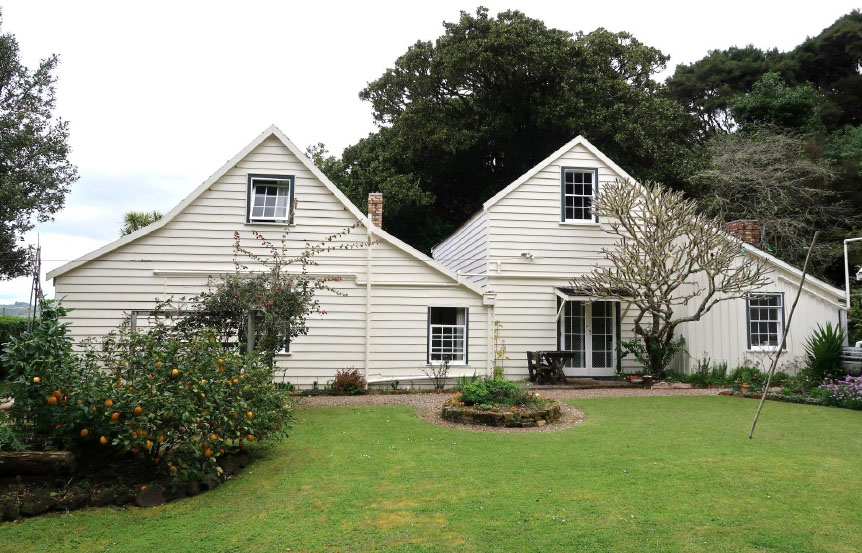
By 1850 Butler was firmly established on the peninsula while White investigated the overlapping land claims of settlers at Mangonui which had been unresolved since they were first investigated in 1843. Butler formally purchased his house site from the Crown and then purchased most of the land now known Butler Point in 1852 at public auction. Butler had established a complex of buildings at the point by this year which included Butler House and four other timber buildings which were likely associated with his trading activities, notably one of these buildings was probably a bonded store which Butler had been authorised to build in 1851. Three of the commercial buildings were located south of Butler House and one was north. Also north of the House was a fenced area possibly used for keeping stock. Butler House is reported to have been brought to the Point from Paewhenua Island on rollers and floated across the harbour. In 1852 the house was a two-up, two-down one and a half storey building with an eastern verandah overlooking the harbour. The interior was comprised of a parlour, ground floor bedroom with stairs to the upper level and two small rooms.
The Trading Station
The trading station at the Point was well placed to take advantage of the increased port activity at Mangonui in the late 1840s through the 1850s. Records of whaling boats visiting the harbour indicate that there was a significant increase in American whalers visiting during this period which subsequently decreased from the 1860s. The station was located closer to the entrance of the harbour than Paewhenua Island and, as one of the main landing places, had deep water anchorage for visiting ships. The station was also near the new customhouse established in the late 1840s on the opposite side of the harbour entrance. Butler was still reliant on produce and goods traded from Māori who evidently transported goods to the Point on waka and camped on the foreshore when whaling boats came into port.
The trading station was very successful through the 1850s and the Butler family prospered. In 1852 Butler was reported to be the only merchant at the port and he expanded his enterprise over the decade including constructing additional buildings at the southern tip of the Point. An archaeological excavation of these buildings found a range of artefacts including clay pipes, bottles, and buttons that date usage of this part of the station to the 1850s and mid to late 1860s. The excavation also found copper nails that were associated with boat building and repairs. Mangonui was noted for being a good anchorage to have whaling boats repaired and refitted during the period when the trading station was operating. The station supplied provisions to whaling ships in exchange for oil and whale bone and provided storage facilities where whalers could leave barrels of oil temporarily. Butler also grew his business through importing and exporting goods on his own boats. He imported goods including tobacco, spirits, and other merchandise and exported flax, kauri gum, timber, and produce to the Bay of Islands, Auckland, and Sydney. Butler also attempted to diversify his operation into whaling. He invested in a whaling venture from 1859 with a number of other investors however the enterprise lost money with only a small number of barrels of oil being obtained each voyage and the desertion of the Māori and Pākehā crew. In 1863 Butler’s trading station was described as consisting of several buildings namely a “shop, stores, including Bonded Store, Stockyard, [and a] Bowling Alley”. Butler’s operation dominated trade in Mangonui which resulted in Maori finding it difficult to compete and profit in commercial ventures. In addition to his business interests Butler was appointed Pilot for Mangonui Harbour in 1851 and Harbour Master in 1857 and was involved in the construction of a new multi-denominational place of worship in 1860.
Domestic Life and Butler House
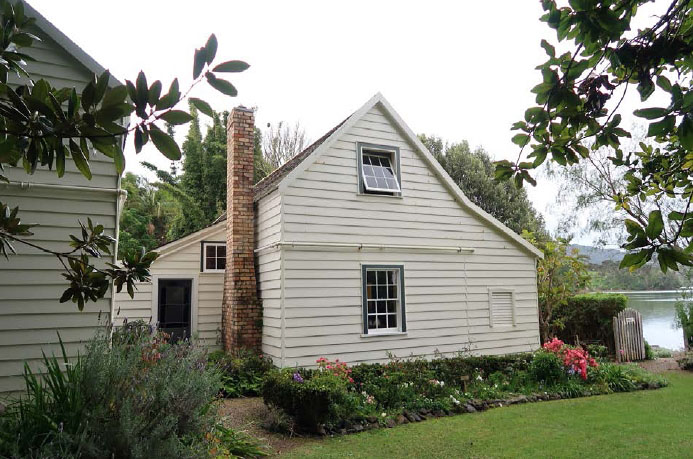
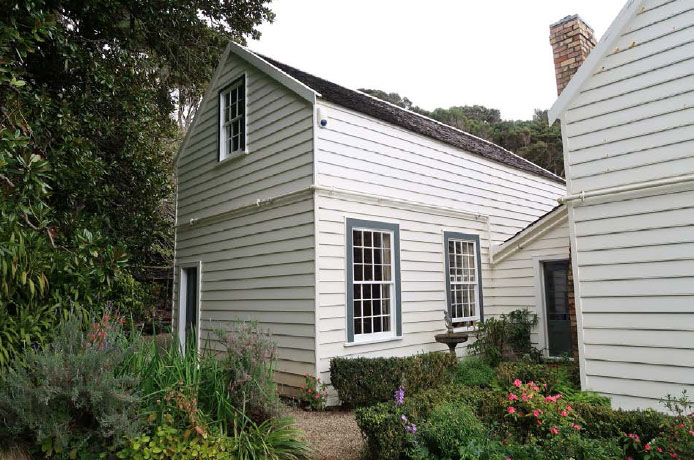
Along with the trading station, Butler House was integral to the functioning of Butler Point. William and Eliza had nine of their thirteen children after the family moved to the Point and the house was expanded significantly by 1858. The expansion was completed in multiple phases. First was a narrow single storey lean-to extension at the rear of the 1847 house that is likely associated with a layout reorganisation of the house as the staircase replaced the earlier access arrangement from the downstairs bedroom. This extension may have been completed before 1852 and a further room was also added between this extension and the front bedroom. The next phase of development added a second one and a half storey building behind the lean-to. This building also had a stair that is accessed from the lean-to and incorporated a large living room on the ground floor. A further structure with a pentice roof was built onto the back of the main extension that includes the kitchen and an additional room. The family also planted a number of plants and trees around the house including a magnolia on the south side of the house and an olive tree on the north side.
Eliza provided support for whalers’ wives when they came into port including providing accommodation when required and assisting with childbirth. The Butler’s also hosted many visitors to Mangonui and the house was the social centre in the district. A burial ground was created at the property by the family where they buried William and Eliza’s sons Richard (1852-1856) and George (1850-1869) and grandson Francis (1870-1870). The burial ground was not only used for family burials. It is reported that Mary Ann Williard, the wife of a whaling captain, who died in childbirth was buried in an unmarked grave at the point and there are unverified stories that unnamed sailors were also buried at the Point in early years.
Later Developments at Mangonui
In the 1860s Mangonui was formally laid out and established as a town. It was the administrative centre of the far north with government buildings and businesses being established around the customhouse opposite Butler Point. Butler was granted an allotment of land at the new township where he built a large building and likely shifted some of his trading interests to during the 1860s while he expanded his land holdings at the point. The trading station at the point continued operation through the 1860s and 70s. William Butler was elected as the first representative for Mangonui in the House of Representatives between 1861 and 1866. While representing Mangonui Butler may have stepped down from running the trading station day to day and temporarily left the settlement between 1863 and 1864. Butler advertised the business and house for lease while he was in Auckland but it is unknown if a tenant was found. Butler declined to stand again represent Mangonui after parliament was relocated to Wellington, returning instead to Butler Point until his death in 1875 following complications related to an accident. He was buried at Butler Point in the family cemetery beside his sons and grandson. William Butler’s will stipulated that his property should be undivided and, after attempts to sell part of the land to raise money for his widow were refused by the courts, Eliza rented out the house and grounds and moved to Grafton, Auckland with her younger daughters. The trading station at the point was likely closed around the time of Butler’s death and the buildings were demolished as none of the Butler’s sons were in a position to continue the business.
Interim years (1875-1912)
The first known tenant of Butler House was Captain John Leslie Chapman. Chapman had been appointed to replace Butler as Pilot of the Port of Mangonui after the former’s death and lived at the house in the years before his own death in 1884. In 1895 Edward James Holmes, a farmer who had previously had a farm east of Butler Point, and his family rented the home for a number of years. At this time the house was falling into disrepair and the upstairs floors were ‘in a dangerous state’. Holmes youngest son, Edward Cheselden Holmes, died in 1900 and was also interred at the cemetery on the grounds. In 1905 the Theophilius Wake and his wife reportedly occupied Butler point with plans to improve the property and adapt it for viticulture. Wake left Mangonui shortly after unsuccessfully contesting the 1905 parliamentary election and Mogford suggests that Butler House may have been temporarily occupied by a Māori family before it was rented in 1912 to Hubert Henry Dacre, a dentist previously from Auckland.
Post-Butler Ownership
Hubert Dacre was the grandson of Ranulph Dacre who had given up his early land purchase at Mangonui in the late 1830s.. Hubert was a prominent sportsman who represented both Auckland and Wellington in rugby and helped found the reformed North Shore Football Club in 1891. Also secretary of the Auckland Swimming Club, he won competitions such as the Amateur Swimming Championship of Wellington in 1894 and was later remembered as ‘one of the best and most powerful swimmers in New Zealand’. Dacre established himself as a dentist in Mangonui district in 1908 and for a time had his practice rooms at the Mangonui Store (List No. 2584, Category 2) opposite Butler Point. Following the death of Eliza Butler in 1919, Butler Point was able to be sold and Dacre purchased the land in 1921. Dacre made a number of changes to the place including replacing the shingle roof with corrugated iron for weather proofing and an extension that was built onto the kitchen to hold a gas plant for a new cooker. Dacre planted an orchard in the grounds, landscaped the garden with shell paths and cared for the original plantings of the Butler family. Butler House continued to be a family home during the period it was owned by the Dacre family. The youngest son of Hubert and his wife Florence was born in Mangonui in 1916 and grew up at the Point. After Hubert Dacre died in 1939, Butler Point was purchased by Robert and Mary Marchant who had been employed as caretakers by Dacre. The house and grounds fell into disrepair over the next decades and stock roamed over the former store site. In 1964 there were three buildings at the property, the House, an old shed and a wool shed which was located at the southern end. Parts of the house were rotted and requiring repairs.
Restoration of Butler House
The Marchants sold the property in 1970 to Dr Lindo Ferguson and his wife Laetitia. The Marchants and their daughter continued living at Butler House after the sale and following Mary’s death a memorial stone was placed for her in the burial grounds. Lindo Ferguson, a former deputy mayor of Auckland City Council, had a long involvement in heritage issues in the city and along with his family was keen to repair and restore Butler House and the wider property. The repairs included rebuilding the chimneys with bricks from the recently demolished bakery at Mangonui, replacement of the battens and the corrugated iron was replaced with shingles as had been originally used. The house was also reblocked and the floors levelled including the kitchen which was replaced with a kauri floor above a concrete apron. The outside privy was restored while an updated internal bathroom was installed inside the house. The other internal rooms were also restored. Wallpaper samples were collected and catalogued during the restoration of the house. Lindo and Laetitia retired to a new house they built at the property and established a whaling museum alongside the restored homestead.