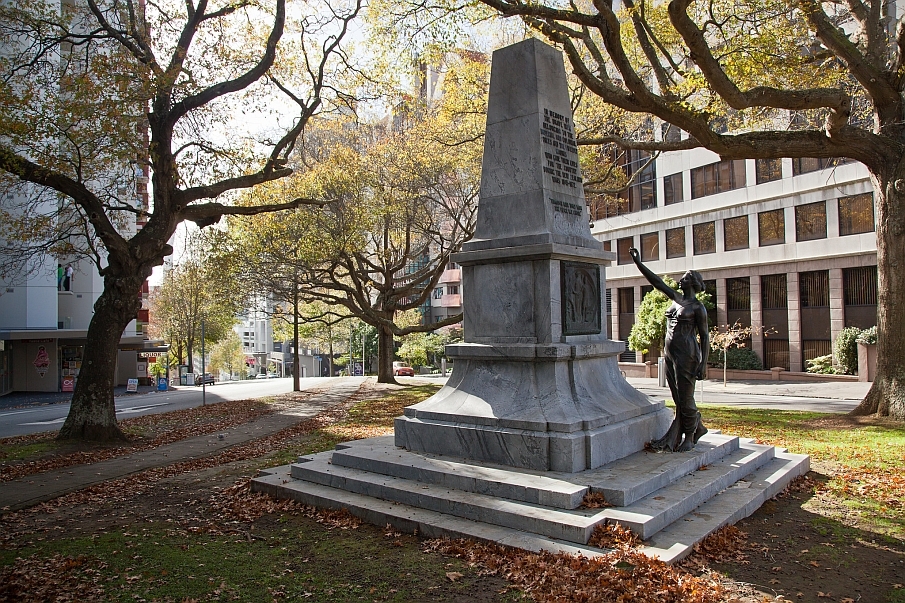
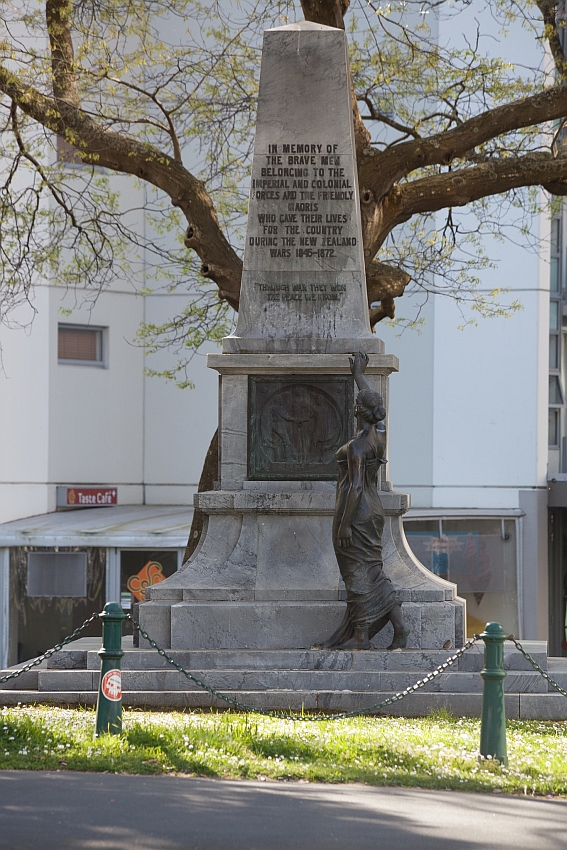
The New Zealand Wars Memorial commemorates Pakeha and Maori who fought on the side of the British in the New Zealand Wars (1845-72). The monument was unveiled in 1920 in the Wakefield Street Reserve, in Auckland City.
The monument is one of a number of war memorials to the New Zealand Wars erected in the 1920s. Prior to the twentieth century, very few memorials were erected to commemorate the colonial wars of the 1840s to the 1870s in New Zealand. This was largely because the concept of erecting collective monuments to those who fought in war was still at an early stage during the mid to late nineteenth century. But historians Chris Maclean and Jock Phillips also suggest that it may have been due to the Pakeha frustration and embarrassment at the time about the long, drawn-out conflict, which ended with no clear-cut victory. It was not until the early 1900s that interest began to develop in erecting memorials specifically to the New Zealand Wars. This occurred as a reaction to the deteriorating headboards of the soldiers in the wars and as young Pakeha New Zealanders began to look back on the pioneering days of the previous century with nostalgia.
The idea of a collective memorial in Auckland for the New Zealand Wars originated with the Victoria League in the early 1900s. The Victoria League was founded in London in 1901, with the aim of conserving 'the deeds of British soldiers and sailors, and other patriotic men and women in the Empire'. At the time, colonial troops were supporting the British in the Boer War (1899 -1902). An Auckland branch of the League was established in 1909, shortly after New Zealand became a Dominion, to help 'foster the bonds of Empire'. The Victoria League was one of the most active groups in commemorating the dead of the New Zealand Wars. The focus of their activities was initially the restoration of New Zealand War graves, in order to promote Imperial ties to the younger generation by teaching school children about the 'Maori war'. Edith Stratham, who was in charge of the project, remarked that most people knew nothing about the war. However, when the League discovered that many of the graves were unmarked, they formed the idea of erecting a collective memorial instead.
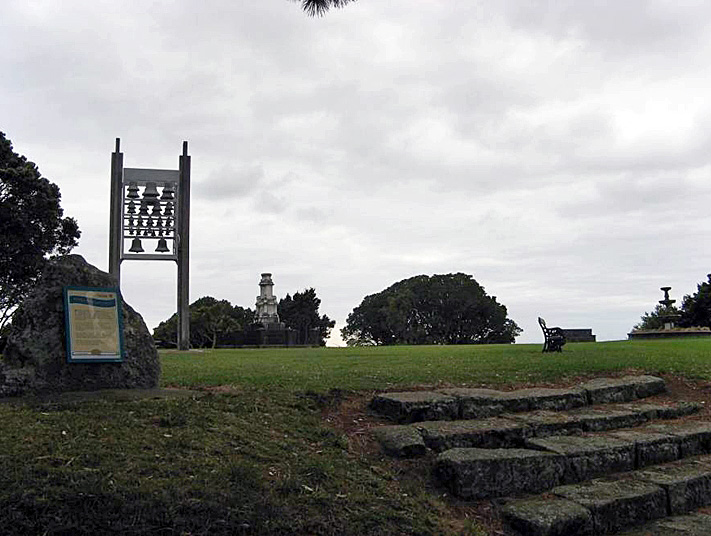
The erection of the memorial, from its inception to final unveiling, took many years. It began in 1911, when the Government gave the Victoria League £100 for the memorial. The city council then provided a site for the memorial on a reserve on the corner of Wakefield Street and Symonds Street. Wakefield Street was a major thoroughfare at the time and there was already a statue of a major colonial figure, the former Governor and Premier Sir George Grey (erected in 1904, moved in 1922), at the bottom of the street. The Reserve was also close to a number of other places associated with the New Zealand Wars, including the Symonds Street cemetery, where many soldiers were buried.
The Victoria League held a competition for the design of the memorial, which was initially won by a local architect, John Park. However, the city council wanted a more conspicuous design, and the project was delayed for two years until the Government provided a further £1000 pounds for the project. When the Victoria League held another competition it was won by British sculptor, T. Eyre Macklin, much to the consternation of some local sculptors. T. Eyre Macklin (1867-1943) was a landscape and portrait painter, sculptor, illustrator and engraver. He was elected a member of the Royal Society of British Artists in 1902. The Auckland Weekly News described him as 'an eminent Royal Academician. His other sculpting works included the South African War Memorial, in Newcastle on Tyne, England.
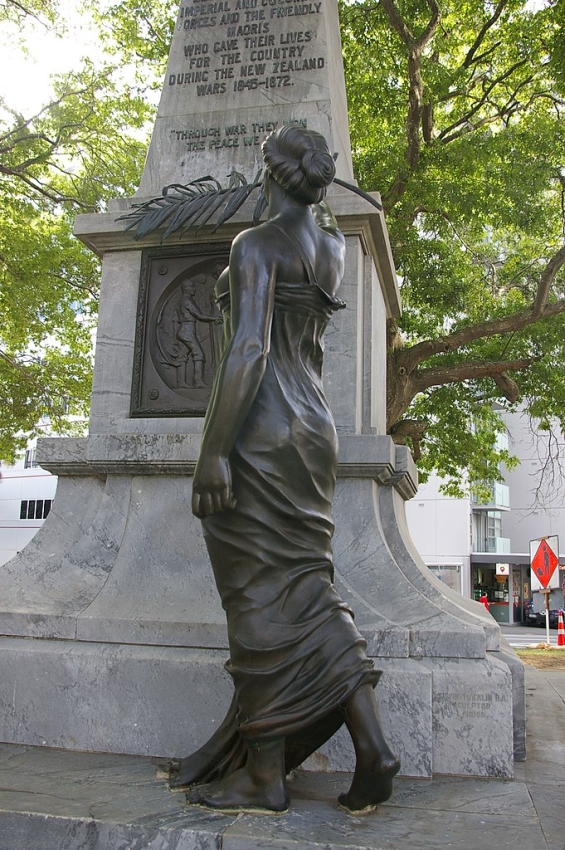
Dates visible on the bronze castings indicate that Macklin's work was carried out in 1915. Delivery of the castings to Auckland, however, was delayed by the First World War (1914-1918). After they eventually arrived in Auckland in 1917, the works remained in storage until 1919 while decisions were made about the materials and construction methods of the associated obelisk. The obelisk was constructed by W. Parkinson & Co., a local company.
Following construction, the memorial was unveiled on 18 August 1920, attended by a large crowd including a number of veterans. The ceremony was presided over by the Victoria League President, Mr. W. J. Napier, who handed over the memorial to the Mayor of Auckland Mr. J. H. Gunson. Veteran Lieutenant-Colonel Morrow also spoke, remembering 'a distant past, when the youth and manhood of this province was summoned by the tocsin (sic) of war, to uphold British rule in this colony'. In fact, the dates of the Wars on the inscription were incorrect, reading 1845-66, and were only corrected after a veteran complained. The veteran also suggested that the monument be translated into Maori, but his suggestion was declined on the grounds of lack of money.
The New Zealand Wars Memorial's exclusive tribute to those who fought on the British side of the conflict conveys the dominant view of Pakeha New Zealanders at the time, and support for the British Empire. The references to peace and the symbolism of unity between Maori and Pakeha in the artwork of the memorial also reflect the prevailing perception that the New Zealand Wars had led to racial harmony. These views were demonstrated in the speeches at the unveiling of the memorial. The Victoria League President, Mr. Napier, mentioned that 'the heroes whose virtues and memories they were perpetuating in this monument did great service in their fight for civilisation ... They should cherish the memory of those who fell in the swamps, on the hillsides, and in the bush of New Zealand to secure to them and their children this great country, and for the betterment of both races'. He paid a tribute to the chivalrous Maoris who had fought with the British. In his reply, Mr. Gudgeon said 'there was no finer aboriginal race than the Maoris. They were proud of them.' Maori who fought against the British and other colonial forces were not specifically mentioned.
For many years, the Victoria League laid a wreath at the foot of the memorial and at Queen Victoria's statue in Albert Park on Empire Day (later known as Commonwealth Day, and subsequently the Queen's Birthday). However, as attitudes changed in the later twentieth century, the New Zealand Wars Memorial became the focus of protest on a number of occasions. In 1981, the statue was tarred and feathered and pulled off its feet during the Springbok Tour protests. A few months later the head of the statue was hacked off and the statue was removed by the council. The head was never recovered and the statue was reinstated with a new head in August 2004. Today, graffiti on the memorial includes the words 'Peace - suxessful (sic) colonialism' and 'reread the treaty'.
The monument is one of a number of war memorials to the New Zealand Wars erected in the 1920s. Prior to the twentieth century, very few memorials were erected to commemorate the colonial wars of the 1840s to the 1870s in New Zealand. This was largely because the concept of erecting collective monuments to those who fought in war was still at an early stage during the mid to late nineteenth century. But historians Chris Maclean and Jock Phillips also suggest that it may have been due to the Pakeha frustration and embarrassment at the time about the long, drawn-out conflict, which ended with no clear-cut victory. It was not until the early 1900s that interest began to develop in erecting memorials specifically to the New Zealand Wars. This occurred as a reaction to the deteriorating headboards of the soldiers in the wars and as young Pakeha New Zealanders began to look back on the pioneering days of the previous century with nostalgia.
The idea of a collective memorial in Auckland for the New Zealand Wars originated with the Victoria League in the early 1900s. The Victoria League was founded in London in 1901, with the aim of conserving 'the deeds of British soldiers and sailors, and other patriotic men and women in the Empire'. At the time, colonial troops were supporting the British in the Boer War (1899 -1902). An Auckland branch of the League was established in 1909, shortly after New Zealand became a Dominion, to help 'foster the bonds of Empire'. The Victoria League was one of the most active groups in commemorating the dead of the New Zealand Wars. The focus of their activities was initially the restoration of New Zealand War graves, in order to promote Imperial ties to the younger generation by teaching school children about the 'Maori war'. Edith Stratham, who was in charge of the project, remarked that most people knew nothing about the war. However, when the League discovered that many of the graves were unmarked, they formed the idea of erecting a collective memorial instead.
The erection of the memorial, from its inception to final unveiling, took many years. It began in 1911, when the Government gave the Victoria League £100 for the memorial. The city council then provided a site for the memorial on a reserve on the corner of Wakefield Street and Symonds Street. Wakefield Street was a major thoroughfare at the time and there was already a statue of a major colonial figure, the former Governor and Premier Sir George Grey (erected in 1904, moved in 1922), at the bottom of the street. The Reserve was also close to a number of other places associated with the New Zealand Wars, including the Symonds Street cemetery, where many soldiers were buried.
The Victoria League held a competition for the design of the memorial, which was initially won by a local architect, John Park. However, the city council wanted a more conspicuous design, and the project was delayed for two years until the Government provided a further £1000 pounds for the project. When the Victoria League held another competition it was won by British sculptor, T. Eyre Macklin, much to the consternation of some local sculptors. T. Eyre Macklin (1867-1943) was a landscape and portrait painter, sculptor, illustrator and engraver. He was elected a member of the Royal Society of British Artists in 1902. The Auckland Weekly News described him as 'an eminent Royal Academician. His other sculpting works included the South African War Memorial, in Newcastle on Tyne, England.
Dates visible on the bronze castings indicate that Macklin's work was carried out in 1915. Delivery of the castings to Auckland, however, was delayed by the First World War (1914-1918). After they eventually arrived in Auckland in 1917, the works remained in storage until 1919 while decisions were made about the materials and construction methods of the associated obelisk. The obelisk was constructed by W. Parkinson & Co., a local company.
Following construction, the memorial was unveiled on 18 August 1920, attended by a large crowd including a number of veterans. The ceremony was presided over by the Victoria League President, Mr. W. J. Napier, who handed over the memorial to the Mayor of Auckland Mr. J. H. Gunson. Veteran Lieutenant-Colonel Morrow also spoke, remembering 'a distant past, when the youth and manhood of this province was summoned by the tocsin (sic) of war, to uphold British rule in this colony'. In fact, the dates of the Wars on the inscription were incorrect, reading 1845-66, and were only corrected after a veteran complained. The veteran also suggested that the monument be translated into Maori, but his suggestion was declined on the grounds of lack of money.
The New Zealand Wars Memorial's exclusive tribute to those who fought on the British side of the conflict conveys the dominant view of Pakeha New Zealanders at the time, and support for the British Empire. The references to peace and the symbolism of unity between Maori and Pakeha in the artwork of the memorial also reflect the prevailing perception that the New Zealand Wars had led to racial harmony. These views were demonstrated in the speeches at the unveiling of the memorial. The Victoria League President, Mr. Napier, mentioned that 'the heroes whose virtues and memories they were perpetuating in this monument did great service in their fight for civilisation ... They should cherish the memory of those who fell in the swamps, on the hillsides, and in the bush of New Zealand to secure to them and their children this great country, and for the betterment of both races'. He paid a tribute to the chivalrous Maoris who had fought with the British. In his reply, Mr. Gudgeon said 'there was no finer aboriginal race than the Maoris. They were proud of them.' Maori who fought against the British and other colonial forces were not specifically mentioned.
For many years, the Victoria League laid a wreath at the foot of the memorial and at Queen Victoria's statue in Albert Park on Empire Day (later known as Commonwealth Day, and subsequently the Queen's Birthday). However, as attitudes changed in the later twentieth century, the New Zealand Wars Memorial became the focus of protest on a number of occasions. In 1981, the statue was tarred and feathered and pulled off its feet during the Springbok Tour protests. A few months later the head of the statue was hacked off and the statue was removed by the council. The head was never recovered and the statue was reinstated with a new head in August 2004. Today, graffiti on the memorial includes the words 'Peace - suxessful (sic) colonialism' and 'reread the treaty'.