

Waihi had sprung up in the early 'eighties' following the discovery of the Martha Gold Reef in 1878. Until the late 1890s, however, Waihi was little different from other shanty towns. The advent of the cyanide process of gold extraction in 1893 and the establishment of the British Waihi Gold Mining Company brought permanence and prosperity to Waihi. The erection of the courthouse in 1901 was a further indication of this permanence.
Mining matters such as miners' rights and licences were also administered by the Warden's Court from the building. Additions to the courthouse were needed in 1906 to accommodate the Inspector of Mines, Waihi.
During the Waihi Strike of 1912 the Waihi Magistrate's Court came to the nation's attention when prosecutions were brought against 82 striking miners. The strike which commenced in May and lasted for six months was particularly acrimonious. Waihi ultimately became the scene of confrontation between Massey's newly-elected Reform Government and the Federation of Labour. Several members of the "Red Feds" who became involved in the issue of the Waihi Strike were later to achieve prominence as members of the Labour Government elected in 1935.
Although used less intensively than in the days of Waihi's mining boom, the building remains a District Court serving the largely rural community which subsequently grew up around Waihi.
List Entry Information
Status
Listed
List Entry Status
Historic Place Category 1
Access
Private/No Public Access
List Number
4685
Date Entered
13th December 1990
Date of Effect
13th December 1990
City/District Council
Hauraki District
Region
Waikato Region
Extent of List Entry
Extent includes the land described as Secs 1‐2 SO 58615 (RTs SA48B/897, SA51C/75), South Auckland Land District, and the building and structures known as Waihi Courthouse thereon.
Legal description
Secs 1‐2 SO 58615 (RTs SA48B/897, SA51C/75), South Auckland Land District
Status
Listed
List Entry Status
Historic Place Category 1
Access
Private/No Public Access
List Number
4685
Date Entered
13th December 1990
Date of Effect
13th December 1990
City/District Council
Hauraki District
Region
Waikato Region
Extent of List Entry
Extent includes the land described as Secs 1‐2 SO 58615 (RTs SA48B/897, SA51C/75), South Auckland Land District, and the building and structures known as Waihi Courthouse thereon.
Legal description
Secs 1‐2 SO 58615 (RTs SA48B/897, SA51C/75), South Auckland Land District
Why is this place significant?
Historic Significance
Historical Significance or Value The Courthouse was a public building of considerable significance to the permanent township developing at Waihi at the turn of the century. The role of the warden's court in the administration of mining matters reinforced the building's importance in a town, the fortunes of which were closely associated with those of the country's largest gold mine. The courthouse was the venue of the trials following the Waihi Miners' Strike of 1912, an event of major significance in New Zealand labour history.
Physical Significance
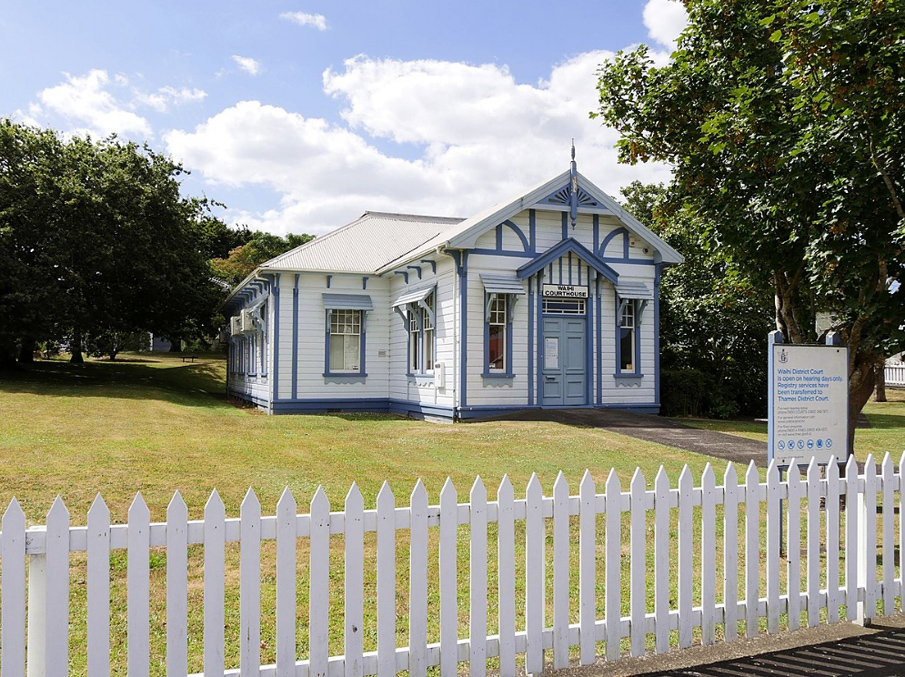
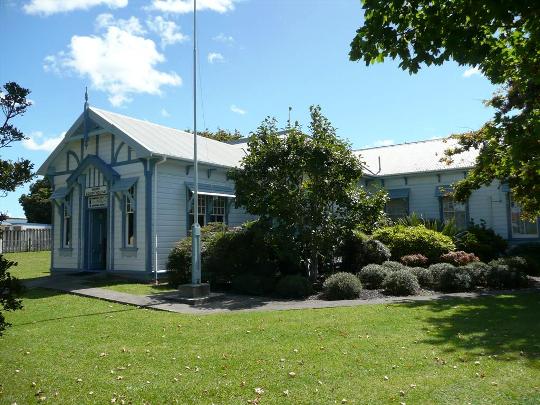
ARCHITECTURAL QUALITY: Waihi Courthouse is one of the finest extant examples of the wooden public buildings constructed under the direction of John Campbell as Government Architect. The design, which conforms to fairly well defined standards, was once common in New Zealand. An attractive, domestic-scale building sited on a generous, picturesque section it has recently been restored with care and attention. The interior remains largely in original appearance and condition and the courtroom is a fine example of a turn-of-the-century public space. TOWNSCAPE/LANDMARK VALUE: The courthouse is enhanced by its picket fence and garden setting but it does not have significant townscape presence.
Why is this place significant?
Historic Significance
Historical Significance or Value The Courthouse was a public building of considerable significance to the permanent township developing at Waihi at the turn of the century. The role of the warden's court in the administration of mining matters reinforced the building's importance in a town, the fortunes of which were closely associated with those of the country's largest gold mine. The courthouse was the venue of the trials following the Waihi Miners' Strike of 1912, an event of major significance in New Zealand labour history.
Physical Significance
ARCHITECTURAL QUALITY: Waihi Courthouse is one of the finest extant examples of the wooden public buildings constructed under the direction of John Campbell as Government Architect. The design, which conforms to fairly well defined standards, was once common in New Zealand. An attractive, domestic-scale building sited on a generous, picturesque section it has recently been restored with care and attention. The interior remains largely in original appearance and condition and the courtroom is a fine example of a turn-of-the-century public space. TOWNSCAPE/LANDMARK VALUE: The courthouse is enhanced by its picket fence and garden setting but it does not have significant townscape presence.
Construction Professional
Name
Campbell, John
Type
Architect
Biography
John Campbell (1857-1942) served his articles under John Gordon (c1835-1912) in Glasgow. He arrived in Dunedin in 1882 and after a brief period as a draughtsman with Mason and Wales joined the Dunedin branch of the Public Works Department in 1883. His first known work, an unbuilt design for the Dunedin Railway Station, reveals an early interest in Baroque architecture. In November 1888 Campbell was transferred to Wellington where in 1889 he took up the position of draughtsman in charge of the Public Buildings Division of the Public Works Department. He remained in charge of the design of government buildings throughout New Zealand until his retirement in 1922, becoming in 1909 the first person to hold the position of Government Architect. Government architecture designed under his aegis evidences a change in style from Queen Anne to Edwardian Baroque. His best-known Queen Anne design is the Dunedin Police Station (1895-8), modelled on Richard Norman Shaw's New Scotland Yard (1887-90). Among his most exuberant Edwardian Baroque buildings is the Public Trust Office, Wellington (1905-09). Although Campbell designed the Dunedin Law Courts (1899-1902) in the Gothic style with a Scottish Baronial inflection, he established Edwardian Baroque as the government style for police stations, courthouses and post offices throughout New Zealand. In 1911 Campbell won the nation-wide architectural competition for the design of Parliament Buildings, Wellington. Although only partially completed, Parliament House is the crowning achievement of Campbell's career.
Name
Vickerman, Charles
Type
Architect
Biography
Charles Ranken Vickerman, District Engineer of the Public Works Department.
Construction Details
Start Year
1906
Type
Addition
Description
Tenders for addition to the east wing called for by CR Vickerman on 11 Jan 1906.
Start Year
1901
Type
Original Construction
Start Year
1906
Type
Addition
Description
East Wing addition completed.
Start Year
1983
Type
Modification
Description
Porch extended and converted into a waiting room. Witness room converted to public toilet. Judge's chamber extended and rooms added to rear of building. Part of east wing opened into general office, and wing extended.
Construction Materials
Concrete footings and foundation wall; timber framing with rusticated kauri weatherboards; long run corrugated steel roofing.
Construction Professional
Name
Campbell, John
Type
Architect
Biography
John Campbell (1857-1942) served his articles under John Gordon (c1835-1912) in Glasgow. He arrived in Dunedin in 1882 and after a brief period as a draughtsman with Mason and Wales joined the Dunedin branch of the Public Works Department in 1883. His first known work, an unbuilt design for the Dunedin Railway Station, reveals an early interest in Baroque architecture. In November 1888 Campbell was transferred to Wellington where in 1889 he took up the position of draughtsman in charge of the Public Buildings Division of the Public Works Department. He remained in charge of the design of government buildings throughout New Zealand until his retirement in 1922, becoming in 1909 the first person to hold the position of Government Architect. Government architecture designed under his aegis evidences a change in style from Queen Anne to Edwardian Baroque. His best-known Queen Anne design is the Dunedin Police Station (1895-8), modelled on Richard Norman Shaw's New Scotland Yard (1887-90). Among his most exuberant Edwardian Baroque buildings is the Public Trust Office, Wellington (1905-09). Although Campbell designed the Dunedin Law Courts (1899-1902) in the Gothic style with a Scottish Baronial inflection, he established Edwardian Baroque as the government style for police stations, courthouses and post offices throughout New Zealand. In 1911 Campbell won the nation-wide architectural competition for the design of Parliament Buildings, Wellington. Although only partially completed, Parliament House is the crowning achievement of Campbell's career.
Name
Vickerman, Charles
Type
Architect
Biography
Charles Ranken Vickerman, District Engineer of the Public Works Department.
Construction Details
Start Year
1906
Type
Addition
Description
Tenders for addition to the east wing called for by CR Vickerman on 11 Jan 1906.
Start Year
1901
Type
Original Construction
Start Year
1906
Type
Addition
Description
East Wing addition completed.
Start Year
1983
Type
Modification
Description
Porch extended and converted into a waiting room. Witness room converted to public toilet. Judge's chamber extended and rooms added to rear of building. Part of east wing opened into general office, and wing extended.
Construction Materials
Concrete footings and foundation wall; timber framing with rusticated kauri weatherboards; long run corrugated steel roofing.
ARCHITECTURAL DESCRIPTION: Waihi Courthouse is a single-storey wooden public building with a domestic scale and style. Originally symmetrical about the gabled entrance it has a compatibly designed wing to the east (1906). The building is distinguished by its decoration and attention to detail. Apart from the entrance gable the building has a hipped-roof with eave brackets and is clad with rusticated weatherboards. The main entrance is through panelled double doors flanked by slender sash windows. On each side are paired sash windows. The gable is faced with decorative timber battens and capped with a finial and cut-timber ornamentation. The main body of the building and the extension have single and paired sash windows. All windows have multi-paned upper lights, bracketed hoods, timber aprons and scriber boards. The principal feature of the interior is the courtroom, located on the south side of the main block. It has a panelled coved ceiling, tongue-and-groove dado panelling and elegant doors, architraves and courtroom joinery, all in rimu. The foyer, judges rooms and office in the east wing are all similarly finished but the remainder of the building spaces have little or no applied decoration. MODIFICATIONS: 1906 - East wing added 1983 - Porch extended and converted into a waiting room - Witness room converted to public toilet - Judge's chamber extended and rooms added to rear of building - Part of east wing opened into general office, and wing extended
ARCHITECTURAL DESCRIPTION: Waihi Courthouse is a single-storey wooden public building with a domestic scale and style. Originally symmetrical about the gabled entrance it has a compatibly designed wing to the east (1906). The building is distinguished by its decoration and attention to detail. Apart from the entrance gable the building has a hipped-roof with eave brackets and is clad with rusticated weatherboards. The main entrance is through panelled double doors flanked by slender sash windows. On each side are paired sash windows. The gable is faced with decorative timber battens and capped with a finial and cut-timber ornamentation. The main body of the building and the extension have single and paired sash windows. All windows have multi-paned upper lights, bracketed hoods, timber aprons and scriber boards. The principal feature of the interior is the courtroom, located on the south side of the main block. It has a panelled coved ceiling, tongue-and-groove dado panelling and elegant doors, architraves and courtroom joinery, all in rimu. The foyer, judges rooms and office in the east wing are all similarly finished but the remainder of the building spaces have little or no applied decoration. MODIFICATIONS: 1906 - East wing added 1983 - Porch extended and converted into a waiting room - Witness room converted to public toilet - Judge's chamber extended and rooms added to rear of building - Part of east wing opened into general office, and wing extended
Historical and Associated Iwi / Hapū / Whānau
Information Sources
Appendices to the Journals of the House of Representatives (AJHR)
Appendices to the Journals of the House of Representatives
Auckland Weekly News
Auckland Weekly News
McAra, J. B., 1988
J B McAra, Gold Mining at Waihi 1878-1952, Waihi, 1988
Climie, 1962
N S Climie, (ed) Waihi Borough Council: Diamond Jubilee, 1902-1962, Paeroa, 1962
Olssen, 1988
E Olssen. The Red Feds : Revolutionary Industrial Unionism of the NZ Federation of Labour 1908-1913, Auckland, 1988
Roche, 1982
S Roche, The Red and the Gold : An Informal Account of the Waihi Strike 1912, Auckland, 1982
Waihi Art Centre & Museum
Waihi Art Centre & Museum
Waihi Daily Telegraph
Waihi Daily Telegraph
Other Information
This historic place was registered under the Historic Places Act 1980. This report includes the text from the original Building Classification Committee report considered by the NZHPT Board at the time of registration. Please note that entry on the New Zealand Heritage List/Rarangi Korero identifies only the heritage values of the property concerned, and should not be construed as advice on the state of the property, or as a comment of its soundness or safety, including in regard to earthquake risk, safety in the event of fire, or insanitary conditions.
Historical and Associated Iwi / Hapū / Whānau
Information Sources
Appendices to the Journals of the House of Representatives (AJHR)
Appendices to the Journals of the House of Representatives
Auckland Weekly News
Auckland Weekly News
McAra, J. B., 1988
J B McAra, Gold Mining at Waihi 1878-1952, Waihi, 1988
Climie, 1962
N S Climie, (ed) Waihi Borough Council: Diamond Jubilee, 1902-1962, Paeroa, 1962
Olssen, 1988
E Olssen. The Red Feds : Revolutionary Industrial Unionism of the NZ Federation of Labour 1908-1913, Auckland, 1988
Roche, 1982
S Roche, The Red and the Gold : An Informal Account of the Waihi Strike 1912, Auckland, 1982
Waihi Art Centre & Museum
Waihi Art Centre & Museum
Waihi Daily Telegraph
Waihi Daily Telegraph
Other Information
This historic place was registered under the Historic Places Act 1980. This report includes the text from the original Building Classification Committee report considered by the NZHPT Board at the time of registration. Please note that entry on the New Zealand Heritage List/Rarangi Korero identifies only the heritage values of the property concerned, and should not be construed as advice on the state of the property, or as a comment of its soundness or safety, including in regard to earthquake risk, safety in the event of fire, or insanitary conditions.
Current Usages
Uses: Law Enforcement
Specific Usage: Courthouse
Current Usages
Uses: Law Enforcement
Specific Usage: Courthouse
