Early History
The history of Coastal Otago (Te Tai o Araiteuru) relates to the tradition of the waka Arai Te Uru. These traditions and histories provide the basis for tribal identity. Muaupoko (Otago Peninsula) in particular provided a sheltered place for settlement, and Waitaha, Ngāti Mamoe and Ngāi Tahu, who remain associated with the area, all visited and lived in the vicinity. At one time up to 12 kainga existed in the lower Otago harbour. The coastline was a major trade route. Tauranga waka and associated nohoanga occurred up and down the coast, linking sea and land based resources. The mahinga kai and the varieties of plant resources were important to iwi, and with the Pakeha settlement and land sales starting in the late 1840s (particularly the sale of the 400,000 acre Otago Block) there was a significant loss of access to land based food sources.
Dr Edward Hulme (1812-1876)
Hulme was born in Kent, England, in May 1812 to Alice and William, a captain in the Royal Staff Corps. At age 16 Edward Hulme was apprenticed at the Royal College of Surgeons in London. In 1834, after a six year apprenticeship and serving as the dresser of noted surgeon Sir Charles Bell, he was admitted as a Member of the Royal College of Surgeons (MRCS). In 1837 he obtained a Doctor of Medicine from the University of St Andrews. Hulme then settled in Exeter where, in 1845, he was elected to the Exeter Dispensary’s office of physician. A testimony following Hulme’s 1849 resignation spoke of his ‘great worth’ and that ‘his great skill and attention’ meant that ‘the poor generally preferred Dr Hulme.’
Hulme continued his studies, first in Paris and then Dublin. Yet Hulme ‘became restless, and decided to give up his profession and go to the new colony of which everyone was speaking. No doubt correspondence with his old friend Williams [Dr Williams, Colonial Surgeon in Dunedin] influenced him, and newspapers giving glowing account of the opportunities of investing money in land, sheep and cattle, would reach him….In addition to this, his half-brother Colonel Hulme, who had gone out to the colony 10 years before…further inclined him to try the new adventure’.
In October 1856 Hulme arrived at Port Chalmers as the ship’s surgeon on the Strathmore. Dr Williams resigned from his post at the hospital soon after and ‘on talking matters over with the settlers from the country and residents of the town’ Hulme applied for the vacant position. In January 1857 it was announced that Hulme was to be the new Provincial Surgeon at the Dunedin Hospital located in the Octagon (where the Town Hall now stands).
The influx of gold-seeking migrants transformed Hulme from a part-time public general practitioner into, what one historian has called, New Zealand’s first full-time health administrator. The doctor performed all the duties in the hospital, which ranged from care of the mentally ill, to amputations, to infectious diseases. The newspaper remarked that his duties were ‘excessively onerous and fatiguing’.
Hulme also lobbied for the creation of a separate mental hospital and the replacement of the city's existing unsatisfactory hospital. He became medical superintendent of the new Lunatic Asylum and Dunedin Gaol, while continuing his administration of the Hospital. He continued to encourage public health innovations which ‘developed a tradition of scientific medical research which eventually led to the development of Dunedin as the principal academic medical centre of this country…Hulme…kept the local authorities in New Zealand in touch with the latest public health research on the sources of epidemic disease (a significant cause of infant mortality in particular) and the need to develop practical and comprehensive schemes in the new settlements to deal with clean water reticulation and the disposal of sewage and garbage’.
Hulme was also President of the Otago Medical Board from 1864, where he attempted to improve the standard of medical practitioners; he served on the Town Board from 1862; and was a foundation member of the Otago University Council in 1869. In the 1870s, during a court case, a lawyer suggested he had retired from practice. Hulme replied: ‘I can hardly say that…I think I am safely within a good margin if I say I see between two and three hundred patients daily.’
Hulme was the forerunner of the operating surgeons of Otago, in private and public practice. He also kept the local authorities informed on matters of public health including the need to have clean water reticulation and the proper disposal of sewage and garbage. Hulme also oversaw the introduction of ‘Listerism’, or regular use of antiseptic, into Otago. Such was his influence, that Hulme was recently named one of New Zealand’s first social entrepreneurs who fostered social innovation - one of just twenty, alongside the likes of Sir Truby King, Kate Sheppard, and Sir Apirana Ngata.
Hulme’s Court
In November 1856 sections 7, 8, 11, 12 and 13 in the Town of Dunedin, were put up for sale by the Waste Lands Board. Town Board rates records for 1857 show Hulme as the new owner. The sections were valued at £12 and were unoccupied. By 1858 section 6 had been added to Hulme’s holdings and a stable had been erected on one of the sections. By 1859 he also owned section 39 but no dwelling was recorded on any of the sections. Hulme now owned a sizeable amount of land between present day Dowling Street (renamed Tennyson Street in 1916) and Moray Place.
The rates moved substantially from £30 to £48 in March 1860. For the first time a dwelling house was noted on site. In March 1861 rates rose again to £72, indicating that the dwelling was enlarged during the year. The house was certainly complete by May 1861 when board and residence was advertised ‘opposite the residence of Dr. Hulme’.
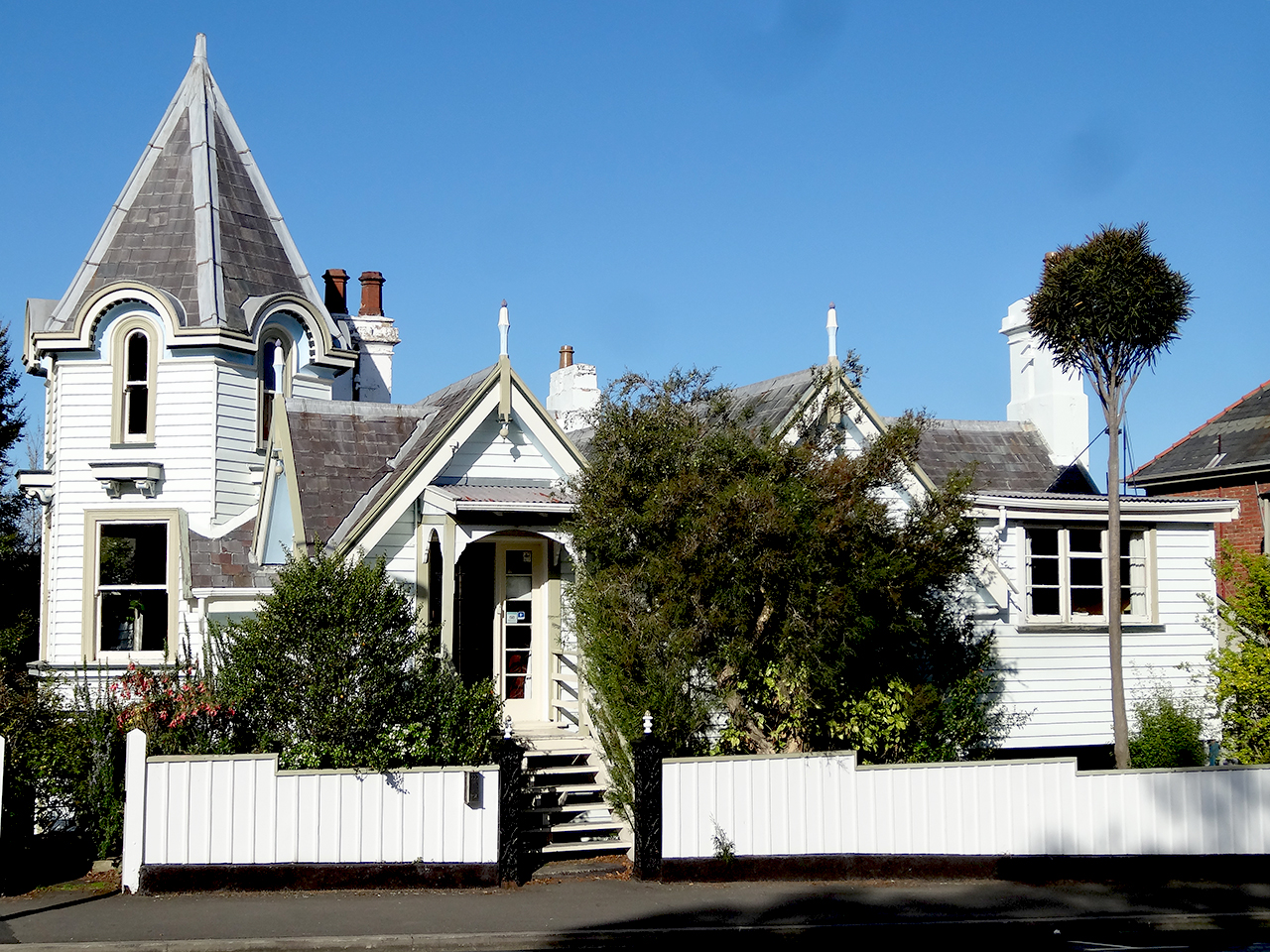
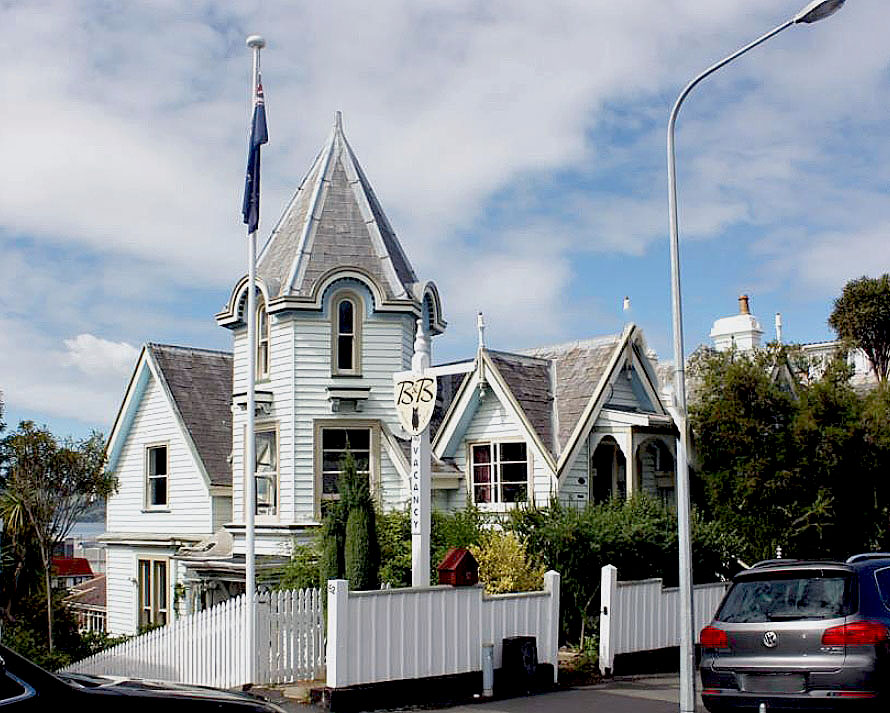
The first available photographic evidence dates to 1862. Different roof heights indicate the house was built in stages, consistent with the rating records. Given the roof lines and the respective size of the portions, it is likely that the very first part of the house constructed was towards the corner of View and Dowling Streets (on the left of the image shown in Figure 1). There were likely two entrances; the front entrance from Dowling Street, and the rear entrance from, what was likely, the kitchen which provided access to View Street.
In February 1863 architect David Ross requested tenders for ‘extensive additions’ to the residence of Dr Hulme. David Ross is recognised as one of the most significant architects to have worked in Dunedin. Ross began his career in Scotland, immigrated to Victoria in 1853 and arrived in Dunedin in May 1862. He designed many of Dunedin’s noted buildings including the Imperial Hotel, Bank of Otago, the Otago Museum and the Prince of Wales Hotel. Hulme’s Court appears to be Ross’ first residential design in New Zealand. The resulting home was typical of his later architecture: ‘strong yet elegant, and rich yet unfussy design’.
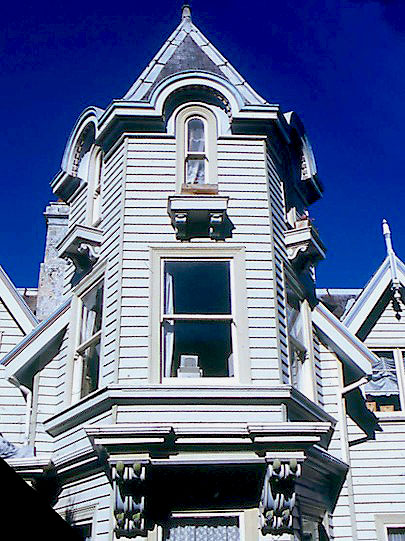
Ross’ additions provided the footprint of the house as it is today. The original 1859-1860 portion of the house and chimney remained but the 1861 addition was largely subsumed within Ross’ alterations, which included a turret. Although the varying roof heights were unified, the changing floor levels on the interior continued to mark the the line between the original 1860/1861 dwelling and the 1863 addition.
Hulme’s completed residence was later described as four stories high, including the basement which sat above ground level. Atop the basement were the lower level, which gave access to View Street, and then the upper level at Dowling Street level. The top level was the room in the turret, accessed from the room below. Elegant details were added to the exterior including window boxes, scrolls, finials and lattice work.
Hulme ran a private consulting practice from home and it is believed that the doctor’s surgery was the middle level of the turret with a ‘sweeping bay window commanding a view in almost every direction’. The surgery also provided the only access to the turret, through a trap door in the ceiling. It is also likely that the small room between the turret and Tennyson Street functioned as a small foyer/waiting room. The Burton Brothers photograph (Figure 3), however, shows no external access to this ‘foyer’. As the 1860s building must have included stairs, they may have been located just beyond the original entrance door and wound up to the small waiting room.
The residence also contained four bedrooms, a sunroom, a drawing room, dining room, kitchen, box room and store rooms. The house included black-flecked marble fireplaces, two of which survive. The ceilings in the main rooms were moulded, and those on the upper level were a variety of pitches following the varied lines of the roof. It was built from a mix of imported Baltic pine and native timbers. The basement was stone.
Presumably there were also servant’s quarters, perhaps adjacent to the kitchen on the ground floor. Hulme’s housekeeper was Amelia Provost. Born c.1821, Miss Provost immigrated with her brothers to New Zealand on board the Alpine in 1859. This placed her in Dunedin as an almost 40 year old spinster in need of work, just as Hulme was building his home. Amelia was the first beneficiary mentioned in Hulme’s will and he left her an annuity of £60.
Hulme was a keen gardener and horticulturist, and there were a number of outbuildings, including glasshouses on site. His fruit was prizewinning. The garden had ‘fine fruit trees, and grew famous grapes.’
Hulme died suddenly on 27 December 1876, aged 64. He was remembered as ‘an able surgeon, and carried on his consulting practice to such good purpose that when he died 7000 half sovereigns were found in his safe’. He was also described as:
rather reserved in his manner…and while many thought him very rough and inclined to be dictatorial others had pleasant recollections of the dry humour which showed in much of his conversation. When deeply engrossed with professional anxiety he was inclined to be brusque, if not absolutely rude, and was often thought unfeeling...of medium height and abrupt manner, he wore a snuff coloured surtout buttoned up to the chin, and a black bowler hat; he had a thick husky voice, and would say “Gad, sir, I told you to do so and so; why did you not do it?” He had a rooted objection to taking off his hat in response to a lady’s bow…
Yet contemporaries also remembered Hulme as a man with a ‘kindly and considerable manner’ and his ‘cheery greeting would be missed.’ He was also known to be ‘liberal to a remarkable degree in letting money lie out of his pocket…in the shape of uncollected fees…and also never hesitated to give his time to those who could not afford to pay for medical advice’.
Hulme left his estate to his sister Maria’s children. John, William and Maria Hart lived in England but nephew Edward Hulme Hart lived in Dunedin and managed the estate. Hart was married to Captain William Cargill’s granddaughter, Frances Cutten, and was in partnership with his grandson, Francis. Hart’s father-in-law, William Henry Cutten, was a politician, and owner and founder of the Otago Witness and Otago Daily Times. This link may explain why, following Hulme’s death, Cutten took
over residence of the house for much of 1877 and 1878.
Dr John Wilkins(1826-1905)
Dr Wilkins was the second doctor to take up residence. The architecture of the house, including the surgery, and its central location, marked it out as a natural doctor’s residence. Wilkins arrived in Dunedin in 1877 from Melbourne. In May 1878 he moved into the house.
Dr Wilkins’ residency was short. Controversy followed him, and statements he made concerning his own expertise were called into question by a fellow doctor in 1878. Leaving Dunedin in 1879, he was later charged with manslaughter after an ‘illegal operation’ led to the death of his female patient.
Dr Alexander Hyndman Neill (1836-1893)
By 1880 Dr Neill was in residence. In 1878 Neill visited New Zealand with the 5th Lancers Company and he returned in October 1879 as the doctor in charge of the immigrant ship Timaru.
Photographic evidence indicates it was during Neil’s residency that a narrow lean to structure was added to the ground floor of the home. It was not part of Ross’ additions. It appeared to have large openings and may have been a stable. In the twentieth century it was used as a carport.
In June 1881 Neill advertised a ‘family residence to let containing eleven rooms, with garden, vineries, stabling etc.’ Neill was soon to take up the management of Seacliff Asylum.
Dr Alexander John Fergusson (1840-1897)
In June 1884 Dr Fergusson moved into the residence, which eight years after his death was still referred to as ‘the house formerly occupied by the late Dr Hulme’. Fergusson also used the residence as part private consulting rooms.
Fergusson was the medical officer with the Lodge of Oddfellows and a surgeon at Dunedin Hospital. His specialty was eyes and he was even referred to the ‘the Eminent Eye Doctor of Dunedin’. He was also doctor to Bishop Moran and was highly-esteemed by the Catholics of Dunedin and Otago.
Fergusson lived in and worked from Hulme’s former home until 1896. His death came a year later in 1897. The newspaper remarked that there were ‘few men in Otago who were better or more favourably known’ than Fergusson and ‘fully eight out of ten people, between here and Balclutha were personally acquainted with him, and his generous, open-hearted, high-spirited qualities…’
‘Superior Board and Residence’
In March 1896 the house was first observably referred to as ‘Hulme’s Court. Mrs Sarah Walls established a boarding residence in the house. Directories indicate up to four, probably single, gentlemen were in residence in any given year.
Mrs Walls was followed by Miss L.A. Connnell in 1900. She likely catered for married couples as a Mrs Meldrum advertised for a ‘nurse girl’ at Hulmescourt in 1901. In July 1901 Miss Connell , who was leaving the colony, held a sale of ‘fine and extensive furnishings’ including the residence’s linoleum and stair carpet.
Mrs Macdonald took over the boarding establishment in 1901. Under Mrs Macdonald’s regime, the boarding establishment was likely for single men only. The atmosphere of the residence must have been convivial. For example the ‘Hulmescourt’ team entered a ping pong tournament in May 1902. When Mrs Macdonald eventually closed the establishment some years later, her ‘gentlemen boarders’ presented her with a travelling trunk, spoke of her ‘many good qualities, and expressed the regret that they all felt at her decision to leave Dunedin’.
In 1906 Hulme’s estate was subdivided and the sections put up for sale by Edward Hulme Hart, who still owned the estate in tandem with his siblings. ‘Hulme’s Court House and Freehold’ became Lot 4 and was 75 x 117 feet (22.86 x 35.66 metres). Four of Hulme’s Court substantial outbuildings were divided over Lots 1, 2 and 3.
After the sale, in early November, Mrs Macdonald advertised the furniture of Hulme’s Court for sale and the stable for removal. She had decided to retire to Wellington.
The new owner of Hulme’s Court was Alexander Campbell. He had sold his Middlevale farm, near Gore, in May of that year. Yet Campbell’s occupation was brief – he died at Hulme’s Court in September 1907. His widow Jane remained in the house until 1913.
Signor Raffaello Squarise (1856-1945)
In 1913, Signor Squarise purchased Hulme’s Court. Born in Vicenza Italy, at the age of 12 he entered the Liceo Musicale in Turin. He graduated in the mid-1870s with a master's diploma in violin and composition. In 1882 Squarise immigrated to Australia and began work with a Melbourne opera company. He soon moved to Adelaide where, in 1887, he married Louise Villanis.
In 1889 Squarise left his position as leader of the Theatre Royal Orchestra to lead the orchestra for Dunedin’s New Zealand and South Seas Exhibition. Once in town ‘his performing abilities were instantly recognised by the public…’and at the end of the Exhibition, Squarise decided to stay.
Squarise quickly became ‘one of a talented group who were to develop enormously Dunedin's enthusiasm for and participation in classical music. As a result of their efforts the musical life of the city grew to impressive proportions in quantity and quality. ’ In 1904 he formed a string orchestra – the Dunedin Philharmonic Society. The orchestra held 28 seasons, 27 conducted by Squarise, and its success ‘was due to Squarise's skills as a music director and teacher.’ He saw the Philharmonic ‘as a means of uplifting the artistic tastes of our people and giving them some knowledge of what is doing in modern music.'
Squarise lived and taught music pupils from Hulme’s Court for over a decade before commissioning architect E.W. Walden to undertake alterations in 1924, with the aim of dividing the home into two flats. The plan saw a new porch and steps rising from Tennyson Street to the small room/foyer outside, what was likely, the surgery. The only access to this room/foyer had been the surgery – it had no access to the rest of the house. Walden now removed part of the wall and installed an archway to provide access to the home’s hallway. A new tiled fireplace was added to the surgery/music room. Three other bedrooms were shown on the plan, as well as a bathroom, kitchen and large new linen press. The kitchen was updated with a new gas range and new sink and bench.
Downstairs on the ground floor a new window was added to the 1880s lean-to, which no longer exists, beside the base of the turret. Inside, the old door to the kitchen quarters was closed off to create a small bathroom. A new door was created from the hall to the kitchen, which included a large range. Off the kitchen was a room with benches and sink, no doubt the scullery. This room had lost half its space to the new bathroom. New linen presses were also added below the stairs and the stairway was slightly altered. Each floor could now function as a separate apartment.
In 1933 Squarise retired from public life, but continued to teach music. By 1937 the house had become a dwelling for two couples. Squarise and his wife were listed at 52a Tennyson Street. Frederick Morrison, an accountant, and his wife Flora probably occupied the 52 Tennyson Street.
Louise died at Hulme’s Court in 1941. Her obituary noted that she was a prominent Red Cross worker during the First World War and taught many soldiers conversational French before they went abroad. Described as ‘Dunedin’s chief musical asset’, ‘Old Square Eyes’ died on 15 April 9 July 1945.
Frederick and Flora Morrison
In 1946 Hulme’s Court was purchased by the Morrisons. In 1950 they hired builder H.E. Tyrrell to make alterations and additions to their home. The changes were made on the front portion facing Tennyson Street. The drawings referred to the top and bottom flats and indeed directories indicate the Morrisons continued to live at 52 Tennyson Street while renting out 52a. A porch was built over the steps leading up from Tennyson Street. Additional steps were built to the front and rear entrances of the bottom flat. A garage was also added to the extreme left of the property in 1926.
On the interior, the double sash window of ‘Bedroom 4’ facing Tennyson Street was replaced by a multi-paned awning window. Bedroom 4 became a living room and the range was replaced by a gas fire. Beside the, now, living room was the kitchen. Its exterior wall, facing Tennyson Street, was extended to meet the line of the living room exterior wall and another multi-paned awning window was added. The room was extended by approximately one quarter of its original size. New appliances were fitted into the additional space and the bathroom behind was also extended and rearranged. This area, with its exterior chimney is likely the first part of the house ever built.
Frederick died in 1959 but Flora remained at Tennyson Street. Further alterations were made: the interior stairway was stopped, doors were blocked and others put in. Flora died in her home in 1979, aged 82.
Glenys Kindley then purchased Hulme’s Court. She restored original doorways and passages and returned rooms to their original function. For the next few owners, Hulme’s Court functioned as a private family home. The former surgery became a study.
In 1997 Norman Wood purchased the house and opened ‘Hulmes Court Bed and Breakfast’. Various alterations were made, including the addition of ensuites, to meet the needs of a bed and breakfast.
Hulme’s Court is now marketed on various tourism and accommodation sites. It is described as ‘an architectural treasure situated right in the heart of Dunedin’. When it was placed on the market in 2017, the news was reported in national newspapers and websites. It was described as a ‘grand mansion’ and ‘one of Dunedin’s most highly regarded residential buildings’.
Despite alterations and the passage of almost 160 years, Hulme’s Court retains much of its original footprint and ornamentation – and its quirky sense of grandeur.
t and ornamentation – and its quirky sense of grandeur.