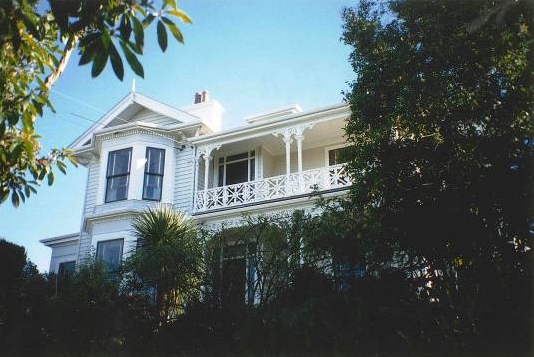
Described as Dunedin’s least-known grand house, Alyth at 34 Royal Terrace, was built in the 1870s by prominent businessman and community leader, Keith Ramsay (1844-1906), and renowned architect Robert Arthur Lawson (1833-1902).
The section on which this house stands was originally part of a larger block purchased by John Logan (1819-1895) in 1855. In April 1875 Keith Ramsay purchased sections 33 and part 34. Ramsay immigrated to Dunedin in 1862 from Alyth, Scotland. He established a shipping agency in 1865 acting as agent for small vessels. Keith Ramsay Ltd remained one of the principal shipping agents and stevedores in Dunedin until it ceased business in 1977. Ramsay was also a Dunedin City Councillor (1871-1873) and Mayor (1874-1875). For many years he was a member of the Otago Harbour Board, and chairman for three years. His directorships included the National Insurance Company, Perpetual Trustees, and the Dunedin Stock Exchange. In February 1871 he married Janet Torry Douglas, with whom he had nine children. His sister Mary, who lived with the family, spoke of Keith ‘doing very well, he is a general favourite I think, he is well spoken of…he is so steady & industrious & so thoroughly independent of anything but his own exertions…There are not many like him in Dunedin either in manner or appearance’.
In September 1874, noted architect R.A. Lawson invited tenders for the erection of a residence in Royal Terrace for Keith Ramsay. Born in Scotland, Lawson (1833-1902) began his professional career in Australia. In 1862 Lawson sailed for Dunedin, where his sketch plans had won the competition for the design of First Church, now regarded as his masterpiece and one of the finest nineteenth century churches in New Zealand. Lawson became one of the most important architects in New Zealand.
Ramsay’s house was completed at the latest by March 1875. Lawson designed a two storey timber villa with an iron roof. The exterior showed an exuberance of fretted timber balustrading and brackets framing the verandas. The interior included many spacious rooms including a dining room, lounge and library. The kitchen, scullery and maid’s bedroom completed the ground floor. A hipped lantern light was set in the roof, complete with stained glass, to provide the staircase with natural light. Upstairs were five bedrooms, a bathroom and linen press. The home was named Alyth after Ramsay’s birth place.
Ramsay died in 1906 but Janet remained at Alyth until May 1914 when she sold the property to John J.J. Mallard (1860-1935). Mallard worked for National Insurance Company. Educated in Dunedin, for several years he was posted to Wellington as the Branch manager but returned in 1914 when he was appointed Secretary of the Company. He became General Manager in 1919. Following Mallard’s death in 1935 his son, Stuart (1906-1991), and daughter, Lilian (1890-1966), continued to live at Alyth, although the unmarried siblings deferred maintenance. By 1989 Alyth was in such a state of disrepair that it was almost demolished. Instead it was decided to reroof and replace some weatherboards.
By 1996, when new owners Richard and Lynley Bunton took possession, the house was in decline: ‘the section was overgrown and Alyth was known as the haunted house of Royal Terrace’. The Buntons carried out repairs and restoration works. Rotten garages and stables were replaced by a new garage connected to the house by a glass-roofed porch. The kitchen was refurbished and the wall between the dining area and maid’s bedroom was removed for extra living space. The dimly-lit north-facing lounge was connected to other rooms and French doors were added. The small room off the lounge, originally used by the butler, was converted into a wine cellar. The upstairs bathroom was retained in its original state with Victorian conveniences, including a tin bath with canopy overhead. Another room was converted into a small second bathroom, retaining the maid’s wooden ironing press. Outside the owners resurrected the original flagpole which was found decaying on the section. The old glasshouse was replaced with a summer house and the rotten rose arbour was rebuilt.
In a street of some of Dunedin’s most impressive houses, Alyth rates as one of the finest. It is architecturally, historically and socially significant for its association with prominent local politician and businessmen Keith Ramsey, and is a fine example of the design skills of renowned architect R.A. Lawson. An important part of the group of fine Victorian houses in the Pitt Street/Royal Terrace conservation area, Alyth stands as a testament to the wealth and entrepreneurism which established Dunedin as an early commercial centre.
The section on which this house stands was originally part of a larger block purchased by John Logan (1819-1895) in 1855. In April 1875 Keith Ramsay purchased sections 33 and part 34. Ramsay immigrated to Dunedin in 1862 from Alyth, Scotland. He established a shipping agency in 1865 acting as agent for small vessels. Keith Ramsay Ltd remained one of the principal shipping agents and stevedores in Dunedin until it ceased business in 1977. Ramsay was also a Dunedin City Councillor (1871-1873) and Mayor (1874-1875). For many years he was a member of the Otago Harbour Board, and chairman for three years. His directorships included the National Insurance Company, Perpetual Trustees, and the Dunedin Stock Exchange. In February 1871 he married Janet Torry Douglas, with whom he had nine children. His sister Mary, who lived with the family, spoke of Keith ‘doing very well, he is a general favourite I think, he is well spoken of…he is so steady & industrious & so thoroughly independent of anything but his own exertions…There are not many like him in Dunedin either in manner or appearance’.
In September 1874, noted architect R.A. Lawson invited tenders for the erection of a residence in Royal Terrace for Keith Ramsay. Born in Scotland, Lawson (1833-1902) began his professional career in Australia. In 1862 Lawson sailed for Dunedin, where his sketch plans had won the competition for the design of First Church, now regarded as his masterpiece and one of the finest nineteenth century churches in New Zealand. Lawson became one of the most important architects in New Zealand.
Ramsay’s house was completed at the latest by March 1875. Lawson designed a two storey timber villa with an iron roof. The exterior showed an exuberance of fretted timber balustrading and brackets framing the verandas. The interior included many spacious rooms including a dining room, lounge and library. The kitchen, scullery and maid’s bedroom completed the ground floor. A hipped lantern light was set in the roof, complete with stained glass, to provide the staircase with natural light. Upstairs were five bedrooms, a bathroom and linen press. The home was named Alyth after Ramsay’s birth place.
Ramsay died in 1906 but Janet remained at Alyth until May 1914 when she sold the property to John J.J. Mallard (1860-1935). Mallard worked for National Insurance Company. Educated in Dunedin, for several years he was posted to Wellington as the Branch manager but returned in 1914 when he was appointed Secretary of the Company. He became General Manager in 1919. Following Mallard’s death in 1935 his son, Stuart (1906-1991), and daughter, Lilian (1890-1966), continued to live at Alyth, although the unmarried siblings deferred maintenance. By 1989 Alyth was in such a state of disrepair that it was almost demolished. Instead it was decided to reroof and replace some weatherboards.
By 1996, when new owners Richard and Lynley Bunton took possession, the house was in decline: ‘the section was overgrown and Alyth was known as the haunted house of Royal Terrace’. The Buntons carried out repairs and restoration works. Rotten garages and stables were replaced by a new garage connected to the house by a glass-roofed porch. The kitchen was refurbished and the wall between the dining area and maid’s bedroom was removed for extra living space. The dimly-lit north-facing lounge was connected to other rooms and French doors were added. The small room off the lounge, originally used by the butler, was converted into a wine cellar. The upstairs bathroom was retained in its original state with Victorian conveniences, including a tin bath with canopy overhead. Another room was converted into a small second bathroom, retaining the maid’s wooden ironing press. Outside the owners resurrected the original flagpole which was found decaying on the section. The old glasshouse was replaced with a summer house and the rotten rose arbour was rebuilt.
In a street of some of Dunedin’s most impressive houses, Alyth rates as one of the finest. It is architecturally, historically and socially significant for its association with prominent local politician and businessmen Keith Ramsey, and is a fine example of the design skills of renowned architect R.A. Lawson. An important part of the group of fine Victorian houses in the Pitt Street/Royal Terrace conservation area, Alyth stands as a testament to the wealth and entrepreneurism which established Dunedin as an early commercial centre.