

Early activity on the Otago Peninsula has been supported by reliable archaeological evidence centred on the thirteenth and fourteenth centuries. Once an estuary full of shellfish, fish, birds and other wildlife, South Dunedin was traditionally where tuna (eels) were harvested as an important food source by local Māori – so much so the area was known as Kaituna. At the time of European settlement in the mid-1800s, the low lying area known as ‘The Flat’ was a marshy environment with tussock, rushes and flax. Caversham is the oldest of Dunedin’s southern suburbs located on The Flat. The first European settlers there were the Valpy’s who arrived in 1849. Small townships began to develop at Caversham and at Parkside, catering for the gold rush traffic heading inland. Land was cheap, and from the 1870s both industry and housing gravitated towards the area. There was a wide variety in the size and quality of houses. Poorer families lived in small cottages on tiny sections of just one-sixteenth of an acre, but nearly everyone lived in a single house on a section of its own.
The Grimmett family, which included seven sons, decided to emigrate to New Zealand in 1874 on the Scimitar. Charles Holloway, delegate and chairman of the Oxfordshire branch of the Agricultural Labourers’ Union of England, was keen to settle emigrants on what he saw as workable agricultural land, and was encouraged to bring out emigrants with agricultural backgrounds. An advertisement was put in the paper to encourage people to travel to New Zealand with him, and 209 people signed up to board the Scimitar including the Grimmetts. The Scimitar had a treacherous journey to New Zealand with both Scarlet Fever and measles breaking out amongst the passengers. It was berthed at Quarantine Island in the Dunedin Harbour for some time. While the Grimmetts did not have an agricultural background, Richard and his sons had useful building and masonry skills that were valuable in any burgeoning settlement.
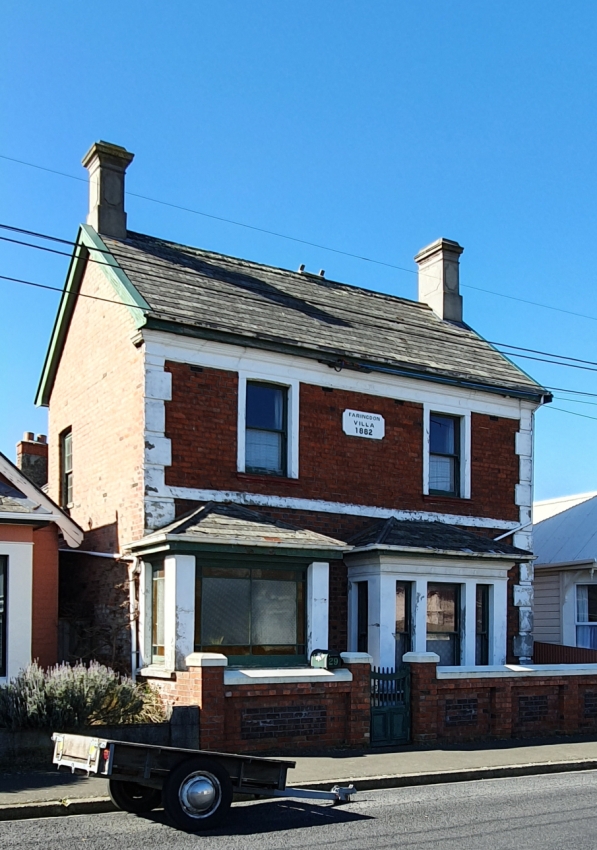
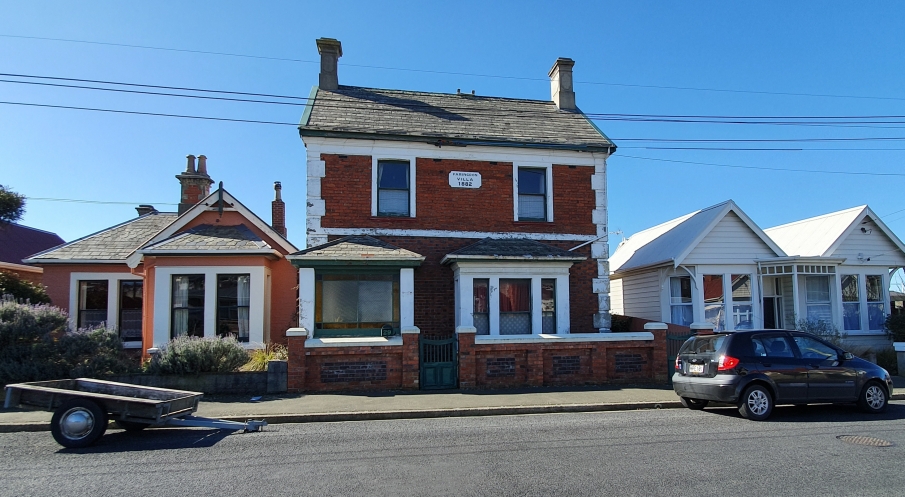
The Grimmetts were early residents of the suburb of Calderville within the suburb of Caversham. The section was purchased by Richard Grimmett in 1874. Richard Grummett [sic] is recorded as living in Smith Street, Caversham, in the 1875-1876 Directory. Faringdon Villa was built a few years later in 1882 and Richard, being a mason/bricklayer, probably built the house himself. The brick villa is unusual architecture set amongst New Zealand cottages and villas, but mimics those where the Grimmetts lived and worked in England. The villa is named after Faringdon, Berkshire, where Richard and his wife were married in 1861 and lived before emigrating to New Zealand. It is almost built to accommodate attached buildings on either side, but the villas on both sides were constructed single storey.
The Grimmetts’ daughter Leah (born in New Zealand) ran the household while Rachel managed the finances for her husband’s contracting business. Richard’s father Thomas had been a stonemason in England, and Richard was recorded as a mason, bricklayer and storekeeper in the English census. Their son Rowland and his wife Emma lived next door. Richard died in 1906 after a ‘long and painful illness’, aged 67 years.
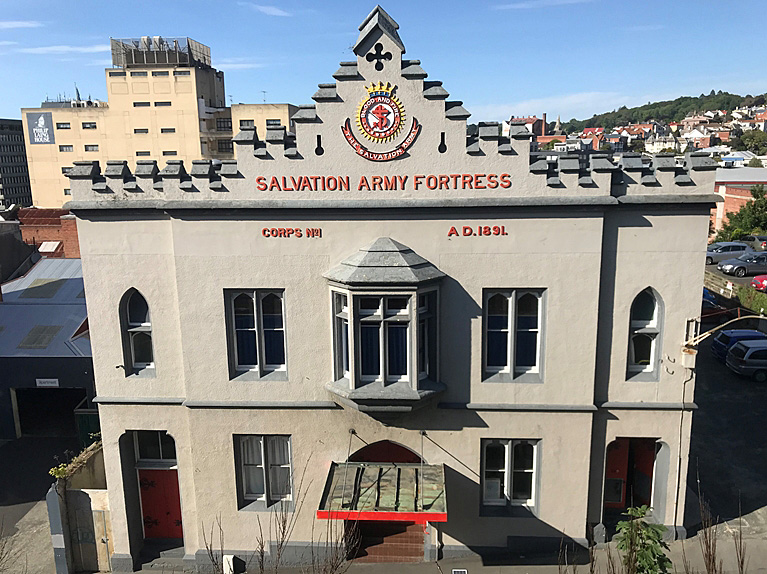
Richard was preaching at the Temperance Hall from 1875. Rachel and Richard later joined the Salvation Army in the 1890s, and Rachel embraced the Army’s brand of feminism. The church rejected the idea that women should stay at home and allowed them to hold positions of authority, and she was previously recorded as a shopkeeper in the 1871 England Census. Rachel supported suffrage and the temperance movement. In her mid-50s she signed the 1893 Women’s Suffrage Petition from her home in Caversham. Rachel was a passionate prohibitionist and an active campaigner. She would stand outside the Waterloo Hotel shaking her collection box at departing drinkers and selling copies of ‘War Cry’, the Salvation Army’s publication. She died in 1921, aged 85. In 1923 the Grimmett family sold Faringdon Villa to George Milligan. There has been a number of owners since Milligan, who sold the property in the 1940s.
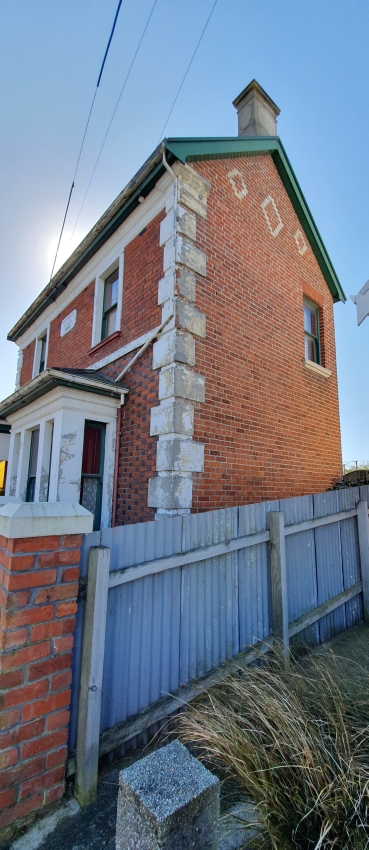
Faringdon Villa is constructed of double brick with plaster quoins, bay windows and ornate trims. There is a diamond diaper pattern in light-coloured bricks at the top of the side wall (Figure 6), which serves as a testament to Richard’s skill and artistry, as it was complex to plan and design. The roof is slate while the rear addition has a corrugated iron roof. Originally it appears the villa had two rooms downstairs and three bedrooms upstairs. It is thought that the addition at the rear was erected pre-1911 with a new kitchen at the ground level and a bedroom above, allowing for an upstairs bedroom to be converted into a bathroom. Although a small house, it still had ornate features such as a tessellated tile floor in the front entrance, and an elegant plaster ceiling rose in the front parlour.
The house has been renovated over the years, including the addition of a marble fireplace and the inclusion of panelling in the dining room, which came from Onslow House in St Kilda. Several repairs have been undertaken over the last decades.
List Entry Information
Status
Listed
List Entry Status
Historic Place Category 2
Access
Private/No Public Access
List Number
4741
Date Entered
25th September 1986
Date of Effect
25th September 1986
City/District Council
Dunedin City
Region
Otago Region
Legal description
Pt Lot 31 DP 92 (RT OT280/149), Otago Land District
Status
Listed
List Entry Status
Historic Place Category 2
Access
Private/No Public Access
List Number
4741
Date Entered
25th September 1986
Date of Effect
25th September 1986
City/District Council
Dunedin City
Region
Otago Region
Legal description
Pt Lot 31 DP 92 (RT OT280/149), Otago Land District
Construction Details
Type
Modification
Description
Extension at the rear
Period
Pre-1911
Start Year
1882
Type
Original Construction
Construction Details
Type
Modification
Description
Extension at the rear
Period
Pre-1911
Start Year
1882
Type
Original Construction
Historical and Associated Iwi / Hapū / Whānau
Completion Date
31st March 2026
Report Written By
Alison Breese
Information Sources
Galer, L., 1995
Lois Galer, Houses of Dunedin: An illustrated collection of the city's historic homes, Hyndman Publishing, Dunedin, 1995
Rutherford, 1978
Alma Rutherford, The Edge of the Town: historic Caversham as seen through its streets and buildings, Dunedin, McIndoe, 1978.
Faringdon History Website
Faringdon History Website, Faringdon & District Archaeological & Historical Society (FDAHS), https://www.fdahs.org.uk/
Other Information
This place was identified as significant under previous legislation with different information requirements. It remains significant under the current legislation. A fully referenced copy of the Upgrade Report is available upon request from the Otago/Southland Area Office of Heritage New Zealand Pouhere Taonga. Disclaimer Please note that entry on the New Zealand Heritage List/Rārangi Kōrero identifies only the heritage values of the property concerned, and should not be construed as advice on the state of the property, or as a comment of its soundness or safety, including in regard to earthquake risk, safety in the event of fire, or insanitary conditions. Archaeological sites are protected by the Heritage New Zealand Pouhere Taonga Act 2014, regardless of whether they are entered on the New Zealand Heritage List/Rārangi Kōrero or not. Archaeological sites include ‘places associated with pre-1900 human activity, where there may be evidence relating to the history of New Zealand’. This List entry report should not be read as a statement on whether or not the archaeological provisions of the Act apply to the property(s) concerned. Please contact your local Heritage New Zealand office for archaeological advice.
Historical and Associated Iwi / Hapū / Whānau
Completion Date
31st March 2026
Report Written By
Alison Breese
Information Sources
Galer, L., 1995
Lois Galer, Houses of Dunedin: An illustrated collection of the city's historic homes, Hyndman Publishing, Dunedin, 1995
Rutherford, 1978
Alma Rutherford, The Edge of the Town: historic Caversham as seen through its streets and buildings, Dunedin, McIndoe, 1978.
Faringdon History Website
Faringdon History Website, Faringdon & District Archaeological & Historical Society (FDAHS), https://www.fdahs.org.uk/
Other Information
This place was identified as significant under previous legislation with different information requirements. It remains significant under the current legislation. A fully referenced copy of the Upgrade Report is available upon request from the Otago/Southland Area Office of Heritage New Zealand Pouhere Taonga. Disclaimer Please note that entry on the New Zealand Heritage List/Rārangi Kōrero identifies only the heritage values of the property concerned, and should not be construed as advice on the state of the property, or as a comment of its soundness or safety, including in regard to earthquake risk, safety in the event of fire, or insanitary conditions. Archaeological sites are protected by the Heritage New Zealand Pouhere Taonga Act 2014, regardless of whether they are entered on the New Zealand Heritage List/Rārangi Kōrero or not. Archaeological sites include ‘places associated with pre-1900 human activity, where there may be evidence relating to the history of New Zealand’. This List entry report should not be read as a statement on whether or not the archaeological provisions of the Act apply to the property(s) concerned. Please contact your local Heritage New Zealand office for archaeological advice.
Current Usages
Uses: Accommodation
Specific Usage: House
Former Usages
General Usage: Accommodation
Specific Usage: House
Current Usages
Uses: Accommodation
Specific Usage: House
Former Usages
General Usage: Accommodation
Specific Usage: House
Sign up to hear more
Get the latest heritage news, features and events delivered
straight to your inbox.
