

Both iwi history and archaeological evidence show Māori occupation in the Ōtākou / Otago region since the 12th century. Today, Kāi Tahu mana whenua is recognised over a large part of Te Wai Pounamu. Kāti Māmoe and Waitaha shared occupation are always acknowledged. The hapū Kai Te Pahi, Kāti Moki, and Kāti Taoka still maintain their presence and responsibility as kaitiaki in this region. While there were no permanent settlements around George Street, the area near the Toitū Tauraka waka (List No. 9774) was known as Ōtepoti.
Section 1, Block 29, Town of Dunedin was first owned by Alexander Rennie in 1858 and was unoccupied until possibly 1871 when a timber villa was built. Dr David Blair owned the property from 1878 - 1882 and developed a substantial family residence, stables, coach-house on the section. From March 1881, Dr De Zouche ran his doctor’s practice from this house, presumably as Blair had left Dunedin but had not yet sold the property. Blair sold the property to Mr A Dornwell, butcher, in July 1882 and there were various tenants in the residence until 1900.
In 1900-1901 Dr Closs purchased the property. The current building was built for Dr. Joseph Osborne Closs MD Ch M, one of the earliest graduates from the Otago Medical School, as a dwelling and as a doctor’s rooms. Born in Glasgow, he came to New Zealand at an early age. Closs lectured for many years on clinical surgery at the Dunedin Hospital and he occupied and practised in the house until his death in 1912.
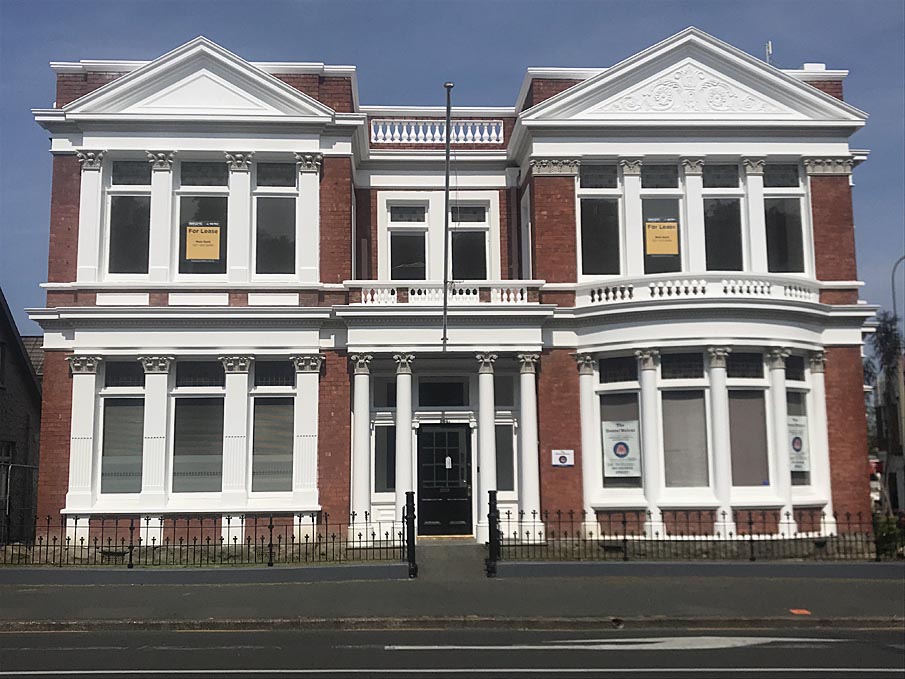
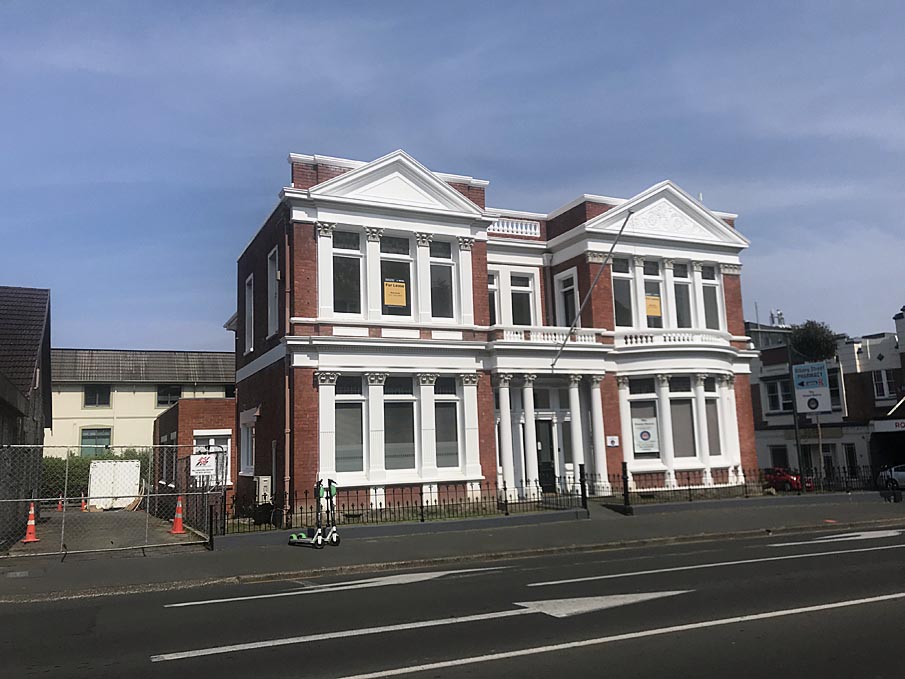
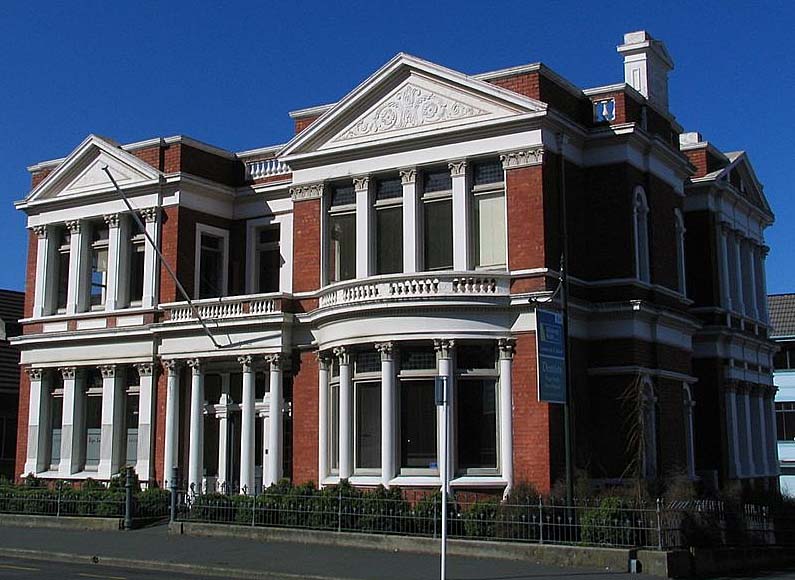
The building contractor, Gabriel Hodges, was a former Mayor of South Dunedin Borough 1878-1879, and St Kilda Borough 1902-1903. The architect was James Hislop who advertised for a building to be removed from site in November 1902 before the tender was advertised for a two storey brick dwelling. The house is an imposing two storey brick house with a lower storey bay at the left front and a square bay at the side. The bays have gables above and the front ones have ornamental plaster work. There are balconies above the front bay and the portico, which is supported by engaged pillars with Corinthian capitals matching the windows. The chimney at the side has a false front and is flanked by rounded topped windows forming a square bay. The roof is slate.
After Dr Closs’s death Miss Rosa Collier, surgeon, was living at the house from 1913 until 1915 when she moved to Milton. A number of other people resided at the property until Mr James John Clark, former Mayor of Dunedin and Dunedin City councillor (1909-1933), lived at the address from 1928 to 1937. It was known as St Duthus from this time and while there is no documentary evidence on why the property was named St Duthus, Clark’s parents were married in Tain, Scotland in 1863 where St Duthus is the patron saint. The hospital opened in 1937 as St Duthus Private Hospital. Mrs Joy Clark (née Mowat), the head of the hospital, had been a nurse prior to her marriage to James. In 1939 Mrs Clark put the household goods up for auction as the property presumably sold. In 1940 the residence was altered into six flats for F.K.L Orton. It became known as St Duthus Flats or simply St Duthus, and in 1946 the ground floor was altered again and used as doctor’s surgeries. The upper floor remained as flats. In 1983 the consultation rooms were upgraded, and the interior altered for a group of consultants.
List Entry Information
Status
Listed
List Entry Status
Historic Place Category 2
Access
Private/No Public Access
List Number
4743
Date Entered
25th September 1986
Date of Effect
25th September 1986
City/District Council
Dunedin City
Region
Otago Region
Extent of List Entry
Extent includes the land described as Lot 1 DP 451942, (RT OT 577062), Otago Land District, and the building known as St Duthus House, thereon.
Legal description
Lot 1 DP 451942, (RT OT 577062), Otago Land District.
Status
Listed
List Entry Status
Historic Place Category 2
Access
Private/No Public Access
List Number
4743
Date Entered
25th September 1986
Date of Effect
25th September 1986
City/District Council
Dunedin City
Region
Otago Region
Extent of List Entry
Extent includes the land described as Lot 1 DP 451942, (RT OT 577062), Otago Land District, and the building known as St Duthus House, thereon.
Legal description
Lot 1 DP 451942, (RT OT 577062), Otago Land District.
Construction Professional
Name
G Hodges
Type
Builder
Biography
Builder
Name
Hislop, James (1859-1904)
Type
Architect
Biography
‘James Hislop (1859-1904) was born in Glasgow and came to New Zealand at a very early age. He was educated at North East Valley School and received his architectural training in the office of Mason and Wales. He also spent two years with the Public Works Department, as district manager of Nelson. In 1880 he entered into business with W.H. Terry who retired three years later. He established his own practice in Dunedin and later entered into a partnership with Edward Walter Walden. In 1889 Hislop designed and supervised the erection of the South Seas Exhibition among a number of prominent buildings both in Otago and elsewhere in the country.’ ‘Among the significant buildings designed by James Hislop, or by the Hislop and Walden partnership are Crown Milling Co. building, Miller Place, Dunedin (c.1880); New Zealand Steam Shipping Co. office, Dunedin; DIC, Christchurch; Evans and Co. Mill, Timaru; National Bank, George Street, Dunedin; Napier Abattoirs (1902); Hallenstein Building, The Octagon; Dunedin City Abattoirs.’ Hislop moved to Wellington around 1903, where he died as the result of an accident in 1904. Source: Heritage New Zealand Review Report for Ferntree Lodge, List No. 368, 27 Jun 2017, Heather Bauchop.
Construction Details
Start Year
1903
Type
Original Construction
Start Year
1940
Type
Refurbishment/renovation
Description
Convert Dwelling into Six Flats
Start Year
1946
Type
Modification
Description
Re-roof Conservatory, alter window, raise floor and alter internal partition
Start Year
1948
Type
Modification
Description
Alter Suite in North West Corner of First Floor
Start Year
1983
Type
Refurbishment/renovation
Description
Convert Flats to Consulting Rooms
Start Year
1990
Type
Modification
Description
Alter Internal Partitions on Ground Floor
Construction Professional
Name
G Hodges
Type
Builder
Biography
Builder
Name
Hislop, James (1859-1904)
Type
Architect
Biography
‘James Hislop (1859-1904) was born in Glasgow and came to New Zealand at a very early age. He was educated at North East Valley School and received his architectural training in the office of Mason and Wales. He also spent two years with the Public Works Department, as district manager of Nelson. In 1880 he entered into business with W.H. Terry who retired three years later. He established his own practice in Dunedin and later entered into a partnership with Edward Walter Walden. In 1889 Hislop designed and supervised the erection of the South Seas Exhibition among a number of prominent buildings both in Otago and elsewhere in the country.’ ‘Among the significant buildings designed by James Hislop, or by the Hislop and Walden partnership are Crown Milling Co. building, Miller Place, Dunedin (c.1880); New Zealand Steam Shipping Co. office, Dunedin; DIC, Christchurch; Evans and Co. Mill, Timaru; National Bank, George Street, Dunedin; Napier Abattoirs (1902); Hallenstein Building, The Octagon; Dunedin City Abattoirs.’ Hislop moved to Wellington around 1903, where he died as the result of an accident in 1904. Source: Heritage New Zealand Review Report for Ferntree Lodge, List No. 368, 27 Jun 2017, Heather Bauchop.
Construction Details
Start Year
1903
Type
Original Construction
Start Year
1940
Type
Refurbishment/renovation
Description
Convert Dwelling into Six Flats
Start Year
1946
Type
Modification
Description
Re-roof Conservatory, alter window, raise floor and alter internal partition
Start Year
1948
Type
Modification
Description
Alter Suite in North West Corner of First Floor
Start Year
1983
Type
Refurbishment/renovation
Description
Convert Flats to Consulting Rooms
Start Year
1990
Type
Modification
Description
Alter Internal Partitions on Ground Floor
Historical and Associated Iwi / Hapū / Whānau
Completion Date
20th February 2023
Report Written By
Alison Breese
Information Sources
Evening Star
Evening Star
New Zealand Medical Journal
New Zealand Medical Journal
Papers Past
Papers Past, www.paperspast.natlib.govt.nz
Wright-St Clair, 2003
Wright-St Clair, Rex Earl, Medical Practitioners in New Zealand 1840 to 1930, Cotter Medical History Trust, University of Otago, 2003, p. 89.
Other Information
This place was identified as significant under previous legislation with different information requirements. It remains significant under the current legislation. There is opportunity under our legislation and policies to add to this information. Further information about this place may be available from the Otago/Southland Office of Heritage New Zealand Pouhere Taonga. A fully referenced copy of the upgrade report is available on request from the Southern Area Office of Heritage New Zealand Pouhere Taonga Please note that entry on the New Zealand Heritage List/Rarangi Korero identifies only the heritage values of the property concerned, and should not be construed as advice on the state of the property, or as a comment of its soundness or safety, including in regard to earthquake risk, safety in the event of fire, or insanitary conditions.
Historical and Associated Iwi / Hapū / Whānau
Completion Date
20th February 2023
Report Written By
Alison Breese
Information Sources
Evening Star
Evening Star
New Zealand Medical Journal
New Zealand Medical Journal
Papers Past
Papers Past, www.paperspast.natlib.govt.nz
Wright-St Clair, 2003
Wright-St Clair, Rex Earl, Medical Practitioners in New Zealand 1840 to 1930, Cotter Medical History Trust, University of Otago, 2003, p. 89.
Other Information
This place was identified as significant under previous legislation with different information requirements. It remains significant under the current legislation. There is opportunity under our legislation and policies to add to this information. Further information about this place may be available from the Otago/Southland Office of Heritage New Zealand Pouhere Taonga. A fully referenced copy of the upgrade report is available on request from the Southern Area Office of Heritage New Zealand Pouhere Taonga Please note that entry on the New Zealand Heritage List/Rarangi Korero identifies only the heritage values of the property concerned, and should not be construed as advice on the state of the property, or as a comment of its soundness or safety, including in regard to earthquake risk, safety in the event of fire, or insanitary conditions.
Current Usages
Uses: Accommodation
Specific Usage: House
Uses: Health
Specific Usage: Dentist Surgery/ Dental Clinic
Former Usages
General Usage: Accommodation
Specific Usage: House
General Usage: Health
Specific Usage: Doctor’s Surgery
Current Usages
Uses: Accommodation
Specific Usage: House
Uses: Health
Specific Usage: Dentist Surgery/ Dental Clinic
Former Usages
General Usage: Accommodation
Specific Usage: House
General Usage: Health
Specific Usage: Doctor’s Surgery
Location
Sign up to hear more
Get the latest heritage news, features and events delivered
straight to your inbox.
