Both iwi history and archaeological evidence show Māori occupation in the Ōtākou / Otago region since the twelfth century. In 1844 the Otago Purchase was signed at Kōpūtai / Port Chalmers. This agreement left the majority of Muaupoko / Otago Peninsula in European hands. The area of land now between Princes Street and Vogel Street was formerly part of the harbour foreshore and has special importance as ‘one of several Kāti Māmoe-Kāi Tahu tauraka waka (landing places) in the Otago harbour. Situated beside the Toitū creek as it emptied into the harbour, the tauraka waka site provided a softly sloped beach for landing waka, a good point of entry to the surrounding bush and mahinga kai, as well as access to fresh water.’ Reclamation of this area started in 1863 and progressed into the 1880s; the area of land at the corner of Vogel and Rattray Streets was reclaimed by about 1875, with the land being formally surveyed in 1880.
The Equitable Insurance Association had operated from offices nearby. However, by 1885, tenders were invited for the construction ‘at the corner of Rattray Street and Vogel Street, for the Equitable Insurance Company’, by architect Frank W. Petre. In May 1886, the building was noted as under construction and described thus:
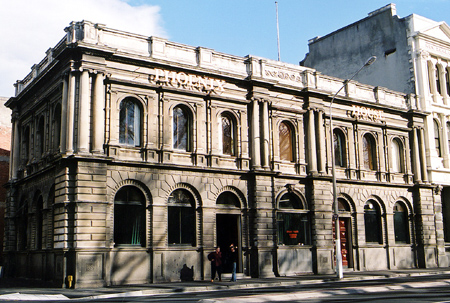
The frontage to [Rattray Street] will be 83ft and to [Vogel Street] 51ft... The external appearance will give two fronts of bluestone base, with Oamaru stone above, and the general handling of the front will be Romanry nasiance [sic].
The upper front in Rattray Street will be subdivided into three bays, distinguished by columns in the upper floor—three-quarter detached in, the lonic order. In the central bay on the ground floor will be the entrance to the Equitable Insurance Company's offices, with a single large window over the entrance. In the two side bays there are to be two separate entrances for other office suites on the ground floor...
The front in Vogel Street will have a couple of columns on the first floor of the same order, with three windows in between. On the upper floor the large windows will have lonic pilastered jambs and corniced hoods all filled in with plate glass...
On the other wings will be two suites of offices, and these and all the first floor will be reserved for letting. The internal arrangements, in fact the whole building, will be fireproof; the floors of concrete, the girders of iron, with brick partitions and walls. Six strong rooms are to be constructed in the building, besides provision being made for inserting fireproof safes let into the wall.
The building was occupied by March 1887.
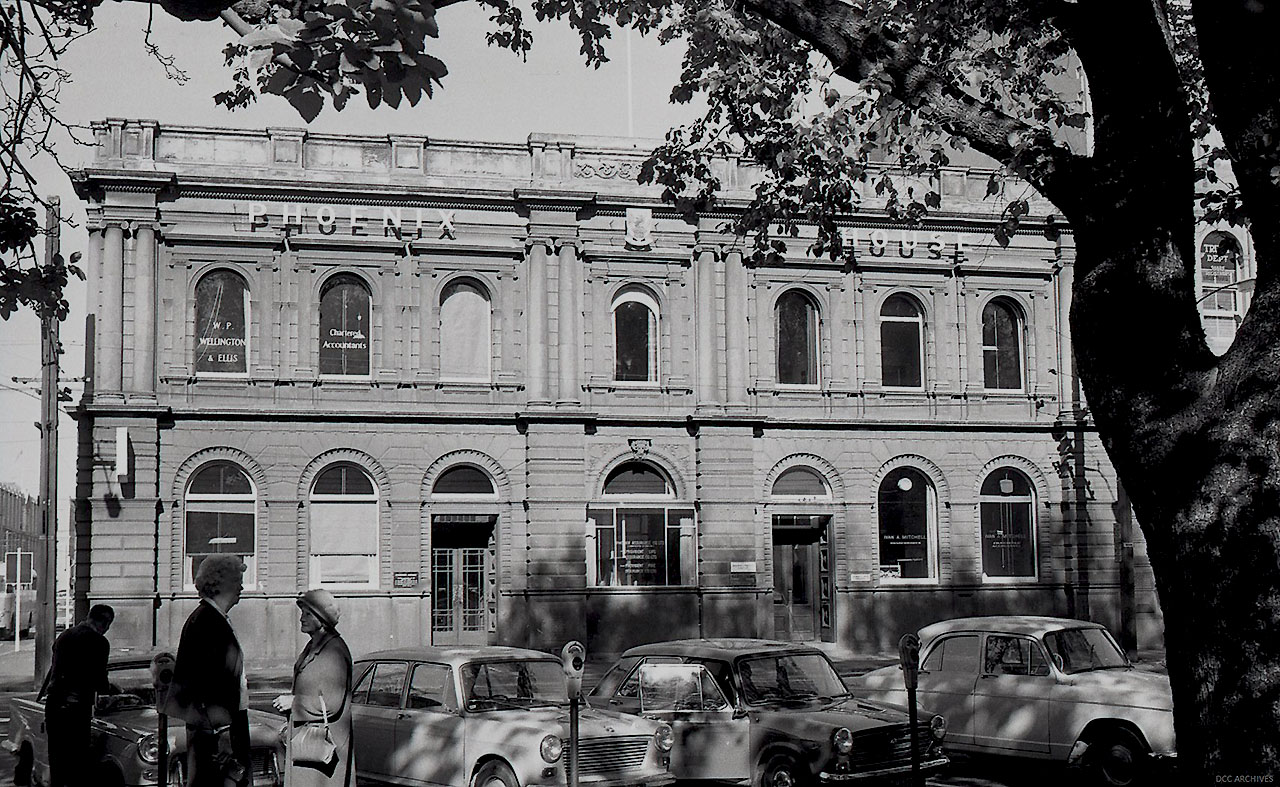
In 1894, the Equitable Insurance Company went into liquidation and was acquired by the Provident and Industrial Insurance Company, which was later known as the Provident Life Assurance Company. In 1906, this company created an addition to the building on the Vogel Street frontage, creating more office spaces. Various alterations were undertaken in 1919, which may have included the conversion of the building’s main Rattray Street doorway into a window. Numerous interior alterations were made throughout the twentieth century, both before and after the acquisition of the Provident Life Assurance Company by the Phoenix Assurance Company. The building’s later life saw its ownership change to the Ritchies Transport company; its interior was also modified to include self-contained flats on the first floor, a take-away bar on the ground floor, as well as an ‘adult shop’ in the 1990s. Its exterior is largely unchanged from its design, with the exception of some modification to its parapet at an unknown date. Late twentieth-century modifications include the removal of the 1906 Vogel Street addition. As of 2025, the building is in use as a mixture of business and short to long term rentals.

List Entry Information
Status
Listed
List Entry Status
Historic Place Category 1
Access
Private/No Public Access
List Number
4751
Date Entered
19th April 1990
Date of Effect
19th April 1990
City/District Council
Dunedin City
Region
Otago Region
Extent of List Entry
Extent includes the land described as Lot 4 DP 448678 (RT 575032), Otago Land District, and the building known as Equitable Insurance Association Building (Former) thereon.
Legal description
Lot 4 DP 448678 (RT 575032), Otago Land District
Status
Listed
List Entry Status
Historic Place Category 1
Access
Private/No Public Access
List Number
4751
Date Entered
19th April 1990
Date of Effect
19th April 1990
City/District Council
Dunedin City
Region
Otago Region
Extent of List Entry
Extent includes the land described as Lot 4 DP 448678 (RT 575032), Otago Land District, and the building known as Equitable Insurance Association Building (Former) thereon.
Legal description
Lot 4 DP 448678 (RT 575032), Otago Land District
Why is this place significant?
Historic Significance
Historical Significance or Value Airport House reflects the commercial life of Dunedin and Otago through its 85 year association with a succession of major insurance companies. It has served Dunedin as a commercial building for over 100 years.
Physical Significance
ARCHITECTURAL QUALITY: F.W. Petre is best known for his ecclesiastical designs and Airport House has significance as one of two few commercial designs. Just as the emerging wealthy merchant class of Western Europe seized upon the classical style of the Renaissance for their impressive commercial buildings and town houses so too did the merchant colonists in New Zealand. Airport House is such an example. It relates to the other Petre design nearby, the Royal Guardian Exchange building (1881) in the same Renaissance idiom. Together they demonstrate the architect's considerable versatility and skill. TOWNSCAPE/LANDMARK VALUE: An important building in the streetscape fronting Queen's Gardens.
Why is this place significant?
Historic Significance
Historical Significance or Value Airport House reflects the commercial life of Dunedin and Otago through its 85 year association with a succession of major insurance companies. It has served Dunedin as a commercial building for over 100 years.
Physical Significance
ARCHITECTURAL QUALITY: F.W. Petre is best known for his ecclesiastical designs and Airport House has significance as one of two few commercial designs. Just as the emerging wealthy merchant class of Western Europe seized upon the classical style of the Renaissance for their impressive commercial buildings and town houses so too did the merchant colonists in New Zealand. Airport House is such an example. It relates to the other Petre design nearby, the Royal Guardian Exchange building (1881) in the same Renaissance idiom. Together they demonstrate the architect's considerable versatility and skill. TOWNSCAPE/LANDMARK VALUE: An important building in the streetscape fronting Queen's Gardens.
Construction Professional
Name
Burnside, John Arthur
Type
Architect
Biography
Burnside (1856-1920) was born in Dunedin and is believed to be one of the first professional architects who were born and trained in New Zealand. He was articled to the architectural firm of Mason and Wales, remaining with them for two or three years. During this time he won important prizes for designs which he exhibited at international exhibitions. In 1880 he established his own practice at Dunedin. His buildings include Transit House (1880s), Philips Hotel (now Gresham Hotel, 1882) and the Otago Early Settlers' Museum (1908).
Name
Petre, Francis William
Type
Architect
Biography
Petre (1847-1918) was born in Lower Hutt. He was the son of the Hon. Henry William Petre and grandson of the eleventh Baron Petre, Chairman of the second New Zealand Company. Petre trained in London as a naval architect, engineer, and architect, returning to New Zealand in 1872. During the next three years he was employed by Brogden and Sons, English railway contractors, superintending the construction of the Dunedin-Clutha and the Blenheim-Picton railways. He set up office in Dunedin in 1875 as an architect and civil engineer. He designed a house for Judge Chapman (1875), followed by 'Cargill's Castle' (1876) for E B Cargill and then St Dominic's Priory (1877), all in mass concrete. It is for his church designs and for his pioneering use of concrete that Petre is most recognised. His church buildings include St Joseph's Cathedral, Dunedin (1878-86), Sacred Heart Basilica (now Cathedral of the Sacred Heart), Wellington (1901), St Patrick's Basilica, Oamaru, (1894 and 1903) and the Cathedral of the Blessed Sacrament, Christchurch, (1904-05), which is the outstanding achievement of his career. Petre's commercial buildings include the Guardian Royal Exchange Assurance Building (1881-82) and Pheonix House (now Airport House, c.1885), both in Dunedin.
Name
Mr. J Small
Type
Builder
Biography
Construction Details
Type
Other
Description
Land area reclaimed from the sea and surveyed
Period
1875-80
Start Year
1906
Type
Addition
Description
Further offices added over the yard on Vogel Street
Start Year
1919
Type
Modification
Description
Central door to Rattray Street converted into a window
Type
Modification
Description
Changes to the interior, including self-contained flats on the first floor, a take-away bar on the ground floor, as well as an ‘adult shop’
Period
By 1990
Start Year
1886
Finish Year
1887
Type
Original Construction
Construction Materials
Base constructed of Port Chalmers breccia and the walls of Oamaru limestone.
Notable Features
The fine handling of the facade.
Construction Professional
Name
Burnside, John Arthur
Type
Architect
Biography
Burnside (1856-1920) was born in Dunedin and is believed to be one of the first professional architects who were born and trained in New Zealand. He was articled to the architectural firm of Mason and Wales, remaining with them for two or three years. During this time he won important prizes for designs which he exhibited at international exhibitions. In 1880 he established his own practice at Dunedin. His buildings include Transit House (1880s), Philips Hotel (now Gresham Hotel, 1882) and the Otago Early Settlers' Museum (1908).
Name
Petre, Francis William
Type
Architect
Biography
Petre (1847-1918) was born in Lower Hutt. He was the son of the Hon. Henry William Petre and grandson of the eleventh Baron Petre, Chairman of the second New Zealand Company. Petre trained in London as a naval architect, engineer, and architect, returning to New Zealand in 1872. During the next three years he was employed by Brogden and Sons, English railway contractors, superintending the construction of the Dunedin-Clutha and the Blenheim-Picton railways. He set up office in Dunedin in 1875 as an architect and civil engineer. He designed a house for Judge Chapman (1875), followed by 'Cargill's Castle' (1876) for E B Cargill and then St Dominic's Priory (1877), all in mass concrete. It is for his church designs and for his pioneering use of concrete that Petre is most recognised. His church buildings include St Joseph's Cathedral, Dunedin (1878-86), Sacred Heart Basilica (now Cathedral of the Sacred Heart), Wellington (1901), St Patrick's Basilica, Oamaru, (1894 and 1903) and the Cathedral of the Blessed Sacrament, Christchurch, (1904-05), which is the outstanding achievement of his career. Petre's commercial buildings include the Guardian Royal Exchange Assurance Building (1881-82) and Pheonix House (now Airport House, c.1885), both in Dunedin.
Name
Mr. J Small
Type
Builder
Biography
Construction Details
Type
Other
Description
Land area reclaimed from the sea and surveyed
Period
1875-80
Start Year
1906
Type
Addition
Description
Further offices added over the yard on Vogel Street
Start Year
1919
Type
Modification
Description
Central door to Rattray Street converted into a window
Type
Modification
Description
Changes to the interior, including self-contained flats on the first floor, a take-away bar on the ground floor, as well as an ‘adult shop’
Period
By 1990
Start Year
1886
Finish Year
1887
Type
Original Construction
Construction Materials
Base constructed of Port Chalmers breccia and the walls of Oamaru limestone.
Notable Features
The fine handling of the facade.
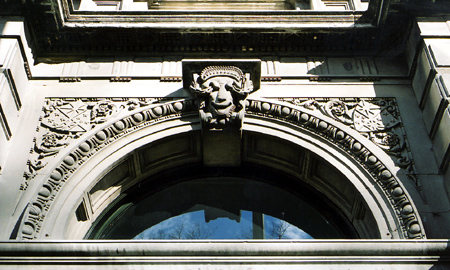
ARCHITECTURAL DESCRIPTION This two storey building is in the Italian Palazzo style of the Renaissance. The rusticated ground floor elevations of the building feature a regular series of round-headed windows. The symmetrical Rattray Street facade consists of a central bay, flanked on either side by three round-headed windows. It is likely this central bay originally contained the entrance to the building. Entry is now through the innermost of the flanking arches on either side of the central bay. For continuity the Vogel Street facade also continues this window arrangement. The first floor of the building has been treated in a more decorative manner. Repetition of round headed windows of a slightly smaller scale and the rusticated surfaces treatment give unity to the two levels, while the Ionic order at first floor leads to a more imposing upper level. The central bay on the Rattray Street facade is framed by paired Ionic columns. In addition both ends of the street facades have paired Ionic columns which give definition to the building. The Ionic order is repeated in pilasters which flank each of the windows at this upper level. The building is capped with a classical cornice and a parapet. The parapet is probably not the original. MODIFICATIONS: Alterations to interior partitions and relining for retail outlets and flats. Fireplaces removed or blocked off. Exterior has modified window joinery. Original central entrance has been blocked in favour of the two flanking entrances. Parapet is probably modified.
Historical and Associated Iwi / Hapū / Whānau
Completion Date
15th September 2025
Report Written By
Andrew Winter
Information Sources
Cyclopedia of New Zealand, 1905
Cyclopedia Company, Industrial, descriptive, historical, biographical facts, figures, illustrations, Wellington, N.Z, 1897-1908, Vol. 4 Otago and Southland, Cyclopedia Company, Christchurch, 1905
Knight, H. & N. Wales, 1988
Hardwicke Knight and Niel Wales, Buildings of Dunedin: An Illustrated Architectural Guide to New Zealand's Victorian City, John McIndoe, Dunedin, 1988
McCoy, 1968
E McCoy and J G Blackman, Victorian City of New Zealand, Dunedin, 1968
Other Information
This historic place was registered under the Historic Places Act 1980. A fully referenced copy of the Upgrade Report is available upon request from the Otago/Southland Area Office of Heritage New Zealand Pouhere Taonga. Disclaimer Please note that entry on the New Zealand Heritage List/Rārangi Kōrero identifies only the heritage values of the property concerned, and should not be construed as advice on the state of the property, or as a comment of its soundness or safety, including in regard to earthquake risk, safety in the event of fire, or insanitary conditions. Archaeological sites are protected by the Heritage New Zealand Pouhere Taonga Act 2014, regardless of whether they are entered on the New Zealand Heritage List/Rārangi Kōrero or not. Archaeological sites include ‘places associated with pre-1900 human activity, where there may be evidence relating to the history of New Zealand’. This List entry report should not be read as a statement on whether or not the archaeological provisions of the Act apply to the property(s) concerned. Please contact your local Heritage New Zealand office for archaeological advice.
Historical and Associated Iwi / Hapū / Whānau
Completion Date
15th September 2025
Report Written By
Andrew Winter
Information Sources
Cyclopedia of New Zealand, 1905
Cyclopedia Company, Industrial, descriptive, historical, biographical facts, figures, illustrations, Wellington, N.Z, 1897-1908, Vol. 4 Otago and Southland, Cyclopedia Company, Christchurch, 1905
Knight, H. & N. Wales, 1988
Hardwicke Knight and Niel Wales, Buildings of Dunedin: An Illustrated Architectural Guide to New Zealand's Victorian City, John McIndoe, Dunedin, 1988
McCoy, 1968
E McCoy and J G Blackman, Victorian City of New Zealand, Dunedin, 1968
Other Information
This historic place was registered under the Historic Places Act 1980. A fully referenced copy of the Upgrade Report is available upon request from the Otago/Southland Area Office of Heritage New Zealand Pouhere Taonga. Disclaimer Please note that entry on the New Zealand Heritage List/Rārangi Kōrero identifies only the heritage values of the property concerned, and should not be construed as advice on the state of the property, or as a comment of its soundness or safety, including in regard to earthquake risk, safety in the event of fire, or insanitary conditions. Archaeological sites are protected by the Heritage New Zealand Pouhere Taonga Act 2014, regardless of whether they are entered on the New Zealand Heritage List/Rārangi Kōrero or not. Archaeological sites include ‘places associated with pre-1900 human activity, where there may be evidence relating to the history of New Zealand’. This List entry report should not be read as a statement on whether or not the archaeological provisions of the Act apply to the property(s) concerned. Please contact your local Heritage New Zealand office for archaeological advice.
Current Usages
Uses: Accommodation
Specific Usage: Complex of flats
Uses: Trade
Specific Usage: Office building/Offices
Former Usages
General Usage: Finance
Specific Usage: Finance - other
Current Usages
Uses: Accommodation
Specific Usage: Complex of flats
Uses: Trade
Specific Usage: Office building/Offices
Former Usages
General Usage: Finance
Specific Usage: Finance - other
Location
Stay up to date with Heritage this month

