

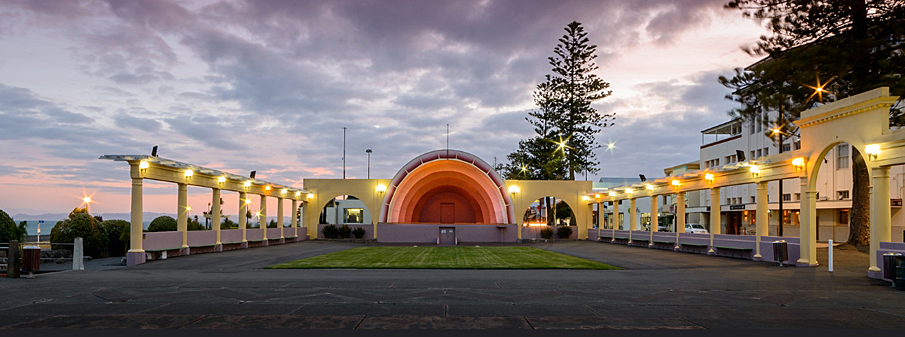
After the destructive 1931 Hawke’s Bay Earthquake rubble was cleared from central Napier and dumped along the newly uplifted foreshore. It was levelled for new development, which was ongoing through the 1930s. This included not just the skating rink and Sound Shell, but also in the immediate proximity the arches, colonnades, Veronica Sunbay and Kirk Sundial, each memorialising the Hawke’s Bay Earthquake and Napier’s subsequent rebirth.
The construction of the skating rink was funded by Government Relief and council funds, with contributions by the public. The cement, ordered from England, arrived in 1933 and was poured to create a colourful Art Deco pattern in the centre and around the borders of the surface. A public fundraising campaign for the rink’s construction, involving paying for individual paving slabs, was well supported. It was originally designed as a space for outdoor dancing but it soon became a town square-like space popular for the new craze of recreational skating.
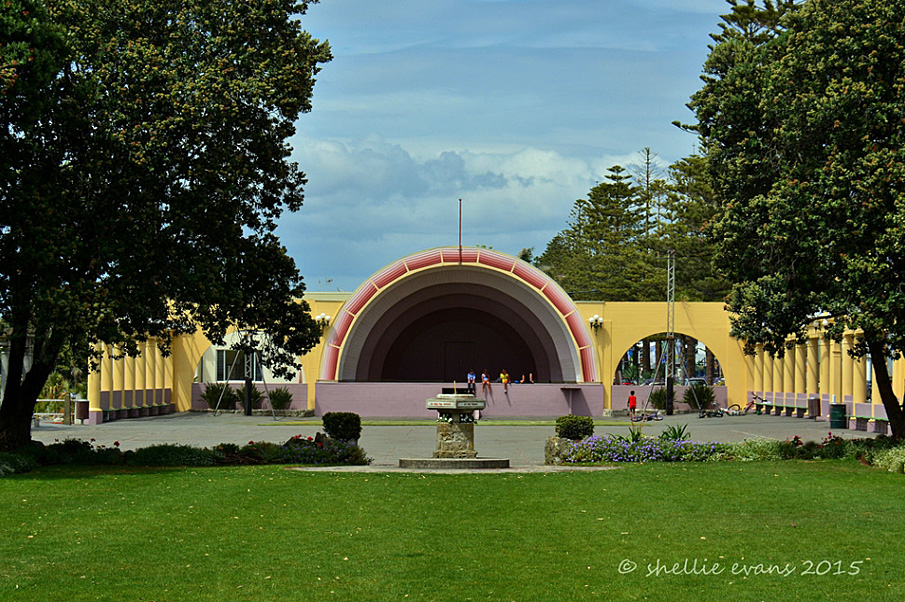
In 1934, the Sound Shell was constructed immediately south of the skating rink. The Sound Shell stage is set within a north-facing semi-circular dome. It was designed by Napier architect John Thomas Watson to promote the space’s use for outdoor concerts, assorted entertainment and civic events. The Thirty Thousand Club funded the project, and opened it with ceremony in December 1934 with speeches, fireworks and a band rendition of ‘The New Napier March’. It was described in the press at the time as ‘the first music shell erected on the foreshore in any part of the world’.
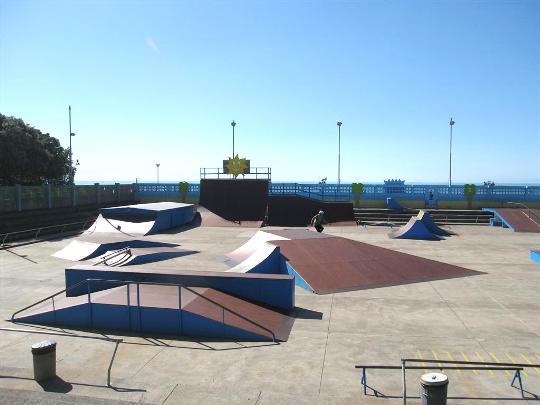
Originally a temporary structure, Napier’s citizens - initially dubious of the Sound Shell’s aesthetic contribution to the landscape - were eventually convinced to retain it permanently. It quickly became an icon of Napier, appearing on promotional material produced by both the Napier Borough Council and the Thirty Thousand Club. By the 1950s the concrete surface of the skating rink had deteriorated and it was no longer possible to skate on it. In 2017 it was described as ‘a health and safety hazard area’ with ‘multiple cracks’ and a dangerously uneven concrete surface. Although it is no longer used for skating, the rink and the Sound Shell are still a venue for public occasions, such as Annual New Year’s Eve celebrations and Art Deco Weekend events.
List Entry Information
Status
Listed
List Entry Status
Historic Place Category 2
Access
Able to Visit
List Number
4822
Date Entered
27th November 1986
Date of Effect
27th November 1986
City/District Council
Napier City
Region
Hawke's Bay Region
Extent of List Entry
Extent includes part of the land described as Sec 3 SO 396199 (RT 462213, NZ Gazette 2008, p.5188) and part of the land described as Lot 1 DP 25889 (RT HBV4/537, NZ Gazette 1996, p.4644), Hawkes Bay Land District. Refer to the extent map tabled at the Heritage List/Rārangi Kōrero Committee meeting on 29 October 2020.
Legal description
Sec 3 SO 396199 (RT 462213, NZ Gazette 2008, p.5188); Lot 1 DP 25889 (RT HBV4/537, NZ Gazette 1996, p.4644), Hawkes Bay Land District
Status
Listed
List Entry Status
Historic Place Category 2
Access
Able to Visit
List Number
4822
Date Entered
27th November 1986
Date of Effect
27th November 1986
City/District Council
Napier City
Region
Hawke's Bay Region
Extent of List Entry
Extent includes part of the land described as Sec 3 SO 396199 (RT 462213, NZ Gazette 2008, p.5188) and part of the land described as Lot 1 DP 25889 (RT HBV4/537, NZ Gazette 1996, p.4644), Hawkes Bay Land District. Refer to the extent map tabled at the Heritage List/Rārangi Kōrero Committee meeting on 29 October 2020.
Legal description
Sec 3 SO 396199 (RT 462213, NZ Gazette 2008, p.5188); Lot 1 DP 25889 (RT HBV4/537, NZ Gazette 1996, p.4644), Hawkes Bay Land District
Construction Professional
Name
Watson, John Thomas
Type
Architect
Biography
Watson was born in Hull, England, and worked on the construction of the Rand goldmines in South Africa before coming to New Zealand in 1905. He practised architecture in Greymouth, Masterton and Wellington before moving to Napier in 1932. In Masterton he was responsible for the design of the Soldiers' Wing at Masterton Hospital (1918) and in Wellington for the Wellington Show Association Buildings (1927) while working as an architect for the Edwards Construction Company. Initially he practised privately in Napier, but in 1935 he was pointed Borough Architect and designed the Memorial Colonnade (1937), New Napier Arch (1937), the Sound Shell and the Municipal Theatre (1937). In 1955 Watson retired to resume private practice. He then designed the Power Board building, Marewa (1956), the Napier Boys' High School Memorial Gateway (1960) and also had a role in the design of extensions to Napier Girls' High School and the construction of the Napier Airport Terminal Building.
Construction Details
Start Year
1933
startYearCirca
Type
Original Construction
Description
Skating Rink
Start Year
1934
Type
Original Construction
Description
Sound Shell
Construction Professional
Name
Watson, John Thomas
Type
Architect
Biography
Watson was born in Hull, England, and worked on the construction of the Rand goldmines in South Africa before coming to New Zealand in 1905. He practised architecture in Greymouth, Masterton and Wellington before moving to Napier in 1932. In Masterton he was responsible for the design of the Soldiers' Wing at Masterton Hospital (1918) and in Wellington for the Wellington Show Association Buildings (1927) while working as an architect for the Edwards Construction Company. Initially he practised privately in Napier, but in 1935 he was pointed Borough Architect and designed the Memorial Colonnade (1937), New Napier Arch (1937), the Sound Shell and the Municipal Theatre (1937). In 1955 Watson retired to resume private practice. He then designed the Power Board building, Marewa (1956), the Napier Boys' High School Memorial Gateway (1960) and also had a role in the design of extensions to Napier Girls' High School and the construction of the Napier Airport Terminal Building.
Construction Details
Start Year
1933
startYearCirca
Type
Original Construction
Description
Skating Rink
Start Year
1934
Type
Original Construction
Description
Sound Shell
Historical and Associated Iwi / Hapū / Whānau
Completion Date
2nd October 2020
Report Written By
Miranda Williamson
Information Sources
Campbell, 1975
M. D. N. Campbell, Story of Napier, 1874-1974; Footprints Along the Shore
Annabell, 2012
John Barry Annabell, ‘Planning Napier, 1850-1968,’
Woodward, 2002
Woodward, Robin. Cultivating Paradise: Aspects of Napier’s Botanical History, Napier: Hawke’s Bay Cultural Trust, 2002.
Other Information
This place was identified as significant under previous legislation with different information requirements. It remains significant under the current legislation. There is opportunity under our legislation and policies to add to this information. Further information about this place may be available from the Central Regional Office of Heritage New Zealand Pouhere Taonga. Please note that entry on the New Zealand Heritage List/Rarangi Korero identifies only the heritage values of the property concerned, and should not be construed as advice on the state of the property, or as a comment of its soundness or safety, including in regard to earthquake risk, safety in the event of fire, or insanitary conditions. A fully referenced upgrade report is available on request from the Central Region Office of Heritage New Zealand.
Historical and Associated Iwi / Hapū / Whānau
Completion Date
2nd October 2020
Report Written By
Miranda Williamson
Information Sources
Campbell, 1975
M. D. N. Campbell, Story of Napier, 1874-1974; Footprints Along the Shore
Annabell, 2012
John Barry Annabell, ‘Planning Napier, 1850-1968,’
Woodward, 2002
Woodward, Robin. Cultivating Paradise: Aspects of Napier’s Botanical History, Napier: Hawke’s Bay Cultural Trust, 2002.
Other Information
This place was identified as significant under previous legislation with different information requirements. It remains significant under the current legislation. There is opportunity under our legislation and policies to add to this information. Further information about this place may be available from the Central Regional Office of Heritage New Zealand Pouhere Taonga. Please note that entry on the New Zealand Heritage List/Rarangi Korero identifies only the heritage values of the property concerned, and should not be construed as advice on the state of the property, or as a comment of its soundness or safety, including in regard to earthquake risk, safety in the event of fire, or insanitary conditions. A fully referenced upgrade report is available on request from the Central Region Office of Heritage New Zealand.
Current Usages
Uses: Civic Facilities
Specific Usage: Stage
Uses: Civic Facilities
Specific Usage: Theatre
Former Usages
General Usage: Civic Facilities
Specific Usage: Skating Rink
Themes
Sport
Current Usages
Uses: Civic Facilities
Specific Usage: Stage
Uses: Civic Facilities
Specific Usage: Theatre
Former Usages
General Usage: Civic Facilities
Specific Usage: Skating Rink
Themes
Sport
Location
Sign up to hear more
Get the latest heritage news, features and events delivered
straight to your inbox.
