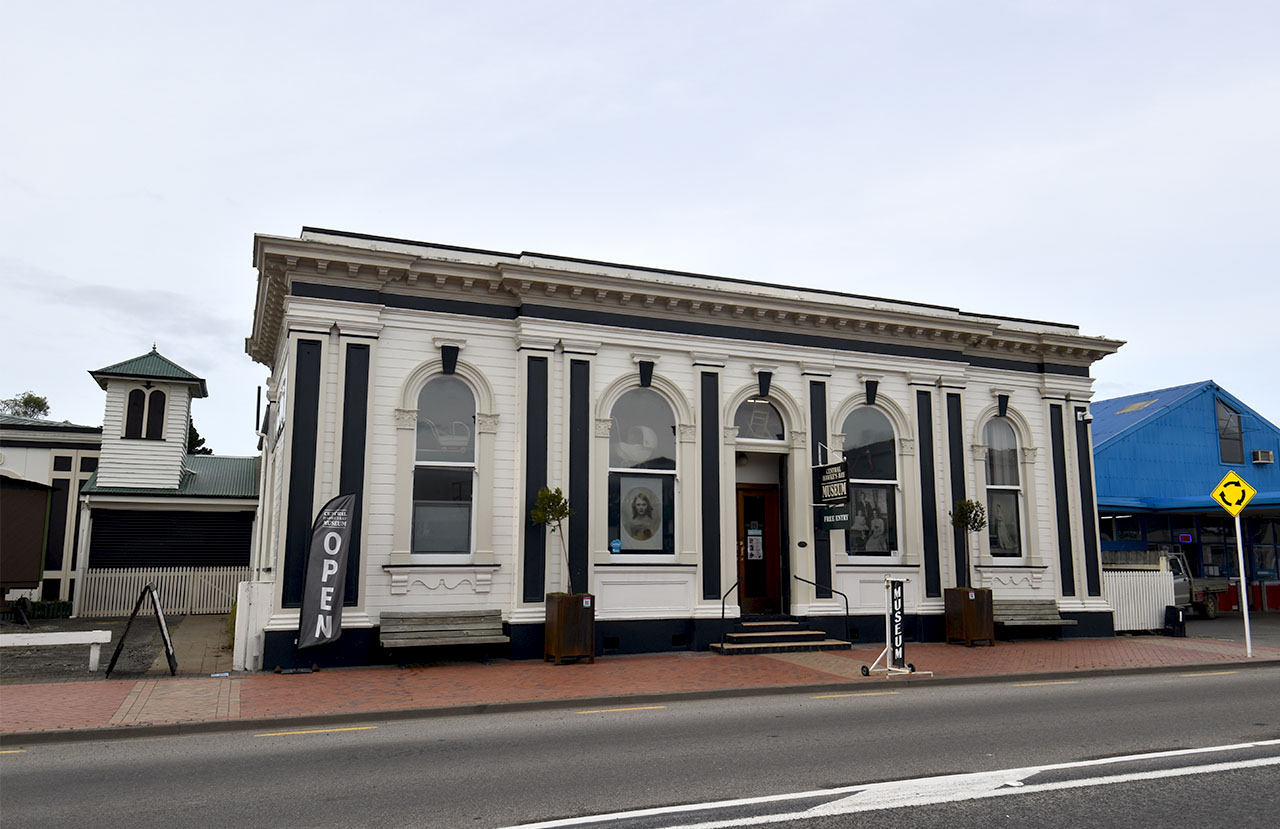
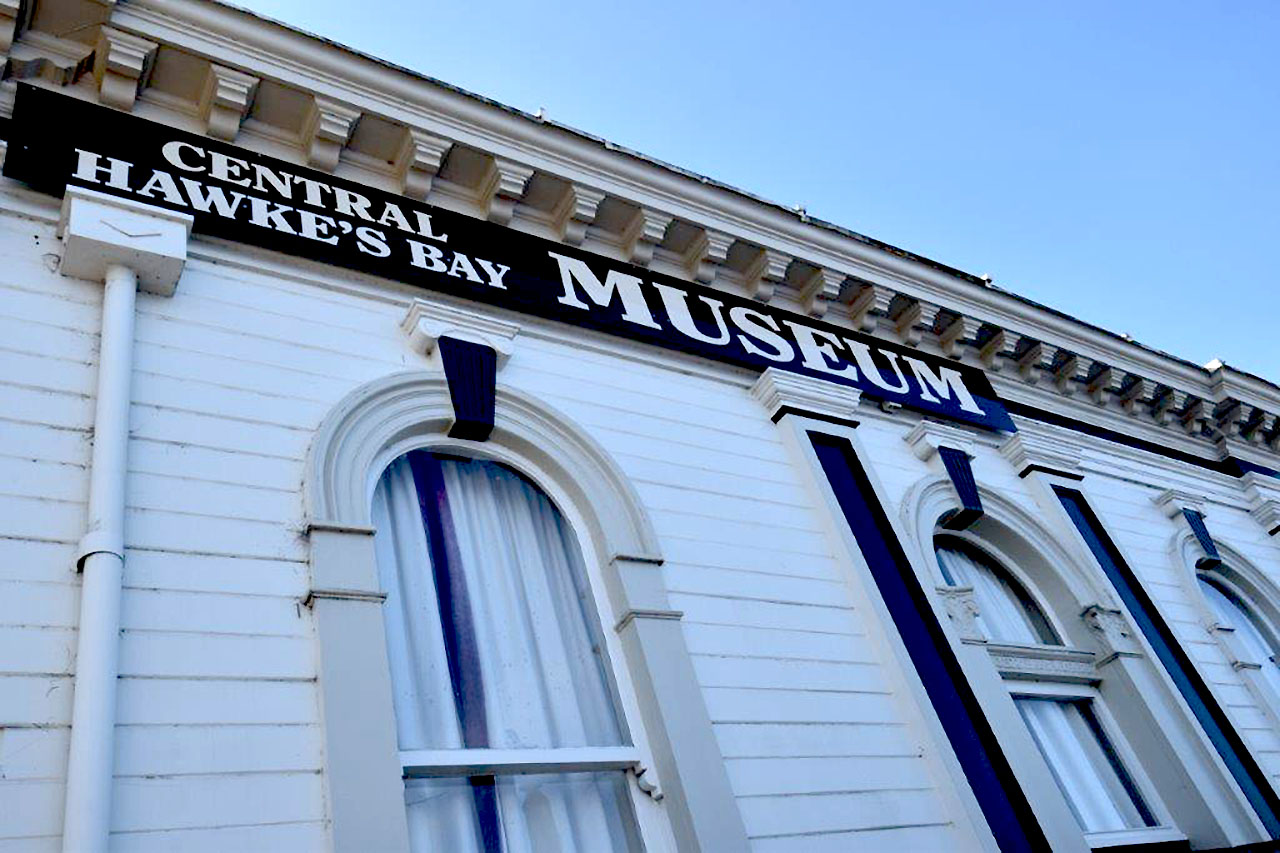
Standing almost in isolation on the eastern side of High Street, the former Bank of New Zealand is a landmark for visitors passing along State Highway 2 through the Central Hawke’s Bay town of Waipawa. Once flanked by shops, hotels and the post office, it is the sole survivor of a range of service buildings that were demolished in 1986 . No longer a bank, the building now houses a museum, its solid neo-classical frontage providing a tangible link to Waipawa’s history as an important hub for the farming community that developed in the area during the second half of the nineteenth century.
Settlements were established by Māori in Hawke’s Bay between 1250 and 1300 AD, along the coast between Māhia to the north and Pōrangahau to the south, and along the inland rivers. Rangitāne ancestors arrived around the same time, settling in the Heretaunga area. With the migration into the region of Ngāti Kahungunu in the sixteenth century Rangitāne moved south to Tāmaki-nui-a-Rua (Dannevirke area) and Ngāti Kahungunu became the dominant tribal group in Hawke’s Bay . In the Central Hawke’s Bay area, Whātuma (now known as Lake Hātuma) was an important food-gathering area. The lake was renowned for eeling, and the stands of timber surrounding the lake provided an abundance of Kereru (wood pigeon). From the 1820s, Ngāti Kahungunu were attacked by tribes from the north and the west, who had traded with European settlers and acquired muskets. Ngāti Kahungunu moved to Māhia to escape the raids, only returning in the late 1830s just as European settlers started to arrive, attracted by the opportunities for farming in the area. The first flock of sheep arrived in Hawke’s Bay in 1849, and negotiations took place directly with Māori to lease land for agriculture. Large-scale sheep stations soon dominated the Central Hawke’s Bay landscape.
Settled by runholder Frederick Abbott in 1860, Waipawa was originally named Abbottsford after its founder; so called because Abbott founded the town next to a ford over the Tukituki River. Early settlers however preferred the Māori name, Waipawa, and the fledgling town, surrounded by rich pasture lands, became an important rural service centre throughout the late nineteenth century. By 1861 it already boasted a church, courthouse, survey office, and blacksmith, alongside four hotels, two stores, two butcher shops and a milkman. Ten years later there was a daily coach service between Napier, Waipawa and Waipukurau. Waipawa was ideally suited as a stopping place being situated at the junction of Middle Road and Te Aute Road.
The Bank of New Zealand first opened a branch in Waipawa in June 1874, operating firstly from the bar of Cowper’s hotel, and then at Mr Rathbone’s store from 1 July 1874. In January 1886 a fire destroyed the bank building that had been constructed in 1882, and a replacement building was constructed in 1886, opening in January of 1887. This building, although somewhat altered internally since its construction, housed the bank until 1985. The design is typical of bank buildings of the time, featuring a symmetrical façade with a central entrance and arched windows framed by pilasters topped with Corinthian capitals. On its completion the building provided banking services at the front of the building, and accommodation for the bank manager at the rear.
The bank closed in 1985, and the building was sold to Waipawa District Council who gifted it to the people of Waipawa in 1986 to house a museum dedicated to the history of Central Hawke’s Bay.