

Constructed in circa 1886, the one and a half storeyed cottage at 13 Spencer Street, Christchurch, is an unusual example of a nineteenth century worker’s cottage, in that it is constructed of natural river stones. It has architectural, historical and social significance as an important example of a small colonial dwelling, built by its owner in uncommon materials, in the historically working class suburb of Addington.
In the early days of colonial settlement, Addington had been purchased as a substantial block of land outside the central city boundaries, and subsequently subdivided. The location of the railway line between this area and the city centre encouraged settlement in Addington by labourers and tradesmen. The cottage at 13 Spencer Street (formerly Spenser Street) is one of a number of small cottages surviving in the area. Thomas Novis, a bricklayer from Sussex, arrived in Canterbury in 1866 with his wife and young children. He purchased this section in 1880 and in 1886 divided it for his two of his sons, George, a bricklayer, and Edwin, a blacksmith. It is thought that the house was built by George Novis (b.1859-d.1919) in 1886 or in the years soon after.
Situated on a triangular section north side of Spencer Street, the cottage is notable for its construction in Greywacke river stones. On the south-western front elevation, the dark randomly set stones are knapped and contrast with light coloured plaster quoins. The main elevation has a central door flanked by sash windows and a bull-nosed verandah, with chamfered columns, which runs the length of the facade and features panels of timber fretwork at each end. On the other elevations, the river stones are set in horizontal courses and are painted white. Some modifications have been made at the rear of the cottage, including a timber extension with a large flat roofed dormer.
In 1885 George Novis married Mary Sherriff and therefore it would have been timely for the cottage to have been built soon after in which to raise a family. George retained ownership of the cottage until 1899, while brother Edwin owned the cottage next door until 1921. Although the cottage at 13 Spencer Street has had a number of owners since the Novis’s, and has had some modification, its street frontage retains a high degree of authenticity. The chimneys were removed following the 2010-2011 Canterbury earthquakes.
In the early days of colonial settlement, Addington had been purchased as a substantial block of land outside the central city boundaries, and subsequently subdivided. The location of the railway line between this area and the city centre encouraged settlement in Addington by labourers and tradesmen. The cottage at 13 Spencer Street (formerly Spenser Street) is one of a number of small cottages surviving in the area. Thomas Novis, a bricklayer from Sussex, arrived in Canterbury in 1866 with his wife and young children. He purchased this section in 1880 and in 1886 divided it for his two of his sons, George, a bricklayer, and Edwin, a blacksmith. It is thought that the house was built by George Novis (b.1859-d.1919) in 1886 or in the years soon after.
Situated on a triangular section north side of Spencer Street, the cottage is notable for its construction in Greywacke river stones. On the south-western front elevation, the dark randomly set stones are knapped and contrast with light coloured plaster quoins. The main elevation has a central door flanked by sash windows and a bull-nosed verandah, with chamfered columns, which runs the length of the facade and features panels of timber fretwork at each end. On the other elevations, the river stones are set in horizontal courses and are painted white. Some modifications have been made at the rear of the cottage, including a timber extension with a large flat roofed dormer.
In 1885 George Novis married Mary Sherriff and therefore it would have been timely for the cottage to have been built soon after in which to raise a family. George retained ownership of the cottage until 1899, while brother Edwin owned the cottage next door until 1921. Although the cottage at 13 Spencer Street has had a number of owners since the Novis’s, and has had some modification, its street frontage retains a high degree of authenticity. The chimneys were removed following the 2010-2011 Canterbury earthquakes.
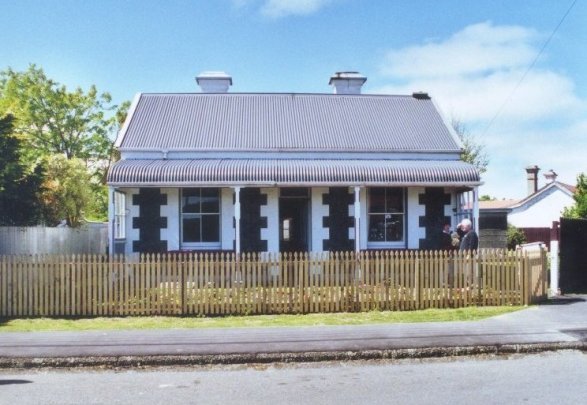
Cottage, Sydenham, Christchurch | Chris Webster | 01/11/2001 | Chris Webster
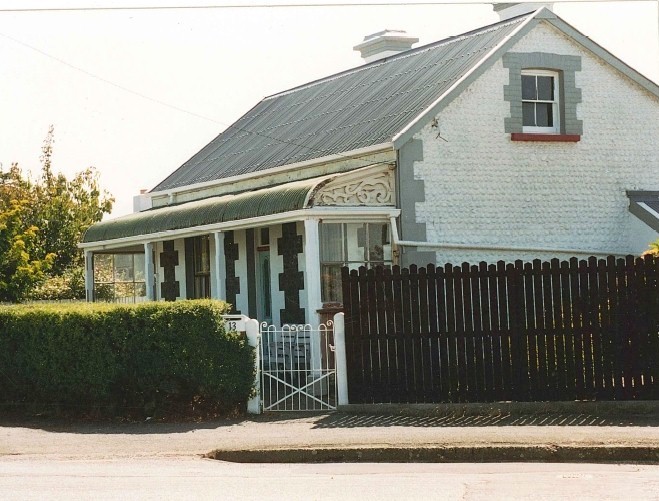
Original image submitted at time of registration. February 1993 | M E Emberson | Heritage New Zealand Pouhere Taonga
Cottage, Sydenham, Christchurch | Chris Webster | 01/11/2001 | Chris Webster
Original image submitted at time of registration. February 1993 | M E Emberson | Heritage New Zealand Pouhere Taonga
