Quick links


Quick links
Quick links
Quick links
Quick links
Quick links
Municipal Chambers (Former)
119 Palmerston Street and 8 Lyndhurst Street, WESTPORT
Private
Historic Place Category 1
List No. 5000
Quick links:
List GalleryLocationDetails
119 Palmerston Street and 8 Lyndhurst Street, WESTPORT
Private
Historic Place Category 1
List No. 5000
List Entry Information
Status
Listed
List Entry Status
Historic Place Category 1
Access
Private/No Public Access
List Number
5000
Date Entered
30th August 1990
Date of Effect
30th August 1990
City/District Council
Buller District
Region
West Coast Region
Extent of List Entry
Extent of registration includes part of the land described as Lot 1 DP 442862 (RT 552950), Nelson Land District, and the building known as Municipal Chambers thereon.
Legal description
Lot 1 DP 442862 (RT 552950), Nelson Land District
Status
Listed
List Entry Status
Historic Place Category 1
Access
Private/No Public Access
List Number
5000
Date Entered
30th August 1990
Date of Effect
30th August 1990
City/District Council
Buller District
Region
West Coast Region
Extent of List Entry
Extent of registration includes part of the land described as Lot 1 DP 442862 (RT 552950), Nelson Land District, and the building known as Municipal Chambers thereon.
Legal description
Lot 1 DP 442862 (RT 552950), Nelson Land District
Why is this place significant?
Historic Significance
Historical Significance or Value Having been established in 1861, Westport is the oldest European settlement on the West Coast. The town's Municipal Chambers reflect the pre-eminent position of Westport in the Buller district and the local borough council's contribution to the government of the region.
Physical Significance
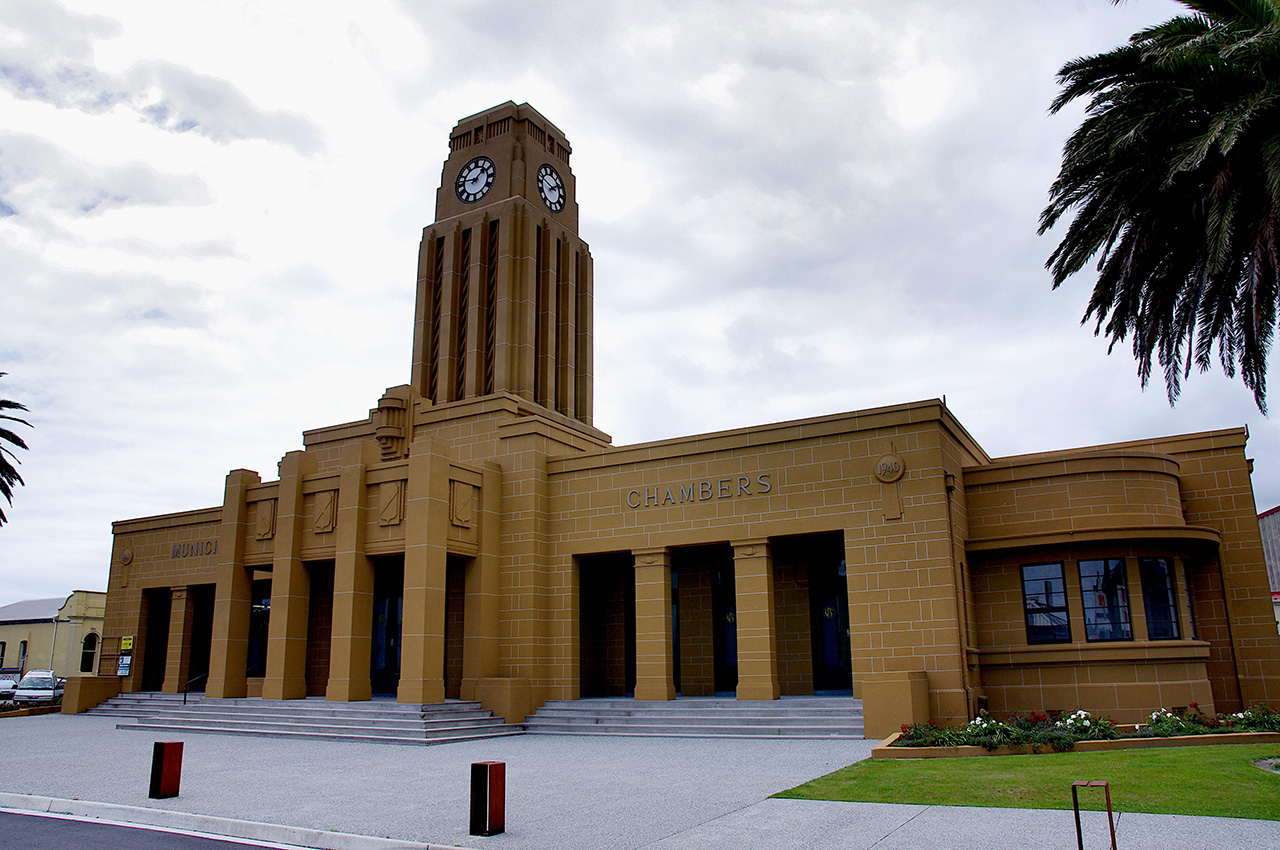
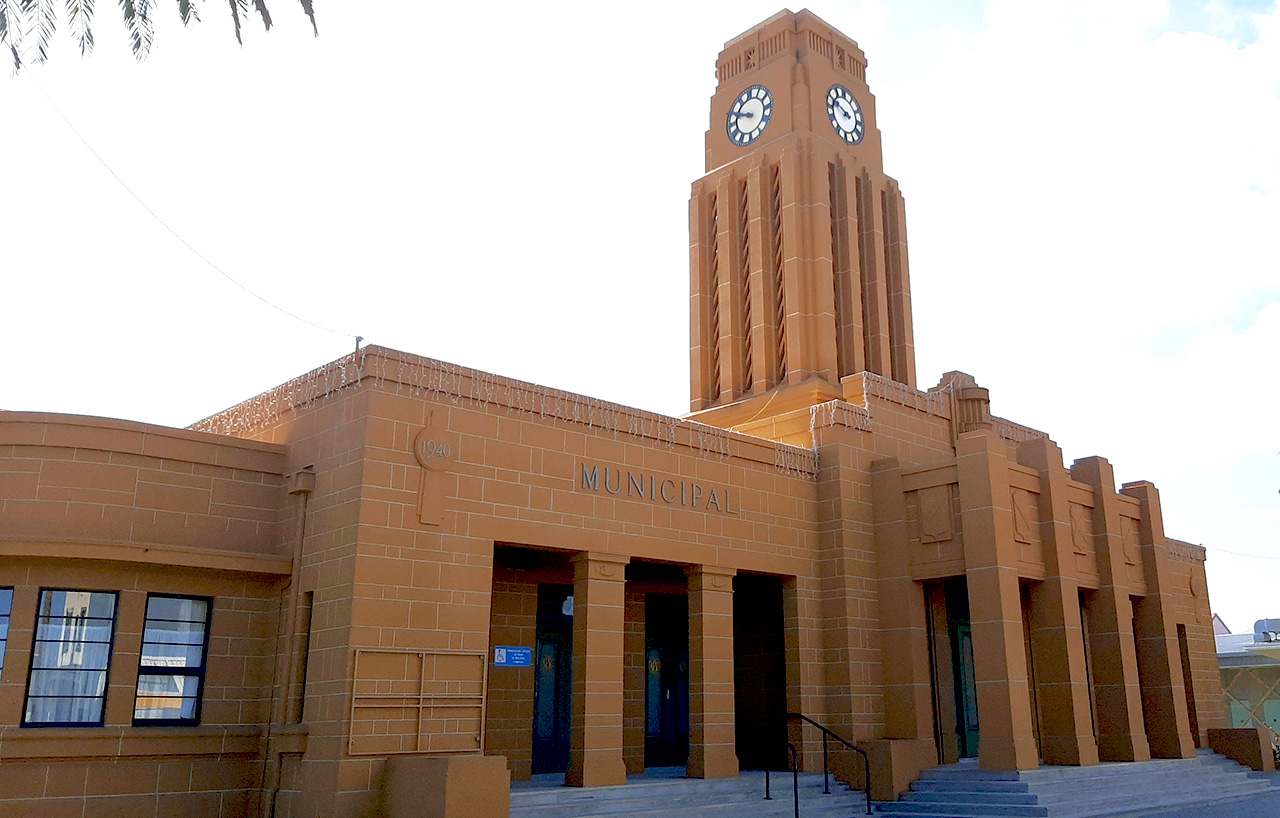
ARCHITECTURAL QUALITY: The Municipal Chambers is a striking building with a dramatic appearance which makes it one of Westport's most prominent public buildings. The clock, which was donated by Harry Morgan, the owner/operator of a local cinema, serves as a functional landmark and the Moderne elements in the building's principal facades reflect the impact this popular interpretation of the International Style had upon New Zealand architecture in the late 1930s. TOWNSCAPE/LANDMARK VALUE: The clock tower of the Municipal Chambers is Westport's most prominent landmark and has a considerable impact on the town's main thoroughfare, Palmerston Street.
Why is this place significant?
Historic Significance
Historical Significance or Value Having been established in 1861, Westport is the oldest European settlement on the West Coast. The town's Municipal Chambers reflect the pre-eminent position of Westport in the Buller district and the local borough council's contribution to the government of the region.
Physical Significance
ARCHITECTURAL QUALITY: The Municipal Chambers is a striking building with a dramatic appearance which makes it one of Westport's most prominent public buildings. The clock, which was donated by Harry Morgan, the owner/operator of a local cinema, serves as a functional landmark and the Moderne elements in the building's principal facades reflect the impact this popular interpretation of the International Style had upon New Zealand architecture in the late 1930s. TOWNSCAPE/LANDMARK VALUE: The clock tower of the Municipal Chambers is Westport's most prominent landmark and has a considerable impact on the town's main thoroughfare, Palmerston Street.
Construction Professional
Name
Macdonald, Archibald
Type
Architect
Biography
Archibald MacDonald resided in Westport between c.1938 and 1943 during which time he designed both the Municipal Chambers and the Buller County Chambers (c.1940). Further information about his training, personal life and professional achievements has yet to come to light. It seems likely, however, that MacDonald was in Westport solely on account of his work for the borough and county councils, and that after the completion of their new premises he left the town to work elsewhere, either in New Zealand or overseas.
Construction Details
Start Year
1985
startYearCirca
Type
Modification
Description
Building refurbished, single storey addition made to the rear and a kitchen unit built into the entrance foyer.
Start Year
1938
Finish Year
1941
Type
Original Construction
Description
Site cleared December 1938. Work on building began January 1939. Foundations and steel work almost complete by April 1939.
Construction Materials
Concrete, steel, Motueka sand, rimu.
Notable Features
The interior ornament and prominent clock tower.
Construction Professional
Name
Macdonald, Archibald
Type
Architect
Biography
Archibald MacDonald resided in Westport between c.1938 and 1943 during which time he designed both the Municipal Chambers and the Buller County Chambers (c.1940). Further information about his training, personal life and professional achievements has yet to come to light. It seems likely, however, that MacDonald was in Westport solely on account of his work for the borough and county councils, and that after the completion of their new premises he left the town to work elsewhere, either in New Zealand or overseas.
Construction Details
Start Year
1985
startYearCirca
Type
Modification
Description
Building refurbished, single storey addition made to the rear and a kitchen unit built into the entrance foyer.
Start Year
1938
Finish Year
1941
Type
Original Construction
Description
Site cleared December 1938. Work on building began January 1939. Foundations and steel work almost complete by April 1939.
Construction Materials
Concrete, steel, Motueka sand, rimu.
Notable Features
The interior ornament and prominent clock tower.
DESCRIPTION: The Westport Borough Council was founded in 1873, twelve years after the settlement at the mouth of the Buller River had been established. The present Municipal Chambers, which replaced a building erected for the council on the same site in 1880, were first proposed in 1936 by Mayor Kilkenny. After Archibald MacDonald's design for the building had been accepted Kilkenny polled the town's ratepayers to gauge their support for the new council offices. Tenders were subsequently called in July 1938 and construction began at the end of the same year with MacDonald acting as his own clerk of works. Built at a cost of £18,423 but without the proposed town hall which was to have been built behind the council offices, the Municipal Chambers were never officially opened. The building is soon to be vacated by Buller District Council.
DESCRIPTION: The Westport Borough Council was founded in 1873, twelve years after the settlement at the mouth of the Buller River had been established. The present Municipal Chambers, which replaced a building erected for the council on the same site in 1880, were first proposed in 1936 by Mayor Kilkenny. After Archibald MacDonald's design for the building had been accepted Kilkenny polled the town's ratepayers to gauge their support for the new council offices. Tenders were subsequently called in July 1938 and construction began at the end of the same year with MacDonald acting as his own clerk of works. Built at a cost of £18,423 but without the proposed town hall which was to have been built behind the council offices, the Municipal Chambers were never officially opened. The building is soon to be vacated by Buller District Council.
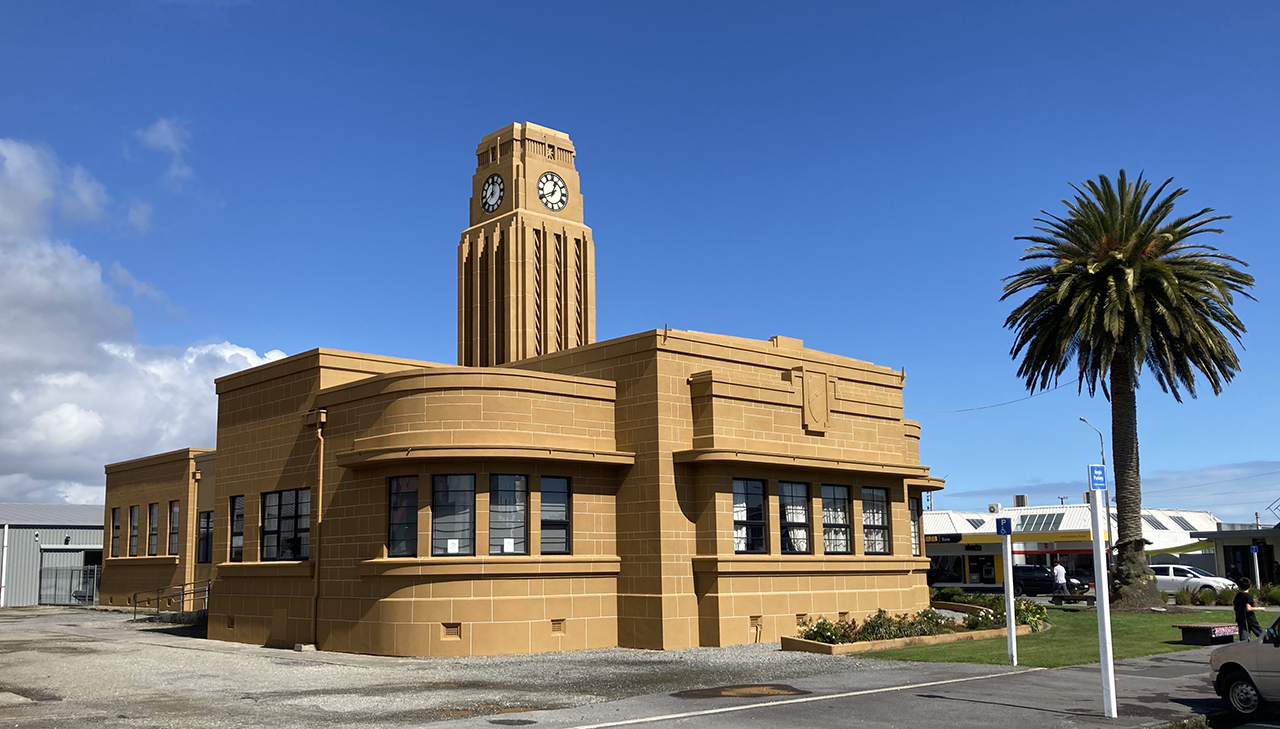
ARCHITECTURAL DESCRIPTION: The Municipal Chambers is a reinforced concrete building with a golden sand plaster finish which has been lined out. Combining Moderne features with a stripped classical style, the building stands on a corner site with its main elevations facing north and west. The latter is the principal facade and is symmetrical about a central clock tower and prostyle portico which opens into a large entrance foyer. Flanking the foyer are two spacious corridors which communicate with enclosed porticos through pairs of glazed doors. The council chambers and mayor's office are situated at the end of the southern corridor whilst the northern corridor provides access to the administration offices and staff facilities. The northern elevation of the building is also symmetrical and features bands of steel casement windows beneath horizontal slabs of concrete. The end bays of this facade are curved and clearly derived from contemporary Moderne architecture; as are the building's flat roofs, simple cornices, and varying wall heights. Ornament is concentrated within the central bays of the two principal elevations and in the public corridors, council chambers and entrance foyer of the building's interior. The foyer features a boldly coffered ceiling and four large octagonal columns with stylised capitals which support the tower. By contrast, the rear walls of the Municipal Chambers are devoid of any ornamentation and a recent office addition behind the foyer has been treated in a similar way to harmonise with the rest of the building. MODIFICATIONS: c.1985 - Building refurbished, single storey addition made to the rear and a kitchen unit built into the entrance foyer.
ARCHITECTURAL DESCRIPTION: The Municipal Chambers is a reinforced concrete building with a golden sand plaster finish which has been lined out. Combining Moderne features with a stripped classical style, the building stands on a corner site with its main elevations facing north and west. The latter is the principal facade and is symmetrical about a central clock tower and prostyle portico which opens into a large entrance foyer. Flanking the foyer are two spacious corridors which communicate with enclosed porticos through pairs of glazed doors. The council chambers and mayor's office are situated at the end of the southern corridor whilst the northern corridor provides access to the administration offices and staff facilities. The northern elevation of the building is also symmetrical and features bands of steel casement windows beneath horizontal slabs of concrete. The end bays of this facade are curved and clearly derived from contemporary Moderne architecture; as are the building's flat roofs, simple cornices, and varying wall heights. Ornament is concentrated within the central bays of the two principal elevations and in the public corridors, council chambers and entrance foyer of the building's interior. The foyer features a boldly coffered ceiling and four large octagonal columns with stylised capitals which support the tower. By contrast, the rear walls of the Municipal Chambers are devoid of any ornamentation and a recent office addition behind the foyer has been treated in a similar way to harmonise with the rest of the building. MODIFICATIONS: c.1985 - Building refurbished, single storey addition made to the rear and a kitchen unit built into the entrance foyer.
Historical and Associated Iwi / Hapū / Whānau
Information Sources
Cyclopedia of New Zealand, 1906
Cyclopedia Company, Industrial, descriptive, historical, biographical facts, figures, illustrations, Wellington, N.Z, 1897-1908, Vol. 5, Nelson, Marlborough, Westland, 1906
Department of Conservation
Department of Conservation
Wises Post Office Directories
Wises Post Office Directories
Macdonald, 1973
B. Macdonald, Westport - Struggle for Survival, Westport, 1973 [Westport Borough Council]
Plans
Architectural Drawings/Plans
Stone's Post Office Directory
Stone's Canterbury, Nelson, Marlborough and Westland Post Office Directory, Christchurch.
Buller District Council
Buller District Council
Other Information
This historic place was registered under the Historic Places Act 1980. This report includes the text from the original Building Classification Committee report considered by the NZHPT Board at the time of registration. Please note that entry on the New Zealand Heritage List/Rarangi Korero identifies only the heritage values of the property concerned, and should not be construed as advice on the state of the property, or as a comment of its soundness or safety, including in regard to earthquake risk, safety in the event of fire, or insanitary conditions.
Historical and Associated Iwi / Hapū / Whānau
Information Sources
Cyclopedia of New Zealand, 1906
Cyclopedia Company, Industrial, descriptive, historical, biographical facts, figures, illustrations, Wellington, N.Z, 1897-1908, Vol. 5, Nelson, Marlborough, Westland, 1906
Department of Conservation
Department of Conservation
Wises Post Office Directories
Wises Post Office Directories
Macdonald, 1973
B. Macdonald, Westport - Struggle for Survival, Westport, 1973 [Westport Borough Council]
Plans
Architectural Drawings/Plans
Stone's Post Office Directory
Stone's Canterbury, Nelson, Marlborough and Westland Post Office Directory, Christchurch.
Buller District Council
Buller District Council
Other Information
This historic place was registered under the Historic Places Act 1980. This report includes the text from the original Building Classification Committee report considered by the NZHPT Board at the time of registration. Please note that entry on the New Zealand Heritage List/Rarangi Korero identifies only the heritage values of the property concerned, and should not be construed as advice on the state of the property, or as a comment of its soundness or safety, including in regard to earthquake risk, safety in the event of fire, or insanitary conditions.
Former Usages
General Usage: Government
Specific Usage: Council/local government building
Former Usages
General Usage: Government
Specific Usage: Council/local government building
Location
Get the latest heritage news, features and events delivered
straight to your inbox.
