

Poutini Māori names for the glacier include Te Tai-o-Wawe and Kā Roimata-o-Hinehukatere (the frozen tears of the snow-girl Hinehukatere after the death of her lover, Wawe). Julius von Haast of the Canterbury Provincial Government renamed it Franz Josef Glacier in 1866, after the Austrian emperor of his home country. Adventurers and visitors had admired the beauties of the glacier country, and in the early twentieth century active steps were taken to promote Westland and its Franz Josef and Fox Glaciers as the scenic wonderland of New Zealand. In 1911, the well-known guiding and mountaineering brothers, Jim and Alex (Alec) Graham, purchased the first hotel at Waiho (Waiau) Gorge at Franz Josef, and this became a base for their mountain guiding business and led to growth of tourism and mountaineering in the area. In response to the Graham brothers’ offer to build a hut, the Department of Tourist and Health Resorts made available a sum of £160 for the project and provided sketch plans and specifications. The materials were carried up by hand to the alpine hut’s first site, a moraine terrace above Harpers Creek on the west side of the Franz Josef Glacier Valley, at 2,657 feet (809 metres), where the hut commanded excellent views of the main icefall.
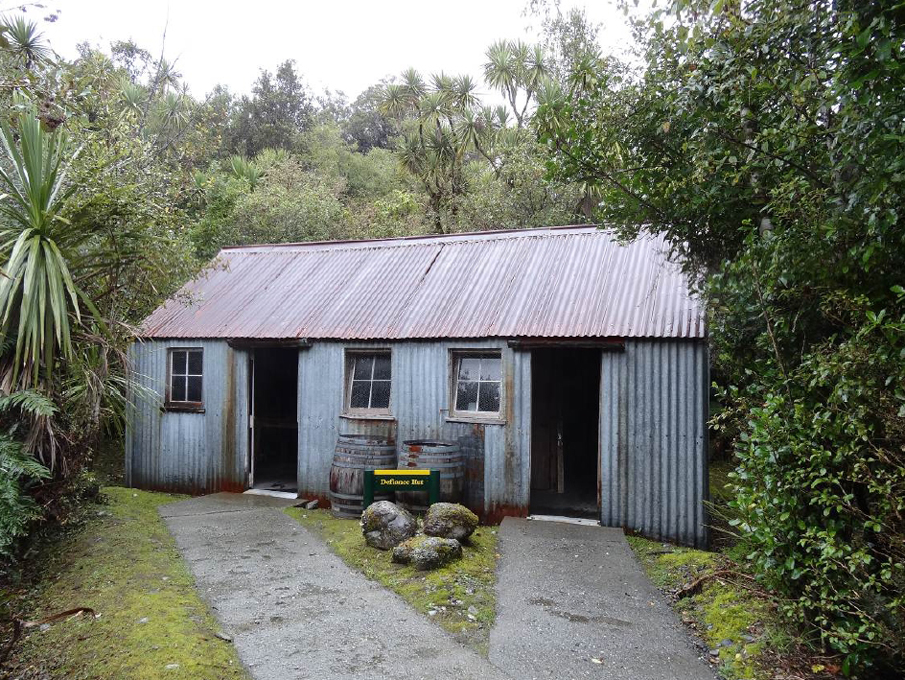
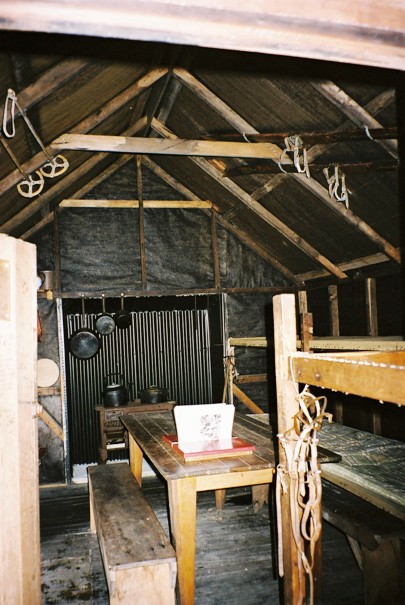
Defiance Hut is rectangular in plan, 7.4 metres by 3.9 metres, with the ridge of its gabled roof form running north-east to south-west. The height to the eaves is approximately two metres and approximately 3.5 metres to the ridge. The exterior cladding is vertical corrugated steel, lapped on the gable ends at the level of the eaves, and corrugated steel to the roof. At each end, the roofing material is wrapped down onto the face of the gable walls. A projection on the north-east elevation signifies where the fireplace originally was on the interior. The front or south-east elevation has three timber-framed windows and two door openings, one to each of its two rooms. The interior plan arrangement includes a large room (originally for cooking and sleeping for men) and a smaller room (originally for women). The south-western larger room now has clear glazing in place at the place of its opened exterior door, allowing an additional outside view of that room set out with old equipment. The north-eastern door allows access to the smaller north-east room, and a fenced opening from there provides an additional view into the larger room.
The Defiance Hut extended the available tourist excursion to the glacier. The hut offered night shelter to visitors and mountaineers, enabling them to make ascents of some of the peaks on the western side of the glacier, including Mount Moltke, which became very popular. The Graham brothers’ good relationship with Poutini Māori led them, from the 1920s, to employ Joseph Puruti (Fluerty) first as a porter to carry supplies up the ice, including to Defiance Hut, and then as an expert glacier climbing guide, where he was particularly well regarded. As the glacier receded and the ice pressure diminished the terrace, Defiance Ridge began to crumble and erode. In December 1936 it was decided to move the hut to the safety of the crest of the Defiance Ridge. The hut was pulled apart and the two tons of material, which had originally been carried to the site by hand, was moved. The hut was re-assembled and remained in constant use until the 1950s when the site was again threatened by erosion and access became a problem. A replacement hut was built at Castle Rocks, 650 metres high up the ridge, in 1974. In 1978 the Defiance Hut was rescued from its precarious position, flown out in sections, and reassembled and restored behind the then Westland National Park Visitors Centre at Franz Josef township to serve as an example of an old-style mountain hut. After a new Visitors Centre was built in circa 2016, the hut’s location was no longer deemed appropriate. In 2020 it was shifted again, this time back to a location that is a little closer to its original high-level locations, at the road-end carpark for visitors going to see the Franz Josef Glacier.
List Entry Information
Status
Listed
List Entry Status
Historic Place Category 2
Access
Able to Visit
List Number
5046
Date Entered
21st September 1989
Date of Effect
10th September 2025
City/District Council
Westland District
Region
West Coast Region
Extent of List Entry
Extent includes part of the land described as Pt Res 1461 (NZ Gazette 1960, p. 416), Westland Land District and the building known as Defiance Hut thereon.
Legal description
Pt Res 1461 (NZ Gazette 1960, p. 416), Westland Land District
Location Description
The building is located at the Franz Josef Glacier Car Park which is located at the end of an access road which runs south off State Highway 6 at the Waiho River.
Status
Listed
List Entry Status
Historic Place Category 2
Access
Able to Visit
List Number
5046
Date Entered
21st September 1989
Date of Effect
10th September 2025
City/District Council
Westland District
Region
West Coast Region
Extent of List Entry
Extent includes part of the land described as Pt Res 1461 (NZ Gazette 1960, p. 416), Westland Land District and the building known as Defiance Hut thereon.
Legal description
Pt Res 1461 (NZ Gazette 1960, p. 416), Westland Land District
Location Description
The building is located at the Franz Josef Glacier Car Park which is located at the end of an access road which runs south off State Highway 6 at the Waiho River.
Why is this place significant?
Cultural Significance
Cultural Significance or Value Defiance Hut has cultural value. It demonstrates the way of life of those who stayed in the hut, from 1913 until circa 1959, and its retention and restoration for use as a display reflects how the mountaineering community has continued to value it. It embodies the sense of identity that many New Zealanders derive from the pursuit of high-country outdoor recreation. Social Significance or Value Defiance Hut has social value. It contributes towards our understanding of efforts people have made to establish the mountaineering base and climbing tourism. Through activities associated with the hut and climbing, and later its restoration and partial reconstruction, climbing and tramping communities have come together and formed bonds. While no longer functioning as mountain accommodation, it continues as a road-end visitor interpretation experience.
Historic Significance
Historical Significance or Value Defiance Hut has historical significance. It contributes towards our understanding of adventure tourism and mountaineering history and, in particular, mountaineering in South Westland. It is the earliest New Zealand high-level mountain hut still surviving. Its history of relocations tells the story of the ever-changing nature of mountain environments.
Physical Significance
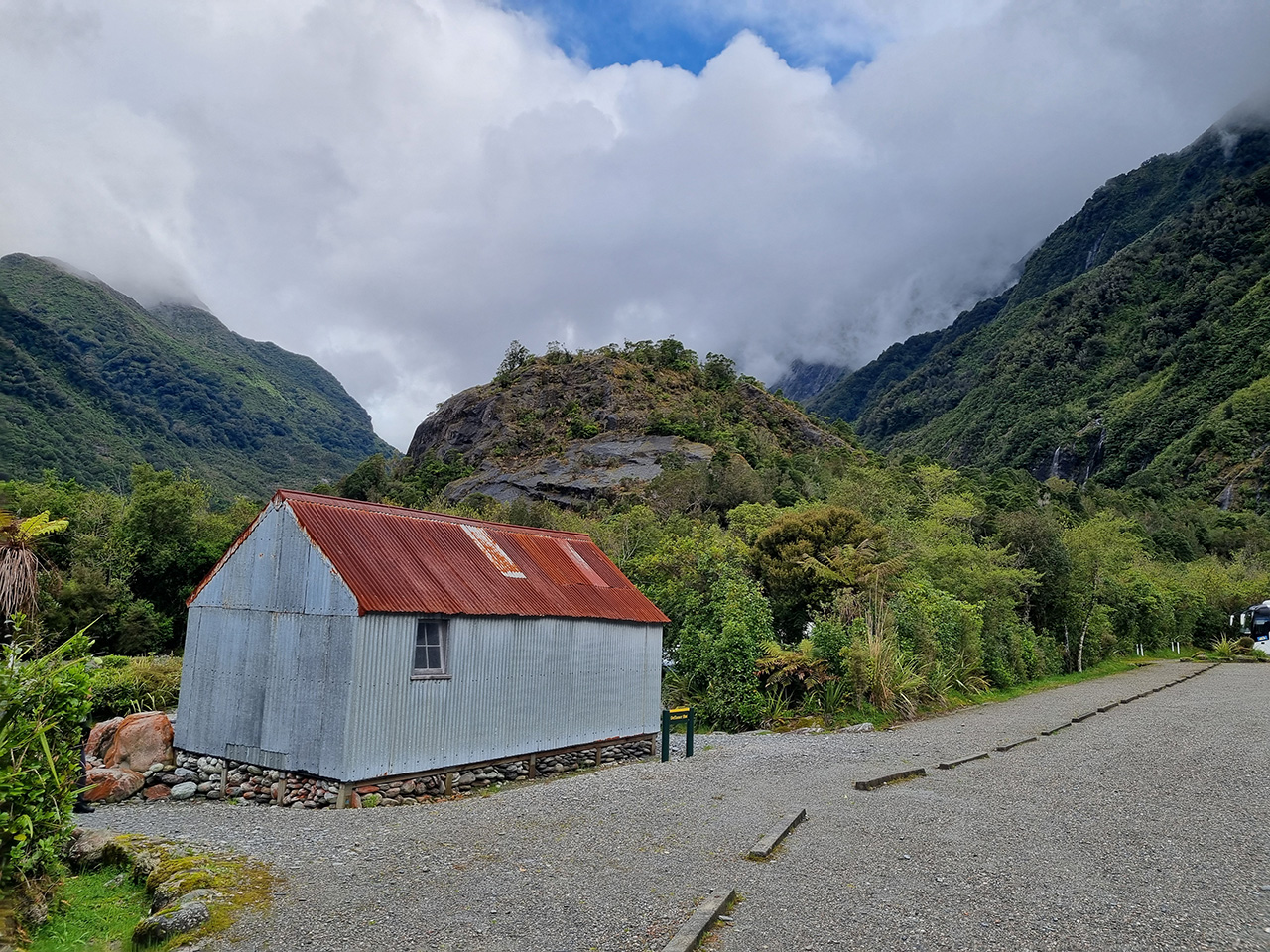
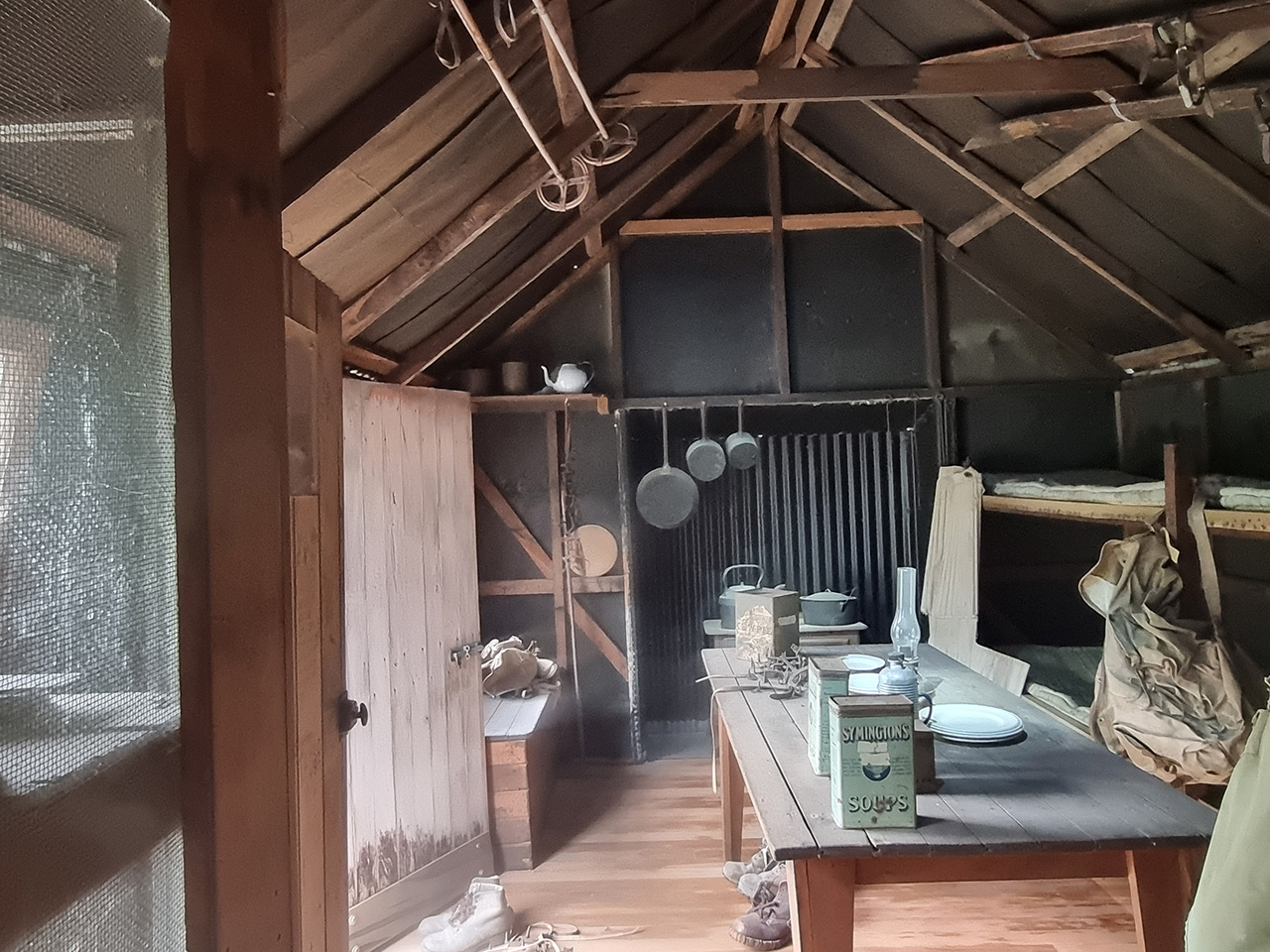
Aesthetic Significance or Value Defiance Hut, set within the road end carpark with a bush and mountainous backdrop, has aesthetic value. With its rustic appearance, enhanced by internal displays that include old mountaineering equipment and a voice-over, the hut’s appearance, sounds, smell and feel combine to evoke a sense of place. These qualities are demonstrably valued, as evidenced by earlier efforts of the mountaineer friends’ group who helped establish the hut, in its previous relocated position, as a place for visitors to get a sense of the history of glacier tourism at Franz Josef. It is appealing to visitors, some of whom post photographs of the hut on social media. It could be expected that these communities could be expected to experience a sense of loss if these aesthetic qualities were no longer there. Architectural Significance or Value The modest Defiance Hut building has architectural significance. It is an example of a simple vernacular building form (rectangular in plan with a gable roof) being adopted to meet very specific logistical requirements. It needed to be transportable since its parts had to be carted by hand for erection in a remote high-altitude location; it needed to be a relatively low maintenance yet robust shelter with cooking and sleeping facilities for mountaineering parties; and it needed to withstand severe environmental conditions, including high wind and snow loadings. With characteristics reflecting development in New Zealand’s high and back country huts, its design became the standard for mountain huts for some 50 years. While some new materials have been introduced as part of the hut’s conservation, the building retains a high degree of authenticity.
Why is this place Category 1 / Category 2?
Detail Of Assessed Criteria
Defiance Hut reflects a historic milestone in the history of New Zealand’s backcountry and mountain huts. Though thrice relocated and reassembled, it retains significance in its ability to convey the history, culture and social stories of tramping and mountaineering in South Westland. This place was assessed against the criteria set out in section 66(3) of the Heritage New Zealand Pouhere Taonga Act 2014 and found to qualify as a Category 2 historic place under the following criteria: a, b, e, f, g and j. (a) The extent to which the place reflects important or representative aspects of New Zealand history. Defiance Hut reflects aspects of New Zealand’s mountaineering and adventure tourism history. As a building owned built for the Department of Tourist and Health Resorts, it fits into the broader concepts of tourism in the outdoors, something for which New Zealand has long been held in high regard. Like other modest high-altitude huts, in its two locations on Defiance Ridge it provided a base for climbing expeditions and acted as a refuge in the harsh mountain environment. Its history of relocation also reflects the tendency and capacity of shifting small and not-so-small buildings when their original location no longer suits. (b) The association of the place with events, persons, or ideas of importance in New Zealand history. Defiance Hut is associated with notable guides and climbers, such as the Graham brothers who erected, stocked and maintained the hut as part of their guiding business, and many other well-known mountaineers used the hut and signed the visitors’ book. The hut is closely associated with well-known Māori climbing guide and mountaineer, Joseph Puruti (Fluerty), who, in continuing a family tradition of adventure, achieved a number of first ascents for Māori. (e) The community association with, or public esteem for the place The climbing community of Westland’s association with the place is demonstrated through their advocacy for having the building conserved when it was removed to Franz Josef township. As an aesthetically pleasing and accessible building in the Westland National Park, it is frequently photographed by tourists. (f) The potential of the place for public education The hut was originally a three-hour climb from the Franz Josef township, but in its relocated position at the road-end carpark of the access road for visitors wanting to walk to see the glacier, it is accessible to many. Its layout, displays and interpretive material provides information to visitors about its place in mountaineering history. (g) The technical accomplishment, value, or design of the place The design of Defiance Hut has technical value as the progenitor of many huts built subsequently in New Zealand’s high country and alpine environments. Methods and materials used in its reassembly remain true to the original structure. (j) The importance of identifying rare types of historic places Because mountain huts have a relatively short life span, there are few remaining from the pre-World War Two period. Dating from the early period of recreational hut construction, and even though three times relocated, Defiance Hut has rarity value as the earliest high-level mountain hut extant in New Zealand. Defiance Hut reflects a historic milestone in the history of New Zealand’s backcountry and mountain huts. Though thrice relocated and reassembled, it retains significance in its ability to convey the history, culture and social stories of tramping and mountaineering in South Westland.
Why is this place significant?
Cultural Significance
Cultural Significance or Value Defiance Hut has cultural value. It demonstrates the way of life of those who stayed in the hut, from 1913 until circa 1959, and its retention and restoration for use as a display reflects how the mountaineering community has continued to value it. It embodies the sense of identity that many New Zealanders derive from the pursuit of high-country outdoor recreation. Social Significance or Value Defiance Hut has social value. It contributes towards our understanding of efforts people have made to establish the mountaineering base and climbing tourism. Through activities associated with the hut and climbing, and later its restoration and partial reconstruction, climbing and tramping communities have come together and formed bonds. While no longer functioning as mountain accommodation, it continues as a road-end visitor interpretation experience.
Historic Significance
Historical Significance or Value Defiance Hut has historical significance. It contributes towards our understanding of adventure tourism and mountaineering history and, in particular, mountaineering in South Westland. It is the earliest New Zealand high-level mountain hut still surviving. Its history of relocations tells the story of the ever-changing nature of mountain environments.
Physical Significance
Aesthetic Significance or Value Defiance Hut, set within the road end carpark with a bush and mountainous backdrop, has aesthetic value. With its rustic appearance, enhanced by internal displays that include old mountaineering equipment and a voice-over, the hut’s appearance, sounds, smell and feel combine to evoke a sense of place. These qualities are demonstrably valued, as evidenced by earlier efforts of the mountaineer friends’ group who helped establish the hut, in its previous relocated position, as a place for visitors to get a sense of the history of glacier tourism at Franz Josef. It is appealing to visitors, some of whom post photographs of the hut on social media. It could be expected that these communities could be expected to experience a sense of loss if these aesthetic qualities were no longer there. Architectural Significance or Value The modest Defiance Hut building has architectural significance. It is an example of a simple vernacular building form (rectangular in plan with a gable roof) being adopted to meet very specific logistical requirements. It needed to be transportable since its parts had to be carted by hand for erection in a remote high-altitude location; it needed to be a relatively low maintenance yet robust shelter with cooking and sleeping facilities for mountaineering parties; and it needed to withstand severe environmental conditions, including high wind and snow loadings. With characteristics reflecting development in New Zealand’s high and back country huts, its design became the standard for mountain huts for some 50 years. While some new materials have been introduced as part of the hut’s conservation, the building retains a high degree of authenticity.
Why is this place Category 1 / Category 2?
Detail Of Assessed Criteria
Defiance Hut reflects a historic milestone in the history of New Zealand’s backcountry and mountain huts. Though thrice relocated and reassembled, it retains significance in its ability to convey the history, culture and social stories of tramping and mountaineering in South Westland. This place was assessed against the criteria set out in section 66(3) of the Heritage New Zealand Pouhere Taonga Act 2014 and found to qualify as a Category 2 historic place under the following criteria: a, b, e, f, g and j. (a) The extent to which the place reflects important or representative aspects of New Zealand history. Defiance Hut reflects aspects of New Zealand’s mountaineering and adventure tourism history. As a building owned built for the Department of Tourist and Health Resorts, it fits into the broader concepts of tourism in the outdoors, something for which New Zealand has long been held in high regard. Like other modest high-altitude huts, in its two locations on Defiance Ridge it provided a base for climbing expeditions and acted as a refuge in the harsh mountain environment. Its history of relocation also reflects the tendency and capacity of shifting small and not-so-small buildings when their original location no longer suits. (b) The association of the place with events, persons, or ideas of importance in New Zealand history. Defiance Hut is associated with notable guides and climbers, such as the Graham brothers who erected, stocked and maintained the hut as part of their guiding business, and many other well-known mountaineers used the hut and signed the visitors’ book. The hut is closely associated with well-known Māori climbing guide and mountaineer, Joseph Puruti (Fluerty), who, in continuing a family tradition of adventure, achieved a number of first ascents for Māori. (e) The community association with, or public esteem for the place The climbing community of Westland’s association with the place is demonstrated through their advocacy for having the building conserved when it was removed to Franz Josef township. As an aesthetically pleasing and accessible building in the Westland National Park, it is frequently photographed by tourists. (f) The potential of the place for public education The hut was originally a three-hour climb from the Franz Josef township, but in its relocated position at the road-end carpark of the access road for visitors wanting to walk to see the glacier, it is accessible to many. Its layout, displays and interpretive material provides information to visitors about its place in mountaineering history. (g) The technical accomplishment, value, or design of the place The design of Defiance Hut has technical value as the progenitor of many huts built subsequently in New Zealand’s high country and alpine environments. Methods and materials used in its reassembly remain true to the original structure. (j) The importance of identifying rare types of historic places Because mountain huts have a relatively short life span, there are few remaining from the pre-World War Two period. Dating from the early period of recreational hut construction, and even though three times relocated, Defiance Hut has rarity value as the earliest high-level mountain hut extant in New Zealand. Defiance Hut reflects a historic milestone in the history of New Zealand’s backcountry and mountain huts. Though thrice relocated and reassembled, it retains significance in its ability to convey the history, culture and social stories of tramping and mountaineering in South Westland.
Construction Professional
Name
Graham Brothers (David, Jack, Alex and Jim)
Type
Builder
Biography
Name
Department of Tourist and Health Resorts
Type
Designer
Biography
Construction Details
Start Year
1912
Finish Year
1913
Type
Original Construction
Description
Construction of Defiance Hut in original position, Cape Defiance
Start Year
1936
Type
Relocation
Description
Relocation to crest of ridge
Start Year
1978
Type
Relocation
Description
Relocation of hut to Franz Josef township
Start Year
2020
Type
Relocation
Description
Relocation of hut to Franz Josef Glacier carpark
Construction Materials
Corrugated iron/steel, timber, river pebbles
Construction Professional
Name
Graham Brothers (David, Jack, Alex and Jim)
Type
Builder
Biography
Name
Department of Tourist and Health Resorts
Type
Designer
Biography
Construction Details
Start Year
1912
Finish Year
1913
Type
Original Construction
Description
Construction of Defiance Hut in original position, Cape Defiance
Start Year
1936
Type
Relocation
Description
Relocation to crest of ridge
Start Year
1978
Type
Relocation
Description
Relocation of hut to Franz Josef township
Start Year
2020
Type
Relocation
Description
Relocation of hut to Franz Josef Glacier carpark
Construction Materials
Corrugated iron/steel, timber, river pebbles
Te Tai-o-Wawe/ Kā Roimata-o-Hinehukatere (Franz Josef Glacier) In te ao Māori, Te Tai o Poutini (the ‘West Coast’) is the place of some of the earliest stories of creation and exploration. Sparsely populated in comparison to the east coast of Te Wai Pounamu, it has a long history of Māori occupation and the resources that were available on Te Tai o Poutini, including food and highly prized pounamu, were sufficient to support vibrant communities and frequent visitors. While Poutini Māori were well acquainted with the alpine passes and kept an oral map of the landscape, for the most part they did not traditionally seek the snow and ice. Nevertheless, stories are recounted about the appeal of snow and glaciers to the more daring, such as with Puha, who is remembered for her efforts to ascend the steep snow slope known today as the Hanging Glacier behind Franz Josef township. Her repeated attempts to ascend the sides of the icefield amused her friends who, impressed with her reti (tobogganing) skills as she slid down the ice with each failed climbing attempt, named that area Te Reti-a-Puha and the glacier Awareti. In another story, Hinehukatere (the snow girl) enticed her lover, Wawe, into the mountains but he was unable to keep up with the fun-loving wahine on the mountaintops and slipped to his death before her eyes. Hinehukatere’s grief was such that she cried a river which froze as it flowed down the mountainside, forming the slow moving glacier past Te Reti-a-Puha and on towards the sea. The new glacier was called Te Tai-o-Wawe and also Kā Roimata-o-Hinehukatere (the frozen tears of Hinehukatere). Poutini Ngāi Tahu held manawhenua over Te Tai o Poutini around the time Pākehā first arrived and showed interest in acquiring their resources and their lands in the mid nineteenth century. A controversial 1860 Arahura Deed of Purchase saw West Coast land title transfer to the Crown. The Pākehā applied numerous new names to the land, including, in 1866, Te Tai-o-Wawe/ Kā Roimata-o-Hinehukatere being renamed as Franz Josef Glacier, after the Austrian emperor. Defiance Hut and Glacier Tourism Pākehā adventurers and visitors had admired the beauties of the glacier country since the nineteenth century, and in the early twentieth century active steps were taken to promote Westland and its Franz Josef and Fox Glaciers as the scenic wonderland of New Zealand. In 1911, the well-known guiding and mountaineering brothers, Jim and Alex Graham, purchased the first hotel at Waiho (Waiau) Gorge at Franz Josef, and this became a base for their mountain guiding business and led to growth of tourism and mountaineering in the area. In response to the Graham brothers’ offer to build a hut, the Department of Tourist and Health Resorts made available a sum of £160 for the project and provided sketch plans and specifications. Built on a moraine terrace above Harpers Creek on the west side of the Franz Josef Glacier Valley, at 2,657 feet (809 metres), the alpine hut commanded excellent views of the main icefall. The hut was built by Alex and his brothers, Jim, Dave and Jack, who packed in materials over several months. Although a government facility, it was maintained by the Graham brothers and became a mainstay of their guiding business. Three hours walk from Franz Josef Glacier township, but only a short distance away from the glacier, the hut made the closest peaks more accessible to climbers. The Defiance Hut extended the available tourist excursion to the glacier. The hut offered night shelter to visitors and mountaineers, enabling them to make ascents of some of the peaks on the western side of the glacier, including Mount Moltke, which became very popular. The Graham brothers’ good relationship with Poutini Māori led them, from the 1920s, to employ Joseph Puruti (Fluerty) first as a porter to carry supplies up the ice, including to Defiance Hut, and then as an expert glacier climbing guide, where he was particularly well regarded. A Visitors’ Book was placed at Defiance Hut by the Department of Tourist and Health Resorts recorded visitors to the hut between 1914 and 1930. Each visitor entered the date of their visit, their name and residence, and comments ranging from their climbing intentions, to sketches and comments about their surroundings. On 2 January 1914 A. Croft of Victoria was the first to sign the hut book and on 23 November 1930 Peter Graham was the last entry. As the glacier receded and the ice pressure diminished the terrace, Defiance Ridge began to crumble and erode. In December 1936 it was decided to move the hut to the safety of the crest of the Defiance Ridge. The hut was pulled apart and the two tons of material, which had originally been carried to the site by hand, was moved. The original fireplace, built of local stone, would not have been moved at this time. The hut was re-assembled and remained in constant use until the 1950s when the site was again threatened by erosion and access became a problem. A replacement hut was built at Castle Rocks, 650 metres high up the ridge, in 1974. In 1978 the Defiance Hut was rescued from its precarious position, flown out in sections, and reassembled and eventually restored behind the then Westland National Park Visitors Centre at Franz Josef township to serve as an example of an old-style mountain hut. In 1991, a ‘gathering of mountain guides and mountain people’ at Franz Josef led to the formation of Friends of South Westland Mountaineering, a voluntary group created to ensure the proper recording and presentation of South Westland’s climbing history, especially through displays in the relocated Defiance Hut, and through the retention of remaining historic huts and structures in the mountains. This group donated old equipment such as ice axes, snow shoes, crampons, cookers, skis, ropes, hob-nail boots and snow goggles for display in the hut. After a new Visitors Centre was built in circa 2016, the hut’s location was no longer deemed appropriate. In 2020 it was shifted again, this time back to a location closer to its original locations at the road end carpark for visitors going to see the Franz Josef Glacier. The building today matches closely the original construction drawings of 1913, though the original stone fireplace would not have been moved during the first relocation of the hut, in 1936.
Te Tai-o-Wawe/ Kā Roimata-o-Hinehukatere (Franz Josef Glacier) In te ao Māori, Te Tai o Poutini (the ‘West Coast’) is the place of some of the earliest stories of creation and exploration. Sparsely populated in comparison to the east coast of Te Wai Pounamu, it has a long history of Māori occupation and the resources that were available on Te Tai o Poutini, including food and highly prized pounamu, were sufficient to support vibrant communities and frequent visitors. While Poutini Māori were well acquainted with the alpine passes and kept an oral map of the landscape, for the most part they did not traditionally seek the snow and ice. Nevertheless, stories are recounted about the appeal of snow and glaciers to the more daring, such as with Puha, who is remembered for her efforts to ascend the steep snow slope known today as the Hanging Glacier behind Franz Josef township. Her repeated attempts to ascend the sides of the icefield amused her friends who, impressed with her reti (tobogganing) skills as she slid down the ice with each failed climbing attempt, named that area Te Reti-a-Puha and the glacier Awareti. In another story, Hinehukatere (the snow girl) enticed her lover, Wawe, into the mountains but he was unable to keep up with the fun-loving wahine on the mountaintops and slipped to his death before her eyes. Hinehukatere’s grief was such that she cried a river which froze as it flowed down the mountainside, forming the slow moving glacier past Te Reti-a-Puha and on towards the sea. The new glacier was called Te Tai-o-Wawe and also Kā Roimata-o-Hinehukatere (the frozen tears of Hinehukatere). Poutini Ngāi Tahu held manawhenua over Te Tai o Poutini around the time Pākehā first arrived and showed interest in acquiring their resources and their lands in the mid nineteenth century. A controversial 1860 Arahura Deed of Purchase saw West Coast land title transfer to the Crown. The Pākehā applied numerous new names to the land, including, in 1866, Te Tai-o-Wawe/ Kā Roimata-o-Hinehukatere being renamed as Franz Josef Glacier, after the Austrian emperor. Defiance Hut and Glacier Tourism Pākehā adventurers and visitors had admired the beauties of the glacier country since the nineteenth century, and in the early twentieth century active steps were taken to promote Westland and its Franz Josef and Fox Glaciers as the scenic wonderland of New Zealand. In 1911, the well-known guiding and mountaineering brothers, Jim and Alex Graham, purchased the first hotel at Waiho (Waiau) Gorge at Franz Josef, and this became a base for their mountain guiding business and led to growth of tourism and mountaineering in the area. In response to the Graham brothers’ offer to build a hut, the Department of Tourist and Health Resorts made available a sum of £160 for the project and provided sketch plans and specifications. Built on a moraine terrace above Harpers Creek on the west side of the Franz Josef Glacier Valley, at 2,657 feet (809 metres), the alpine hut commanded excellent views of the main icefall. The hut was built by Alex and his brothers, Jim, Dave and Jack, who packed in materials over several months. Although a government facility, it was maintained by the Graham brothers and became a mainstay of their guiding business. Three hours walk from Franz Josef Glacier township, but only a short distance away from the glacier, the hut made the closest peaks more accessible to climbers. The Defiance Hut extended the available tourist excursion to the glacier. The hut offered night shelter to visitors and mountaineers, enabling them to make ascents of some of the peaks on the western side of the glacier, including Mount Moltke, which became very popular. The Graham brothers’ good relationship with Poutini Māori led them, from the 1920s, to employ Joseph Puruti (Fluerty) first as a porter to carry supplies up the ice, including to Defiance Hut, and then as an expert glacier climbing guide, where he was particularly well regarded. A Visitors’ Book was placed at Defiance Hut by the Department of Tourist and Health Resorts recorded visitors to the hut between 1914 and 1930. Each visitor entered the date of their visit, their name and residence, and comments ranging from their climbing intentions, to sketches and comments about their surroundings. On 2 January 1914 A. Croft of Victoria was the first to sign the hut book and on 23 November 1930 Peter Graham was the last entry. As the glacier receded and the ice pressure diminished the terrace, Defiance Ridge began to crumble and erode. In December 1936 it was decided to move the hut to the safety of the crest of the Defiance Ridge. The hut was pulled apart and the two tons of material, which had originally been carried to the site by hand, was moved. The original fireplace, built of local stone, would not have been moved at this time. The hut was re-assembled and remained in constant use until the 1950s when the site was again threatened by erosion and access became a problem. A replacement hut was built at Castle Rocks, 650 metres high up the ridge, in 1974. In 1978 the Defiance Hut was rescued from its precarious position, flown out in sections, and reassembled and eventually restored behind the then Westland National Park Visitors Centre at Franz Josef township to serve as an example of an old-style mountain hut. In 1991, a ‘gathering of mountain guides and mountain people’ at Franz Josef led to the formation of Friends of South Westland Mountaineering, a voluntary group created to ensure the proper recording and presentation of South Westland’s climbing history, especially through displays in the relocated Defiance Hut, and through the retention of remaining historic huts and structures in the mountains. This group donated old equipment such as ice axes, snow shoes, crampons, cookers, skis, ropes, hob-nail boots and snow goggles for display in the hut. After a new Visitors Centre was built in circa 2016, the hut’s location was no longer deemed appropriate. In 2020 it was shifted again, this time back to a location closer to its original locations at the road end carpark for visitors going to see the Franz Josef Glacier. The building today matches closely the original construction drawings of 1913, though the original stone fireplace would not have been moved during the first relocation of the hut, in 1936.
Defiance Hut is located within Westland Tai Poutini National Park, which is part of Te Wāhipounamu World Heritage Area. Its new location is at the far end of the Franz Josef Glacier visitor carpark, which is on an open river terrace close to the shoulder of the hills on the true left bank of the Waiho River. The immediate surroundings of the hut are the flat area of the carpark, which is divided longitudinally with plantings, and fringes of bush, running down to the river on the east and up to the hills on the west. Although the glacier cannot be seen from the carpark, the hut site has extensive views of the flanking mountains. Defiance Hut, rectangular in plan, 7.4 metres by 3.9 metres - sits on stacked river stone and timber piles. Its overall form, which is a simple and unadorned gabled box, remains much as it was when first constructed – excepting the corrugated steel fireplace which dates to the 1936 move. It retains a high level of authenticity. The roof form is gabled, with the ridge running north-east to south-west. The height to the eaves is approximately two metres and approximately 3.5 metres to the ridge. The exterior cladding is original - vertical corrugated steel, lapped on the gable ends at the level of the eaves, and original rich rusty corrugated steel to the roof. At the verge, the roofing is neatly turned down over the walls as barge flashings. The front or north elevation has three timber-framed windows and two doors, one to each of its two rooms. The east elevation chimney, at only about two metres in height, is truncated and sealed. The plan arrangement of the interior includes a large room (originally for cooking and sleeping for men) and a smaller room (for women). While the floor framing appears to be old or original, the rimu flooring is very nearly all new material. The rimu roof and wall frame dates to 1913 and 1978, with some radiata pine repairs of 2020. The interior contains a fireplace nook with stove, a table and forms, cupboards containing old supplies, canvas bunks and assorted mountaineering artefacts such as skis and packs. The hut was designed in what became the standard design for mountain huts for approximately 50 years.
Defiance Hut is located within Westland Tai Poutini National Park, which is part of Te Wāhipounamu World Heritage Area. Its new location is at the far end of the Franz Josef Glacier visitor carpark, which is on an open river terrace close to the shoulder of the hills on the true left bank of the Waiho River. The immediate surroundings of the hut are the flat area of the carpark, which is divided longitudinally with plantings, and fringes of bush, running down to the river on the east and up to the hills on the west. Although the glacier cannot be seen from the carpark, the hut site has extensive views of the flanking mountains. Defiance Hut, rectangular in plan, 7.4 metres by 3.9 metres - sits on stacked river stone and timber piles. Its overall form, which is a simple and unadorned gabled box, remains much as it was when first constructed – excepting the corrugated steel fireplace which dates to the 1936 move. It retains a high level of authenticity. The roof form is gabled, with the ridge running north-east to south-west. The height to the eaves is approximately two metres and approximately 3.5 metres to the ridge. The exterior cladding is original - vertical corrugated steel, lapped on the gable ends at the level of the eaves, and original rich rusty corrugated steel to the roof. At the verge, the roofing is neatly turned down over the walls as barge flashings. The front or north elevation has three timber-framed windows and two doors, one to each of its two rooms. The east elevation chimney, at only about two metres in height, is truncated and sealed. The plan arrangement of the interior includes a large room (originally for cooking and sleeping for men) and a smaller room (for women). While the floor framing appears to be old or original, the rimu flooring is very nearly all new material. The rimu roof and wall frame dates to 1913 and 1978, with some radiata pine repairs of 2020. The interior contains a fireplace nook with stove, a table and forms, cupboards containing old supplies, canvas bunks and assorted mountaineering artefacts such as skis and packs. The hut was designed in what became the standard design for mountain huts for approximately 50 years.
Historical and Associated Iwi / Hapū / Whānau
Completion Date
8th July 2025
Report Written By
Robyn Burgess
Information Sources
Kelly, 1992
Kelly, Michael, Historic Huts of Westland, Historic Places, June 1992.
Madgwick, 2024
Madgwick, Paul, Poutini: The Ngāi Tahu History of the West Coast, 2024.
Other Information
A fully referenced New Zealand Heritage List/Rārangi Kōrero report is available on request from the Southern Regional Office of Heritage New Zealand Pouhere Taonga. Disclaimer Please note that entry on the New Zealand Heritage List/Rārangi Kōrero identifies only the heritage values of the property concerned and should not be construed as advice on the state of the property, or as a comment of its soundness or safety, including in regard to earthquake risk, safety in the event of fire, or insanitary conditions. Archaeological sites are protected by the Heritage New Zealand Pouhere Taonga Act 2014, regardless of whether they are entered on the New Zealand Heritage List/Rārangi Kōrero or not. Archaeological sites include ‘places associated with pre-1900 human activity, where there may be evidence relating to the history of New Zealand’. This List entry report should not be read as a statement on whether or not the archaeological provisions of the Act apply to the property (s) concerned. Please contact your local Heritage New Zealand office for archaeological advice.
Historical and Associated Iwi / Hapū / Whānau
Completion Date
8th July 2025
Report Written By
Robyn Burgess
Information Sources
Kelly, 1992
Kelly, Michael, Historic Huts of Westland, Historic Places, June 1992.
Madgwick, 2024
Madgwick, Paul, Poutini: The Ngāi Tahu History of the West Coast, 2024.
Other Information
A fully referenced New Zealand Heritage List/Rārangi Kōrero report is available on request from the Southern Regional Office of Heritage New Zealand Pouhere Taonga. Disclaimer Please note that entry on the New Zealand Heritage List/Rārangi Kōrero identifies only the heritage values of the property concerned and should not be construed as advice on the state of the property, or as a comment of its soundness or safety, including in regard to earthquake risk, safety in the event of fire, or insanitary conditions. Archaeological sites are protected by the Heritage New Zealand Pouhere Taonga Act 2014, regardless of whether they are entered on the New Zealand Heritage List/Rārangi Kōrero or not. Archaeological sites include ‘places associated with pre-1900 human activity, where there may be evidence relating to the history of New Zealand’. This List entry report should not be read as a statement on whether or not the archaeological provisions of the Act apply to the property (s) concerned. Please contact your local Heritage New Zealand office for archaeological advice.
Current Usages
Uses: Accommodation
Specific Usage: Hut/shack
Uses: Civic Facilities
Specific Usage: Historic Property
Former Usages
General Usage: Civic Facilities
Specific Usage: Tramping/Mountain Hut
Themes
Sport
Current Usages
Uses: Accommodation
Specific Usage: Hut/shack
Uses: Civic Facilities
Specific Usage: Historic Property
Former Usages
General Usage: Civic Facilities
Specific Usage: Tramping/Mountain Hut
Themes
Sport
Location
Sign up to hear more
Get the latest heritage news, features and events delivered
straight to your inbox.
