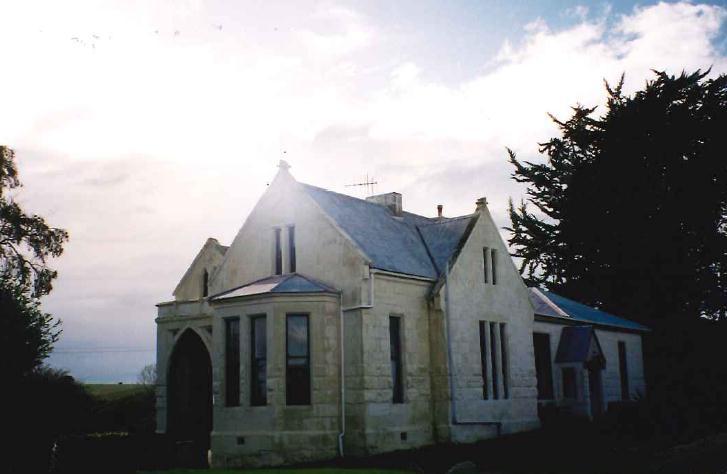
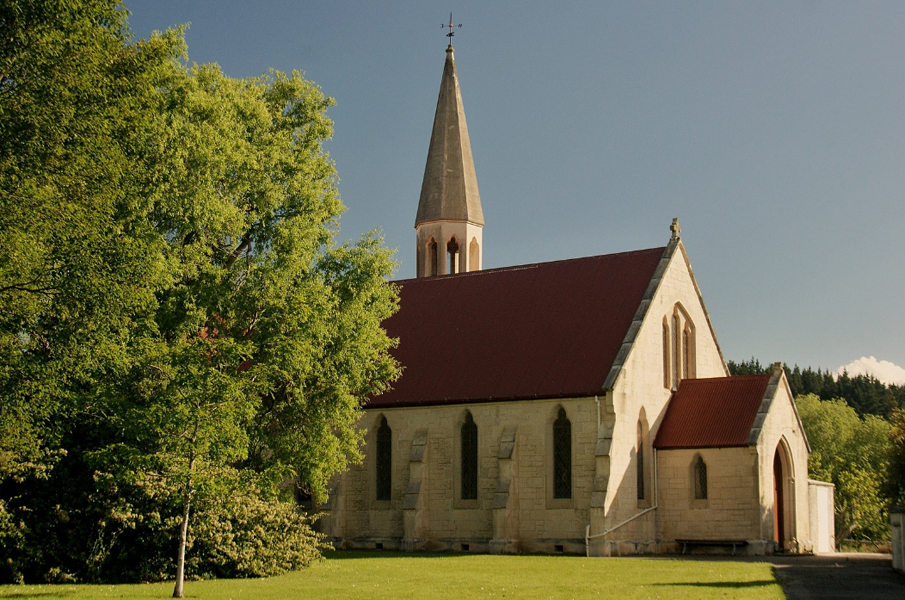
In 1865 the local Presbyterian congregation commissioned prominent Dunedin architect Robert Arthur Lawson to design a church. Completed in 1866, the church was Lawson’s first use of Ōamaru stone. Lawson was then commissioned to design the manse, his second Ōamaru stone structure. The ten acre site, close to the main north road, was donated to the congregation by Mr Anderson and by October 1866 work was underway. The contractor was Mr King from nearby Ōamaru.
By April 1867 the manse was complete. It was described as ‘exceedingly handsome, and is of a rather imposing appearance’. The one and a half storey building had a cruciform plan. The entranceway was adorned with a pointed arch porch and double panelled doors with side and fanlights. The windows on the first floor above the entrance had a trefoil form. A faceted bay window projected from the front elevation. The roof had faceted hips on the north elevation, with a transecting gable on the south elevation. The manse was also notable for its abraded stone work. The lining of the interior walls was ‘laths [sic] and plaster bound with hair from cows’ tails’. A wooden stable was likely erected soon after, as tenders were advertised in May 1867.
Reverend John Ryley became the first resident minister of the manse. The Ryleys hosted Sunday School picnics and various meetings, including the Ōamaru Presbytery and church groups such as the Ladies’ Guild. In 1883 the Ōamaru Presbytery granted £300 for an addition to the manse. A tender for timber ‘additions and alterations’ indicated that the plans could be seen as Mr Lemon’s office – presumably, then, the plans were designed by Forrester and Lemon. The plain, single-story, wooden addition was at the rear.
The manse saw a number of tragedies. Reverend George Lindsay, who ministered from 1881, lost his 4 year old son, George, at the manse in 1885. In 1896 Reverend A.D. Thomson, from Tasmania, lost his daughters - Grace, aged 5, and May, aged 4, died at the manse within half an hour of each other. By the 1930s there was still no electricity upstairs and the lining was crumbling into holes. The resident children would poke sticks through the holes ‘hoping to find a secret chamber’. The wife of the next minister, John Freeman who arrived in 1937, thought the manse was haunted and lamented the state of the bathroom. Formerly the study, it ‘boasted the luxury of a galvanised tin bath…To save 30cm of piping, the wash basin was half over the bath and made ablutions an awkward performance, while the rest of the room was vast’. In 1938 a new manse was built and the old one was sold to retired farmer Stanley Bratrum, who owned the property until his death. Since then the residence has remained a private home.
List Entry Information
Status
Listed
List Entry Status
Historic Place Category 2
Access
Private/No Public Access
List Number
5250
Date Entered
7th April 1983
Date of Effect
7th April 1983
City/District Council
Waitaki District
Region
Otago Region
Extent of List Entry
Extent includes part of the land described as Sec 1 SO 441510 and Sec 64 Blk V Otepopo SD (RT 597021), Otago Land District, and the building known as Ōtepopo Presbyterian Manse (Former) thereon.
Legal description
Sec 1 SO 441510 and Sec 64 Blk V Otepopo SD (RT 597021), Otago Land District
Status
Listed
List Entry Status
Historic Place Category 2
Access
Private/No Public Access
List Number
5250
Date Entered
7th April 1983
Date of Effect
7th April 1983
City/District Council
Waitaki District
Region
Otago Region
Extent of List Entry
Extent includes part of the land described as Sec 1 SO 441510 and Sec 64 Blk V Otepopo SD (RT 597021), Otago Land District, and the building known as Ōtepopo Presbyterian Manse (Former) thereon.
Legal description
Sec 1 SO 441510 and Sec 64 Blk V Otepopo SD (RT 597021), Otago Land District
Construction Professional
Name
Forrester & Lemon
Type
Architect
Biography
The architectural partnership of Forrester and Lemon was established in Oamaru in 1872. Thomas Forrester (1838-1907) was born in Glasgow and educated at the Glasgow School of Art. Emigrating to New Zealand in 1861 he settled in Dunedin and worked under William Mason (1810-97) and William Henry Clayton (1823-77) and later Robert Arthur Lawson (1833-1902). In 1865 he superintended the Dunedin Exhibition and from 1870 he became involved with the supervision of harbour works. Some time after 1885 he became Engineer to the Oamaru Harbour Board and in this capacity designed the repairs to the breakwater following storm damage in 1886 and later the Holmes Wharf. On his death in 1907 he was still in the employ of the Harbour Board. John Lemon (1828-1890) was born in Jamaica and travelled to England before emigrating to New Zealand in 1849. He settled in Oamaru in 1860 and with his brother Charles established a timber merchant's business. By 1869 he was in partnership with his father-in-law, George Sumpter calling themselves "Timber and General Merchants, Land and Commission Agents". This partnership was dissolved in 1872 and Lemon entered into partnership with Forrester. Lemon had no architectural experience at all, but had a wide circle of business contacts and was an efficient administrator. Buildings designed by the partnership of Forrester and Lemon include St Paul's Church (1875-76), the Harbour Board Offices (1876), Queen's (later Brydone) Hotel (1881), Waitaki Boys' High School (1883), The Courthouse (1883) and the Post Office (1883-84), all in Oamaru. Forrester and Lemon contributed greatly to Oamaru's nineteenth century character. On Lemon's death in 1890 the practice was taken over by Forrester's son, John Megget Forrester (1865-1965).
Name
Lawson, Robert Arthur
Type
Architect
Biography
Born in Scotland, Lawson (1833-1902) began his professional career in Perth. At the age of 25 he moved to Melbourne and was engaged in goldmining and journalism before resuming architectural practice. In 1862 Lawson sailed for Dunedin, where his sketch plans had won the competition for the design of First Church. This was built 1867-73. Lawson went on to become one of the most important architects in New Zealand. First Church is regarded as his masterpiece and one of the finest nineteenth century churches in New Zealand. He was also responsible for the design of the Trinity Church (now Fortune Theatre), Dunedin (1869-70), the East Taieri Presbyterian Church (1870), and Knox Church, Dunedin (1874). He designed Park's School (1864) and the ANZ Bank (originally Union Bank, 1874). In Oamaru he designed the Bank of Otago (later National Bank building, 1870) and the adjoining Bank of New South Wales (now Forrester Gallery, 1881). See also: Ledgerwood, Norman, 2013. 'R.A. Lawson: Victorian Architect of Dunedin'. Historic Cemeteries Conservation NZ.
Name
King, Mr.
Type
Stonemason
Biography
No biography is currently available for this construction professional
Name
King, Mr.
Type
Builder
Biography
No biography is currently available for this construction professional
Construction Details
Type
Addition
Description
Timber addition
Period
1880s
Construction Professional
Name
Forrester & Lemon
Type
Architect
Biography
The architectural partnership of Forrester and Lemon was established in Oamaru in 1872. Thomas Forrester (1838-1907) was born in Glasgow and educated at the Glasgow School of Art. Emigrating to New Zealand in 1861 he settled in Dunedin and worked under William Mason (1810-97) and William Henry Clayton (1823-77) and later Robert Arthur Lawson (1833-1902). In 1865 he superintended the Dunedin Exhibition and from 1870 he became involved with the supervision of harbour works. Some time after 1885 he became Engineer to the Oamaru Harbour Board and in this capacity designed the repairs to the breakwater following storm damage in 1886 and later the Holmes Wharf. On his death in 1907 he was still in the employ of the Harbour Board. John Lemon (1828-1890) was born in Jamaica and travelled to England before emigrating to New Zealand in 1849. He settled in Oamaru in 1860 and with his brother Charles established a timber merchant's business. By 1869 he was in partnership with his father-in-law, George Sumpter calling themselves "Timber and General Merchants, Land and Commission Agents". This partnership was dissolved in 1872 and Lemon entered into partnership with Forrester. Lemon had no architectural experience at all, but had a wide circle of business contacts and was an efficient administrator. Buildings designed by the partnership of Forrester and Lemon include St Paul's Church (1875-76), the Harbour Board Offices (1876), Queen's (later Brydone) Hotel (1881), Waitaki Boys' High School (1883), The Courthouse (1883) and the Post Office (1883-84), all in Oamaru. Forrester and Lemon contributed greatly to Oamaru's nineteenth century character. On Lemon's death in 1890 the practice was taken over by Forrester's son, John Megget Forrester (1865-1965).
Name
Lawson, Robert Arthur
Type
Architect
Biography
Born in Scotland, Lawson (1833-1902) began his professional career in Perth. At the age of 25 he moved to Melbourne and was engaged in goldmining and journalism before resuming architectural practice. In 1862 Lawson sailed for Dunedin, where his sketch plans had won the competition for the design of First Church. This was built 1867-73. Lawson went on to become one of the most important architects in New Zealand. First Church is regarded as his masterpiece and one of the finest nineteenth century churches in New Zealand. He was also responsible for the design of the Trinity Church (now Fortune Theatre), Dunedin (1869-70), the East Taieri Presbyterian Church (1870), and Knox Church, Dunedin (1874). He designed Park's School (1864) and the ANZ Bank (originally Union Bank, 1874). In Oamaru he designed the Bank of Otago (later National Bank building, 1870) and the adjoining Bank of New South Wales (now Forrester Gallery, 1881). See also: Ledgerwood, Norman, 2013. 'R.A. Lawson: Victorian Architect of Dunedin'. Historic Cemeteries Conservation NZ.
Name
King, Mr.
Type
Stonemason
Biography
No biography is currently available for this construction professional
Name
King, Mr.
Type
Builder
Biography
No biography is currently available for this construction professional
Construction Details
Type
Addition
Description
Timber addition
Period
1880s
Historical and Associated Iwi / Hapū / Whānau
Completion Date
4th June 2019
Report Written By
Susan Irvine and Heather Beauchop
Information Sources
McKenzie, 1988
Dorothy McKenzie, Otepopo and Herbert Township, Otago Heritage Books, Dunedin, 1988
Otepopo Presbyterian Church, 1915
Otepopo Presbyterian Church, Jubilee Souvenir 1865-1915, March 1915, Ōamaru, 1915
Other Information
This place was identified as significant under previous legislation with different information requirements. It remains significant under the current legislation. There is opportunity under our legislation and policies to add to this information. Further information about this place may be available from the Otago/Southland Office of Heritage New Zealand Pouhere Taonga. A fully referenced upgrade report is available on request from the Otago/Southland Office of Heritage New Zealand. Please note that entry on the New Zealand Heritage List/Rarangi Korero identifies only the heritage values of the property concerned, and should not be construed as advice on the state of the property, or as a comment of its soundness or safety, including in regard to earthquake risk, safety in the event of fire, or insanitary conditions.
Historical and Associated Iwi / Hapū / Whānau
Completion Date
4th June 2019
Report Written By
Susan Irvine and Heather Beauchop
Information Sources
McKenzie, 1988
Dorothy McKenzie, Otepopo and Herbert Township, Otago Heritage Books, Dunedin, 1988
Otepopo Presbyterian Church, 1915
Otepopo Presbyterian Church, Jubilee Souvenir 1865-1915, March 1915, Ōamaru, 1915
Other Information
This place was identified as significant under previous legislation with different information requirements. It remains significant under the current legislation. There is opportunity under our legislation and policies to add to this information. Further information about this place may be available from the Otago/Southland Office of Heritage New Zealand Pouhere Taonga. A fully referenced upgrade report is available on request from the Otago/Southland Office of Heritage New Zealand. Please note that entry on the New Zealand Heritage List/Rarangi Korero identifies only the heritage values of the property concerned, and should not be construed as advice on the state of the property, or as a comment of its soundness or safety, including in regard to earthquake risk, safety in the event of fire, or insanitary conditions.
Current Usages
Uses: Accommodation
Specific Usage: House
Former Usages
General Usage: Religion
Specific Usage: Vicarage/Manse/Presbytery/Rectory
Current Usages
Uses: Accommodation
Specific Usage: House
Former Usages
General Usage: Religion
Specific Usage: Vicarage/Manse/Presbytery/Rectory
Stay up to date with Heritage this month


