

Akaroa Harbour is a large, long harbour on the southern coast of Horomaka/Te Pātaka-a-Rākaihautū (Banks Peninsula). Tuhiraki (Mount Bossu) is the kō (digging stick) of the famous Waitaha explorer Rākaihautū. Akaroa was occupied by iwi such as Hāwea, Waitaha, Rapuwai, and Kāti Māmoe prior to the southern Kāi Tūhaitara migration to Canterbury. Te Ake was one of several Ngāi Tahu tūpuna (ancestors) who claimed land during this migration, placing his tokotoko at the head of the harbour. Akaroa continues to be a renowned mahinga kai (food-gathering area) for the local Kāi Tahu hapū based at the small kāika of Ōnuku which is located just to the south of Paka Ariki, Akaroa township. By the early nineteenth century, Akaroa Harbour had become a favourite port of call for whaling ships. French whaler, Jean François Langlois became involved in land transactions in the area in the late 1830s, which eventually lead to the founding of the Nanto-Bordelaise Company and ultimately, in August 1840, French (and some German) settlers from the Comte de Paris landing at Paka Ariki/Akaroa. A handful of other French settlers arrived in the decades after 1840, Henri Citron being one who arrived in Akaroa in 1870. Citron purchased the section at 58 Rue Lavaud in 1879 but initially operated his pharmacy business elsewhere in town. In 1882, he engaged one-time Canterbury Provincial architect, Thomas Cane, to design ‘a wooden 10 roomed house and offices, with concrete foundations, at the corner of Cross street and Lavaud street’.
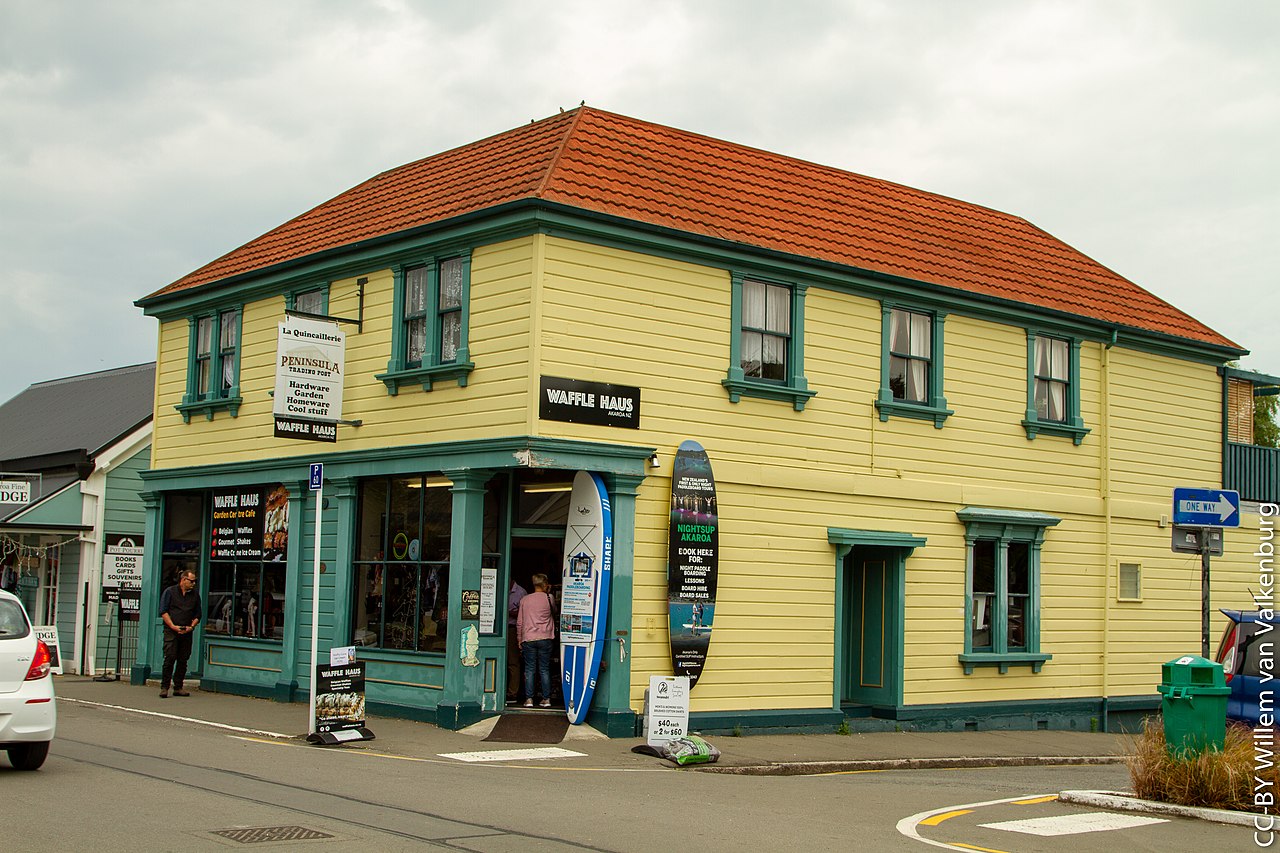
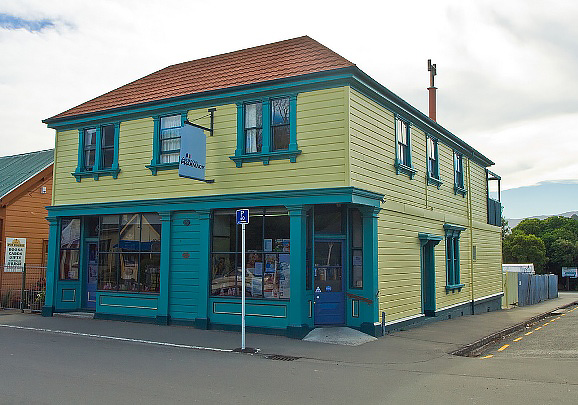
Standing in a prominent position on the corner of Akaroa’s main street, Rue Lavaud, and Rue Croix, the Akaroa Pharmacy is a two-storeyed timber-framed commercial building clad in rusticated weatherboards, with a hipped roof of Decramastic tiles that sits over earlier corrugated iron. The foundations are of concrete. The principal (east) façade, fronting Rue Lavaud, has two display windows and two recessed doorways, one parallel to the street and one on a diagonal at the corner. Windows and door frames have Italianate style decoration, with matching details in the upper floor windows.
At the start of 1888, Citron retired from business due to ill health. He sold his property that year to George Fawcit Dodds Senior who also ran a pharmacy, called ‘The Medical Hall’, on the site. The Dodds family retained ownership until 1947 and throughout this time a chemist or pharmacy operated out of the building, although not always by the Dodds. Other pharmacists have owned the building since 1947 and until well into the second decade of the twenty first century, it still functioned as a pharmacy. The Rue Croix frontage of the building has been altered, particularly by an extension west towards Rue Jolie. In 1940 the Rue Croix side of the building was damaged from a fire relating to a fatal light aircraft crash. A series of alterations, starting with a lean-to that was in place by 1940, have culminated in an extended concrete block ground floor and 1979 first floor above. When the building was repaired and strengthened in 2014 and 2015, following damaged caused by the Canterbury Earthquakes of 2010 and 2011, some of the charred timber from the 1940 fire was found. At the time of writing this report, in 2021, Jamie Stewart operates Peninsula Trading Post services, stocking a wide variety of hardware and other supplies, representing the third generation to run a business from the building after his father R.E. Stewart (Chemist) and grandfather, R.S.C. Stewart (Chemist), dating back to the 1930s. Haus Waffles also operates at the corner front of the building.
List Entry Information
Status
Listed
List Entry Status
Historic Place Category 2
Access
Private/No Public Access
List Number
5287
Date Entered
25th October 1990
Date of Effect
25th October 1990
City/District Council
Christchurch City
Region
Canterbury Region
Extent of List Entry
Extent includes part of the land described as Town Sec 87 Town of Akaroa (RT CB400/295) and road reserve, Canterbury Land District, and the building known as Akaroa Pharmacy (Former) thereon. Refer to map tabled at the Rārangi/Kōrero meeting of 29 July 2021.
Legal description
Town Sec 87 Town of Akaroa (RT CB400/295) and road reserve, Canterbury Land District
Status
Listed
List Entry Status
Historic Place Category 2
Access
Private/No Public Access
List Number
5287
Date Entered
25th October 1990
Date of Effect
25th October 1990
City/District Council
Christchurch City
Region
Canterbury Region
Extent of List Entry
Extent includes part of the land described as Town Sec 87 Town of Akaroa (RT CB400/295) and road reserve, Canterbury Land District, and the building known as Akaroa Pharmacy (Former) thereon. Refer to map tabled at the Rārangi/Kōrero meeting of 29 July 2021.
Legal description
Town Sec 87 Town of Akaroa (RT CB400/295) and road reserve, Canterbury Land District
Construction Professional
Name
Cane, Thomas Walter
Type
Architect
Biography
Thomas Cane (1830-1905) was born in Brighton, Sussex. For many years he worked for Sir Gilbert Scott, the celebrated architect of London. Cane came to Lyttelton in 1874 and succeeded Benjamin Woolfield Mountfort (1825-1898) as Provincial Architect for Canterbury. He held this position until the abolition of the provinces in 1876, making his name as a Christchurch architect. Cane was responsible for Corfe House at Christ's College and for Christchurch Girls' High School which became the School of Art, and later an extension of the University of Canterbury Library. Cane also achieved recognition as a landscape artist.
Construction Details
Start Year
1882
Finish Year
1883
Type
Original Construction
Description
Building constructed
Start Year
1940
Type
Maintenance/repairs
Description
repair to north façade following fire damage from plane crash, concrete block extension to the west
Start Year
1979
Type
Addition
Description
first floor addition above concrete block extension
Construction Professional
Name
Cane, Thomas Walter
Type
Architect
Biography
Thomas Cane (1830-1905) was born in Brighton, Sussex. For many years he worked for Sir Gilbert Scott, the celebrated architect of London. Cane came to Lyttelton in 1874 and succeeded Benjamin Woolfield Mountfort (1825-1898) as Provincial Architect for Canterbury. He held this position until the abolition of the provinces in 1876, making his name as a Christchurch architect. Cane was responsible for Corfe House at Christ's College and for Christchurch Girls' High School which became the School of Art, and later an extension of the University of Canterbury Library. Cane also achieved recognition as a landscape artist.
Construction Details
Start Year
1882
Finish Year
1883
Type
Original Construction
Description
Building constructed
Start Year
1940
Type
Maintenance/repairs
Description
repair to north façade following fire damage from plane crash, concrete block extension to the west
Start Year
1979
Type
Addition
Description
first floor addition above concrete block extension
Historical and Associated Iwi / Hapū / Whānau
Completion Date
26th May 2021
Report Written By
Robyn Burgess
Other Information
This place was identified as significant under previous legislation with different information requirements. It remains significant under the current legislation. There is opportunity under our legislation and policies to add to this information. Further information about this place may be available from the Southern Regional Office of Heritage New Zealand Pouhere Taonga. A fully referenced upgrade report is available on request from the Canterbury/West Coast Area Office of Heritage New Zealand Please note that entry on the New Zealand Heritage List/Rarangi Korero identifies only the heritage values of the property concerned, and should not be construed as advice on the state of the property, or as a comment of its soundness or safety, including in regard to earthquake risk, safety in the event of fire, or insanitary conditions.
Historical and Associated Iwi / Hapū / Whānau
Completion Date
26th May 2021
Report Written By
Robyn Burgess
Other Information
This place was identified as significant under previous legislation with different information requirements. It remains significant under the current legislation. There is opportunity under our legislation and policies to add to this information. Further information about this place may be available from the Southern Regional Office of Heritage New Zealand Pouhere Taonga. A fully referenced upgrade report is available on request from the Canterbury/West Coast Area Office of Heritage New Zealand Please note that entry on the New Zealand Heritage List/Rarangi Korero identifies only the heritage values of the property concerned, and should not be construed as advice on the state of the property, or as a comment of its soundness or safety, including in regard to earthquake risk, safety in the event of fire, or insanitary conditions.
Former Usages
General Usage: Health
Specific Usage: Pharmacy
General Usage: Trade
Specific Usage: Shop
Former Usages
General Usage: Health
Specific Usage: Pharmacy
General Usage: Trade
Specific Usage: Shop
Location
Sign up to hear more
Get the latest heritage news, features and events delivered
straight to your inbox.
