

‘Somebody’s darling lies buried here’: so says the epitaph on the headstone of one of the two ‘Lonely Graves’ at Horseshoe Bend on the Clutha/Mata-au River. The story of the miner first buried here and the man who lies beside him has captured and inspired people’s imaginations embedding the tale in popular culture, giving the site national and international appeal.
The first man buried at Horseshoe Bend was probably Charles Alms. It seems likely that his was the body Robert Harris discovered washed up at Rag Beach on the western bank of the Clutha/Mata-au River on 7 February 1865. An inquest identified the body as Charles Alms, a resident of the Nevis who drowned while crossing Clutha/Mata-au River near Clyde, on 25 January 1865. While the inquest was certain that the body was that of Alms, the decomposed state of the body meant that it could not be positively identified, and a death certificate was not issued for Alms. The body was buried in an unmarked grave at Horseshoe Bend. Miner William Rigney arranged for the grave maker inscribed ‘Somebody’s darling lies buried here’. When Rigney died in 1912, on his request he was buried next to the grave. Even before Rigney died, the other grave had captured peoples’ imaginations – and stories circulated and became part of local legend.
The Lonely Graves Historic Reserve contains the two graves, each is marked by a white marble headstone. The graves are enclosed within a painted concrete and iron rail fence. The marble headstone and enclosure around Charles Alms grave dates from 1903. It replaced an original nineteenth century timber slab or grave marker that was formed from black pine painted white, and erected at the grave by William Rigney. In 1922 the original timber grave marker was encased in a clear container and mounted on the front of the marble headstone. At some point, the original marker disappeared from the grave and reappeared in Wellington. The marker was returned on 5 September 2002 in an official ceremony.
In 2014, the Lonely Graves remain a poignant reminder of life, death and the power of stories.
The first man buried at Horseshoe Bend was probably Charles Alms. It seems likely that his was the body Robert Harris discovered washed up at Rag Beach on the western bank of the Clutha/Mata-au River on 7 February 1865. An inquest identified the body as Charles Alms, a resident of the Nevis who drowned while crossing Clutha/Mata-au River near Clyde, on 25 January 1865. While the inquest was certain that the body was that of Alms, the decomposed state of the body meant that it could not be positively identified, and a death certificate was not issued for Alms. The body was buried in an unmarked grave at Horseshoe Bend. Miner William Rigney arranged for the grave maker inscribed ‘Somebody’s darling lies buried here’. When Rigney died in 1912, on his request he was buried next to the grave. Even before Rigney died, the other grave had captured peoples’ imaginations – and stories circulated and became part of local legend.
The Lonely Graves Historic Reserve contains the two graves, each is marked by a white marble headstone. The graves are enclosed within a painted concrete and iron rail fence. The marble headstone and enclosure around Charles Alms grave dates from 1903. It replaced an original nineteenth century timber slab or grave marker that was formed from black pine painted white, and erected at the grave by William Rigney. In 1922 the original timber grave marker was encased in a clear container and mounted on the front of the marble headstone. At some point, the original marker disappeared from the grave and reappeared in Wellington. The marker was returned on 5 September 2002 in an official ceremony.
In 2014, the Lonely Graves remain a poignant reminder of life, death and the power of stories.
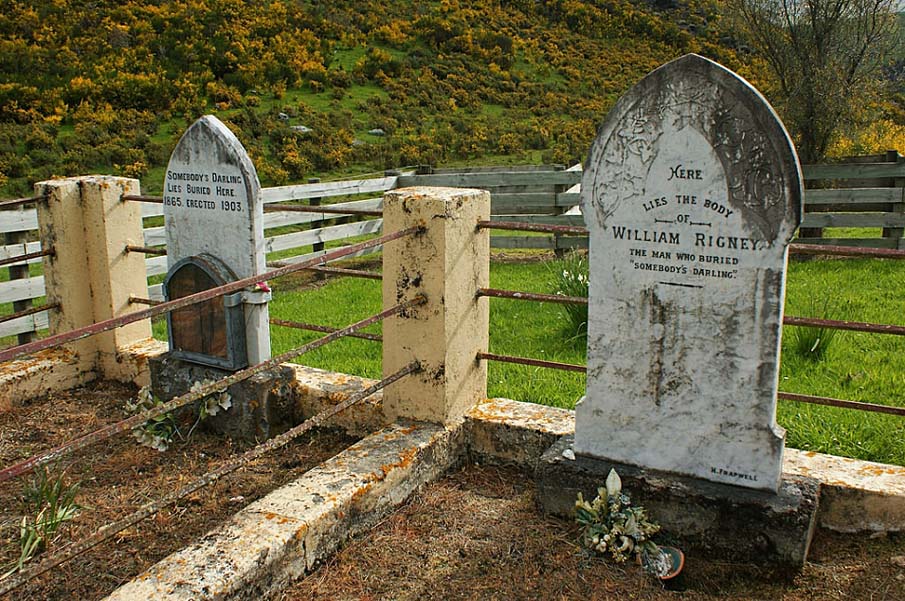
Lonely Graves, Millers Flat-Beaumont Road, Horseshoe Bend, Central Otago | PhilBee NZ - Phil Braithwaite | 28/10/2015 | Phil Braithwaite
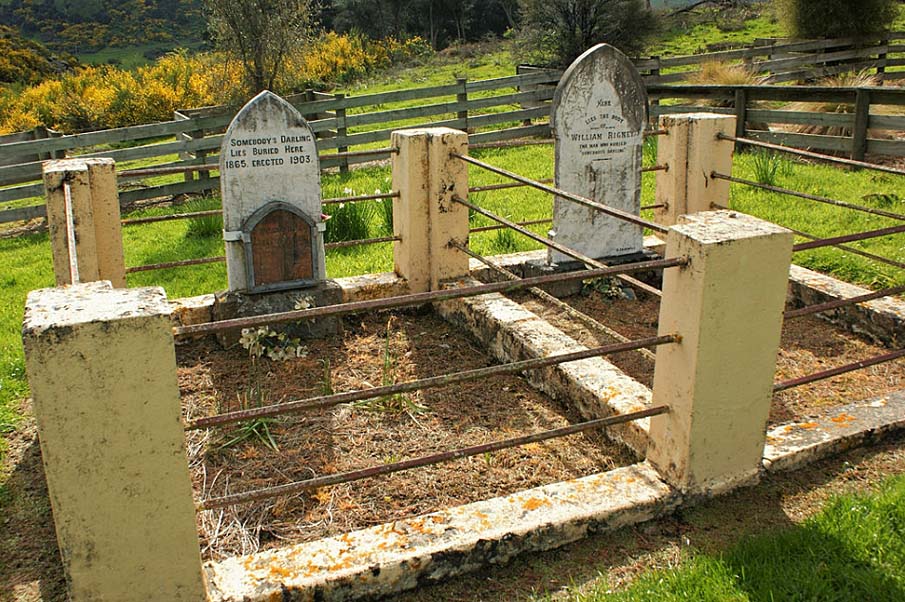
Lonely Graves, Millers Flat-Beaumont Road, Horseshoe Bend, Central Otago | PhilBee NZ - Phil Braithwaite | 28/10/2015 | Phil Braithwaite
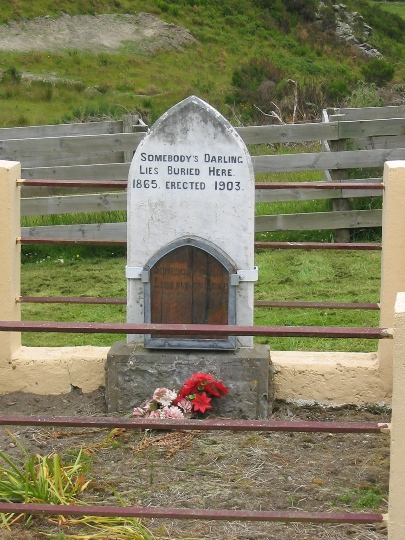
Lonely Graves, Millers Flat-Beaumont Road, Horseshoe Bend, Central Otago | 08/01/2007 | Department of Conservation
Lonely Graves, Millers Flat-Beaumont Road, Horseshoe Bend, Central Otago | PhilBee NZ - Phil Braithwaite | 28/10/2015 | Phil Braithwaite
Lonely Graves, Millers Flat-Beaumont Road, Horseshoe Bend, Central Otago | PhilBee NZ - Phil Braithwaite | 28/10/2015 | Phil Braithwaite
Lonely Graves, Millers Flat-Beaumont Road, Horseshoe Bend, Central Otago | 08/01/2007 | Department of Conservation
