

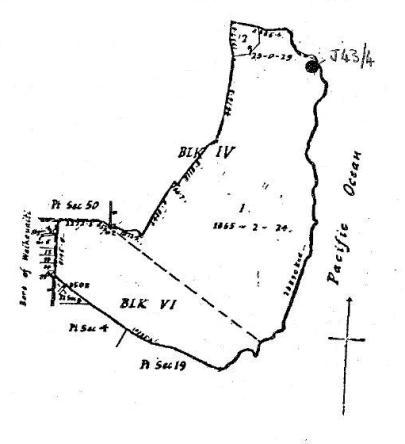
The site is located on the southern side of the Pleasant River estuary near the locality of Tumai in east Otago, opposite the better-known site of Pleasant River Mouth (New Zealand Archaeological Association Site Record No's J43/1 and J43/25) to the north. It is positioned at the mouth of a small coastal gully overlooking the sea, and a rocky boulder beach fronts the site. Tumai [ditto] has eroded considerably since its initial discovery by archaeologists in the early 1960s, but archaeological deposits are still visible today.
An archaeological excavation of Tumai in 1976 revealed that it was a small settlement, and was likely to have been intermittently occupied by Māori. Radiocarbon dates from the site have proven unreliable, but the archaeological assemblage may indicate a later occupation (c 14th - 15th centuries A.D). Fish bone appears extensively within the excavated assemblage, whilst moa and seal remains are only represented in lower numbers. Shells from both the rocky seashore and estuarine environments are present, including Cooks turban, mussels, mud snails and pipi. Artefacts recovered from the site include stone flakes (obsidian, schist, chalcedony, nephrite and silcrete) and fishhooks, which support the interpretation of Tumai as a locale for fishing activities.
List Entry Information
Status
Listed
List Entry Status
Historic Place Category 2
Access
Private/No Public Access
List Number
5701
Date Entered
11th March 1985
Date of Effect
11th March 1985
City/District Council
Dunedin City
Region
Otago Region
Extent of List Entry
The registration includes Lot 1 DP 8602, Otago Land District (comprised in RT OT398/220) and archaeological site J43/4 as shown on the extent of registration map in Appendix 4 of the Upgrade Report of 12 March 2007.
Legal description
Lot 1 DP 8602 (RT OT398/220), Otago Land District
Location Description
South side of Pleasant River Mouth [access via Tumai Station Road].
Status
Listed
List Entry Status
Historic Place Category 2
Access
Private/No Public Access
List Number
5701
Date Entered
11th March 1985
Date of Effect
11th March 1985
City/District Council
Dunedin City
Region
Otago Region
Extent of List Entry
The registration includes Lot 1 DP 8602, Otago Land District (comprised in RT OT398/220) and archaeological site J43/4 as shown on the extent of registration map in Appendix 4 of the Upgrade Report of 12 March 2007.
Legal description
Lot 1 DP 8602 (RT OT398/220), Otago Land District
Location Description
South side of Pleasant River Mouth [access via Tumai Station Road].
Why is this place significant?
Cultural Significance
Cultural and Traditional Significance or Value Tumai is of significance to Kati Huirapi ki Puketerangi (a runaka of Kai Tahu) who exercise manawhenua of the area south of the Shag (Waihemo) River. It is one of many archaeological sites that reflect the ancestral Maori occupation of this landscape.
Historic Significance
Historical Significance or Value This place was assessed for its archaeological, cultural and traditional significance or value
Physical Significance
Archaeological Significance or Value Archaeological investigation of Tumai has assisted in our understanding of the nature of early Maori settlement in southern New Zealand, particularly within the east Otago region. It reflects the mobility of early Maori between specialised sites like Tumai, where fishing played a dominant role, to more permanent villages such as the nearby site of Shag River Mouth.
Why is this place Category 1 / Category 2?
Detail Of Assessed Criteria
This place was assigned a Category II status having regard to the following criteria: a, c, d, i, k (a) The extent to which the place reflects important or representative aspects of New Zealand history: Tumai reflects an important period in New Zealand history - the early Maori settlement of southern New Zealand and the discovery and utilisation of New Zealand's resources, such as moa, seal and a range of stone sources for tool production. (c) The potential of the place to provide knowledge of New Zealand history: Archaeological investigation of Tumai has contributed to our knowledge of early Maori occupation in southern New Zealand, particularly in relation to settlement patterns. Additional research such as the extraction of new samples for radiocarbon dating may further assist in our understanding of this site, and the nature of early Maori settlement within the east Otago region. (d) The importance of the place to tangata whenua: Tumai is of cultural, traditional and spiritual significance to Kai Tahu, in particular Kati Huirapa ki Puketeraki, as it provides a tangible link between the past and present. Tumai [ditto] is just one of many recorded archaeological sites in east Otago that demonstrates the importance of this landscape to early Maori. (i) The importance of the identifying historic places known to date from early periods of New Zealand settlement: Archaeological evidence such as the presence of moa bone indicates that Tumai was occupied during the Archaic phase of New Zealand's initial settlement, but additional radiocarbon dating is required to more accurately ascertain the approximate date of the site. (k) The extent to which the place forms part of a wider historical and cultural complex or historical and cultural landscape: Tumai is one of ten archaeological sites recorded in the immediate vicinity of the Pleasant River estuary, and forms part of a much wider archaeological and cultural landscape reflecting early Maori settlement in east Otago. This landscape incorporates sites such as Pleasant River Mouth on the north side of the estuary, Shag River Mouth and the Waitaki River Mouth to the north, and Warrington and Papatowai to the south. In summary Tumai has been assigned Category II status on the basis of its archaeological, cultural and traditional significance. Tumai has significance as part of the archaeological landscape of early Maori occupation in southern New Zealand, and is of cultural and traditional value to Kati Huirapa ki Puketeraki.
Why is this place significant?
Cultural Significance
Cultural and Traditional Significance or Value Tumai is of significance to Kati Huirapi ki Puketerangi (a runaka of Kai Tahu) who exercise manawhenua of the area south of the Shag (Waihemo) River. It is one of many archaeological sites that reflect the ancestral Maori occupation of this landscape.
Historic Significance
Historical Significance or Value This place was assessed for its archaeological, cultural and traditional significance or value
Physical Significance
Archaeological Significance or Value Archaeological investigation of Tumai has assisted in our understanding of the nature of early Maori settlement in southern New Zealand, particularly within the east Otago region. It reflects the mobility of early Maori between specialised sites like Tumai, where fishing played a dominant role, to more permanent villages such as the nearby site of Shag River Mouth.
Why is this place Category 1 / Category 2?
Detail Of Assessed Criteria
This place was assigned a Category II status having regard to the following criteria: a, c, d, i, k (a) The extent to which the place reflects important or representative aspects of New Zealand history: Tumai reflects an important period in New Zealand history - the early Maori settlement of southern New Zealand and the discovery and utilisation of New Zealand's resources, such as moa, seal and a range of stone sources for tool production. (c) The potential of the place to provide knowledge of New Zealand history: Archaeological investigation of Tumai has contributed to our knowledge of early Maori occupation in southern New Zealand, particularly in relation to settlement patterns. Additional research such as the extraction of new samples for radiocarbon dating may further assist in our understanding of this site, and the nature of early Maori settlement within the east Otago region. (d) The importance of the place to tangata whenua: Tumai is of cultural, traditional and spiritual significance to Kai Tahu, in particular Kati Huirapa ki Puketeraki, as it provides a tangible link between the past and present. Tumai [ditto] is just one of many recorded archaeological sites in east Otago that demonstrates the importance of this landscape to early Maori. (i) The importance of the identifying historic places known to date from early periods of New Zealand settlement: Archaeological evidence such as the presence of moa bone indicates that Tumai was occupied during the Archaic phase of New Zealand's initial settlement, but additional radiocarbon dating is required to more accurately ascertain the approximate date of the site. (k) The extent to which the place forms part of a wider historical and cultural complex or historical and cultural landscape: Tumai is one of ten archaeological sites recorded in the immediate vicinity of the Pleasant River estuary, and forms part of a much wider archaeological and cultural landscape reflecting early Maori settlement in east Otago. This landscape incorporates sites such as Pleasant River Mouth on the north side of the estuary, Shag River Mouth and the Waitaki River Mouth to the north, and Warrington and Papatowai to the south. In summary Tumai has been assigned Category II status on the basis of its archaeological, cultural and traditional significance. Tumai has significance as part of the archaeological landscape of early Maori occupation in southern New Zealand, and is of cultural and traditional value to Kati Huirapa ki Puketeraki.
Historical and Associated Iwi / Hapū / Whānau
Public NZAA Number
J43/4
Completion Date
12th March 2007
Report Written By
Joanna Wylie
Information Sources
Allingham, 1977
Brian Allingham, 'Archaeological Investigations Exercised at the Mouth of the Pleasant River, North Otago from 20/11/76 to 28/12/76'. Preliminary Report to the NZ Historic Places Trust, 1977.
Smith, 1985
Alan Smith, 'Sea Mammal Hunting and Prehistoric Subsistence in New Zealand', Unpublished PhD Thesis, Anthropology, University of Otago, 1985.
Other Information
This place was identified as significant under previous legislation with different information requirements. It remains significant under the current legislation. There is opportunity under our legislation and policies to add to this information. Further information about this place may be available from the Otago/Southland Office of Heritage New Zealand Pouhere Taonga. A fully referenced upgrade report (12 March 2007) is available from the National Office of the NZHPT. Please note that entry on the New Zealand Heritage List/Rarangi Korero identifies only the heritage values of the property concerned, and should not be construed as advice on the state of the property, or as a comment of its soundness or safety, including in regard to earthquake risk, safety in the event of fire, or insanitary conditions.
Historical and Associated Iwi / Hapū / Whānau
Public NZAA Number
J43/4
Completion Date
12th March 2007
Report Written By
Joanna Wylie
Information Sources
Allingham, 1977
Brian Allingham, 'Archaeological Investigations Exercised at the Mouth of the Pleasant River, North Otago from 20/11/76 to 28/12/76'. Preliminary Report to the NZ Historic Places Trust, 1977.
Smith, 1985
Alan Smith, 'Sea Mammal Hunting and Prehistoric Subsistence in New Zealand', Unpublished PhD Thesis, Anthropology, University of Otago, 1985.
Other Information
This place was identified as significant under previous legislation with different information requirements. It remains significant under the current legislation. There is opportunity under our legislation and policies to add to this information. Further information about this place may be available from the Otago/Southland Office of Heritage New Zealand Pouhere Taonga. A fully referenced upgrade report (12 March 2007) is available from the National Office of the NZHPT. Please note that entry on the New Zealand Heritage List/Rarangi Korero identifies only the heritage values of the property concerned, and should not be construed as advice on the state of the property, or as a comment of its soundness or safety, including in regard to earthquake risk, safety in the event of fire, or insanitary conditions.
Current Usages
Uses: Agriculture
Specific Usage: Farm
Former Usages
General Usage: Maori
Specific Usage: Midden
Themes
Of Significance to Maori
Current Usages
Uses: Agriculture
Specific Usage: Farm
Former Usages
General Usage: Maori
Specific Usage: Midden
Themes
Of Significance to Maori
