

Prior to European arrival, successive iwi and hapu groups occupied Horotiu, present-day Queen Street gully. To the south of the property was Te Iringaorauru, the site of an incident regarded as a possible contributory cause of Ngati Whatua’s later conquest of the Auckland isthmus. Following establishment of the colonial capital and Karangahape Road in the 1840s, portions of allotments 13 and 14 were bought by building contractor Allan McGuire in 1879. In May 1908, Auckland Charles Plummer (1869-1944) purchased the property promoted as one of the finest positions in the city for a merchant’s residence. Charles was the son of an early Nonconformist settler who took up land at Albertland before founding Auckland’s only straw hat manufacturing business in 1876.
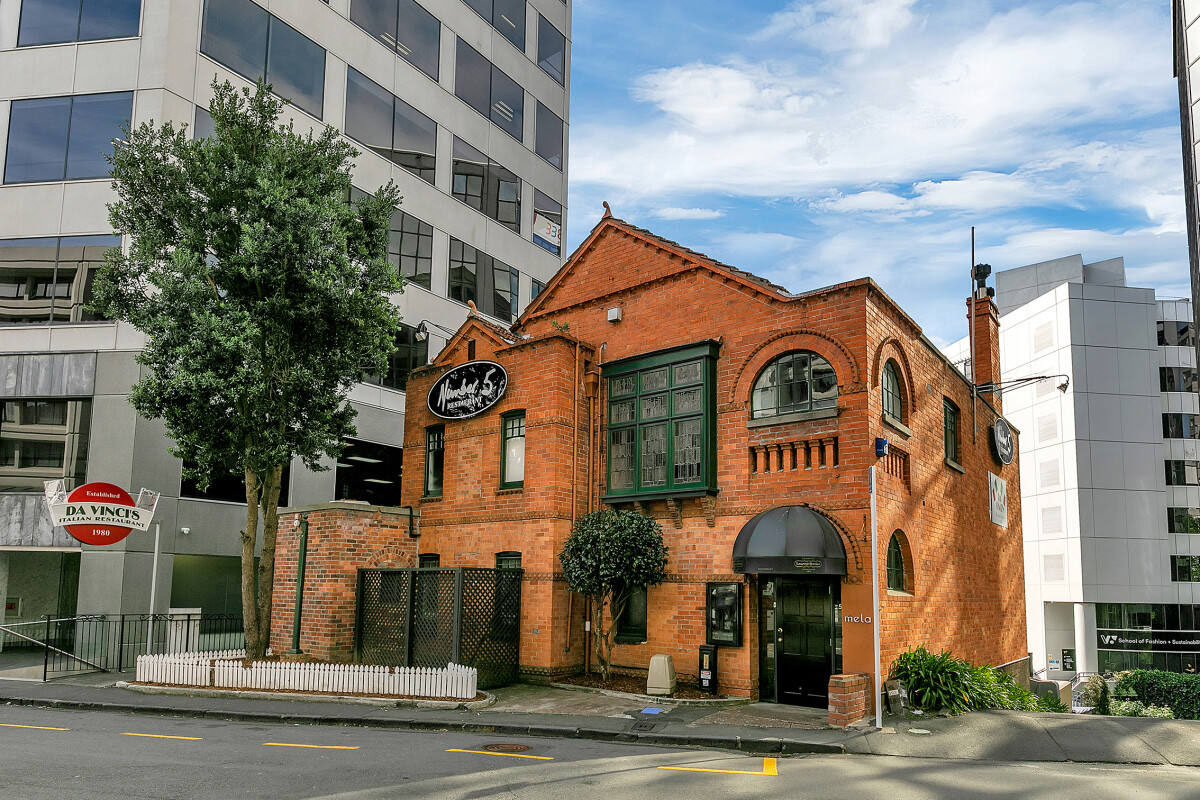
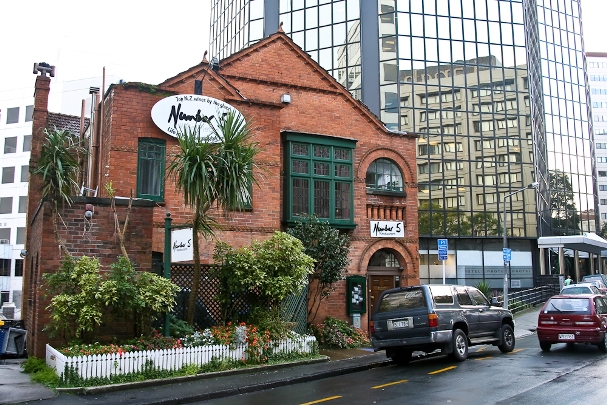
The two-storey brick house with basement and Marseille-tile roof was constructed in 1908-9 by Auckland building contractor William Ernest Trevarthen, to a design by John Currie (c.1849-1921) a noted Auckland architect responsible for a number of significant mercantile warehouses in the city. The dwelling reflected Arts and Crafts influences favoured by many well-to-do New Zealanders of the Edwardian era. The recessed porch opened into a sizable reception hall off which were north-facing rooms (drawing, and dining); and a cloakroom leading to a kitchen with separate scullery and store. Upstairs were five bedrooms.
The Plummers were active in local social and cultural circles. Charles was president of the Auckland Choral Society and Chairman of the Operatic Society. Clara (1873-1943) the eldest daughter of former Auckland Mayor and Member of the House of Representatives William Crowther (1834-1900) was president of the Auckland Grammar School Old Girls Association. The Plummer Hat Company incorporated in 1919, produced Ladies’ millinery exclusively for Macky, Logan, Caldwell (MLC) one of New Zealand’s largest manufacturing and wholesaling companies. Although the Rutland Street factory employing 70 burnt down in 1930, the venture survived MLC’s collapse in the Great Depression.
Dentist George Burtenshaw bought in 1944, converting the house into three flats. The arches of the upper porch were glazed, and arcading designed by Auckland architect Robert Young added to the west elevation. The house became professional consulting rooms soon after, with an increasingly broad range of commercial tenants in the 1960s and 1970s preceding conversion of the lower two floors to restaurant use in 1977. The first floor became what is said to have been New Zealand’s only photographic dealer gallery. The property was incorporated into an extensive commercial office tower development in 1986-7. A unit title was issued for the former Plummer House which by then included a single-storey extension to the rear.
List Entry Information
Status
Listed
List Entry Status
Historic Place Category 2
Access
Private/No Public Access
List Number
621
Date Entered
26th November 1981
Date of Effect
26th November 1981
City/District Council
Auckland Council
Region
Auckland Council
Extent of List Entry
Extent includes part of the land described as Lot 2 DP 200351 (RT NA130D/507), Unit AB DP 202325 (RT 282328), North Auckland Land District, and the building known as Plummer House (Former) thereon. Refer to the extent map tabled at the Heritage New Zealand Board meeting on 25 June 2015.
Legal description
Lot 2 DP 200351 (RT NA130D/507), Unit AB DP 202325 (RT 282328), North Auckland Land District
Status
Listed
List Entry Status
Historic Place Category 2
Access
Private/No Public Access
List Number
621
Date Entered
26th November 1981
Date of Effect
26th November 1981
City/District Council
Auckland Council
Region
Auckland Council
Extent of List Entry
Extent includes part of the land described as Lot 2 DP 200351 (RT NA130D/507), Unit AB DP 202325 (RT 282328), North Auckland Land District, and the building known as Plummer House (Former) thereon. Refer to the extent map tabled at the Heritage New Zealand Board meeting on 25 June 2015.
Legal description
Lot 2 DP 200351 (RT NA130D/507), Unit AB DP 202325 (RT 282328), North Auckland Land District
Construction Professional
Name
Currie, John
Type
Architect
Biography
John Currie (c.1859-1921) was born in Ireland. He immigrated to New Zealand in 1874 and practised architecture in Auckland on his own account. In 1879 the firm of L.D. Nathan became a major client. Accordingly much of Currie's work was in the designing of commercial and warehouse buildings. Few of these survive with the exception of L.D. Nathan & Co. Bond Store (now Archilles House, 1902) and P. Hayman's Warehouse (now Sofrana House, 1899-1900). Currie also designed buildings for Moss Davis, the Auckland brewer. The two best known works from this association were the Rob Roy Tavern, Freeman's Bay (1884), and the restoration of the interior of the Grand Hotel in Princes Street after fire in 1901. The latter building was designed by H.D. Skinner in 1879, although is sometimes erroneously attributed to Currie. In addition to hotels and commercial work, Currie also undertook residential commissions. The best known of these is "Wickford" in Princes Street. Originally the home of Mr N.A. Nathan, it now accommodates the Registry Office of the University of Auckland. Currie was one of the original members of the New Zealand Institute of Architects formed in 1905. Currie died in Ponsonby in 1921 aged 70.
Name
William Ernest Trevarthen
Type
Builder
Biography
No biography is currently available for this construction professional
Construction Details
Start Year
1944
Type
Modification
Description
Conversion into three separate units
Start Year
1945
Type
Addition
Description
Arcade (first floor); garage
Type
Modification
Description
Professional rooms; and later commercial offices
Period
1950s
Start Year
1977
Type
Modification
Description
Conversion to restaurant.
Type
Modification
Description
Arcade enclosed; two front windows bricked in
Period
Unknown
Type
Modification
Description
Site amalgamation; garage demolished; Office tower constructed.
Period
1986-7
Start Year
1987
Type
Addition
Description
Café / Dining (single-storey, north elevation).
Construction Professional
Name
Currie, John
Type
Architect
Biography
John Currie (c.1859-1921) was born in Ireland. He immigrated to New Zealand in 1874 and practised architecture in Auckland on his own account. In 1879 the firm of L.D. Nathan became a major client. Accordingly much of Currie's work was in the designing of commercial and warehouse buildings. Few of these survive with the exception of L.D. Nathan & Co. Bond Store (now Archilles House, 1902) and P. Hayman's Warehouse (now Sofrana House, 1899-1900). Currie also designed buildings for Moss Davis, the Auckland brewer. The two best known works from this association were the Rob Roy Tavern, Freeman's Bay (1884), and the restoration of the interior of the Grand Hotel in Princes Street after fire in 1901. The latter building was designed by H.D. Skinner in 1879, although is sometimes erroneously attributed to Currie. In addition to hotels and commercial work, Currie also undertook residential commissions. The best known of these is "Wickford" in Princes Street. Originally the home of Mr N.A. Nathan, it now accommodates the Registry Office of the University of Auckland. Currie was one of the original members of the New Zealand Institute of Architects formed in 1905. Currie died in Ponsonby in 1921 aged 70.
Name
William Ernest Trevarthen
Type
Builder
Biography
No biography is currently available for this construction professional
Construction Details
Start Year
1944
Type
Modification
Description
Conversion into three separate units
Start Year
1945
Type
Addition
Description
Arcade (first floor); garage
Type
Modification
Description
Professional rooms; and later commercial offices
Period
1950s
Start Year
1977
Type
Modification
Description
Conversion to restaurant.
Type
Modification
Description
Arcade enclosed; two front windows bricked in
Period
Unknown
Type
Modification
Description
Site amalgamation; garage demolished; Office tower constructed.
Period
1986-7
Start Year
1987
Type
Addition
Description
Café / Dining (single-storey, north elevation).
Historical and Associated Iwi / Hapū / Whānau
Completion Date
1st May 2015
Report Written By
Joan McKenzie
Other Information
This place was identified as significant under previous legislation with different information requirements. It remains significant under the current legislation. There is opportunity under our legislation and policies to add to this information. Further information about this place may be available from the Northern Regional Office of Heritage New Zealand Pouhere Taonga. Please note that entry on the New Zealand Heritage List/Rarangi Korero identifies only the heritage values of the property concerned, and should not be construed as advice on the state of the property, or as a comment of its soundness or safety, including in regard to earthquake risk, safety in the event of fire, or insanitary conditions. A fully referenced upgrade report is available on request from the Northern Region Office of Heritage New Zealand
Historical and Associated Iwi / Hapū / Whānau
Completion Date
1st May 2015
Report Written By
Joan McKenzie
Other Information
This place was identified as significant under previous legislation with different information requirements. It remains significant under the current legislation. There is opportunity under our legislation and policies to add to this information. Further information about this place may be available from the Northern Regional Office of Heritage New Zealand Pouhere Taonga. Please note that entry on the New Zealand Heritage List/Rarangi Korero identifies only the heritage values of the property concerned, and should not be construed as advice on the state of the property, or as a comment of its soundness or safety, including in regard to earthquake risk, safety in the event of fire, or insanitary conditions. A fully referenced upgrade report is available on request from the Northern Region Office of Heritage New Zealand
Current Usages
Uses: Trade
Specific Usage: Restaurant/cafe/tearoom
Former Usages
General Usage: Accommodation
Specific Usage: Complex of flats
General Usage: Accommodation
Specific Usage: House
General Usage: Trade
Specific Usage: Office building/Offices
General Usage: Trade
Specific Usage: Retail & Wholesale - other
Web Links
description:
Current Usages
Uses: Trade
Specific Usage: Restaurant/cafe/tearoom
Former Usages
General Usage: Accommodation
Specific Usage: Complex of flats
General Usage: Accommodation
Specific Usage: House
General Usage: Trade
Specific Usage: Office building/Offices
General Usage: Trade
Specific Usage: Retail & Wholesale - other
Web Links
description:
Location
Sign up to hear more
Get the latest heritage news, features and events delivered
straight to your inbox.
