Early history of the site:
The site lies near a number of places associated with Maori activity along the shoreline of the Waitemata Harbour. To the north and northeast of the site were Kotakerehaea (St Mary’s Bay), Te Onemaru a Huatau (Shelly Beach) and a pa at Okaa / Te Koraenga (Point Erin). The latter overlooked a reef, Te Routu o Ureia (Wahi Tapu, Register no. 7773). To the east of the site, a large pa known as Te To was held by Te Waiohua in the early eighteenth century. Following the conquest of the area by Te Taou hapu of Ngati Whatua, the pa was associated with the rangatira Waitaheke.
After the foundation of Auckland as a colonial settlement, the site formed part of Allotment 13 Section 8 Suburbs of Auckland, which was issued as a Crown grant in 1844 to Alexander Kennedy, manager of the New Zealand Banking Company. The allotment passed through several hands before being broken up by J. G. Brooke in 1862 as part of the Dedwood subdivision - one of the earliest major suburban developments in western Ponsonby. One section, Lot 7, was purchased by William Douglas Carruthers as part of a larger holding fronting Jervois Road. The following year, James Howden bought an adjoining section, Lot 6, on the corner of Jervois Road and Seymour Street, which was onsold in 1865 to Mary Henderson.
In December 1874, this corner lot was purchased for the construction of a chapel and Sunday School by six men of Baptist faith, later collectively known as the church trustees. These individuals held occupations that were primarily linked with commercial or artisan activities, and comprised George William Owen (merchant), John William James (builder), Charles Gaze (saddler), John Bigelow (shipbuilder), Samuel Carey Brown (accountant) and John Edmiston (bondkeeper). In the mid-1870s, there were said to be ‘many persons in Ponsonby who hold the views of John Foster and Robert Hall’. Foster and Hall were prominent late eighteenth- and early nineteenth-century English Baptists who popularised ideas connected with social reform, including anti-slavery and child education.
Baptists were represented among Auckland’s first European settlers, attracted particularly by opportunities in the building trade. Believers initially attended services held by other denominations, but by 1858 had erected a small chapel at the corner of Wellesley Street and Chapel (now Federal) Street, a building which was soon enlarged. Daughter establishments from the Wellesley Street church were created in ensuing years, including that at Ponsonby as well as others at Mt Eden (1864), Thames (1868) and Cambridge (1876). This expansion was overseen by the Reverend Philip Henry Cornford (1818-1901), who was pastor of the Wellesley Street church between 1862 and 1876 when membership more than doubled. Cornford had earlier worked among newly emancipated slaves in Jamaica, reflecting the involvement of many British Baptists in campaigns against the slave trade and slavery.
Construction of Ponsonby Baptist Chapel (1875):
Tenders for the construction of a new chapel at Ponsonby were solicited by mid-January 1875 and the building was said to be rapidly approaching completion a few weeks later. It opened as a Sunday School in mid-March, and for divine service a week later. The first services were held by the Reverend Cornford and by the Reverend Alexander Reid. The cost of the chapel, including its land and fittings, was £285. The architect and builder are unknown although one of the trustees, John William James, later erected St Stephen’s Presbyterian Church, Ponsonby (1879) and the Anglican Church of the Holy Sepulchre in Khyber Pass Road (1881). Another church trustee, G. W. Owen, is said to have been one of the first residents in the Shelly Beach Road area, and later became a chairman of the Auckland Harbour Board and a life deacon of the church.
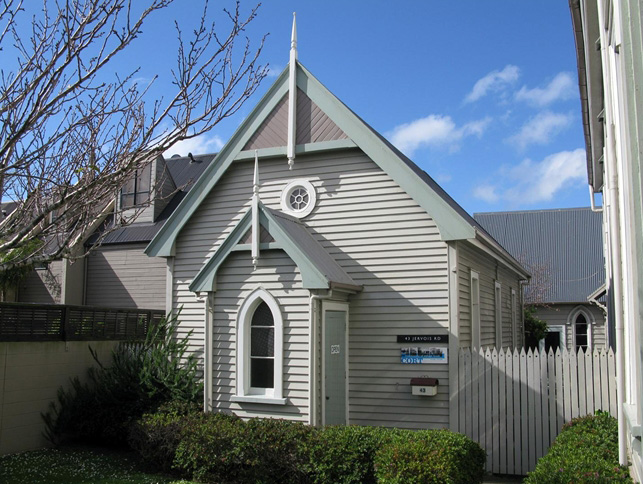
The new building occupied a ‘lofty and pleasant location’ at the junction between Jervois Road and Seymour Street. Described as a ‘neat little chapel’ at the time of its opening, it consisted of a small timber structure with a gabled roof. Like the Wellesley Street church and another early Baptist chapel at Minniesdale (1867), it incorporated Gothic elements in its design. The building was intended from the outset to be used for Sunday services, a Sunday School and probably also a weekday prayer meeting. Services were initially conducted by lay-men. The building was also used for community gatherings, such as ratepayers’ meetings for the Ponsonby Highway District in 1875 and 1876. Alterations in 1876 may have included lining the interior.
In 1880, the congregation formally separated from its mother church in Wellesley Street and a pastor, Richard Jones, was engaged. Two years later, the Ponsonby church strongly supported initiatives for strengthening the Baptist denomination nationally, becoming one of the foundation churches of the Baptist Union of New Zealand. The church pastor between 1881 and 1885, Charles Carter, was the inaugural president of the Union and has been described as ‘one of the intellectual giants of [the Baptist] ministry’.
Between 1881 and 1886, the number of Baptists recorded in the national census increased by 25 per cent (to 14,357). Locally, Ponsonby’s population of 1,640 in 1874 had more than doubled by 1881 and was to double again by 1886. By 1882, three rooms had been added to the building for the use of older Sunday School scholars. In 1885, a combination of large attendances at Sunday evening services and poor ventilation also led the church to hire the nearby Ponsonby Hall for evening services, and later in the year for morning services as well.
Construction of Ponsonby Baptist Church (1886):
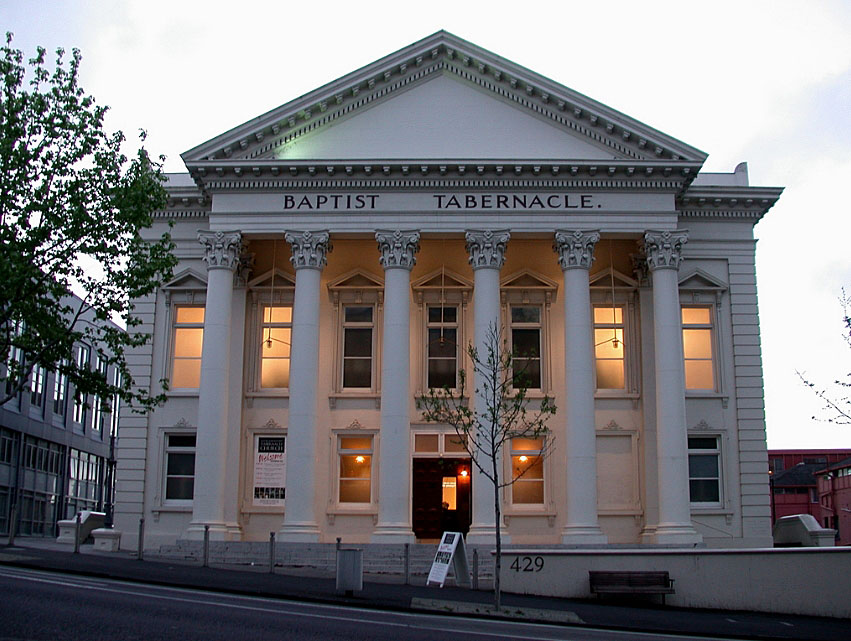
In February 1885, the trustees purchased adjoining Lot 7, enabling the construction of a larger church. The initial chapel was moved to the rear of the site for continued use as a Sunday School. A foundation stone for the new church was laid by Dr T. B. Kenderdine, a philanthropist and the first president of the Auckland Medical Association, at a ceremony conducted on 19 January 1886 in front of up to 300 people. Dr Kenderdine had previously laid the foundation stone for the Baptist Tabernacle (1885) in Queen Street, which superseded the Wellesley Street church as the main place of Baptist worship in Auckland. These works formed part of a period of Baptist construction in the broader region which also saw chapels erected at Otahuhu (1879), Mt Eden (1880) and Cambridge (1883).
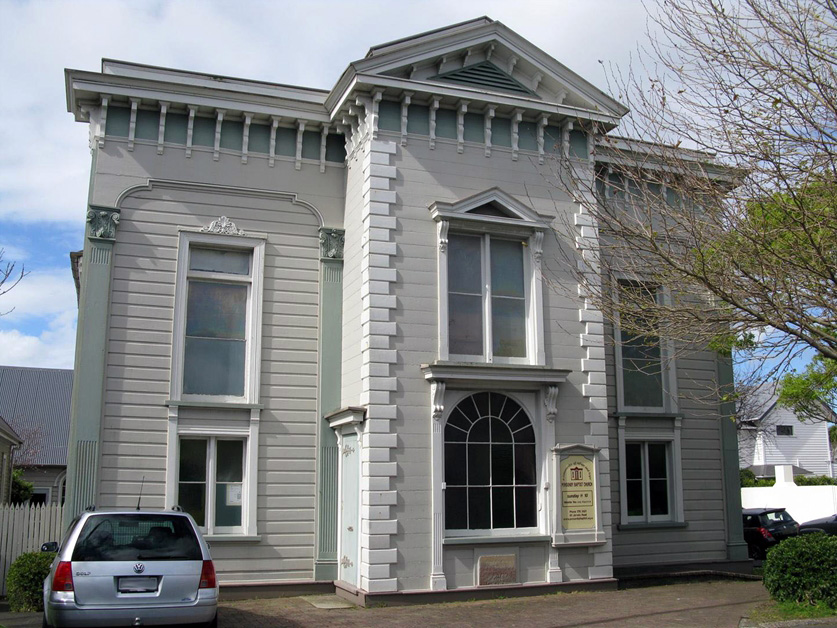
The new Ponsonby church consisted of a large timber building which combined aspects of classical architecture with Italianate design. The architect was Edmund Bell (1841-1917), who was also responsible for the Auckland Tabernacle, the design of which similarly rejected the use of Gothic Revival style. Bell was one of the deacons of the Tabernacle, and subsequently became a president of the Auckland Institute of Architects. The Ponsonby church was completed by contractor W. Hutchison and Sons within the prescribed four-month period at a final cost of £870. It opened on 16 May 1886 with a service conducted by Thomas Spurgeon, pastor of the Auckland Tabernacle. Spurgeon was a son of the celebrated English Baptist preacher C.H. Spurgeon, who strongly favoured neoclassical over Gothic architecture for Baptist church design. In mid-to-late nineteenth-century Britain, there was a move away from Gothic in some nonconformist places of worship, perhaps as divisions between religious denominations hardened.
The building’s design was also influenced by other precepts of nonconformist chapel architecture. These included the belief that a large congregation should be accommodated as cheaply as possible, and that everyone should be able to see and hear the preacher (the sermon being the most important part of the service). Major external ‘architectural’ treatment was consequently restricted to the front elevation, which in this instance included a classical triangular pediment, applied Corinthian pilasters and a projecting central porch that extended to the full height of the building. Internally, a sloping floor in the large auditorium ensured a better view of the rostrum - which was itself raised - and provision was made for a future gallery. Smaller spaces behind the rostrum at the rear of the building comprised two vestries and a pastor’s room. The presence of subsidiary facilities - as represented by these spaces - has also been seen as an essential feature of nonconformist design. Similarly, subsidiary facilities often encompassed Sunday Schools, which were frequently housed in separate structures that were generally less ornate than the main church.
The Ponsonby congregation had a tradition of speaking out on social and moral issues, both before and after construction of the new building. Particular concerns included gaming, alcohol consumption, sexual immorality and threats to Sunday observance. In June 1886, the social reformer and former Premier, Sir William Fox (1812?-1893) addressed a temperance meeting in the new structure. In the following year, the church began its own Band of Hope Society, a branch of the powerful temperance movement, and later allowed the Prohibition Committee to meet twice weekly in its school room. In 1891, the church formed the first Christian Endeavour group in New Zealand, a movement widely adopted in Baptist churches nationally to encourage young people to engage in tract distribution, missionary work, and visiting and assisting the poor. Continuing its support for strengthening the Baptist denomination, the Ponsonby congregation was one of the five founding churches that formed the Auckland Association of the Baptist Union in 1892. Reverend John D. Gilmore, pastor from 1887 until 1892, served as the Association’s first chairman.
The next pastor, Reverend A.H. Collins (1853-1930), was a strong supporter of the trade union movement, and condemned exploitation of the poor. The church gained 53 new members during the first three years of his pastorate. Between 1898 and 1902, the Reverend Collins was chairman of the Auckland Conciliation Board - one of several local boards set up by the first Liberal Government under the Industrial Conciliation and Arbitration Act 1894, probably the world's first compulsory system of state arbitration. While chairman, Collins was responsible for overseeing deliberations in several disputes including those involving the Bootmakers’, Carters’ and Timber Workers’ Unions.
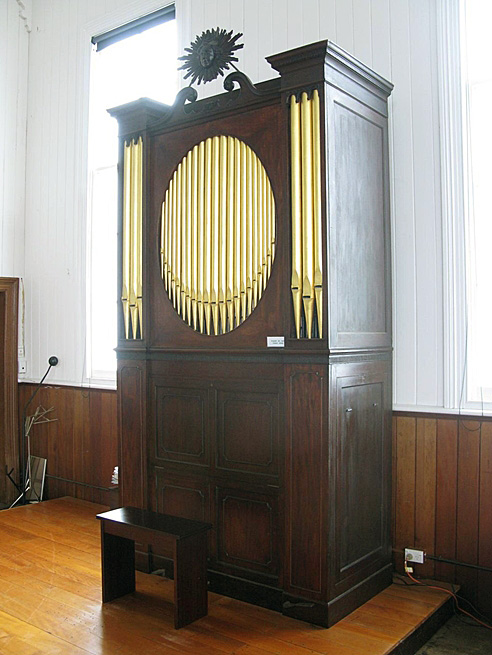
In 1897 a pipe organ was installed, an instrument reported to have been previously erected at St Paul’s Anglican Church, Britomart Point, Auckland. Constructed in London by the noted organ-maker John Avery in 1779, the organ’s early history is uncertain: it may have been created for use in a large, English stately house; then was selected by Dr George Elvey of St George’s Chapel, Windsor, and refurbished in London in 1859 before being shipped to the Anglican Bishop of Auckland, George Augustus Selwyn. Its installation at Ponsonby occurred in the same year that an organ was added to the Baptist Tabernacle.
Construction of Hall (1905):
Between 1903 and 1911, the pastor of the Ponsonby church was Reverend Alfred North (1846-1925), referred to as ‘the senior Baptist minister of New Zealand, and one of the most prominent in the denomination’. North was almost continuously a member of the executive council of the Baptist Union from the 1880s to the 1920s and played a key role in the formation of the New Zealand Baptist Missionary Society in 1885. He also founded, and was for many years editor of the New Zealand Baptist. Additionally he suggested and supervised a scheme for training Baptist ministers; and devised a means by which annuities could be provided for aged and disabled ministers. During his pastorate, the temperance drive in the Ponsonby church remained strong, as evidenced by the formation of a No Licence Committee in 1909, the year that pew rents were abolished.
Between 1902 and 1905, a programme of building and extension was carried out on the site. The church interior had been redecorated by the time of Reverend North’s arrival in February 1903, and total costs for renovation of the building amounted to £174 in the same year. Modifications may have included alterations to the main entrance. Photographic evidence suggests that between circa 1898 and 1915, flanking doors were added to the front vestibule and the earlier front doorway was converted to a large window. A Classical-style arch behind the pulpit was changed to a Gothic form, possibly also at this time. In 1905, a small timber hall was erected beside the main church to provide extra space for junior members of the Sunday School and for other meetings. Of Gothic architectural influence, the design of this building encompassed a projecting porch, a steeply-gabled roof, an asymmetrical floor plan and partly-exposed roof trusses. Its foundations consisted of ceramic piles. The designer is uncertain, but the noted Auckland architect Alexander Wiseman played the organ at the formal opening of the building, and also subsequently prepared alterations to the Baptist Tabernacle. These developments occurred during a period of expansion for Auckland Baptist congregations in the early 1900s, when several new churches were created, including those at Grange Road (1904) and Epsom (1905).
During the First World War (1914-18), numerous members of the congregation fought and died on European battlefields. By 1920, the drift from Ponsonby to locations further afield had begun as wealth and modern transport enabled families to move to suburbs such as Mt Albert, Epsom and Remuera. With the subsequent onset of economic depression, the Church lacked funds to pay for a pastor’s salary and the Sunday School roll also declined. From 1930 onwards, the Church gained a reputation as a training ground for Baptist Ministers by taking on students from the Baptist Theological College (opened in 1926) as short-term pastors. A brief revival in the 1940s occurred during the pastorate of evangelist, Reverend Jack Wakelin, when girls from Salem House (an establishment for ‘problem’ children) and the United Maori Mission hostel regularly attended. During the 1950s and 1960s, Ponsonby had a large Maori community due to population shifts from the countryside to inner city suburbs. Alterations in the 1950s probably included an extension to the former chapel to provide kitchen facilities in 1955, and the re-cladding of the chapel roof and that of the church.
With the arrival of Reverend Murray Beck in 1970, the local church community increasingly became involved in social work. Rising inner city rents saw many Maori and Pacific Island families move away from Ponsonby. Alterations in the 1980s included a connecting link between the church and former chapel; and the addition of French windows and internal toilets to the latter, by now being used as a hall.
In 1988, Reverend Mike Riddell and members of the Ponsonby Baptist Church founded the Community of Refuge Trust to provide low-cost accommodation in Ponsonby and to assist in providing professional services - such as medical advice - to low income households. This body subsequently became one of the largest community housing trusts in New Zealand, owning 75 residences and sub-letting 50 others for low-income tenants. By 2008, the Trust was using the 1905 Sunday School hall building as its administrative base. In 2011 a New Zealand motion picture, ‘The Insatiable Moon’, produced by Mike Riddell and based on his book of the same name, was awarded Best Foreign Film at the 2011 Moondance International Film Festival. Set in Ponsonby, it dealt with issues of mental illness and community perceptions. The main character, Arthur, was based on a person that Riddell came to know during his pastorate in Ponsonby, and significant scenes were shot in the Ponsonby Baptist Church.
In 2005, the Avery organ was restored and repositioned on the east wall of the church rather than in its earlier location in the northwest corner. The church and former chapel continue to serve the congregation and local community as a place of worship and hall, respectively. The 1905 former hall building currently (2013) remains in use as administrative offices.