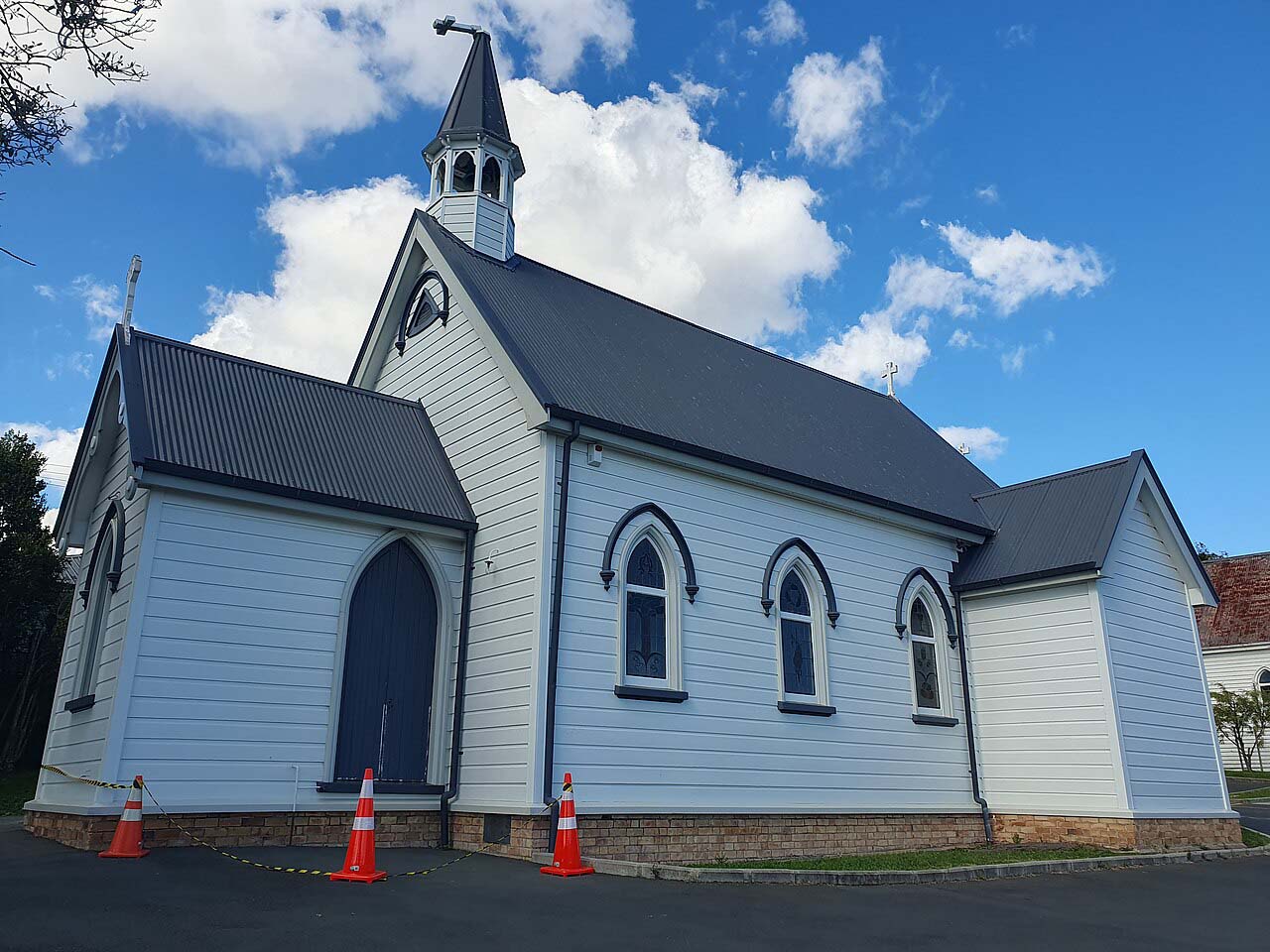
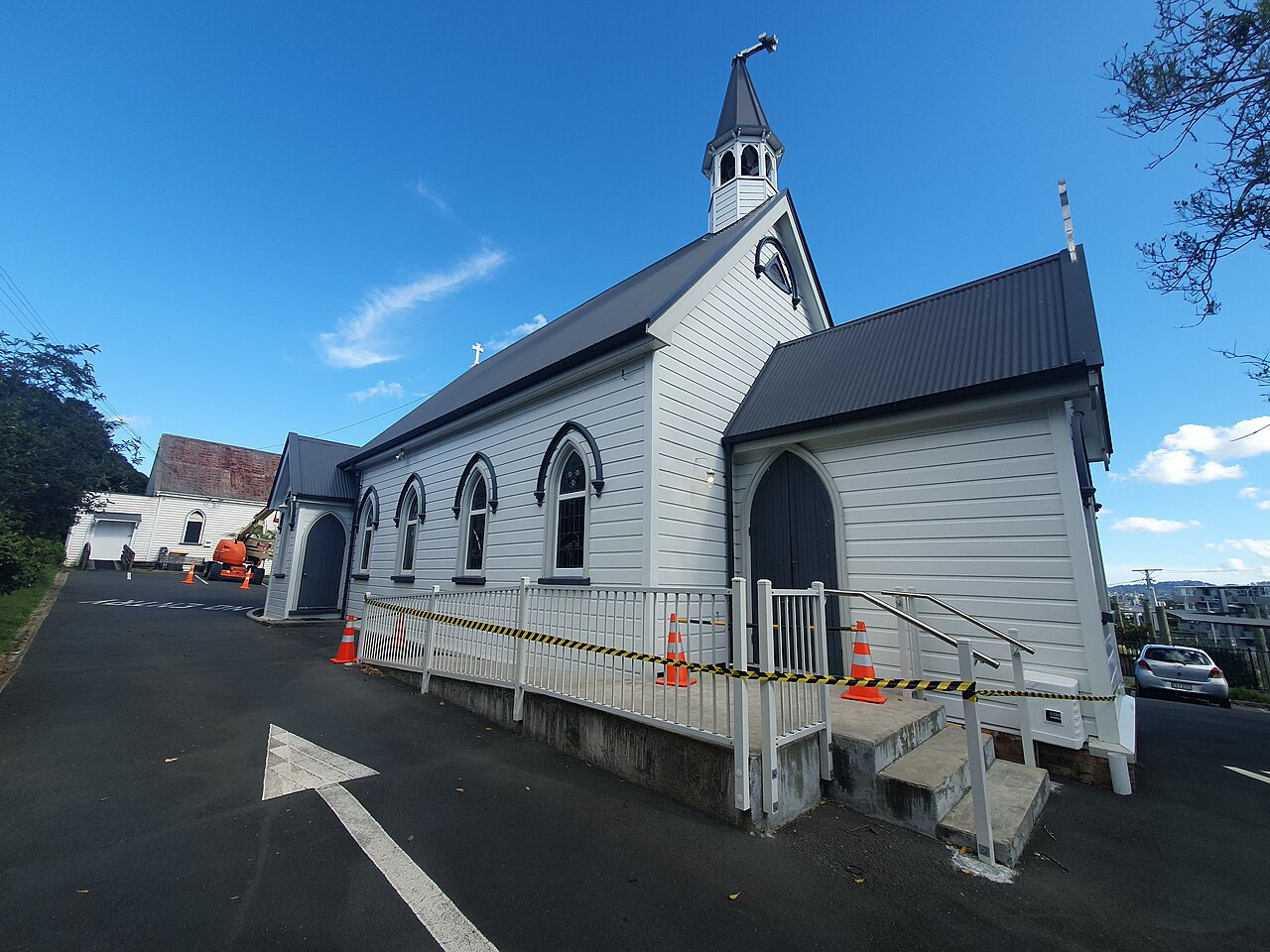
St Jude's Church is a Gothic Revival timber structure, erected in 1884 overlooking the settlement of Avondale on the rural outskirts of colonial Auckland. It is an early surviving Anglican design by the noted Auckland architect Edward Bartley and, also encompassing an associated Sunday School Hall (1907), is Avondale's oldest place of worship still in use for its original purpose.
Prior to European colonisation, Maori occupation in the area included settlement along the Whau River and Oakley Creek. The area was part of an extensive piece of land transferred to the British Crown by Ngati Whatua in 1841, the year after Auckland's founding as colonial capital. The hub of a colonial settlement developed in 1860, the year a local Presbyterian Church opened. The first Anglican services were held in 1874 and a church committee formed with prominent community leader John Bollard (1839-1915) as Minister's Warden. In 1882, a purpose-built church was commissioned by the congregation on a site overlooking the growing township. The site had previously been donated by William Palmer, a local hotelkeeper.
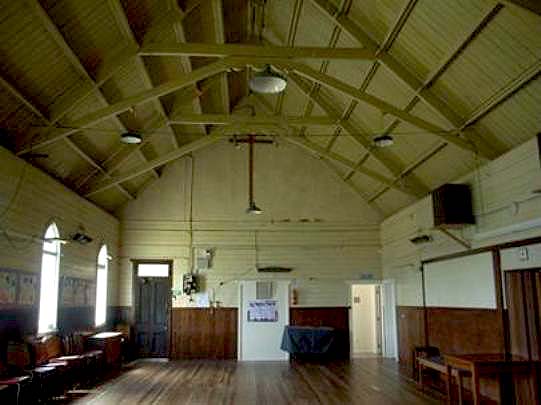
Construction of the church was initially delayed due to expense, and began only after the plans had been reassessed by architect Edward Bartley (1839-1919). Bartley had undertaken a number of important commissions in the early 1880s including St John's Wesleyan Church, Ponsonby (1882); and the Auckland Synagogue in Princes Street, the Opera House, and the Auckland Savings Bank, Queen Street (all 1884). A foundation stone was laid in September 1884 by Bishop William Cowie, who also presided at the church opening three months later. The structure with a hexagonal belfy incorporated a small nave, sanctuary, vestry and porch with steeply gabled roofs. Erected by Avondale builder Amos Bentham, the church stood on brick foundations, reflecting the importance of the local brickmaking industry. The building interior was matchlined, had exposed collar beam trusses and incorporated timber pews that were initially rented out to members of the congregation.
A simple Sunday School Hall designed by architect Arthur White was added at the rear of the site in 1907, and was used as a venue for local clubs and societies as well as for religious education. The hall was enlarged prior to 1920. Memorials to commemorate servicemen and church members who died in the First and Second World Wars were respectively erected in the church porch in 1921 and in the grounds in 1947. A small addition to the church in 1957 housed a pipe organ built by George Croft and Son. Upon the closure of St Ninian's Presbyterian Church in 1984, St Jude's became Avondale's oldest church still in use as a place of worship. Lead-light windows, some depicting local historical themes, were installed to celebrate St Jude's centenary in 1984. The church and hall remain in regular use for services and related activities.
St Jude's Church and Hall is architecturally significant for incorporating well-preserved examples of simple late nineteenth- and early twentieth-century Anglican religious architecture, and as one of the earliest surviving examples of Anglican ecclesiastical design by prominent Auckland practitioner Edward Bartley. The place has aesthetic value for the pleasing form and well-preserved interior of its church, and for its mature plantings. The site has historical significance for its associations with early local pioneering families, the growth of the Anglican Church in Auckland, and the development of the district. It has social significance as a place of public gathering, worship and celebration for over 125 years and has spiritual significance as a longstanding place of Anglican religious observance, place of contemplation and local commemoration.
Prior to European colonisation, Maori occupation in the area included settlement along the Whau River and Oakley Creek. The area was part of an extensive piece of land transferred to the British Crown by Ngati Whatua in 1841, the year after Auckland's founding as colonial capital. The hub of a colonial settlement developed in 1860, the year a local Presbyterian Church opened. The first Anglican services were held in 1874 and a church committee formed with prominent community leader John Bollard (1839-1915) as Minister's Warden. In 1882, a purpose-built church was commissioned by the congregation on a site overlooking the growing township. The site had previously been donated by William Palmer, a local hotelkeeper.
Construction of the church was initially delayed due to expense, and began only after the plans had been reassessed by architect Edward Bartley (1839-1919). Bartley had undertaken a number of important commissions in the early 1880s including St John's Wesleyan Church, Ponsonby (1882); and the Auckland Synagogue in Princes Street, the Opera House, and the Auckland Savings Bank, Queen Street (all 1884). A foundation stone was laid in September 1884 by Bishop William Cowie, who also presided at the church opening three months later. The structure with a hexagonal belfy incorporated a small nave, sanctuary, vestry and porch with steeply gabled roofs. Erected by Avondale builder Amos Bentham, the church stood on brick foundations, reflecting the importance of the local brickmaking industry. The building interior was matchlined, had exposed collar beam trusses and incorporated timber pews that were initially rented out to members of the congregation.
A simple Sunday School Hall designed by architect Arthur White was added at the rear of the site in 1907, and was used as a venue for local clubs and societies as well as for religious education. The hall was enlarged prior to 1920. Memorials to commemorate servicemen and church members who died in the First and Second World Wars were respectively erected in the church porch in 1921 and in the grounds in 1947. A small addition to the church in 1957 housed a pipe organ built by George Croft and Son. Upon the closure of St Ninian's Presbyterian Church in 1984, St Jude's became Avondale's oldest church still in use as a place of worship. Lead-light windows, some depicting local historical themes, were installed to celebrate St Jude's centenary in 1984. The church and hall remain in regular use for services and related activities.
St Jude's Church and Hall is architecturally significant for incorporating well-preserved examples of simple late nineteenth- and early twentieth-century Anglican religious architecture, and as one of the earliest surviving examples of Anglican ecclesiastical design by prominent Auckland practitioner Edward Bartley. The place has aesthetic value for the pleasing form and well-preserved interior of its church, and for its mature plantings. The site has historical significance for its associations with early local pioneering families, the growth of the Anglican Church in Auckland, and the development of the district. It has social significance as a place of public gathering, worship and celebration for over 125 years and has spiritual significance as a longstanding place of Anglican religious observance, place of contemplation and local commemoration.