

The need for a church building was apparent and with the generous help of the members of the First Church Congregation and Port Chalmers settler of various denominations, a wooden church was erected in 1852 on land which had been held in reserve since 1846. This was the second church to be built in Otago and the third in the South Island. It was not always possible to arrange for a Presbyterian preacher in those early days and the church was made available to preachers of other denominations including the Church of England and the Methodist Church.
In 1857 Port Chalmers became a separate parish with Reverend Thomas Burns as moderator. In 1858 Reverend William Johnstone became the first minister. The parish extended to the Waitaki River and included Otago Peninsula.
The wooden church gradually became too small. Plans for a new and larger stone church were produced by NYA Wales. The foundation stone was laid about August 1871 and the building was opened by Reverends Dr Stuart and William Will on 7 January 1872. The congregation continued to grow and a gallery was added in the mid-late 1870s.
This proved to be a temporary solution and further plans were made for additional space. The additions of 1882-83 effectively created a new church. It was opened on 25 November 1883. The town clock was installed by Little John & Co of Wellington c1885.
The Port Chalmers Presbyterian, Methodist and Congregational churches were amalgamated c1963 and some ten years later the district became a full Union parish.
List Entry Information
Status
Listed
List Entry Status
Historic Place Category 1
Access
Private/No Public Access
List Number
7165
Date Entered
21st April 1994
Date of Effect
21st April 1994
City/District Council
Dunedin City
Region
Otago Region
Legal description
Sec 8 & 9 Town of Port Chalmers
Status
Listed
List Entry Status
Historic Place Category 1
Access
Private/No Public Access
List Number
7165
Date Entered
21st April 1994
Date of Effect
21st April 1994
City/District Council
Dunedin City
Region
Otago Region
Legal description
Sec 8 & 9 Town of Port Chalmers
Why is this place significant?
Historic Significance
Historical Significance or Value The site now occupied by Iona Union Church was held in reserve since 1846. An earlier (1852) wooden church was the second church in Otago and the third in the South Island. It was significant in the settlement of Otago by the Free Church of Scotland. Iona Union Church has historical associations with this settlement. Iona Union Church replaced the early wooden building and has accommodated Presbyterians since its opening in 1872. It now has a wider place in the community as a Union church.
Physical Significance
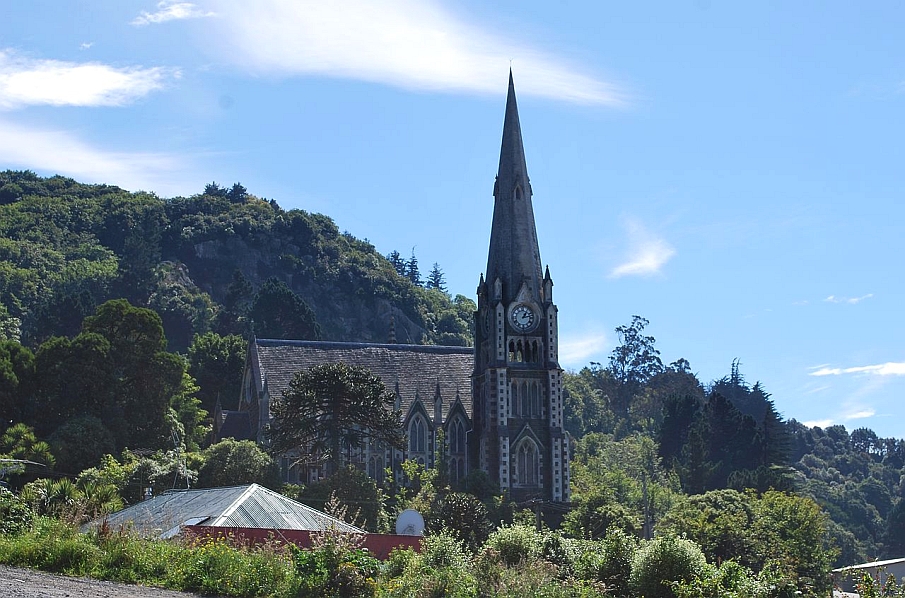
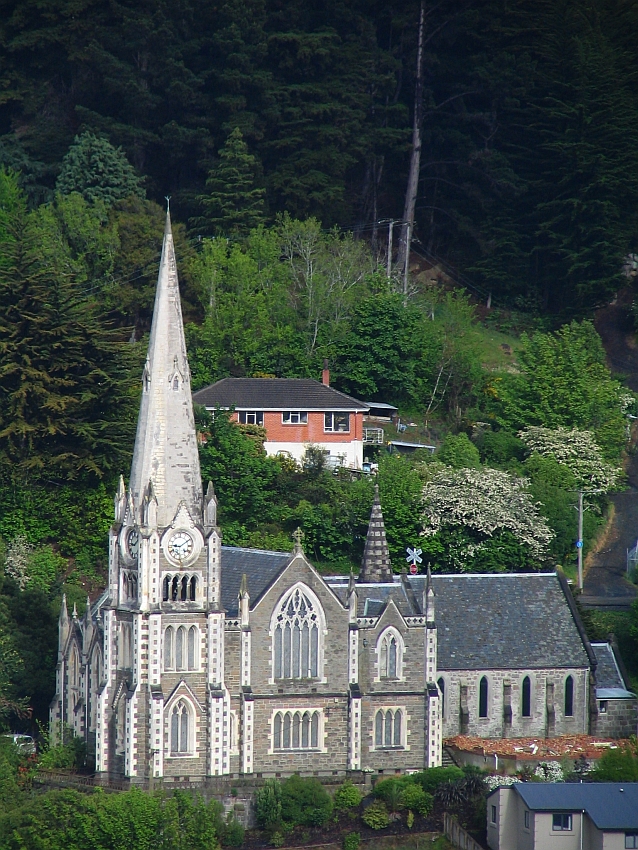
ARCHITECTURAL QUALITY: Comprising an early building (1871-72) and a substantial addition made some ten years later (1882-83), Iona Union Church succeeds in being an integrated and coherent whole. It is a fine example of an ecclesiastical building constructed of stone in the Early English Gothic Revival style. Constructional polychromy emphasises the Gothic Revival styling of the building. The detailing is of a very high standard. Such is the architectural quality of this building that it has in the past been attributed to Robert Lawson. Now thought to have been designed by Thomas Stevenson, it is the only known example of his work and is evidence of the skill of this young architect. TOWNSCAPE/LANDMARK VALUE: The church is enhanced by the bush covered hills which form a backdrop. With its tall spire and its position on a hill above the town of Port Chalmers, this building is a prominent one and can be described as having some landmark value.
Why is this place significant?
Historic Significance
Historical Significance or Value The site now occupied by Iona Union Church was held in reserve since 1846. An earlier (1852) wooden church was the second church in Otago and the third in the South Island. It was significant in the settlement of Otago by the Free Church of Scotland. Iona Union Church has historical associations with this settlement. Iona Union Church replaced the early wooden building and has accommodated Presbyterians since its opening in 1872. It now has a wider place in the community as a Union church.
Physical Significance
ARCHITECTURAL QUALITY: Comprising an early building (1871-72) and a substantial addition made some ten years later (1882-83), Iona Union Church succeeds in being an integrated and coherent whole. It is a fine example of an ecclesiastical building constructed of stone in the Early English Gothic Revival style. Constructional polychromy emphasises the Gothic Revival styling of the building. The detailing is of a very high standard. Such is the architectural quality of this building that it has in the past been attributed to Robert Lawson. Now thought to have been designed by Thomas Stevenson, it is the only known example of his work and is evidence of the skill of this young architect. TOWNSCAPE/LANDMARK VALUE: The church is enhanced by the bush covered hills which form a backdrop. With its tall spire and its position on a hill above the town of Port Chalmers, this building is a prominent one and can be described as having some landmark value.
Construction Professional
Name
Mason & Wales Architects Ltd
Type
Architectural Partnership
Biography
Mason and Wales Architects Ltd is the oldest architectural practice in New Zealand, having been founded by William Mason (1810-1897) in 1862 Dunedin. Mason was born in England, studied under Peter Nicholson and worked under Thomas Telford and Edward Blore. In 1838 he immigrated to New South Wales, and came to New Zealand in 1840. Having spent 22 years in Auckland he went to Dunedin at the time of the gold discoveries and was elected the first mayor of Dunedin in 1865. He was active in politics as well as in architecture. Mason was in partnership firstly with David Ross (1827-1908) and William Henry Clayton (1823-1877) and he took in N.Y.A. Wales (1832-1903) when Clayton left the firm to become Colonial Architect in Wellington. Wales had worked as a clerk of works and was very competent in all aspects of construction. The firm was responsible for many of Dunedin's early important buildings such as the Post Office (later known as the Exchange Building), Princes Street (1864-68), the Exhibition Building (later the Dunedin Hospital), Great King Street (1864), St Matthew's Church, Stafford Street (1873), and the Wains Hotel, Princes Street (1878). Mason and Wales designed the Abbotsford Farm Steading (1871) at Outram, Otago (NZHPT Reg. No. 7579). This farm steading was designed for James Shand, a prominent land owner, politician and businessman in the area. Mason and Wales designed another farm steading for Shand at his property Berkeley in 1881 (demolished 1981). In 1881, Mason and Wales also designed a plain concrete Chicory Kiln (NZHPT Reg. No. 3359, Cat II) at Inch Clutha, South Otago for Gregg and Coy. Mason and Wales continues today. N.Y.A. Wales (b.1927) is a fourth generation director of the firm. WALES, Nathaniel Young Armstrong (1832-1903) Wales was born in Northumberland, England, and educated at Jedburgh, Scotland. He immigrated to Australia in 1854 and found employment as a carpenter working on the buildings for the first exhibition held in Melbourne. He arrived in Dunedin about 1863, and was a clerk of works for William Mason on the old Bank of New Zealand Building (1862-64), the Post Office Building (1864-68) and the Port Chalmers Graving Dock (1868-72). Wales entered partnership with William Mason in 1871. The firm of Mason and Wales was responsible for many fine buildings in Dunedin including Bishopscourt (1873), St Matthew's Church (1873), Government Life Insurance Building (1897) and Wains Hotel (1878). Wales had military and political interests and was a Member of Parliament for some years. He occupied a seat on the Dunedin Harbour Board and was a Dunedin City Councillor. In 1895 he was elected Mayor of Dunedin. In 1900 he was elected a Fellow of the Royal Institute of British Architects.
Name
Wales, Nathaniel Young Armstrong
Type
Architect
Biography
Wales was born in Northumberland, England, and educated at Jedburgh, Scotland. He immigrated to Australia in 1854 and found employment as a carpenter working on the buildings for the first exhibition held in Melbourne. He arrived in Dunedin about 1863, and was a clerk of works for William Mason on the old Bank of New Zealand Building (1862-64), the Post Office Building (1864-68) and the Port Chalmers Graving Dock (1868-72). Wales entered partnership with William Mason in 1871. The firm of Mason and Wales was responsible for many fine buildings in Dunedin including Bishopscourt (1873), St Matthew's Church (1873), Government Life Insurance Building (1897) and Wains Hotel (1878). Wales had military and political interests and was a Member of Parliament for some years. He occupied a seat on the Dunedin Harbour Board and was a Dunedin City Councillor. In 1895 he was elected Mayor of Dunedin. In 1900 he was elected a Fellow of the Royal Institute of British Architects. Nathaniel Wales worked for William Mason as a clerk of works during the 1860s on the old Bank of New Zealand building and on the Post Office building which became the Stock Exchange. He also had the thankless task of being clerk of works to the Port Chalmers Dry dock. Wales began work on his own as an architect untrained, and asked Mason to come back from retirement to enable him to join his firm which became Mason and Wales in 1871 at a time when Wales was building the first part of the Iona Union church at Port Chalmers. Mason retied for good in 1874 and Wales became the senior partner in the firm. Wales designed the Campbell Park Homestead in 1876 and received the commission for the stables about 1878, along with some cottages for the farm labourers. One of his notable buildings is his own big house at 38 Belgrave Crescent (1870), built of stone quarried from the site.
Construction Details
Start Year
1882
Finish Year
1883
Type
Addition
Description
Additions
Start Year
1871
Finish Year
1872
Type
Original Construction
Construction Materials
Original building: Locally quarried breccia with Oamaru stone dressings Additions: Ashlar construction of locally quarried breccia with Oamaru stone dressings. The exterior surface is unhewn. The roof is sheathed in slate.
Notable Features
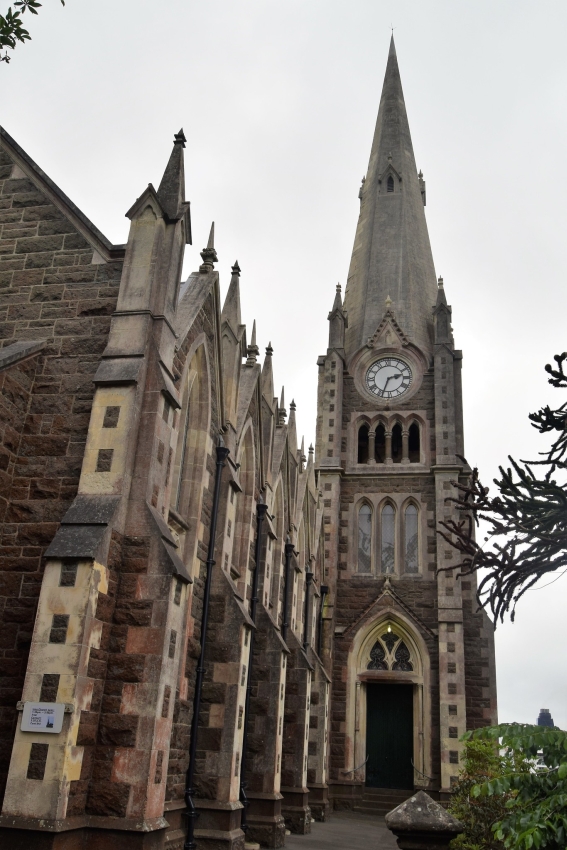
Prominent spire adorned with Oamaru limestone dressings and the town clock
Construction Professional
Name
Mason & Wales Architects Ltd
Type
Architectural Partnership
Biography
Mason and Wales Architects Ltd is the oldest architectural practice in New Zealand, having been founded by William Mason (1810-1897) in 1862 Dunedin. Mason was born in England, studied under Peter Nicholson and worked under Thomas Telford and Edward Blore. In 1838 he immigrated to New South Wales, and came to New Zealand in 1840. Having spent 22 years in Auckland he went to Dunedin at the time of the gold discoveries and was elected the first mayor of Dunedin in 1865. He was active in politics as well as in architecture. Mason was in partnership firstly with David Ross (1827-1908) and William Henry Clayton (1823-1877) and he took in N.Y.A. Wales (1832-1903) when Clayton left the firm to become Colonial Architect in Wellington. Wales had worked as a clerk of works and was very competent in all aspects of construction. The firm was responsible for many of Dunedin's early important buildings such as the Post Office (later known as the Exchange Building), Princes Street (1864-68), the Exhibition Building (later the Dunedin Hospital), Great King Street (1864), St Matthew's Church, Stafford Street (1873), and the Wains Hotel, Princes Street (1878). Mason and Wales designed the Abbotsford Farm Steading (1871) at Outram, Otago (NZHPT Reg. No. 7579). This farm steading was designed for James Shand, a prominent land owner, politician and businessman in the area. Mason and Wales designed another farm steading for Shand at his property Berkeley in 1881 (demolished 1981). In 1881, Mason and Wales also designed a plain concrete Chicory Kiln (NZHPT Reg. No. 3359, Cat II) at Inch Clutha, South Otago for Gregg and Coy. Mason and Wales continues today. N.Y.A. Wales (b.1927) is a fourth generation director of the firm. WALES, Nathaniel Young Armstrong (1832-1903) Wales was born in Northumberland, England, and educated at Jedburgh, Scotland. He immigrated to Australia in 1854 and found employment as a carpenter working on the buildings for the first exhibition held in Melbourne. He arrived in Dunedin about 1863, and was a clerk of works for William Mason on the old Bank of New Zealand Building (1862-64), the Post Office Building (1864-68) and the Port Chalmers Graving Dock (1868-72). Wales entered partnership with William Mason in 1871. The firm of Mason and Wales was responsible for many fine buildings in Dunedin including Bishopscourt (1873), St Matthew's Church (1873), Government Life Insurance Building (1897) and Wains Hotel (1878). Wales had military and political interests and was a Member of Parliament for some years. He occupied a seat on the Dunedin Harbour Board and was a Dunedin City Councillor. In 1895 he was elected Mayor of Dunedin. In 1900 he was elected a Fellow of the Royal Institute of British Architects.
Name
Wales, Nathaniel Young Armstrong
Type
Architect
Biography
Wales was born in Northumberland, England, and educated at Jedburgh, Scotland. He immigrated to Australia in 1854 and found employment as a carpenter working on the buildings for the first exhibition held in Melbourne. He arrived in Dunedin about 1863, and was a clerk of works for William Mason on the old Bank of New Zealand Building (1862-64), the Post Office Building (1864-68) and the Port Chalmers Graving Dock (1868-72). Wales entered partnership with William Mason in 1871. The firm of Mason and Wales was responsible for many fine buildings in Dunedin including Bishopscourt (1873), St Matthew's Church (1873), Government Life Insurance Building (1897) and Wains Hotel (1878). Wales had military and political interests and was a Member of Parliament for some years. He occupied a seat on the Dunedin Harbour Board and was a Dunedin City Councillor. In 1895 he was elected Mayor of Dunedin. In 1900 he was elected a Fellow of the Royal Institute of British Architects. Nathaniel Wales worked for William Mason as a clerk of works during the 1860s on the old Bank of New Zealand building and on the Post Office building which became the Stock Exchange. He also had the thankless task of being clerk of works to the Port Chalmers Dry dock. Wales began work on his own as an architect untrained, and asked Mason to come back from retirement to enable him to join his firm which became Mason and Wales in 1871 at a time when Wales was building the first part of the Iona Union church at Port Chalmers. Mason retied for good in 1874 and Wales became the senior partner in the firm. Wales designed the Campbell Park Homestead in 1876 and received the commission for the stables about 1878, along with some cottages for the farm labourers. One of his notable buildings is his own big house at 38 Belgrave Crescent (1870), built of stone quarried from the site.
Construction Details
Start Year
1882
Finish Year
1883
Type
Addition
Description
Additions
Start Year
1871
Finish Year
1872
Type
Original Construction
Construction Materials
Original building: Locally quarried breccia with Oamaru stone dressings Additions: Ashlar construction of locally quarried breccia with Oamaru stone dressings. The exterior surface is unhewn. The roof is sheathed in slate.
Notable Features
Prominent spire adorned with Oamaru limestone dressings and the town clock
ARCHITECT/ENGINEER/DESIGNER: Original building: Nathaniel Young Armstrong WALES Additions: MASON & WALES, possibly Thomas STEVENSON Thomas STEVENSON: According to J Stacpoole (1971), Stevenson died at Russell in 1881 at the age of 29, up to two years before Iona Union Church was completed. He is thought to have designed Iona Union Church when working for Mason & Wales and it is possible that this is the only surviving example of his work. It is the only known example of a building thought to carry his authorship. ARCHITECTURAL DESCRIPTION: Iona Union Church comprises a church hall, built in 1871-72 and now known as Johnstone Hall, and the church proper, built as an addition in 1882-83. The additions were built at right angles to the original building and, combined, the two approximate a T-shaped plan. Early English Gothic Revival in style and constructed of similar materials, the two sections form a coherent whole. The dark colour of the locally quarried breccia is contrasted by the creamy white of the Oamaru stone. The latter has been used to highlight buttresses, pinnacles, lancets and tracery. These elements make an important contribution to the Early English character of the church as do the pointed windows and arches, the steeply pitched roofs, and the use of a tall spire. The spire of the original building can be seen to the rear, but it is that of the 1882-83 additions which is the most striking element of the exterior. It stands on a square tower which is buttressed and surmounted by a pinnacle at each of its four corners. The spire is octagonal and has four gablets at about mid-height. The original building is now used as a church hall and butts up against the nave of the church proper. The original building is on higher ground and, internally, a turned staircase links the two. The church has an exposed roof structure with tongue and groove sarking. Interior walls are plastered. A gallery is still in place with access gained by the original turned and dark stained staircase. The church has a number of memorial windows including the Watkin-Creed memorial windows, placed in the Iona Union Church vestibule in 1974 when the Port Chalmers Methodist Church was demolished. They have not been permanently installed as a result of their different shape but rest in front of the existing leadlights. Above the altar is a rose window. A toilet block was added to the rear of the original building c1986. Built of the same local quarried breccia, but with aluminium framed windows, this addition is sympathetic to the existing building and does not compromise its architectural quality. MODIFICATIONS: Mid-late 1870s: Gallery added to the original building; has been removed 1882-83: Addition of what is today the church proper. The original building is used as a church hall n.d.: Original building stripped of all furniture and fittings including gallery, altar and raked floor. Entrance portico removed c1885: Town clock installed in spire n.d.: Alterations to the interior of the church addition including the removal of the high altar and the lower level pews. Glass doors have been installed between the vestibule and the nave 1974: Many of the roof slates were replaced as a result of NZHPT assistance c1986: Toilet block added to original building
ARCHITECT/ENGINEER/DESIGNER: Original building: Nathaniel Young Armstrong WALES Additions: MASON & WALES, possibly Thomas STEVENSON Thomas STEVENSON: According to J Stacpoole (1971), Stevenson died at Russell in 1881 at the age of 29, up to two years before Iona Union Church was completed. He is thought to have designed Iona Union Church when working for Mason & Wales and it is possible that this is the only surviving example of his work. It is the only known example of a building thought to carry his authorship. ARCHITECTURAL DESCRIPTION: Iona Union Church comprises a church hall, built in 1871-72 and now known as Johnstone Hall, and the church proper, built as an addition in 1882-83. The additions were built at right angles to the original building and, combined, the two approximate a T-shaped plan. Early English Gothic Revival in style and constructed of similar materials, the two sections form a coherent whole. The dark colour of the locally quarried breccia is contrasted by the creamy white of the Oamaru stone. The latter has been used to highlight buttresses, pinnacles, lancets and tracery. These elements make an important contribution to the Early English character of the church as do the pointed windows and arches, the steeply pitched roofs, and the use of a tall spire. The spire of the original building can be seen to the rear, but it is that of the 1882-83 additions which is the most striking element of the exterior. It stands on a square tower which is buttressed and surmounted by a pinnacle at each of its four corners. The spire is octagonal and has four gablets at about mid-height. The original building is now used as a church hall and butts up against the nave of the church proper. The original building is on higher ground and, internally, a turned staircase links the two. The church has an exposed roof structure with tongue and groove sarking. Interior walls are plastered. A gallery is still in place with access gained by the original turned and dark stained staircase. The church has a number of memorial windows including the Watkin-Creed memorial windows, placed in the Iona Union Church vestibule in 1974 when the Port Chalmers Methodist Church was demolished. They have not been permanently installed as a result of their different shape but rest in front of the existing leadlights. Above the altar is a rose window. A toilet block was added to the rear of the original building c1986. Built of the same local quarried breccia, but with aluminium framed windows, this addition is sympathetic to the existing building and does not compromise its architectural quality. MODIFICATIONS: Mid-late 1870s: Gallery added to the original building; has been removed 1882-83: Addition of what is today the church proper. The original building is used as a church hall n.d.: Original building stripped of all furniture and fittings including gallery, altar and raked floor. Entrance portico removed c1885: Town clock installed in spire n.d.: Alterations to the interior of the church addition including the removal of the high altar and the lower level pews. Glass doors have been installed between the vestibule and the nave 1974: Many of the roof slates were replaced as a result of NZHPT assistance c1986: Toilet block added to original building
Historical and Associated Iwi / Hapū / Whānau
Completion Date
19th November 1993
Report Written By
NZHPT
Information Sources
Cyclopedia of New Zealand, 1905
Cyclopedia Company, Industrial, descriptive, historical, biographical facts, figures, illustrations, Wellington, N.Z, 1897-1908, Vol. 4 Otago and Southland, Cyclopedia Company, Christchurch, 1905
Knight, H. & N. Wales, 1988
Hardwicke Knight and Niel Wales, Buildings of Dunedin: An Illustrated Architectural Guide to New Zealand's Victorian City, John McIndoe, Dunedin, 1988
New Zealand Historic Places Trust (NZHPT)
New Zealand Historic Places Trust
Stacpoole, 1971
John Stacpoole, William Mason: The First New Zealand Architect, Auckland, 1971
Porter, 1983
Frances Porter (ed), Historic Buildings of Dunedin, South Island, Methuen, Auckland, 1983.
Bowman, 1948
HO Bowman, Port Chalmers, Gateway to Otago, originally published by Otago Centennial Historical Publications, 1948
Other Information
A full registration report is available from the NZHPT Southern region office. Please note that entry on the New Zealand Heritage List/Rarangi Korero identifies only the heritage values of the property concerned, and should not be construed as advice on the state of the property, or as a comment of its soundness or safety, including in regard to earthquake risk, safety in the event of fire, or insanitary conditions.
Historical and Associated Iwi / Hapū / Whānau
Completion Date
19th November 1993
Report Written By
NZHPT
Information Sources
Cyclopedia of New Zealand, 1905
Cyclopedia Company, Industrial, descriptive, historical, biographical facts, figures, illustrations, Wellington, N.Z, 1897-1908, Vol. 4 Otago and Southland, Cyclopedia Company, Christchurch, 1905
Knight, H. & N. Wales, 1988
Hardwicke Knight and Niel Wales, Buildings of Dunedin: An Illustrated Architectural Guide to New Zealand's Victorian City, John McIndoe, Dunedin, 1988
New Zealand Historic Places Trust (NZHPT)
New Zealand Historic Places Trust
Stacpoole, 1971
John Stacpoole, William Mason: The First New Zealand Architect, Auckland, 1971
Porter, 1983
Frances Porter (ed), Historic Buildings of Dunedin, South Island, Methuen, Auckland, 1983.
Bowman, 1948
HO Bowman, Port Chalmers, Gateway to Otago, originally published by Otago Centennial Historical Publications, 1948
Other Information
A full registration report is available from the NZHPT Southern region office. Please note that entry on the New Zealand Heritage List/Rarangi Korero identifies only the heritage values of the property concerned, and should not be construed as advice on the state of the property, or as a comment of its soundness or safety, including in regard to earthquake risk, safety in the event of fire, or insanitary conditions.
Current Usages
Uses: Religion
Specific Usage: Church
Former Usages
General Usage: Religion
Specific Usage: Church
Web Links
description: Virtual Tour - Ivan Johnstone
url: https://www.ivanjohnstone.com/f-virtualtours/ionachurch-html5/ionachurch-html5.html
Current Usages
Uses: Religion
Specific Usage: Church
Former Usages
General Usage: Religion
Specific Usage: Church
Web Links
description: Virtual Tour - Ivan Johnstone
url: https://www.ivanjohnstone.com/f-virtualtours/ionachurch-html5/ionachurch-html5.html
