

Hende's Gallery was built by and named for Peter Hende. It was originally two distinct sections, designed to take tourists with some ease over difficult country, in this case sheer rock walls, and also to provide a close view of the glacier. The gallery was built by men suspended from above the wall on ropes or cages who drilled holes and erected the structure.
The present gallery was the higher of the two. The lower section was swept away by a spectacular advance of the glacier just two years after it was completed. Photographs of the nearly completed gallery show the glacier just metres away from the valley wall. Later shots show the twisted wreckage of the lower gallery next to the glacier.
The Roberts Point Track quickly became a popular walk. The gallery was an added attraction. From the point it was possible to drop onto the glacier and walk across to the other side, where, from 1913, Defiance Hut was located. In ensuing years the walk has maintained its popularity but the glacier has now receded some hundreds of metres into the valley floor.
The gallery was just one of a number of structures and features that were part of the Robert Point Track. Financed by the Department of Tourist and Health Resorts, these bridges, steps, drainage and tracks were maintained by the Graham brothers for many decades. The Graham brothers were well known in the area as hoteliers and mountain guides.
List Entry Information
Status
Listed
List Entry Status
Historic Place Category 1
Access
Able to Visit
List Number
7166
Date Entered
21st April 1994
Date of Effect
21st April 1994
City/District Council
Westland District
Region
West Coast Region
Status
Listed
List Entry Status
Historic Place Category 1
Access
Able to Visit
List Number
7166
Date Entered
21st April 1994
Date of Effect
21st April 1994
City/District Council
Westland District
Region
West Coast Region
Why is this place significant?
Historic Significance
Historical Significance or Value Tourism has played an important role in the development of south Westland and in particular the resorts of Franz Josef and Fox Glacier. Remote and difficult to access, the glaciers were attracting considerable attention by the early twentieth century. Anticipating increasing interest the department invested in tourist facilities at Franz Josef. Hende's Gallery is a permanent reminder of the investment made by the Tourist and Health Resorts Department. Allowing good views of the glacier, Hende's Gallery was fundamental to this development.
Physical Significance
ARCHITECTURAL QUALITY: Suspended and cantilevered, the section of Roberts Point Track known as Hende's Gallery is an innovative response to the problem of providing access across a sheer rock face. The apparent simplicity of the gallery belies the engineering skill required in its design and the danger involved in its realisation. As an engineering feat, the gallery is thought to have rarity value among New Zealand's thousands of kilometres of tracks. Much of it is original. TOWNSCAPE/LANDMARK VALUE: When first built the gallery was largely free of vegetation and could be viewed across the valley. Today it is practically obscured by regenerating shrubs and trees and has little impact on the landscape. It is, however, enhanced by its picturesque environment.
Why is this place significant?
Historic Significance
Historical Significance or Value Tourism has played an important role in the development of south Westland and in particular the resorts of Franz Josef and Fox Glacier. Remote and difficult to access, the glaciers were attracting considerable attention by the early twentieth century. Anticipating increasing interest the department invested in tourist facilities at Franz Josef. Hende's Gallery is a permanent reminder of the investment made by the Tourist and Health Resorts Department. Allowing good views of the glacier, Hende's Gallery was fundamental to this development.
Physical Significance
ARCHITECTURAL QUALITY: Suspended and cantilevered, the section of Roberts Point Track known as Hende's Gallery is an innovative response to the problem of providing access across a sheer rock face. The apparent simplicity of the gallery belies the engineering skill required in its design and the danger involved in its realisation. As an engineering feat, the gallery is thought to have rarity value among New Zealand's thousands of kilometres of tracks. Much of it is original. TOWNSCAPE/LANDMARK VALUE: When first built the gallery was largely free of vegetation and could be viewed across the valley. Today it is practically obscured by regenerating shrubs and trees and has little impact on the landscape. It is, however, enhanced by its picturesque environment.
Construction Professional
Name
Hende, Peter (1875-1917)
Type
Designer
Biography
Peter Hende (1875-1917) was a self-taught engineer who was little known outside the West Coast. Having worked as a ferryman on the Wanganui River in South Westland, Hende was, at various times, a blacksmith, engineer, mechanic, salesman, photographer and climber. He built bridges, buildings, roads, machinery, even tools, including his own climbing gear. He was best known for his work around Waiho (now Franz Josef) and in particular for the construction of suspension bridges, the Fox Glacier Road and the gallery known as Hende's Gallery. With his engineering skill and all-round capabilities he made a brief but considerable impact on the development of the local region.
Construction Details
Start Year
1907
Type
Original Construction
Construction Materials
Steps of diagonally sawn timber (prob 4"x 2") rest on hand forged iron bars fixed to the rock wall with molten metal at both ends. Wire handrails are suspended from above.
Notable Features
Suspended and cantilevered construction
Construction Professional
Name
Hende, Peter (1875-1917)
Type
Designer
Biography
Peter Hende (1875-1917) was a self-taught engineer who was little known outside the West Coast. Having worked as a ferryman on the Wanganui River in South Westland, Hende was, at various times, a blacksmith, engineer, mechanic, salesman, photographer and climber. He built bridges, buildings, roads, machinery, even tools, including his own climbing gear. He was best known for his work around Waiho (now Franz Josef) and in particular for the construction of suspension bridges, the Fox Glacier Road and the gallery known as Hende's Gallery. With his engineering skill and all-round capabilities he made a brief but considerable impact on the development of the local region.
Construction Details
Start Year
1907
Type
Original Construction
Construction Materials
Steps of diagonally sawn timber (prob 4"x 2") rest on hand forged iron bars fixed to the rock wall with molten metal at both ends. Wire handrails are suspended from above.
Notable Features
Suspended and cantilevered construction
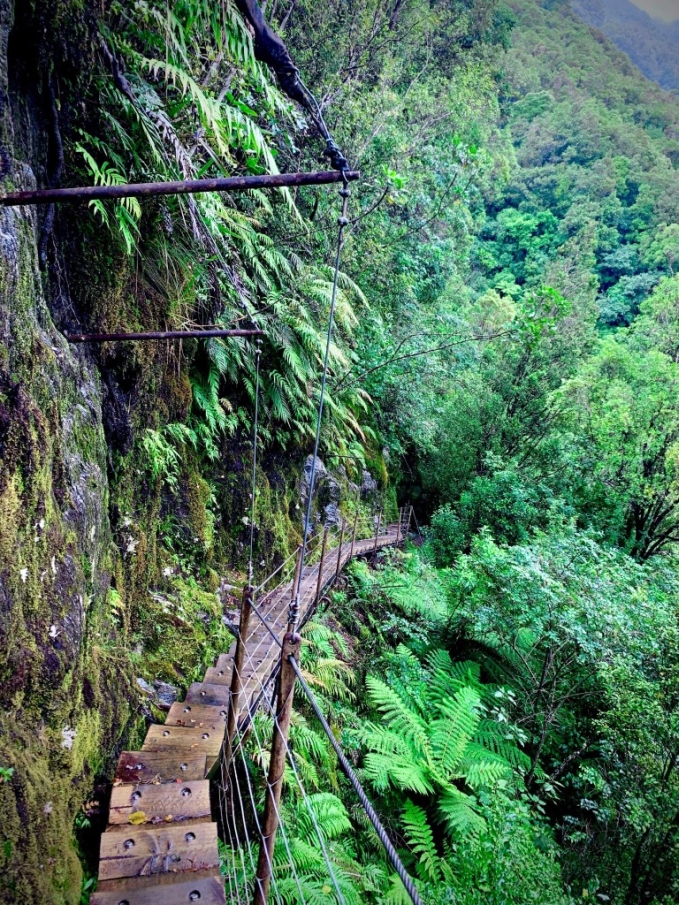
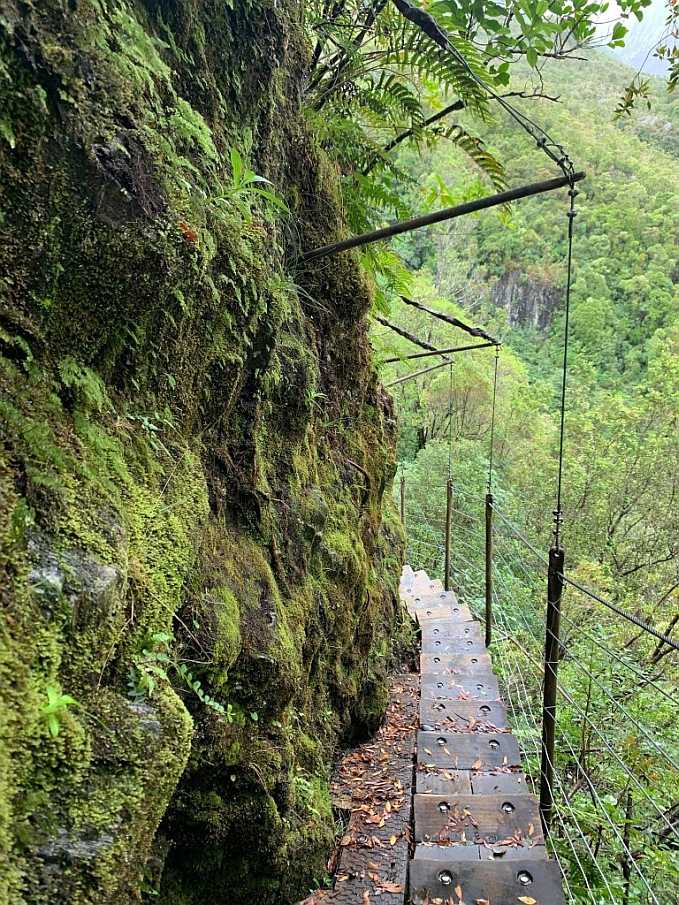
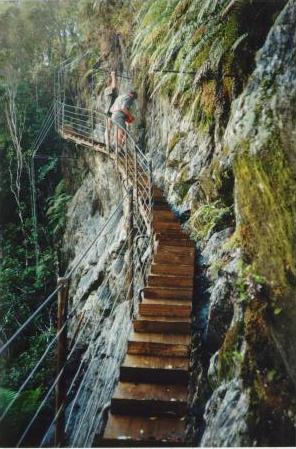
ARCHITECTURAL DESCRIPTION: Hende's Gallery is a suspended and cantilevered balcony or walkway which winds its way across a sheer rock wall for some 60 metres. A moderate gradient is maintained by a series of evenly spaced steps. The steps are of diagonally sawn timber (prob 4"x 2") and rest on iron bars. The bars are doubled over and fixed to the rock wall with molten metal at both ends. Alternate supports carry the wire handrails which are themselves suspended from above by rods fixed at intervals to the wall. The steps are generally placed hard up against the wall although planks have been laid to cover gaps. MODIFICATIONS: Some general maintenance work has been undertaken including the replacement of fence strands, wire ties, steps etc.
ARCHITECTURAL DESCRIPTION: Hende's Gallery is a suspended and cantilevered balcony or walkway which winds its way across a sheer rock wall for some 60 metres. A moderate gradient is maintained by a series of evenly spaced steps. The steps are of diagonally sawn timber (prob 4"x 2") and rest on iron bars. The bars are doubled over and fixed to the rock wall with molten metal at both ends. Alternate supports carry the wire handrails which are themselves suspended from above by rods fixed at intervals to the wall. The steps are generally placed hard up against the wall although planks have been laid to cover gaps. MODIFICATIONS: Some general maintenance work has been undertaken including the replacement of fence strands, wire ties, steps etc.
Historical and Associated Iwi / Hapū / Whānau
Completion Date
19th November 1993
Report Written By
NZHPT
Information Sources
Graham, 1965
Peter Graham. Peter Graham, Mountain Guide, George Allen and Unwin, London, 1965
Other Information
A copy of the original report is available from the NZHPT Southern region office. Please note that entry on the New Zealand Heritage List/Rarangi Korero identifies only the heritage values of the property concerned, and should not be construed as advice on the state of the property, or as a comment of its soundness or safety, including in regard to earthquake risk, safety in the event of fire, or insanitary conditions.
Historical and Associated Iwi / Hapū / Whānau
Completion Date
19th November 1993
Report Written By
NZHPT
Information Sources
Graham, 1965
Peter Graham. Peter Graham, Mountain Guide, George Allen and Unwin, London, 1965
Other Information
A copy of the original report is available from the NZHPT Southern region office. Please note that entry on the New Zealand Heritage List/Rarangi Korero identifies only the heritage values of the property concerned, and should not be construed as advice on the state of the property, or as a comment of its soundness or safety, including in regard to earthquake risk, safety in the event of fire, or insanitary conditions.
Former Usages
General Usage: Transport
Specific Usage: Footpath/Path/track
Web Links
description: Roberts Point Track information
Former Usages
General Usage: Transport
Specific Usage: Footpath/Path/track
Web Links
description: Roberts Point Track information
